Laundry sheets are a pre-dosed film of surfactants encased in polyvinyl alcohol (PVA) that dissolves on contact with water. Ultra-compact format, zero plastic bottles, simplified dosing: the advantages are real for travel and small living spaces. On the other hand, cleaning performance is weaker than conventional detergents on stubborn stains, the cost per load is high and cold-water dissolution is not always complete. This guide cuts through the marketing.
At a Glance
Convenient format -- ultra-light (2-3 g per sheet), no jug, no measuring. Ideal for travellers, students and small flats.
Decent results on everyday laundry -- sheets handle moderately soiled daily wear well. They lack punch on greasy or protein-based stains.
High cost per load -- EUR 0.25 to 0.50 per cycle versus EUR 0.10 to 0.20 for a standard liquid detergent.
Check the ingredients -- PVA is biodegradable, but some sheets contain fragrances or optical brighteners. Read the INCI list.
Unnecessary at a laundromat -- detergent is already included and pre-dosed in professional machines.
Quick Comparison: 5 Laundry Sheet Brands Tested
Before diving into the chemistry, here is a snapshot of the five brands we dissect in this guide. The table relies strictly on manufacturer disclosures from official product pages (accessed May 2026) and — for efficacy — on the Consumer Reports independent test from August 2024, the only public comparative protocol covering this segment today.
| Brand | Sheets / loads | Key differentiator | Cost / load | Self-declared hypoallergenic |
|---|---|---|---|---|
Dr. Beckmann ↗ Magic Leaves↗ | 25 or 80 sheets | Mass-market availability in EU supermarkets | EUR 0.20-0.24 (FR) / USD 0.22-0.27 | No (“vegan, dermo-tested” only) |
Earth Breeze ↗Fragrance Free | 30 sheets = 60 loads | Only one combining enzymes + percarbonate↗ | USD 0.20 (subscription) to USD 0.33 (one-off) | Not explicit (fragrance-free version) |
| Yokuu↗ | 32 sheets = 64 loads | Probiotic sheets (5 bacterial strains) | EUR 0.18-0.23 / USD 0.20-0.26 | No |
| BHALI↗ | 60 sheets = 60 loads | French brand, CLP-style INCI | EUR 0.16-0.28 / USD 0.18-0.31 | Yes (self-declared, no certificate number) |
Tru Earth ↗Fragrance-Free | 32 sheets = 64 loads | North American plastic-free leader | USD 0.23 (subscription) to USD 0.41 (per Consumer Reports 2024) | No (vegan, phosphate / paraben / dye-free) |
Indicative prices recorded in May 2026 (manufacturer disclosures); prices and availability are subject to change. The price shown on Amazon at the time of purchase is the one that applies.
Independent test -- Consumer Reports, August 2024
On 7 stains (blood, body oil, chocolate, coffee, dirt, grass, salad dressing), Consumer Reports scored Tide↗ Plus Ultra Stain Release liquid 84/100, Tide↗ Pods 78/100, Earth Breeze↗ 29/100 and Tru Earth 11/100. The CR verdict: laundry sheets ”
had lower performance as a group than our lowest-performing liquid or pod detergents
”. This is currently the only publicly accessible comparative protocol on this segment — treat it as raw efficacy reference, not as the environmental or budget arbiter.
How Laundry Sheets Work
A laundry sheet is a thin film (roughly 0.5 mm thick) made primarily of polyvinyl alcohol (PVA), a water-soluble polymer. The cleaning agents — surfactants, sequestering agents, sometimes an optical brightener — are embedded directly into the film during manufacturing.
The Dissolution Mechanism
When the sheet contacts water, PVA dissolves gradually and releases the surfactants trapped in its structure. The process unfolds in three stages:
- Hydration (0-30 seconds): water penetrates the PVA film and begins to break the hydrogen bonds between polymer chains. The sheet swells and softens.
- Dissolution (30 seconds to 3 minutes): the PVA chains separate and pass into solution. Surfactants are released into the drum water.
- Cleaning action: the freed surfactants work exactly like those in liquid detergent↗ — their amphiphilic molecules encapsulate greasy soiling in micelles and make it soluble in the rinse water.
Dissolution speed depends on two factors: temperature (the warmer the water, the faster it goes) and mechanical agitation (drum rotation accelerates the process). At 30-40 degrees C, dissolution is usually complete in under 2 minutes. Below 20 degrees C, it can take 5 minutes or more, and some budget sheets leave a gelatinous residue.
What a Typical Sheet Contains
The composition varies across brands, but the core structure is the same:
- Polyvinyl alcohol (PVA): the dissolvable carrier that forms the film. Accounts for 30 to 50 % of the sheet’s weight.
- Anionic surfactants (sodium lauryl sulfate, sodium laureth sulfate): the primary cleaning agents. They lift grease and grime from fabrics.
- Non-ionic surfactants (ethoxylated fatty alcohols): complement anionic surfactants, especially in hard water.
- Sequestering agents (sodium citrate, EDTA): neutralise water hardness so the surfactants can work properly.
- Glycerine: plasticiser that keeps the sheet flexible.
- Fragrance (optional): added to most consumer-grade sheets.
- Optical brightener (optional): creates the illusion of a whiter white under UV light.
Enzymes: the Missing Ingredient
The vast majority of laundry sheets contain no enzymes (proteases, lipases, amylases). Enzymes are fragile proteins that degrade quickly in dry form without controlled storage conditions. This is the main reason sheets underperform compared to liquid or powder detergents on protein-based stains (blood, egg, sweat) and set-in grease marks.
The Real Advantages of Laundry Sheets
Zero Plastic Bottles
A recyclable cardboard box holds 30 to 60 sheets. That replaces one or two 3-litre detergent jugs, saving 200 to 400 g of plastic per year.
Ultra-Lightweight
One sheet weighs 2 to 3 g. A 60-sheet pack weighs under 200 g -- compared to 3 kg for an equivalent jug of liquid detergent. Ideal for travel or hauling groceries upstairs.
Perfect for Travel
No liquid to declare in your carry-on, no risk of spills in your suitcase. Slip a few sheets into a zip bag and you are sorted -- on a plane, camping, or in an Airbnb.
Foolproof Dosing
One sheet = one dose. No measuring cap, no overdosing. The format eliminates the two most common mistakes: too much detergent (residue) and too little (poorly cleaned laundry).
Space Savings and Storage
The sheet format eliminates the bulky-storage problem. A 60-sheet pack is the size of a paperback, whereas a detergent jug takes up a quarter of a shelf. For a student studio, a camper van or a flat without a utility room, the space saving is tangible.
Storage is simpler too: no sticky cap, no leaking jug, no dried detergent residue on the shelf. Sheets keep in their original box, in a dry place, for 12 to 24 months with no loss of effectiveness.
The Drawbacks You Should Know
Lower Efficacy on Stubborn Stains
This is the main criticism. On everyday laundry (t-shirts, sheets, moderately soiled towels), sheets deliver a satisfactory result. But once stains get serious — set-in cooking grease, yellowed shirt collars, dried blood, red wine marks — the gap with a properly formulated detergent becomes visible.
Three factors explain the shortfall:
- Lower concentration: a 2-3 g sheet contains less active matter than a dose of liquid detergent↗ (30-40 ml) or powder (30-40 g).
- No enzymes: as explained above, sheets generally do not include proteases, lipases or amylases. Yet these enzymes are the most effective agents against biological stains.
- No bleaching agents: powder detergents often contain sodium percarbonate↗, a powerful oxygen-based bleaching agent. Sheets do not.
High Cost per Load
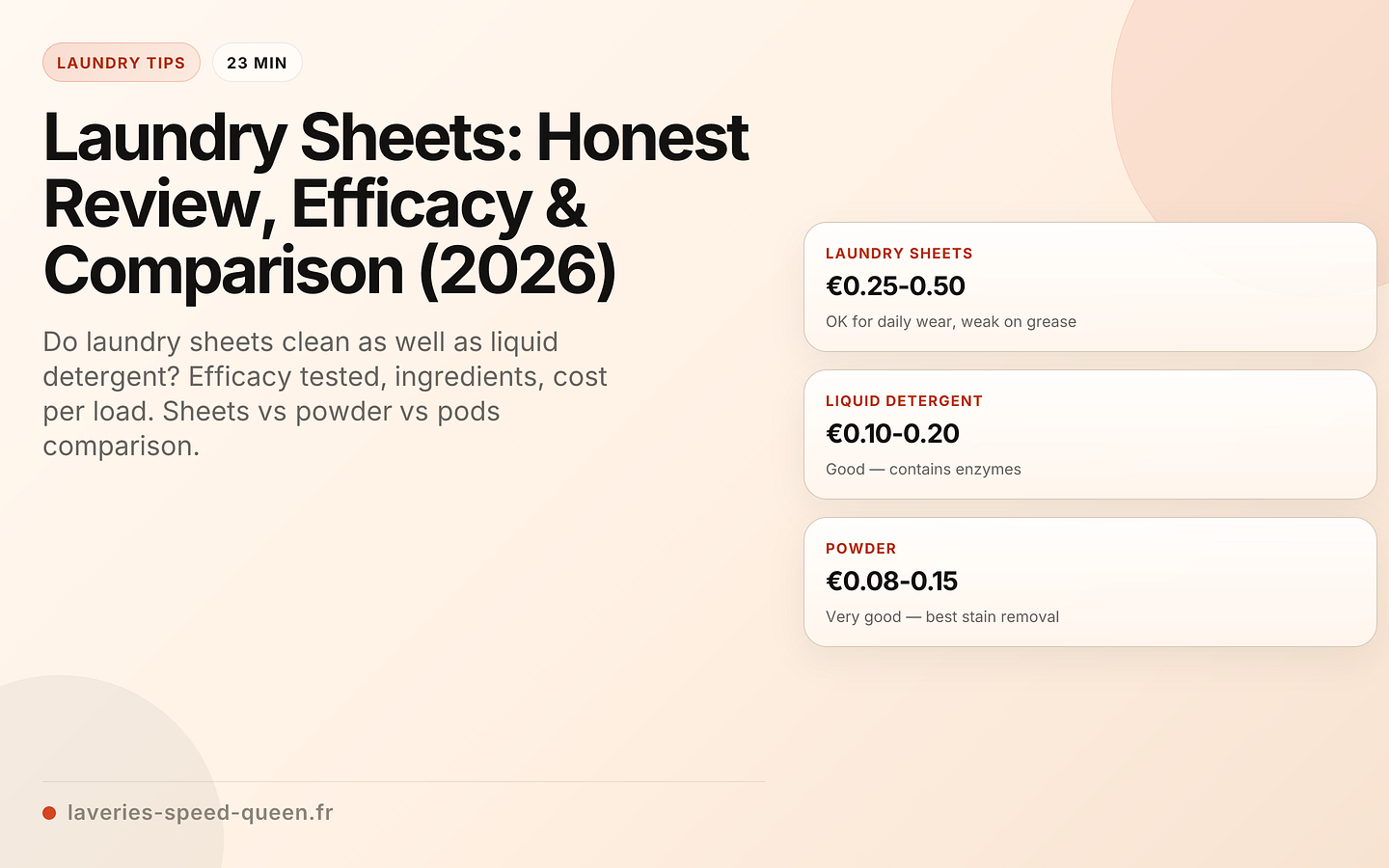
Price remains the main barrier to mass adoption. In 2026, the cost per cycle sits between EUR 0.25 and 0.50 for mainstream brands, and can exceed EUR 0.60 for premium ones. By comparison, a supermarket liquid detergent↗ works out at EUR 0.10-0.20 per cycle and a powder detergent at EUR 0.08-0.15.
Over a year (roughly 200 cycles for a household), the difference adds up:
- Sheets: EUR 50 to 100 per year
-
Liquid detergent
↗ : EUR 20 to 40 per year - Powder detergent: EUR 16 to 30 per year
Incomplete Cold-Water Dissolution
Cold cycles (below 20 degrees C) are increasingly popular for environmental and cost reasons. However, PVA dissolution slows considerably at low temperatures. Undissolved sheet residue can end up on the laundry at the end of the cycle — white or gelatinous marks that require an extra rinse.
Tip: if you wash in cold water, tear the sheet into 4 pieces before placing it in the drum. The contact surface with water is multiplied and dissolution is noticeably faster.
Non-Adjustable Dosing
One sheet = one dose. That is an advantage for standard loads but a drawback for edge cases:
- Heavily soiled load (gym clothes, workwear): one sheet is not enough, two is too much.
- Small load (3 delicate items): a full sheet is an overdose.
- Very hard water (> 20 gpg / > 35 degrees f): more sequestering agents are needed, but the dose is fixed.
With liquid or powder detergent, you can adjust the dose to the millilitre or gram. Correct detergent dosing remains a key factor in results — and sheets only allow rough adjustments (half-sheet or double sheet).
- Do not put the sheet in the detergent drawer -- it must be placed in the drum so it dissolves in direct contact with water. In the drawer, it sticks and does not dissolve.
- Do not use cold water without precaution -- below 20 degrees C, tear the sheet into pieces to ensure complete dissolution.
- Do not automatically double the dose -- two sheets on moderately soiled laundry create overdosing that leaves residue and makes rinsing insufficient.
- Do not store in a damp place -- PVA absorbs ambient moisture. Sheets stick together and lose their integrity if the pouch is not sealed properly.
- Do not skip pre-treatment -- on a stubborn stain, a sheet alone is not enough. Pre-treat with Marseille soap or a stain remover before running the machine.
Comparison: Sheets vs Liquid vs Powder vs Pods
| Criterion | Sheets | Liquid | Powder | Pods |
|---|---|---|---|---|
| Everyday laundry efficacy | Good | Very good | Very good | Good |
| Stubborn stain efficacy | Low | Good | Very good | Good |
| Enzymes | Rarely | Yes (most) | Yes | Yes |
| Bleaching agent | No | Rarely | Yes (percarbonate) | Sometimes |
| Cost per load | EUR 0.25-0.50 | EUR 0.10-0.20 | EUR 0.08-0.15 | EUR 0.20-0.45 |
| Adjustable dosing | No (half or 1 sheet) | Yes (by ml) | Yes (by g) | No |
| Cold-water dissolution | Partial | Complete | Sometimes partial | Good |
| Plastic packaging | No (cardboard) | Yes (jug) | Yes/No (cardboard possible) | Yes (pouch + PVA film) |
| Weight (60 doses) | approx. 150 g | approx. 3 kg | approx. 2 kg | approx. 1.5 kg |
| Travel friendly | Excellent | Poor | Average | Good |
| Overdosing risk | Low | High | High | Low |
| Overall environmental impact | Good | Average | Good | Average |
What the Comparison Reveals
Laundry sheets↗ excel on convenience (weight, footprint, dosing, travel) and plastic footprint (no jug). They fall behind on raw cleaning power (no enzymes, no bleaching agent, lower concentration) and cost per load.
Powder remains the highest-performing format on whites and stubborn stains thanks to oxygen-based bleaching agents. Liquid detergent↗ offers the best value-for-money with adjustable dosing. Pods share the same drawback as sheets (fixed dose) with a larger plastic footprint.
For a full breakdown of detergent formats, see our complete detergent comparison guide.
Eco Brand Test: Beckmann, Earth Breeze, Yokuu, BHALI
The laundry-sheet market is dominated by four very different approaches, and most online comparisons just recite manufacturer marketing. Here is what the official product pages of Dr. Beckmann↗, Earth Breeze↗, Yokuu↗ and BHALI↗ actually say — and what they do not.
Method
All compositions, certifications and prices in this section come from manufacturer product pages (accessed 18 May 2026). We systematically distinguish verified (disclosed by the brand) from not published (ask the manufacturer). No independent test (Que Choisir / 60 Millions de Consommateurs / Consumer Reports) currently covers these four specific SKUs.
Dr. Beckmann Magic Leaves (Germany)
Profile. German household chemistry brand founded in 1953, whose Magic Leaves↗ range is widely stocked in French supermarkets (Carrefour, Monoprix, Auchan, Super U) and on Amazon. Six variants: La Sensible (Cotton Flowers), L’essentielle (Intense Freshness), L’éclatante (Spring Flowers), plus three short-cycle versions (Anti-Odour, Quick Intense Freshness, Colours).
Composition. Dr. Beckmann↗ does not publish the full INCI on its French site. The brand only communicates on three claims: no microplastics, no preservatives, vegan and dermatologically tested. Enzyme content is not publicly documented, which is a transparency gap compared to Earth Breeze↗ or BHALI↗, which publish the functional list.
Price. Roughly EUR 6 for 25 washes in supermarkets, i.e. about EUR 0.24 per cycle. The 80-wash variant (L’éclatante) drops to around EUR 0.20 per load in multi-packs.
Packaging. Cardboard box of 25 sheets, 100% water-soluble. Dr. Beckmann↗ claims 80% less packaging material than an equivalent liquid detergent↗ jug.
Bottom line. Wide availability and decent mainstream value for money, but the INCI opacity is a problem when you want to avoid a specific ingredient (brightener, allergen, preservative).
Earth Breeze (United States)
Profile. US brand based in Harrodsburg, Kentucky, certified B Corp, 1% for the Planet, carbon-neutral, Leaping Bunny (cruelty-free). No dedicated .fr site — Earth Breeze↗ ships Europe from a UK warehouse and is also on Amazon (fragrance-free version).
Composition. This is the most transparent brand in the panel. The Ingredients page explicitly lists:
- Enzymes: protease, amylase, cellulase — which most laundry sheets do not include.
- Surfactants: sodium lauryl sulfate (SLS), sodium laureth sulfate (SLES), cocamidopropyl betaine, lauryl glucoside, methyl ester sulfonate — i.e. a classic anionic + non-ionic + amphoteric mix.
- Bleaching agent: sodium percarbonate↗ (rare on sheets, present here).
- Builder: zeolite + disodium EDTA to soften hard water.
- Film: PVA + hydroxycellulose blend (cellulose reduces pure PVA share).
The Fresh Scent line declares EU fragrance allergens; the Fragrance Free version is the sensitive-skin option.
Price. USD 12 for 60 loads on subscription (~USD 0.20 / load, ~EUR 0.19 at parity), USD 20 one-off. European cost varies with shipping and currency.
Packaging. Plastic-free cardboard, carbon-neutral shipping (self-declared).
Bottom line. The closest sheet to a properly formulated powder — enzymes plus percarbonate is the differentiator. The catch: SLS / SLES presence (controversial on ultra-sensitive skin) even in the fragrance-free version.
Yokuu (Belgium)
Profile. Belgian brand (Probibel BV, Antwerp) with a fundamentally different approach: probiotic sheets, containing 5 strains of non-pathogenic bacteria sourced from the Belgian Ardennes. Sold primarily via yokuu↗.be and yokuu↗.nl; Amazon availability is patchy.
Composition. Yokuu↗ publishes the composition by function with CAS numbers:
- Non-pathogenic bacterial culture (CAS 68038-67-5) — the central claim: probiotics break down odour-causing organic matter continuously (manufacturer-declared: “up to 7 days”).
- Anionic surfactants: plant-derived SLS (coconut / palm), sodium alpha-olefin sulfonate, SLES.
- Non-ionic surfactants: APG glucoside C8-10, C12-14 oxoalcohol polyglycol ether.
- Film + minerals: PVA + bentonite + kaolin + plant-based glycerine.
- No declared classic enzymes (probiotics replace the enzymatic function, per Yokuu↗).
- Self-declared: 65% naturally derived, 100% biodegradable, vegan, no optical brighteners, no phosphates, no microplastics.
Price. EUR 14.95 for 32 sheets = 64 washes = EUR 0.23 / wash (single pack). 4-pack: EUR 0.18 / wash.
Packaging. Compact cardboard, claims 136,000 plastic bottles avoided.
Bottom line. The probiotic angle is unique and plausible for odour breakdown (sport, sweat) but no independent test confirms it outperforms classical enzymes on grease or protein stains. Worth a try if the friendly-bacteria angle appeals; not the pick if you want the most performance-focused formulation.
BHALI (France)
Profile. French brand exclusively dedicated to laundry sheets, sold directly by the brand and on Amazon↗. The only French brand in the panel.
Composition. BHALI↗ publishes a detailed CLP-style percentage-range composition:
- Sulfuric acid mono-C12-14-alkyl esters sodium salts: 15-35% (main anionic surfactant).
- Polyvinyl alcohol: 15-30% (the water-soluble film).
- Water: 5-15%.
- Calcined kaolin: 5-15% and bentonite: 1-10% (mineral builders).
- Glycerine: 1-10% (plasticiser).
- Cocamidopropyl betaine and lauryl glucoside: 0.5-5% each (mild coconut-derived surfactants).
- Citric acid↗: 0.1-1% (limescale sequestrant).
- Phenoxyethanol: 0.1-1% (preservative — worth flagging for cosmetic sensitivities).
BHALI↗ claims plant-sourced surfactants (coconut + corn), no phosphates, parabens, synthetic fragrances or dyes, and self-declares Ecocert, hypoallergenic and dermatologically tested. The Ecocert certificate number is not displayed on the product page. No enzymes listed.
Price. EUR 15.90 for 60 loads = EUR 0.28 per cycle. The Amazon link on this page is for this 60-load format.
Packaging. Compact cardboard (~170 g / 6 oz for 60 sheets).
Bottom line. Solid INCI profile for a mainstream French sheet (no phosphate, no declared brightener, mild surfactants alongside the main one) but no enzymes and a preservative (phenoxyethanol) — do not confuse this with a completely synthetic-preservative-free product.
Tru Earth Eco-Strips (Canada / United States)
Profile. Canadian brand (Victoria, British Columbia) launched in 2019, now the North American Eco-Strips reference on Amazon.com and Amazon.fr. European distribution flows through Amazon’s network via OneLink↗: the 32-strip pack is available on amazon.com and amazon.fr alike.
Composition. Tru Earth↗ publishes a properties list but not the full INCI on the product page. Publicly accessible manufacturer claims:
- Vegan, plant-based formula — plant-based formulation, self-declared.
- Phosphate-free, paraben-free, phthalate-free, dye-free, chlorine bleach↗-free — explicit exclusion list.
- HE-compatible — works in high-efficiency washing machines (all modern units).
- Hot or cold water — no self-declared minimum temperature.
- 100% recyclable cardboard packaging, plastic jug-free.
- Public certifications: B Corp Certified, 1% for the Planet, Ocean Wise. No Leaping Bunny or EWG Verified displayed.
No enzymes and no sodium percarbonate↗ are explicitly declared on the accessed product page — consistent with the lower independent-test score (see below).
Price. USD 16.99 for 32 strips = 64 loads = USD 0.27 / load one-off; USD 14.99 on subscription = USD 0.23 / load. On Amazon.fr the 32-strip pack lands in the same range (~EUR 21-25 depending on stock). Consumer Reports recorded USD 0.41 / load on its Tru Earth product card in 2024 — the gap likely reflects the one-off SRP without promotion or subscription.
Variants. 7 scents (Fresh Linen, Frosted Vanilla Bean, Fragrance-Free, Baby, Lilac Breeze, Autumn Glow, Applewood Blossom) and 3 pack sizes (32 / 64 / 384 strips). The Fragrance-Free version is the only one suited to scent-sensitive users; no official “hypoallergenic” label is displayed.
Independent test. Consumer Reports (August 2024) scored Tru Earth Eco Strips 11/100 Overall — the lowest in the tested panel across 7 stains (blood, body oil, chocolate, coffee, dirt, grass, salad dressing), versus 29/100 for Earth Breeze↗ and 84/100 for Tide↗ Plus Ultra Stain Release liquid. The sheet remains usable on lightly soiled laundry but does not match a properly formulated detergent.
Bottom line. Strong brand-image reference in North America (B Corp + 1% for the Planet is a meaningful signal), genuinely plastic-free packaging, but weaker INCI transparency than BHALI↗ or Earth Breeze↗, and the bottom Consumer Reports score of the tested panel. Buy it for plastic-free / cabin-baggage / studio reasons, not for raw cleaning power.
Honest Recap
| Criterion | Dr. Beckmann ↗ | Earth Breeze ↗ | Yokuu↗ | BHALI↗ | Tru Earth ↗ |
|---|---|---|---|---|---|
| Origin | Germany (1953) | USA (Kentucky) | Belgium (Antwerp) | France | Canada (Victoria, BC) |
| Published INCI | Partial (3 claims) | Detailed by function | Detailed with CAS | CLP percentage ranges | Properties only (no INCI) |
| Enzymes | Not documented | Yes (protease, amylase, cellulase) | No (probiotics instead) | Not mentioned | Not declared |
| Bleaching agent | Not documented | Yes (percarbonate) | No | No | Not declared |
| Preservative | ”None” (self-declared) | Not documented | Not documented | Phenoxyethanol 0.1-1% | Not documented |
| Public certifications | Vegan, dermo-tested (self-declared) | B Corp, 1% for the Planet, Leaping Bunny | Vegan (self-declared) | Self-declared Ecocert, hypoallergenic | B Corp, 1% for the Planet, Ocean Wise |
| Fragrance-free option | Not identified | Yes (Fragrance Free) | No | No synthetic fragrance (self-declared) | Yes (Fragrance-Free) |
| Consumer Reports Aug 2024 score | Not tested | 29 / 100 | Not tested | Not tested | 11 / 100 |
| Price per load | ~EUR 0.24 (25 loads) | ~USD 0.20-0.33 by pack | EUR 0.18-0.23 | EUR 0.16-0.28 by pack | USD 0.23 (sub) to USD 0.41 (CR 2024) |
| Loads per box | 25 or 80 | 60 | 64 (32 sheets) | 60 | 64, 128 or 768 (32 / 64 / 384 strips) |
| Availability | EU supermarkets + Amazon | Amazon US/EU only | Direct site + Amazon (partial) | Direct site + Amazon | Amazon US/EU + tru.earth direct |
Honestly: Are They Better Than Generic Sheets?
On INCI transparency, Earth Breeze↗ and BHALI↗ are the most open; Yokuu↗ has a unique angle (probiotics) worth trying if anti-odour is your focus; Dr. Beckmann↗ and Tru Earth↗ primarily communicate on properties (vegan, plastic-free) and remain the most opaque on active composition. On active composition, Earth Breeze↗ is the only brand combining enzymes AND percarbonate↗ — the closest a sheet gets to a properly formulated powder. The other four stay in the “basic sheet” perimeter: surfactants + PVA film, no enzymes, no bleaching agent.
On the Consumer Reports August 2024 independent test, the only comparative protocol publicly accessible today, Earth Breeze↗ (29/100) beats Tru Earth (11/100) by a factor of ~2.6× on the 7-stain aggregate. Neither approaches a formulated liquid (Tide↗ Plus Ultra Stain Release: 84/100). Beckmann, Yokuu↗ and BHALI↗ were not in that CR panel; their ranking remains to be objectified by a future independent test.
Verdict by Use Case
Rather than crowning a single “best laundry sheet,” here is the brand that fits each common reader scenario, anchored strictly to manufacturer disclosures and — where tested — to the Consumer Reports 2024 scores.
- Eco priority / zero plastic -> Tru Earth↗ (B Corp + 1% for the Planet + Ocean Wise, self-declared plastic-free packaging, best North American availability) or BHALI↗ in the EU (French brand, short transport, CLP-disclosed INCI). Both display the most structured environmental commitments in the panel.
- Sensitive skin / allergen-aware -> Earth Breeze↗ Fragrance Free (published composition, EU-declared fragrance allergens on the Fresh Scent version → fragrance-free version is verifiable) or Tru Earth↗ Fragrance-Free if you want to sidestep the SLS / SLES debate. None of the tested sheets display a third-party hypoallergenic label; every “hypoallergenic” mention in the panel is self-declared.
- Heavy soiling / food / sport stains -> Earth Breeze↗ is the only option in the panel that explicitly lists both enzymes and percarbonate↗. For best raw efficacy, switch to a properly formulated powder with percarbonate — Tide↗ Plus Ultra Stain Release liquid scored 84/100 in the same CR protocol where the best sheet only reached 29/100.
- Travel / cabin baggage / dorm / RV -> Tru Earth↗ (largest North American footprint, 32-strip pack widely stocked, OneLink covers Amazon US and EU) or any brand in the panel. Format trumps performance here: every sheet ticks the “no liquid in carry-on” box.
- Tight budget -> Yokuu↗ 4-box pack at EUR 0.18 / load — the lowest per-cycle price among the linked sheets here. Outside the panel, a good powder detergent still wins at USD 0.10-0.18 per load.
- Beware of vague marketing claims -- '100% natural' without a posted INCI list means nothing. Demand the function-by-function ingredient list (Earth Breeze, Yokuu) or CLP percentage ranges (BHALI) before buying.
- Self-declaration is not third-party certification -- when BHALI or Dr. Beckmann claim 'Ecocert' or 'dermatologically tested' without a visible certificate number, treat it as indicative, not audited proof.
- 'Biodegradable' has a legal threshold -- under OECD 301B, a product must degrade > 60% of its organic carbon within 28 days. Yokuu and BHALI claim biodegradable; check the product page for the specific test (rarely cited in supermarket listings).
- Phenoxyethanol is not neutral -- effective preservative but flagged as suspect for skin sensitivities by some watchdogs (60 Millions de Consommateurs, UFC-Que Choisir). Worth noting for BHALI on reactive skin.
The Environmental Question
Is PVA Really Biodegradable?
Polyvinyl alcohol is classified as biodegradable according to standardised tests (OECD 301B and 302B). It is broken down by specific micro-organisms into CO2 and water. However, this classification is based on optimal laboratory conditions. In the real world:
- Biodegradation depends on the presence of adapted bacteria at the local wastewater treatment plant.
- Water temperature plays a role: below 15 degrees C, degradation slows significantly.
- PVA that passes through treatment plants without being degraded ends up in waterways, where its persistence is less well documented.
The overall balance is still strongly positive compared to HDPE plastic jugs, which take hundreds of years to break down. But the “zero waste” label deserves a caveat: the sheet is a dissolved waste, not an absent one.
The Carbon Footprint of Transport
The real environmental advantage of sheets lies in logistics. A lorry carrying laundry sheets moves 10 to 15 times less weight and volume than one loaded with jugs of liquid detergent↗ (of which 60-80 % of the weight is water). This translates into a significant reduction in transport-related CO2 emissions.
Who Are Laundry Sheets Actually For?
Travellers and Backpackers
The unbeatable format on the go: lightweight, compact, no leak risk, no liquid banned from hand luggage. Slip 10 sheets into your toiletry bag.
Studios and Small Flats
No utility room, no cupboard space: sheets fit in a drawer. Perfect for students in halls or renters of micro-apartments.
Zero-Waste Lifestyles
If cutting plastic packaging is a priority, sheets are the least-packaged format on the market. The cardboard box is recyclable, no jug to throw away.
Lightly Soiled Daily Wear
T-shirts, underwear, sheets worn for a week -- everyday laundry without specific stains is perfectly handled by one sheet.
Who Should Look Elsewhere
- Families with children: food, grass and paint stains need enzymes and stain-lifting power that sheets do not offer. Choose a liquid or powder detergent with enzymes.
- Heavily soiled or professional garments: intensive sportswear, work clothes, kitchen aprons. The active-agent concentration in a sheet is insufficient.
- White laundry: without sodium percarbonate↗, sheets do not bleach↗. Whites will gradually grey. See our guide to whitening yellowed laundry.
- Very hard water: above 20 gpg (35 degrees f), the sequestering agents in a sheet are not enough to neutralise limescale. Surfactants lose effectiveness.
Tips for Getting the Best from Laundry Sheets
Maximising Efficacy
- Pre-treat stains before washing: rub a little Marseille soap↗ on the damp stain and leave for 15 minutes. The sheet handles the overall wash; pre-treatment deals with localised stains.
- Do not overload the drum: two-thirds full is the ideal load. An overpacked drum prevents the dissolved sheet from circulating properly.
- Choose the right temperature: 30-40 degrees C is the sweet spot for full dissolution and effective cleaning. See our guide on choosing between 30 and 40 degrees.
Choosing a Quality Brand
Not all manufacturers are equal. Here are the criteria to check before buying:
- Visible INCI list: if the manufacturer does not publish the full ingredient list, walk away.
- Active-agent concentration: the best sheets show more than 50 % active matter (surfactants + sequestering agents). The worst drop below 30 %.
- Fragrance-free option available: an unscented version is a good sign of formulation transparency.
- Certifications: EU Ecolabel, USDA BioPreferred, or equivalent. They guarantee a minimum level of biodegradability and the absence of problematic compounds.
Sheets + Pre-Treatment = The Winning Combo
Laundry sheets work best as a maintenance detergent combined with targeted pre-treatment. Use Marseille soap or sodium percarbonate on stains before running the machine. The sheet handles the overall wash; the pre-treatment tackles the tough spots.
At the Laundromat: the Pro Machine Beats Every Sheet
At a self-service laundromat, the choice between sheets, liquid, powder or pods simply does not arise — and that is the point. Professional-grade detergent is included and pre-dosed in every machine, formulated for high-efficiency drums: concentrated surfactants, enzymes, anti-redeposition agents and limescale sequestrants. On standard family laundry, this industrial dose outperforms any consumer sheet, including Earth Breeze↗, and approaches a formulated Tide↗ on the seven stains Consumer Reports tested.
The next step up is not even efficacy — it is capacity. Our 18 kg (~40 lb) washers in Blagnac and Croix-Daurade handle a king-size duvet, a family comforter, or a bulk-bedding load that your home machine simply cannot fit — while a sheet pack just multiplies the number of cycles you have to run at home. And 60 °C (140 °F) wash cycles are available on every machine: that is the temperature actually needed for baby clothes, kitchen towels and underwear — well beyond the “hot or cold water” self-declaration on any sheet pack.
You bring nothing. No jug, no sheet, no pod. Dosing is automatic per the selected cycle, a full wash + dry cycle lands in ~60 minutes (30 min wash + 30 min dry), and the loyalty card delivers up to -20% on washing and drying. The only useful at-home action: pre-treat a known stubborn stain with Marseille soap↗ before you come — the machine handles the rest.
As an Amazon Associate, we earn from qualifying purchases through the affiliate links in this article — at no extra cost to you. This helps us maintain this site and produce free guides.
Rather than juggling five sheet brands, drop your 18 kg (~40 lb) duvet, sheets and family bedding into our pro washers. Our laundromats in Blagnac and Croix-Daurade include professional-grade detergent, softener, 60 °C (140 °F) wash and fast drying. Payment contactless card or cash. See our prices.
Methodology
This article draws on the official product pages of Dr. Beckmann↗, Earth Breeze↗, Yokuu↗, BHALI↗ and Tru Earth (accessed May 2026) and on the Consumer Reports independent test from August 2024 (“Do Laundry Detergent Sheets Work as Well as Liquid?”), the only public comparative protocol covering the laundry-sheet segment today. Whenever a manufacturer publishes a self-declaration without third-party certification (Ecocert without a certificate number, “hypoallergenic” without a cited standard), we flag it explicitly rather than treating it as audited fact. No independent test from Que Choisir, 60 Millions de Consommateurs, Stiftung Warentest or Wirecutter / NYT was publicly accessible on these specific SKUs at the time of writing — this will be added as such tests become public.
Sources and References
- How to choose a detergent: full comparison
- Detergent dosage: the complete guide
- Marseille soap for laundry: uses and pitfalls
- Homemade detergent: recipes and limits
- Sodium percarbonate: usage guide
- Whitening yellowed laundry
- Washing at 30 or 40 degrees: which to choose?
- Removing a red wine stain
- OECD Guidelines for the Testing of Chemicals — Biodegradability tests 301B/302B (external link)
- Regulation (EC) No 648/2004 on detergents (external link)