Cloth diapers are washed in two steps: a cold pre-wash (to rinse urine and stools) followed by a long wash at 60 °C with a powder detergent that is glycerin-free and softener-free. Dry storage between washes (no soaking), percarbonate stripping every 1-2 months, and sun drying to naturally bleach stains. The ideal rhythm: one cycle every 2-3 days, with a rotation stock of 20-25 diapers.
At a glance
Dry storage — no soaking. An aerated bucket or wet bag, emptied every 2-3 days.
Cold pre-wash — short cycle with no detergent (or half dose) to rinse urine and residue before the main wash.
60 °C, powder detergent — glycerin-free, softener-free, no essential oils. Full dose.
Fill the drum to two-thirds — add small items to create the friction needed for cleaning.
Monthly stripping — long 60 °C cycle with sodium percarbonate, no detergent. Removes built-up residue.
Why cloth diapers require a specific routine
A cloth diaper is not ordinary laundry. It is a technical device designed to absorb and retain bodily fluids in direct contact with a baby’s fragile skin. This dual requirement — impeccable hygiene + maximum absorbency — demands a much more rigorous wash routine than a standard cycle.
What a soiled diaper contains
A used diaper contains urine (urea, forming ammonia), stools (bacteria, digestive enzymes, biliary pigments), sweat and skin cells. Urine, in contact with bacteria, produces ammonia — that distinctive pungent smell that appears if diapers are left unwashed too long.
Stools contain lipases (fat-degrading enzymes) and biliary pigments (bilirubin) that stain fabrics yellow-green. These pigments are photosensitive — sunlight breaks them down naturally, which is why sun drying is the best stain-removal method.
The structure of a cloth diaper
A typical cloth diaper has three functional layers:
- The stay-dry layer (fleece, microfibre or disposable liner): touches the baby’s skin. Its role is to let moisture pass through while keeping the surface dry.
- The absorbent insert (cotton, bamboo, hemp or microfibre): the absorbent core that retains liquid. This is the part that needs the most rigorous washing.
- The waterproof cover (PUL = polyurethane laminate): the outer waterproof barrier. PUL is a coated fabric that cannot withstand high temperatures or the tumble dryer.
Each component has its own temperature and care limits — which is why the wash routine is more nuanced than simply “everything at 60 °C”.
The wash routine: step by step
Step 1 — Removing waste and storage
At every nappy change, flush solid waste down the toilet. If you use a disposable liner (cellulose or viscose), simply lift the liner with the waste and flush (check the liner is biodegradable and compatible with your plumbing).
Place the soiled diaper in an aerated bucket or wet bag in a ventilated area. The bucket should not be sealed airtight — a loosely placed lid or slightly open bag allows air circulation that limits anaerobic fermentation (the main source of ammonia smell).
Do not soak
Prolonged soaking in water is an outdated practice (1970s-80s) that all cloth diaper brands now advise against. Stagnant water promotes bacterial growth, generates unbearable ammonia odours, deteriorates elastics and PUL through prolonged immersion, and does not clean any better than dry storage followed by a machine cycle.
Step 2 — Cold pre-wash
Every 2-3 days (on wash day), load all stored diapers into the machine. Run a short cycle (15-30 minutes) at cold or 30 °C with no detergent or half a dose.
This pre-wash serves three functions:
- Rinse urine: urea dissolved in cold water is flushed out before the hot cycle, preventing urine proteins from being “cooked” at 60 °C (cause of persistent odours).
- Dilute stool residue: organic residue is carried away by the rinse.
- Prepare inserts: uniformly dampened absorbent fibres wash better in the next cycle.
Step 3 — Main wash at 60 °C
After the pre-wash, do not empty the drum. Add clean small items (towels, flannels, bodysuits) to fill the drum to two-thirds. A drum that is too empty does not create the friction between textiles that is essential for deep cleaning.
Run a long cycle (cotton or intensive) at 60 °C with a full dose of powder detergent. The cycle should include a normal spin (1,000-1,200 rpm) — spinning does not damage inserts and allows faster drying.
Choosing a detergent
Detergent choice is the most critical point in cloth diaper care. The wrong detergent is the number-one cause of leaks, odours and irritation.
Standard powder detergent
Preferred over liquid: richer in surfactants, glycerin-free, more effective at 60 °C. Common supermarket brands work fine.
NO glycerin
Glycerin (found in many liquid detergents) deposits a greasy film that waterproofs inserts and causes leaks.
NO softener
Fabric softener is the absolute enemy of cloth diapers. It creates a hydrophobic layer on fibres that blocks absorption.
NO essential oils
Essential oils are potentially irritating to baby skin and leave an oily residue in absorbent fibres.
Homemade detergent: caution
Homemade detergents based on Marseille soap are not recommended for cloth diapers. Marseille soap naturally contains glycerin and fatty acids that clog absorbent fibres. If you want an eco-friendly alternative, Ecocert-certified powder detergents without glycerin are compatible.
Step 4 — Rinse check
Good rinsing is fundamental. Detergent residue trapped in inserts causes skin irritation (nappy rash) and progressively reduces absorbency.
The clear-water test: at the end of the cycle, check the residual water at the bottom of the drum or observe the final rinse water. It should be perfectly clear and foam-free. If you see foam or cloudy water, run an additional rinse on cold.
If poor rinsing is a recurring problem, you are probably overdosing the detergent. Reduce the dose by 10-20% and see if the result improves.
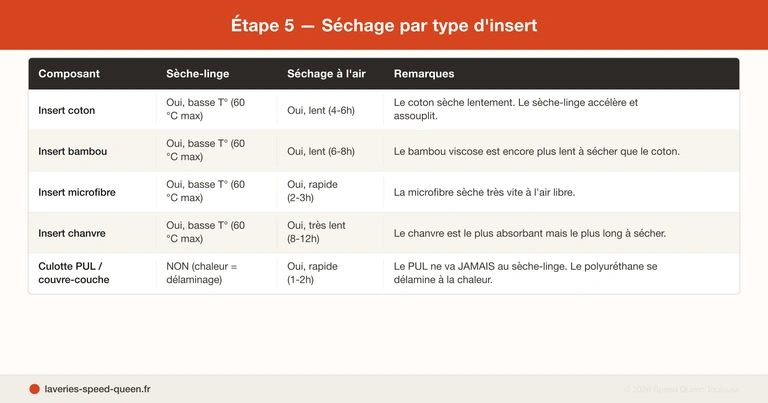
Step 5 — Drying by insert type
Drying depends on the component:
| Component | Tumble dryer | Air drying | Notes |
|---|---|---|---|
| Cotton insert | Yes, low temp (60 °C max) | Yes, slow (4-6 h) | Cotton dries slowly. Tumble drying speeds up and softens. |
| Bamboo insert | Yes, low temp (60 °C max) | Yes, slow (6-8 h) | Bamboo viscose is even slower to dry than cotton. |
| Microfibre insert | Yes, low temp (60 °C max) | Yes, fast (2-3 h) | Microfibre dries very quickly when air dried. |
| Hemp insert | Yes, low temp (60 °C max) | Yes, very slow (8-12 h) | Hemp is the most absorbent but the slowest to dry. |
| PUL cover / wrap | NO (heat = delamination) | Yes, fast (1-2 h) | PUL should NEVER go in the tumble dryer. The polyurethane delaminates with heat. |
Sunlight is your best ally. UV rays break down biliary pigments (yellow stool stains) naturally and for free. Lay damp inserts in direct sunlight — even in winter behind a window, UV passes through glass and bleaches stains. It is the only “stain remover” that is perfectly safe for a textile in contact with a baby’s skin.
Inserts: choosing and caring for by material
Cotton
Cotton is the most common fibre for cloth diaper inserts. It is natural, absorbent, resilient to repeated washing and tumble-dryer safe. Its absorbency is moderate (10-12 ml per gram of fibre) but its absorption speed is good — it captures liquid quickly.
Key point: new cotton inserts are poorly absorbent. They must be pre-washed 5-8 times before first use to remove the natural waxes and oils from raw cotton (this process is called “prepping”).
Bamboo viscose
Bamboo viscose offers absorbency 60% greater than cotton by weight and a very soft feel. However, it dries much more slowly and wears out faster over repeated washes.
Key point: bamboo viscose is not a “natural” fibre despite its name. It is a viscose (regenerated cellulose) made from bamboo pulp via a chemical process. Care is the same as cotton (60 °C, powder detergent), but it is more sensitive to detergent overdosing.
Microfibre
Microfibre (ultra-fine polyester) is the champion of absorption speed: it captures liquid instantly. But its total capacity is lower than cotton and bamboo — it saturates faster. This is why microfibre is often used as a “booster” (extra insert for nights or heavy wetters) rather than as a sole insert.
Key point: microfibre should never touch the baby’s skin directly. Its ultra-fine fibres have a drying effect that can cause irritation. It must always be covered by a layer of cotton, bamboo or fleece.
Hemp
Hemp is the most absorbent material (up to 4 times its weight in water) but also the slowest to absorb and to dry. It is often used combined with cotton (cotton/hemp insert) to combine speed and capacity.
Key point: hemp requires 10-15 pre-washes to reach maximum absorbency. It takes the longest to prep, but is also the most durable over time.
Stripping: the deep clean
Over weeks, despite correct washing, residue builds up in insert fibres: traces of poorly rinsed detergent, residual grease, mineral deposits from hard water. This residue forms an invisible film that gradually reduces absorbency and creates morning ammonia smells.
When to strip?
- Diapers smell of ammonia first thing in the morning (not just after a long night)
- Diapers leak when they did not before
- The insert repels water when you pour a trickle of water on it (instead of absorbing it)
- As a preventive routine: every 1-2 months
Stripping protocol
- Separate inserts from PUL covers. Stripping is mainly for the inserts.
- Run a long cycle at 60 °C (cotton/intensive) with 2 tablespoons of percarbonate↗ and no detergent.
- Percarbonate releases active oxygen that oxidises and breaks down organic residue, detergent films and greasy deposits embedded in fibres.
- Run an additional cold rinse with nothing to flush out the dissolved residue.
- Check: the rinse water should be clear and foam-free. If it foams, run another rinse.
The glass-of-water test
After stripping, slowly pour a trickle of water onto the insert laid flat. The water should be absorbed in a few seconds. If it beads and stays on the surface, the strip was insufficient — run another cycle with percarbonate.
Washing cloth diapers at a laundromat
The laundromat is an underrated but highly relevant option for cloth diapers, especially for families without a washing machine or with a small domestic machine.
Advantages
- Higher water volume: professional machines use 50-60 litres of water per cycle, vs 15-20 litres for a domestic machine. This volume ensures much more effective rinsing — the critical point of cloth diaper care.
- Large capacity: an 18 kg machine can wash the entire diaper stock in one go, with room to add extra laundry (the key two-thirds fill).
- Powerful spin: professional spin significantly reduces drying time, a major advantage for bamboo or hemp inserts.
Laundromat protocol
The protocol is identical to the home routine, with one important adaptation: bring your own detergent. The pre-dosed professional detergent in laundromat machines may contain softeners or glycerin↗ that are incompatible with cloth diapers.
- Run a cold pre-wash (short cycle, 20-30 °C).
- Add your powder detergent (glycerin-free) and run the cotton 60 °C cycle.
- If the machine offers an extra rinse, select it systematically.
Shared hygiene
The question of hygiene in a shared machine is understandable for soiled diapers. In practice, the risk to subsequent users is nil: the 60 °C cycle kills bacteria, and rinsing flushes all residue. For your peace of mind and other users’ comfort, show courtesy: remove solid waste before washing (as you do at home) and leave no traces in the drum. See our article on laundromat hygiene for the scientific data.
Most common mistakes
- Soaking — prolonged soaking promotes bacteria, ammonia and deteriorates elastics/PUL. Store dry.
- Detergent with glycerin or softener — the greasy film reduces absorption and causes leaks. If already done, strip immediately.
- Underdosing detergent — out of fear of residue, many parents underdose. Result: diapers are not clean, bacteria proliferate, odours set in. Dose normally.
- Tumble drying PUL covers — heat delaminates the polyurethane. PUL loses its waterproofing and the diaper leaks. Air dry only.
- Drum too empty — without friction between textiles, washing is ineffective. Always fill to two-thirds by adding small items.
Environmental impact: the numbers
Cloth diapers are often chosen for their reduced environmental impact. ADEME data (2012, revised 2019) shows that a child uses around 4,500 disposable diapers from birth to potty training, producing approximately 1 tonne of non-recyclable waste. Cloth diapers reduce this volume by 90%, but their impact depends on the wash routine.
To maximise the ecological benefit:
- Wash at 60 °C (not 90 °C) — it is sufficient for hygiene and reduces energy consumption by 40%.
- Air dry whenever possible — the tumble dryer represents a significant share of cloth diapers’ carbon footprint.
- Use diapers for two children (or more) — manufacturing accounts for a large share of the environmental impact, and well-maintained diapers last 200-300 washes.
As an Amazon Associate, we earn a small commission on purchases made through the affiliate links in this article — at no extra cost to you. This helps us maintain this site and produce free guides.
Need a high water volume for a perfect cloth diaper rinse? Our laundromats in Blagnac, Croix-Daurade and Montaudran have 11-18 kg machines with 50-60 litres of water per cycle — ideal for impeccable rinsing. Payment CB sans contact ou espèces. Check our prices.
Sources and references
- Sodium percarbonate and laundry
- Homemade detergent: recipe and limits
- Fabric softener: useful or not?
- Laundromat hygiene: what the science says
- Washing baby clothes
- Washing temperature guide
- ADEME — Life cycle analysis of baby diapers (2012, revised 2019)
- UK Environment Agency — Life Cycle Assessment of Disposable and Reusable Nappies (2008)