In short: Essential oils in laundry are appealing in theory but largely ineffective in practice. Most evaporate in the heat of the wash, are diluted in tens of litres of water, and do not survive rinsing. Their disinfecting power in a machine is negligible. They do, however, carry real risks: greasy stains, machine residue and skin allergies. White vinegar and sodium percarbonate work better, cost less and carry no risk.
At a glance
Scent: virtually none after washing -- essential oils evaporate at 30-60 °C and are rinsed away in 40-60 litres of water.
Disinfection: unproven under real conditions -- tea tree works in vitro, not in a machine at 30 °C.
Greasy stain risk -- essential oils are concentrated plant fats; coloured ones stain light fabrics.
Recognised allergens -- linalool, limonene, citronellol: irritating for sensitive skin and babies.
White vinegar and percarbonate are more effective -- proven, affordable, allergen-free.
The promise of essential oils in laundry
Essential oils are promoted as a natural alternative to scent, disinfect and freshen laundry in the machine. Reality is more nuanced.
The enthusiasm for essential oils in laundry reflects a legitimate desire for more natural products. Blogs and social media are full of homemade detergent recipes enriched with tea tree, lavender or lemon. The promises are attractive: a natural fragrance without chemicals, gentle disinfection and an anti-mite effect.
The problem is that these claims often rest on extrapolations. Scientific studies on the antibacterial properties of essential oils are real — but they are conducted in vitro, at pure concentrations, on controlled surfaces. Conditions inside a washing machine (massive dilution, temperature, mechanical agitation, rinsing) are radically different.
What is proven
Tea tree (melaleuca alternifolia) has demonstrated antibacterial and antifungal properties in vitro. Lavender has a documented calming effect in aromatherapy. Eucalyptus has antiseptic properties when applied at high concentration.
What is not
No published study shows that adding 5-10 drops of essential oil to 40-60 litres of wash water produces a significant disinfecting, anti-mite or even olfactory effect on fabrics after rinsing and drying.
Why essential oils are largely ineffective in a machine
Under real washing conditions, three factors cancel virtually all essential oil benefits: dilution, temperature and rinsing.
Dilution: the decisive factor
A domestic washing machine uses 40-60 litres of water per cycle. Professional machines in laundromats may use more. If you add 10 drops of tea tree (about 0.5 ml), the final concentration is around 0.001 %. Studies showing antibacterial activity of tea tree use concentrations of 0.5-5 % — 500 to 5,000 times higher.
This is the fundamental difference between in-vitro effectiveness and in-machine effectiveness. A drop of tea tree placed directly on a contaminated surface can indeed kill bacteria. The same drop diluted in a bathtub of water has no measurable effect.
Evaporation from heat
Essential oils are volatile by nature — that is precisely what gives them their scent. At 30 °C, lavender begins to evaporate. At 40 °C, much of the aromatic compounds are in the air, not on the fabric. At 60 °C, evaporation is virtually complete. This is why a hot wash retains no residual fragrance, even with a generous dose of essential oil.
Paradoxically, this is also why essential oils cannot disinfect effectively in a machine. For tea tree to be bactericidal, it would need to stay in contact with fibres at a sufficient concentration. But the heat that could aid disinfection is precisely what evaporates the active compounds.
Rinsing removes the residue
Even if a fraction of the essential oils survives the wash, the rinse cycle (one or two rinses depending on the programme) eliminates the bulk of the residue. Being oily substances, essential oils are partly emulsified by the detergent and flushed out with the rinse water. What remains on the fibres after spin-drying is infinitesimal.
For fragrance, that is disappointing. For allergy sufferers, it is mostly good news — but not a guarantee of zero residue on the fabric.
Real risks of essential oils in the machine
Beyond ineffectiveness, essential oils pose concrete risks to fabrics, the machine and skin.
Stains on fabrics
Essential oils are concentrated plant-based fats. Poured directly onto fabric, they leave greasy marks that can be difficult to remove — especially on white cotton and light textiles.
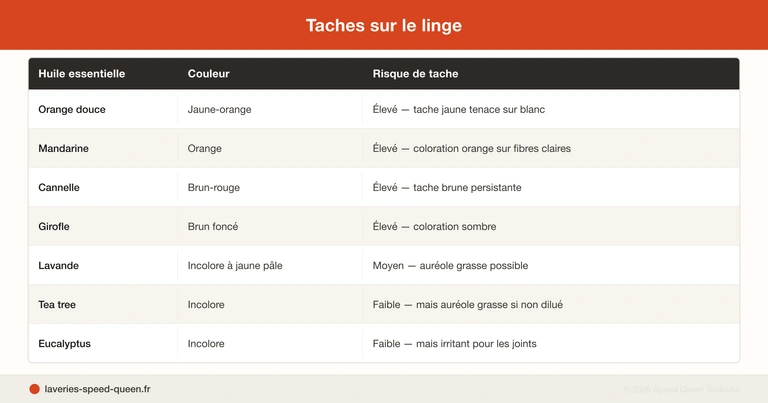
Coloured essential oils are the most problematic:
| Essential oil | Colour | Stain risk |
|---|---|---|
| Sweet orange | Yellow-orange | High — stubborn yellow stain on whites |
| Mandarin | Orange | High — orange discolouration on light fibres |
| Cinnamon | Red-brown | High — persistent brown stain |
| Clove | Dark brown | High — dark discolouration |
| Lavender | Colourless to pale yellow | Medium — possible greasy halo |
| Tea tree | Colourless | Low — but greasy halo if undiluted |
| Eucalyptus | Colourless | Low — but irritating to seals |
If a greasy essential oil stain forms, treat it like a standard grease stain: dish soap, Marseille soap↗ or baking soda before washing. The sooner you act, the easier it comes out.
Machine fouling
The oily compounds in essential oils do not dissolve in water. They build up in poorly rinsed areas of the machine: door seal, detergent drawer, drain hoses. Over time, these greasy residues create a breeding ground for bacterial biofilm — the slimy layer responsible for musty machine odours.
Ironically, essential oils added to “purify” the machine can actually promote mouldy smells. If your machine smells bad, the answer is a mechanical clean (a 90 °C empty cycle with percarbonate↗), not drops of essential oil.
Caution in laundromats
In a laundromat, machines run dozens of cycles a day. Essential oil residues left by one user can transfer to the next person’s laundry — a real issue for allergy sufferers. This is why adding personal products to professional machines is discouraged. The automatically dosed detergent in our Speed Queen laundromats is formulated to be effective and hypoallergenic.
Allergies and skin irritation
This is the most serious and least known risk. Essential oils contain molecules classified as contact allergens under the European cosmetics regulation (EC No 1223/2009). Among the 26 allergens requiring mandatory declaration, several are major components of popular essential oils:
- Linalool (lavender, ylang-ylang): the most common contact allergen in scented products.
- Limonene (citrus, lemon, orange): a recognised skin sensitiser.
- Citronellol (geranium, rose): a documented contact allergen.
- Eugenol (clove, cinnamon): an irritant and sensitiser.
Residues on fabric are in prolonged contact with the skin — sometimes 8 hours a night for sheets. For infants whose skin barrier is immature and people with atopic skin, this contact can trigger contact dermatitis (redness, itching, eczema). For more on residues and sensitive skin, see our guide to detergent residues and sensitive skin.
The few uses that work (with precautions)
Despite the limitations, a few occasional essential oil uses have merit — provided you know exactly what to do and why.
Tea tree in the rinse compartment (occasional use)
Tea tree (melaleuca alternifolia) is the best-documented essential oil for antibacterial properties. Using it in the rinse compartment — not the main wash compartment — maximises contact with the laundry at the end of the cycle, when the water is clean and the temperature is lower (which limits evaporation).
Acceptable use
5 drops of tea tree in the rinse compartment as an occasional hygiene supplement (smelly sportswear, musty towels). The antibacterial effect is limited but not zero at end-of-cycle.
What it does not replace
A 60 °C wash for genuine disinfection of contaminated laundry (gastroenteritis, flu, fungal infection). Temperature alone eliminates pathogens -- tea tree as a backup is superfluous.
For genuine laundry disinfection — in cases of infectious illness or dust mite issues — a 60 °C wash minimum is the only proven method. Tea tree is a marginal supplement, not a substitute.
Dried lavender in the wardrobe (the best use)
This is paradoxically the most effective use, and it does not involve the machine at all. Dried lavender sachets placed in wardrobes and drawers:
- Scent laundry durably — in direct contact, without dilution, without heat to evaporate.
- Repel moths — the linalool in lavender is a natural repellent against clothes moths (Tineola bisselliella). This is a traditional use backed by entomological studies.
- Last several months — a sachet stays active for 3-6 months. Squeeze it regularly to release the scent.
This is more effective, more economical and risk-free compared with adding essential oils to the machine. Dried lavender flowers contain no concentrated plant fats: no stain risk, no machine residue.
Scented dryer balls (with caution)
If you use a domestic tumble dryer, you can place 2-3 drops of lavender or tea tree on a wool dryer ball. The moderate heat of the dryer diffuses the scent gradually. Indirect contact (via the ball, not directly on the fabric) reduces the risk of stains and skin residue.
Warning: essential oils are flammable. Never pour essential oils directly into the dryer, on the filter or on the heating element. Wool dryer balls↗ absorb the oil and release it slowly — this is the only safe method.
Proven alternatives: what actually works
For every essential oil promise, there is a more effective, cheaper and better-documented alternative.
To deodorise: white vinegar
White vinegar is the number-one alternative to essential oils for odour. 50 ml in the rinse compartment neutralises residual odours (sweat, mustiness, tobacco) by dissolving the mineral and organic residues that trap smells in fibres.
Unlike essential oils, vinegar does not mask the odour — it eliminates it. The vinegar smell itself disappears completely on drying. This is why white vinegar↗ is more effective than lavender on laundry that smells bad: lavender covers the odour; vinegar removes it.
To disinfect: sodium percarbonate
Sodium percarbonate is a laundry disinfectant with proven effectiveness. Dissolved in water, it releases active oxygen (hydrogen peroxide) that destroys bacteria, moulds and certain viruses through oxidation.
Conditions for effectiveness
1 tablespoon of percarbonate in the drum, wash at 40-60 °C minimum. Below 40 °C, active oxygen release is too slow to be effective within a single cycle.
Advantages over essential oils
Disinfecting effectiveness proven by independent studies, no allergens, no oily residues, no machine build-up. Breaks down into water, oxygen and sodium carbonate (all harmless).
For serious cases (gastroenteritis, flu or covid wash, or disinfecting contaminated laundry), percarbonate at 60 °C is the benchmark. Tea tree in the rinse compartment does not come close.
To neutralise stubborn odours: baking soda
Baking soda (1-2 tablespoons in the drum) neutralises the organic acids responsible for sweat and musty odours. Its slightly alkaline pH (8.4) creates an environment unfavourable to odour-causing bacteria. It is an effective complement to white vinegar.
Comparison table: essential oils vs alternatives
| Goal | Essential oils | Recommended alternative | Proven effectiveness |
|---|---|---|---|
| Scent laundry | Virtually none after rinsing | Dried lavender sachets in the wardrobe | Yes — direct contact, long-lasting |
| Deodorise | Temporarily masks | White vinegar 50 ml at rinse | Yes — eliminates the cause of odours |
| Disinfect | Negligible in machine | Sodium percarbonate at 40-60 °C | Yes — active oxygen is bactericidal |
| Anti-dust-mite | Unproven in the wash | 60 °C wash, 30 minutes minimum | Yes — heat alone is enough |
| Anti-moth | Possible in direct application | Dried lavender sachets in the wardrobe | Yes — validated natural repellent |
The case of homemade detergent with essential oils
Many homemade detergent recipes include essential oils. The result is a product that cleans less effectively than a standard detergent, with a fragrance that does not last.
Homemade detergent recipes based on Marseille soap, baking soda and essential oils are popular. Marseille soap is a genuine cleaning agent (anionic surfactant) and baking soda softens hard water. But the essential oils added for fragrance and “disinfection” contribute nothing measurable to the final result.
The logic is simple: if essential oils evaporate and get rinsed away in a commercial detergent that already contains cleaning agents, they evaporate and get rinsed away just as much in a homemade detergent. Adding them does not improve cleaning power — it increases cost and risk (greasy residues, allergens).
If you want a homemade detergent, focus on Marseille soap (real soap, not palm-oil imitations) and baking soda. Leave essential oils aside, or save them for the wardrobe.
Common misconceptions about essential oils and laundry
Lemon whitens laundry in the machine
Lemon essential oil has no whitening power in a machine. The whitening effect of lemon comes from citric acid (the juice), not the essential oil (terpenes). To whiten yellowed laundry, sodium percarbonate or hydrogen peroxide are effective.
Eucalyptus removes grease stains
Eucalyptus essential oil is a mild solvent that can help pre-treat a grease stain when applied directly and concentrated. But a few drops in the machine have no stain-removing effect. The detergent itself contains far more powerful surfactants for lifting grease.
Essential oils replace fabric softener
Essential oils have no softening properties. Fabric softener works by depositing cationic surfactants on fibres. Essential oils lack this mechanism. If you want a natural substitute, white vinegar (anti-limescale) is the only documented alternative.
Lavender repels moths in the machine
Clothes moths live in wardrobes, not in the machine. To repel them, lavender must be present where moths lay eggs: in cupboards and drawers. A lavender wash has no residual anti-moth effect on dried and stored laundry.
In a Speed Queen laundromat
In a laundromat, detergent is automatically dosed at every cycle. This professional detergent is formulated to be effective across a wide range of fabrics and soiling levels, without the drawbacks of artisanal products or personal additions.
Adding essential oils to professional machines is discouraged for several reasons:
- Oily residues contaminate subsequent cycles — a problem for allergy-prone customers.
- Plant fats accelerate wear on professional seals.
- The professional detergent is already optimised for cleaning and freshness.
Our laundromats are open 7j/7 de 7h à 22h. Machines from 9 à 18 kg handle everything from everyday clothes to large items (duvets, curtains). Payment by CB sans contact ou espèces.
Mistakes to avoid
- Pouring essential oil directly onto fabric -- risk of greasy stain, especially with coloured oils (orange, cinnamon, clove).
- Expecting disinfection in the machine -- dilution in 40-60 litres of water makes the residual concentration negligible.
- Using essential oils on baby laundry -- infants have immature skin and essential oils contain recognised allergens.
- Adding essential oils to the tumble dryer -- essential oils are flammable. Use wool dryer balls as a carrier if needed.
- Replacing detergent with essential oils -- essential oils contain no surfactants. They do not clean.
- Confusing scent with cleanliness -- laundry that smells of lavender is not cleaner than unscented laundry. Cleanliness depends on detergent and temperature.
As an Amazon Associate, we earn a small commission on purchases made via the affiliate links in this article — at no extra cost to you. This helps us maintain this site and produce free guides.
At Speed Queen laundromats, detergent is automatically dosed — effective, hypoallergenic, no oily residues. No need to add essential oils. Laundry washed and dried in about 1 hour. See our prices or learn how to choose your detergent at home.
Sources and references
- European Regulation (EC) No 1223/2009 on cosmetic products — list of 26 allergens requiring mandatory declaration, accessed 23 March 2026
- Carson CF, Hammer KA, Riley TV, Melaleuca alternifolia (Tea Tree) Oil: a Review of Antimicrobial and Other Medicinal Properties, Clinical Microbiology Reviews, 2006
- ADEME, Les ingredients de base pour un menage plus ecologique, accessed 23 March 2026
- UFC-Que Choisir, Huiles essentielles : pas si inoffensives, accessed 23 March 2026
- White vinegar and laundry: uses and limits
- Sodium percarbonate: the laundry guide
- Baking soda and laundry: real uses
- Homemade detergent: recipe and limits
- Marseille soap and laundry
- Detergent residues: sensitive skin solutions
- Disinfecting laundry: methods that work
- Laundry that smells bad after washing