In short: hard water (120+ mg/L CaCO3) reduces detergent efficiency by 30-50 %, makes laundry rough and scales the machine. Solutions: increase detergent following the manufacturer’s table, add washing soda (1 tbsp per wash) and descale every 1-2 months with white vinegar or citric acid.
What is water hardness
Water hardness measures the concentration of calcium (Ca2+) and magnesium (Mg2+) ions. These minerals are naturally present in water — they come from the dissolution of limestone rocks that water passes through before reaching the tap.
The hardness scale
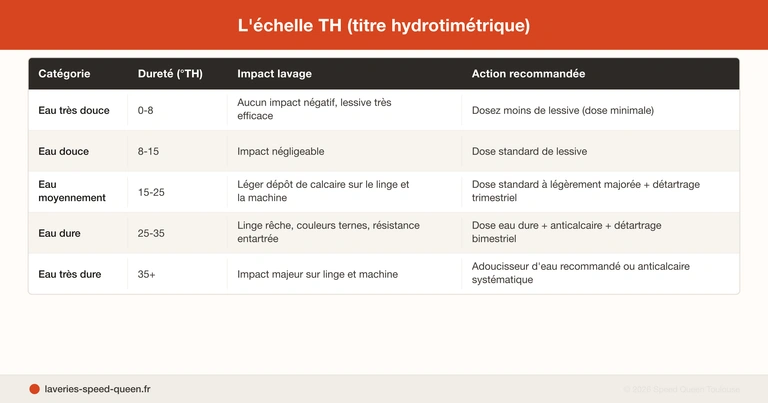
Water hardness is commonly expressed in mg/L of calcium carbonate (CaCO3) or in various national degree scales.
| Category | Hardness (mg/L CaCO3) | Impact on laundry | Recommended action |
|---|---|---|---|
| Very soft | 0-60 | No negative impact, detergent very effective | Use less detergent (minimum dose) |
| Soft | 60-90 | Negligible impact | Standard detergent dose |
| Moderately hard | 90-120 | Slight limescale deposits on fabrics and machine | Standard to slightly increased dose + quarterly descaling |
| Hard | 120-180 | Rough laundry, dull colours, scaled heating element | Hard-water dose + anti-limescale + bi-monthly descaling |
| Very hard | 180+ | Major impact on fabrics and machine | Water softener recommended or systematic anti-limescale |
Where is water hard?
Water hardness varies considerably from one region to another, depending on the geology of the ground.
Soft water (0-90 mg/L)
Regions with granite, schist or volcanic rock. Water passes through rocks low in calcium.
Moderate water (90-120 mg/L)
Mixed geology -- alternating limestone and non-limestone terrain.
Hard water (120-180 mg/L)
Limestone-rich regions -- sedimentary basins that dissolve large amounts of calcium.
Very hard water (180+ mg/L)
The most calcareous areas. Machine maintenance becomes a major concern.
Impact of limescale on laundry
Limescale does not just scale the kettle — it has a direct and measurable effect on wash quality.
Reduced detergent efficiency
Calcium ions in hard water react with the surfactants in detergent to form insoluble salts (calcium soap). These salts do not clean — they are wasted. In hard water (180 mg/L), up to 30-40 % of the detergent is neutralised by calcium before it can act on the laundry.
In practice: with the same detergent dose, washing is significantly less effective in hard water than in soft water. This is why all detergents list two dosages on the packaging (soft water / hard water). For a complete dosing guide, see our article on detergent dosing in the machine.
Effects on fabrics
| Effect | Description | Most affected textiles | Solution |
|---|---|---|---|
| Roughness | Limescale deposits between fibres and stiffens them | Towels, cotton sheets | White vinegar at rinse (50 ml) |
| Dullness | White-grey veil over colours | Dark and coloured garments | White vinegar at rinse + liquid detergent |
| Yellowing | Limescale traps detergent residues, causing progressive yellowing | White laundry, cotton | Periodic sodium percarbonate treatment |
| Reduced absorbency | The limescale film prevents the fabric from absorbing water | Towels, tea towels | 1-hour soak in white vinegar |
| Accelerated wear | Calcified fibres become brittle | All textiles, especially fine cotton | Anti-limescale + adjusted dosage |
If your towels have become rough and poorly absorbent despite regular washing, limescale is likely the cause. See our guide on getting fluffy towels.
For white laundry that has yellowed over time due to limescale, our guide on whitening yellowed laundry details the solutions.
Effects on the washing machine
Scale (solidified limescale deposits) accumulates on three critical areas of the machine:
Heating element
The most affected area. Scale forms an insulating crust around the element -- it must heat longer to reach temperature, using 15-30 % more energy. Eventually it burns out.
Detergent drawer and pipes
Scale reduces water flow in internal pipes and the detergent drawer. Detergent is poorly drawn in, leaving residue in the drawer and insufficient dosage in the drum.
Drum and seals
Scale deposits on the drum create rough spots that can snag delicate fabrics. Scale in the seals promotes mould by creating damp micro-recesses.
Extra energy consumption
A scaled machine uses 15-30 % more energy to heat water. Over a year, that is 20-50 kWh wasted -- EUR 5-15 extra on the electricity bill.
For a complete descaling guide, see our article on descaling a washing machine.
Practical solutions
1. Adjust detergent dosage
This is the first and simplest action. All detergents list a “soft water” and a “hard water” dosage on the packaging. In hard water (120+ mg/L), always use the hard-water dose — roughly 25-50 % more than the soft-water dose.
Caution: increasing the dose does not mean doubling it. Too much detergent creates other problems: residue on fabrics, excess foam, laundry that smells bad after washing. Follow the manufacturer’s table, no more.
Liquid vs powder in hard water: powder detergents often contain built-in anti-limescale agents (zeolites, phosphonates) that make them more effective in hard water than liquid detergents. This is one of the rare cases where powder is objectively superior. To choose the right detergent, see our guide how to choose your detergent.
2. White vinegar at rinse
White vinegar↗ (8-14 % acetic acid) dissolves limescale deposited on fibres and on the machine’s internal walls. Pour 50 ml of white vinegar into the softener compartment at each wash.
Benefits:
- Softer, more supple laundry (limescale is dissolved)
- Brighter colours (the limescale veil is removed)
- More effective rinsing (vinegar removes detergent residue)
- Ongoing machine maintenance (anti-limescale action at every cycle)
White vinegar is a superior replacement for fabric softener — it softens laundry without leaving a chemical film. See our full guide on white vinegar and laundry.
3. Washing soda: a natural anti-limescale
Washing soda (sodium carbonate) softens water by trapping calcium ions. Add 1 tablespoon of washing soda↗ directly in the detergent drawer with your detergent dose.
Advantages:
- Softens wash water, making detergent more effective
- Boosts cleaning power
- Very affordable: EUR 1-2 per kg, about EUR 0.02 per wash
- Compatible with all detergents
This is the most economical alternative to Calgon (5-10x cheaper per wash).
4. Regular machine descaling
Soft water (0-90 mg/L): descale every 6 months -- 1 L white vinegar in an empty cycle at 60 °C.
Moderate water (90-120 mg/L): descale every 3-4 months -- 1 L white vinegar or 100 g citric acid in an empty cycle at 60-90 °C.
Hard water (120-180 mg/L): descale every 1-2 months -- 1 L white vinegar OR 150 g citric acid in an empty cycle at 90 °C.
Very hard water (180+ mg/L): monthly descaling + consider a domestic water softener to protect all appliances.
For a detailed step-by-step protocol, see our guide on descaling a washing machine. For cleaning a detergent drawer clogged with limescale, see cleaning the detergent drawer.
Citric acid vs white vinegar
Citric acid is 2-3 times more powerful than white vinegar for dissolving scale. If your machine is heavily scaled (hard water + neglected descaling), start with a cycle using 150-200 g of citric acid (EUR 3-5 per sachet from a hardware store or online). For regular maintenance, white vinegar is sufficient and cheaper (EUR 0.50-1 per litre).
The laundromat advantage in hard-water areas
If you live in a hard-water area and do not have a domestic water softener, the laundromat offers an often-overlooked benefit.
Professional machine maintenance
In a laundromat, machines are maintained by the operator: regular descaling, heating element replacement, programme calibration. You do not have to manage limescale — it is included in the service.
Automatically dosed detergent
In our Speed Queen laundromats, detergent is automatically dosed by the machine. The dosage is calibrated for the local water hardness — neither too much (residue) nor too little (ineffective wash). This is a significant advantage over manual dosing at home, especially in hard water where dosing errors have a greater impact.
Professional machines built to last
Professional Speed Queen machines are designed to run 15,000-30,000 cycles — far beyond the lifespan of a domestic machine (2,000-5,000 cycles). They are built to withstand the stresses of hard water over the long term.
Mistakes to avoid
- Ignoring your water hardness -- the most common mistake. If your laundry is rough and your machine breaks down often, water hardness is probably the cause. Measure it.
- Massively overdosing detergent -- in hard water you need to adjust the dose, not triple it. Too much detergent leaves sticky residue that attracts dirt and irritates skin. Dosing guide.
- Confusing fabric softener with anti-limescale -- softener coats fibres, anti-limescale treats the water. One does not replace the other. Fabric softener: useful or not?.
- Never descaling -- in hard water, a machine left undescaled for a year may have a heating element coated in 5-10 mm of scale, drastically reducing its efficiency and lifespan.
- Using vinegar AND bleach -- never mix white vinegar and bleach (or any chlorine product). The chemical reaction produces toxic chlorine gas. Bleach and laundry.
- Neglecting the drain filter -- limescale also builds up in the filter. A clogged filter reduces water drainage and causes odours. Drain filter guide.
Limescale and sensitive skin
Limescale deposited on laundry can irritate sensitive skin and worsen eczema. Micro-crystals of limescale in fibres create mechanical friction on the skin. If you or your children have sensitive skin and your water is hard, white vinegar at rinse is essential to dissolve these deposits. See our guide on
washing and sensitive skin/eczema
.
As an Amazon Associate, we earn a small commission on purchases made via the affiliate links in this article — at no extra cost to you. This helps us maintain this site and produce free guides.
Fed up with limescale on your laundry? Our laundromats in Blagnac, Croix-Daurade and Montaudran feature professional Speed Queen machines that are regularly maintained and descaled — detergent automatically dosed for the local water hardness. Payment CB sans contact ou espèces. See our prices.
Limescale and drying: an overlooked impact
Limescale does not only affect washing — it also impacts drying. Fibres loaded with limescale deposits dry more slowly because the mineral film hinders the natural evaporation of water. In practice, a towel washed in hard water without vinegar takes 15-20 % longer to dry than one washed in soft water or rinsed with vinegar.
This drying slowdown has an indirect consequence: laundry that dries slowly is more exposed to the bacteria responsible for musty odours (notably Moraxella osloensis). If your laundry smells “off” despite a correct wash, limescale may be the indirect cause — fibres stay damp too long and bacteria multiply.
The solution is twofold: white vinegar at rinse to dissolve limescale on fibres, and thorough tumble drying when possible. Professional dryers in a laundromat are particularly effective because their heating power compensates for the slowdown caused by residual limescale deposits.