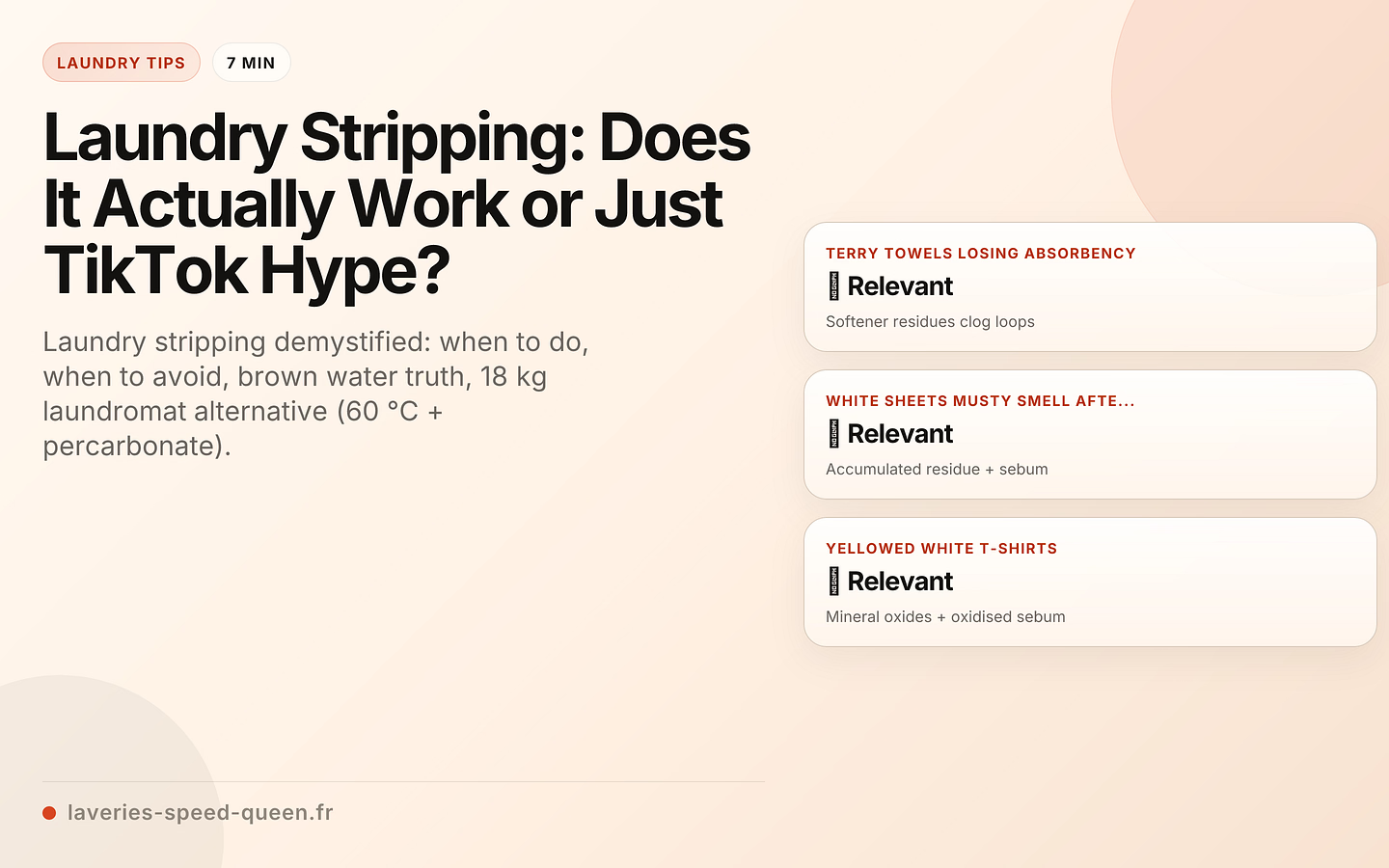
In short: laundry stripping is a viral TikTok protocol that soaks laundry in hot water with percarbonate + washing soda↗ + detergent for 4-6 hours. Water turns brown (accumulated residues across cycles) — hence the virality. Useful on white towels, sheets, yellowed whites that no longer respond to standard washes. Avoid on delicate textiles, bright colours, or more than 1-2 times per year. Simpler laundromat alternative: 60 °C (140 °F) + percarbonate on an 18 kg machine, same effect without the bathtub.
At a glance
Stripping = 4-6 h soak in hot water + percarbonate + washing soda + detergent.
Brown water = residues (detergent + softener + sebum + limescale), not invisible dirt.
Pertinent on terry towels, sheets, yellowed whites (max 1-2 times/year).
Banned on silk, wool, viscose, elastane, bright coloured textiles.
18 kg laundromat alternative: 60 °C (140 °F) + percarbonate (1/2 cup) long cycle — same effect, easier.
What is laundry stripping?
Laundry stripping is a protocol that exploded on TikTok between 2020 and 2024, then resurfaced in 2025-2026 with #LaundryStripping (hundreds of millions of views). The principle:
- Soak already machine-washed laundry in a bathtub or large basin of hot water
- Add percarbonate + washing soda↗ + detergent
- Let act 4-6 hours
- Observe brown water (viral visual)
- Rinse in machine
Visual hook: the water changing colour “proves” the laundry was dirty. The truth is more nuanced.
The brown water truth
Per independent analyses from USA Today Reviewed, Good Housekeeping and the American Cleaning Institute, brown water is not “invisible deep dirt”. It is a mix of:
Detergent residue
Surfactants unrinsed across cycles, accumulated in fibres. More marked with chronic overdosing or hard water (limescale).
Softener residue
Cationic waxy film deposited to 'soften' and scent. Accumulates, masks terry towel absorbency.
Sebum and skin cells
Mostly on sheets and towels — normal accumulation not always evacuated in standard cycles.
Limescale and minerals
Hard water (Toulouse-Blagnac = moderately hard, 20-30 °f) deposits iron/manganese oxides over time.
Plainly: your laundry wasn’t “dirty”. It was clean, but saturated with chemical and mineral residues that accumulate with repeated use, especially in hard water or with detergent overdosing.
Industry position
The American Cleaning Institute recognises stripping as a useful method for removing certain accumulated residues, but advises caution on delicate textiles and insists brown water is not proof of poor laundry hygiene.
When to do, when to avoid
| Case | Verdict | Why |
|---|---|---|
| Terry towels losing absorbency | ✅ Pertinent | Softener residues clogging the terry loops |
| White sheets persistently musty after wash | ✅ Pertinent | Accumulated residues + sebum masking odour bacteria |
| Yellowed white T-shirts not responding to washes | ✅ Pertinent | Mineral oxides + oxidised sebum |
| Baby laundry | ⚠️ Avoid | Too aggressive for sensitive skin — prefer percarbonate alone at 60 °C / 140 °F |
| Bright coloured clothes | ❌ Banned | Percarbonate may progressively fade |
| Silk, wool, viscose | ❌ Banned | Animal/natural fibres attacked by hot alkali |
| Elastane (leggings, sports bras) | ❌ Banned | Elasticity deterioration |
| Already faded / old laundry | ⚠️ Think twice | Stripping does not restore colour, may accelerate end of life |
Step-by-step (bathtub)
Preparation
- Machine wash first (normal cycle). Stripping is done on clean laundry, to remove residues, not raw dirt.
- Check care label: if cuvette + 60 °C / 140 °F is not authorised, do not strip.
- Sort: strip robust whites/cotton together, never with coloured or delicate.
Base recipe
sodium percarbonate↗ — for a standard bathtub (~150 L / 40 gal):
washing soda↗ — - 1/4 cup sodium percarbonate↗ (~50 g / 1.8 oz) - 1/4 cup washing soda↗ (sodium carbonate, ~50 g / 1.8 oz) - **1/4 cup standard
liquid detergent
↗** (~50 mL / 1.7 fl oz) - Hot water 50-60 °C / 120-140 °F (max textile-tolerated temperature)
Soaking
Submerge laundry completely, stir with a long stick or spoon. Cover the bathtub with a large sheet if possible (limits heat loss). Let act 4-6 hours. Stir every 1-2 hours.
Water will gradually go from clear to beige, then brown depending on initial laundry state. Normal.
Rinsing and finishing
Drain laundry without wringing (fibre is weakened by hot alkali). Transfer directly to the machine. Run a rinse-only cycle (no detergent, no softener) to evacuate alkaline residue.
Air dry. First use post-stripping: run a normal cycle + detergent before final use, to eliminate any residue.
Laundromat 18 kg alternative
Stripping without bathtub: 18 kg machine
An 18 kg machine on a long 60 °C / 140 °F cycle + 1/2 cup percarbonate in the drum does the same work as 4-6 h bathtub soaking, without the constraints:
- No bathtub tied up for 4-6 hours
- No heavy wet laundry handling
- Water volume optimised by the machine
- Automatic agitation throughout (equivalent to manual stirring)
For heavily loaded white towels: 90 °C / 194 °F + percarbonate in an intensive programme remains unbeatable and not available on standard domestic machines. Cycle 30 min + drying, total 1 h without intervention.
Limits and risks
- Maximum 1-2 times per year per textile — beyond that, fibres weaken and laundry loses lifespan.
- No silk, wool, viscose, elastane — delicate fibres attacked by hot alkali (percarbonate + washing soda).
- No bright colours — percarbonate may progressively fade, especially in repetition.
- No baby laundry — too aggressive for sensitive skin. Prefer percarbonate alone at 60 °C / 140 °F in machine.
- Long-term overdosing risk — if you do stripping regularly, you're probably overdosing detergent or softener. Cause (overdose) > effect (stripping).
Common mistakes
- Stripping dirty laundry -- stripping removes residues, not raw dirt. Machine wash first, strip after.
- Mixing whites and colours in the bath -- guaranteed fading on colours.
- Wringing laundry after soaking -- fibre weakened by hot alkali. Gentle draining.
- No machine rinse after -- alkaline residues can irritate skin on first wear.
- Trusting the brown water as proof of dirt -- it's TikTok marketing. These are residues, not dirt.
Read also: percarbonate for laundry, whiten yellowed laundry naturally, washing soda for laundry.
Related articles
For more depth, see also:
As an Amazon Associate, we earn from qualifying purchases through the affiliate links in this article — at no extra cost to you. This helps us maintain this site and produce free guides.