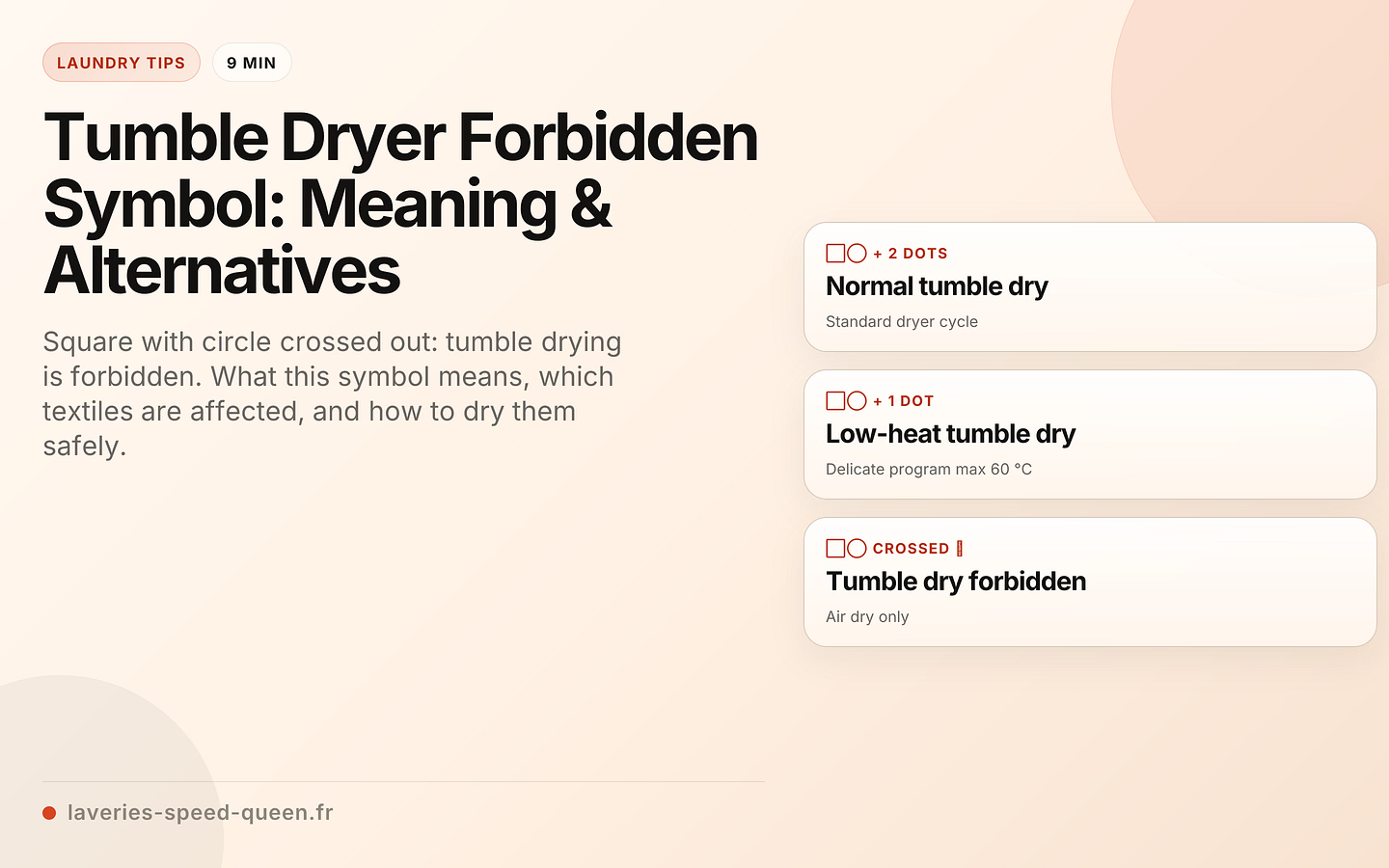
In short: the tumble dryer forbidden symbol is a square containing a crossed-out circle. It means no tumble drying is allowed. Check this instruction on every garment, especially knitwear, silk, stretch items and lingerie. The material alone does not replace the label. The right alternative is air drying, flat or hanging as shown on the label.
At a Glance
Square + circle crossed out — tumble drying forbidden, no exceptions.
1 dot ≠ forbidden — a single dot allows tumble drying at low temperature.
Read the entire square — the label often specifies whether the garment should dry flat or hanging.
Avoid direct heat on wool — Woolmark recommends keeping wool jumpers away from radiators and direct sunlight.
What Exactly Does the Tumble Dryer Forbidden Symbol Mean?
The symbol to recognise is simple: a square with a circle inside, crossed out by an X. Visually, picture a circle inscribed in a square, with a cross striking through the whole thing. The square represents the “drying” category in the GINETEX standard (ISO 3758). The circle inside specifically designates the mechanical drum (tumble dryer). The cross means the operation is prohibited. This pictogram forbids tumble drying regardless of the machine’s heat setting.
The symbol not to confuse
 The
crossed-out circle completely prohibits the drum. By contrast, a circle with a
dot allows tumble drying at low temperature. These two instructions
therefore call for different choices.
The logic works as follows:
- square = drying instruction family;
- circle inside the square = mechanical drum;
- cross = operation prohibited.
The 5 Drying Symbols Explained
The crossed-out square is just one symbol in the “drying” family. To fully understand what the label is telling you, here are the five square pictograms and their precise meanings according to the GINETEX / ISO 3758 standard.
1. Square with circle and two dots: tumble dry normal temperature
The garment permits tumble drying at normal temperature, within the 80 °C (176 °F) limit defined for this symbol. This refers to the drying air, not a temperature to select at random on every machine. Also follow the appliance manufacturer’s programme instructions and the other care-label instructions.
2. Square with circle and one dot: tumble dry low temperature
Tumble drying is allowed with reduced thermal action, within the 60 °C (140 °F) limit defined for this symbol. Choose the gentle programme compatible with the garment’s instructions. Do not confuse it with the crossed-out symbol: one dot permits gentle drying; a cross forbids tumble drying.
3. Square with crossed-out circle: tumble dryer forbidden
This is the main topic of this article. Tumble drying is completely forbidden regardless of temperature. No “delicate” or “cool air” programme makes the tumble dryer acceptable when this symbol is present.
4. Square with horizontal line: flat drying
This symbol requires laying the garment on a flat surface to dry. Woolmark recommends this method for wool jumpers in particular, unless their label permits tumble drying. Hanging wet knitwear can distort it under the weight of the water: laying it flat limits that tension.
5. Square with vertical line: line drying
The garment must dry on a line or a suitable support according to the manufacturer’s instructions. This symbol indicates the drying method; on its own, it does not tell you whether the fabric can withstand pegs or which hanger shape to use. Arrange the garment without squeezing it or leaving it in a heap.
Combined symbols
Drying symbols can be combined with other indicators: diagonal lines in the corner mean “in the shade” (no direct sunlight). So you may see a square with a horizontal line AND diagonals = flat drying, in the shade. For the full breakdown, see our complete care label guide.
Why Some Garments Forbid Tumble Drying
Wet knitwear can lose its shape
Woolmark recommends drying wool jumpers flat to limit stretching under the weight of the water, unless the label permits tumble drying.
The label takes priority over the programme name
A programme named delicate does not lift the tumble-drying prohibition on the care label.
Garment construction matters
An instruction can concern the whole item, including its prints and attached parts. Check the finished garment's instructions.
Shade may be part of the instruction
The diagonal line added to the natural drying symbol requires shade drying.
Which Garments Need a Careful Check?
| Textile or garment | Point to check | If natural drying is required |
|---|---|---|
| Wool, cashmere, knits | The garment label and the shape of the knit | Flat drying |
| Silk | Drying and sunlight instructions | Air drying, in the shade |
| Garments with elastane | Instructions for the fibre blend | Flat or hanging as shown on the label |
| Printed or thermally bonded items | The marking manufacturer’s instructions | Air drying |
| Lingerie and very fine items | Construction, cups and fragile parts | Flat or gentle line drying |
Guidance by Garment Type
These examples help you prepare your sorting; they do not replace the label. The same fibre name can cover different constructions and finishes. Read the instructions for the complete garment before choosing how to dry it.
Wool and cashmere
Woolmark recommends drying wool jumpers flat unless their label says they can be tumble dried. This exception matters: not all wool garments have the same instructions. For a cashmere jumper, also check the garment’s own instructions. If flat drying is required, place it on a clean towel away from direct heat. See our delicate textiles guide.
Silk
LILYSILK recommends air drying its silk in a well-ventilated place and avoiding direct sunlight. This recommendation does not override a label that forbids tumble drying. For your scarf or shirt, follow the method for that item: hanging or flat as instructed by the manufacturer.
Garments with elastane (Lycra, Spandex)
Leggings, swimwear and stretch jeans combine several fibres. LYCRA advises following the clothing manufacturer’s instructions: the presence of elastane is not enough to determine its care. Do not assume that every stretch garment forbids tumble drying or that a low temperature makes it compatible. If the label requires natural drying, also follow its position and shade instructions. See our anti-shrinkage guide.
Leather and faux leather
A leather or faux leather garment is not treated like a t-shirt. Check its instructions before any washing, spinning or drying; some items require professional care. If they permit natural drying, use the position and support indicated by the manufacturer. Do not try tumble drying to save time when its symbol is crossed out.
Printed and thermally bonded items
A design alone does not tell you whether a garment can be tumble dried. Some marking services, such as the Decathlon service cited in the sources, explicitly prohibit tumble drying. Check both the garment instructions and those for the added marking. If tumble drying is forbidden, follow the natural drying method required.
Fine lingerie and lace
Triumph advises against tumble drying its bras and recommends air drying. For your other lingerie, follow the label rather than generalising to all lace. Arrange the item without compressing the cups or pulling the straps, according to the drying method required by its manufacturer.
How to Dry Without a Tumble Dryer Without Damaging the Garment
The safest approach is to follow not only the drum prohibition but also the form of the square that remains on the label. A horizontal line means flat drying; a vertical line means line drying; a diagonal line in the corner specifies shade drying.
| Symbol | What to do | Typical case |
|---|---|---|
| Lay the garment on a flat surface or a net | Wool, cashmere, heavy knits |
| Dry on a line or hanger | Shirts, dresses, structured items |
| Hang while still wet, without prior spinning | Very wet delicate items |
| Avoid direct sunlight and UV | Silk, black garments, sportswear, elastane |
Do not wring (supplementary manufacturer instruction) | Do not twist the garment to extract water | Knits, viscose, silk |
 Flat
 Hanging
 Drip dry
 In the shade
Quick Decision: What to Do After the Crossed-Out Symbol?
| If you see… | Then do… | Mistake to avoid |
|---|---|---|
| Square containing a crossed-out circle, with no other instruction | No drum, natural drying | ”Just a quick pass” in the tumble dryer |
| Square with crossed-out circle + flat drying | Flat drying | Hanging a heavy wet jumper |
| Square with crossed-out circle + line drying | Line drying | Piling it on a radiator in a heap |
| Square with crossed-out circle + shade drying | Dry in the shade | Direct sunlight on silk, black, or sportswear |
| Delicate textile + do not wring | Towel + gentle pressing | Wringing the garment to speed things up |
Spin without force — follow the garment's programme and spin instructions; for drip drying, do not spin it beforehand.
Lay knits flat — hanging wet knitwear can stretch it under the weight of the water; follow the label.
Hang structured items — use a hanger or line when the label requires this drying method.
Ventilate the room well — especially if you are drying indoors.
What to Do When the Tumble Dryer Symbol Is Forbidden?
When the label bears the square with a crossed-out circle, tumble drying is out. But several alternatives allow efficient drying without damaging the textile.
Flat drying suits wool jumpers when their label requires natural flat drying. Woolmark suggests a clean, pale, lint-free towel; a horizontal mesh support can also hold the garment. Gently reshape the item without stretching it. Check it during drying and let air circulate around it.
A horizontal mesh support is useful for laying a jumper flat when its label requires it. A clean towel on a flat surface remains an option without buying anything. Before choosing, measure the available space: the support takes up room during drying and is unsuitable for an item too large for its surface.
A standard drying rack↗ holds garments whose label permits hanging to dry. Use padded hangers for fragile shoulders. Avoid pegs on visible areas — they leave marks on damp fabrics.
Shade drying is required if a diagonal line accompanies the natural drying symbol. For its silk, LILYSILK also recommends avoiding direct sunlight, which can damage fibres and fade colours. Place the garment in a shaded location consistent with its label.
Indoors, ventilation is key. Open a window or place a fan nearby. Drying in a closed, humid room slows evaporation and can cause a musty smell on the laundry.
Pro Tip: The Towel Technique
When tumble drying is forbidden, the right shortcut is not to cheat with the drum — it is to remove excess water before the drying rack↗.
Absorb Excess Water with a Towel
Spread a large clean towel, place the garment on it, roll the whole thing up without wringing the fibre, then press gently with your hands. The towel absorbs some residual moisture. Keep your movements gentle and follow any instruction requiring drying without prior spinning.
This method is especially useful for:
- wool jumpers;
- garments whose instructions allow this gentle pressing;
- items that then need to dry flat;
- garments washed in winter and dried indoors.
Mistakes to Avoid
- Confusing crossed-out circle with 1 dot — a dot allows tumble drying, the cross forbids it.
- Placing on a very hot radiator — that is not 'no tumble dryer', it is often another form of overheating.
- Hanging a wet jumper — the weight of the water can stretch the knit.
- Ignoring the other square symbols — the drum prohibition does not yet tell you whether to dry flat or on a line.
Methodology and Sources
The symbol interpretation is based on international textile care coding and the uses described by appliance manufacturers. This article deliberately distinguishes between tumble-drying prohibition and the natural drying method, because the prohibition alone does not specify how to position the garment.
- GINETEX: care symbols, accessed 5 October 2026.
- Woolmark: drying wool, accessed 5 October 2026.
- LILYSILK: drying silk, accessed 5 October 2026.
- LYCRA: care instructions, accessed 5 October 2026.
- Decathlon: care of the cited marking, accessed 5 October 2026.
- Triumph: bra care and drying, accessed 5 October 2026.
- Internal reference: complete care label guide.
As an Amazon Associate, we earn from qualifying purchases through the affiliate links in this article — at no extra cost to you. This helps us maintain this website and produce free guides.
If the care label permits machine washing, bring this item to our two open laundromats: Blagnac Andromède and Toulouse Croix-Daurade. Both sites have 9 kg (20 lb) and 18 kg (40 lb) washers; the 11 kg (24 lb) washer is available only at Croix-Daurade. Detergent and softener are included. Check the care label before choosing a compatible programme on site. See our prices.