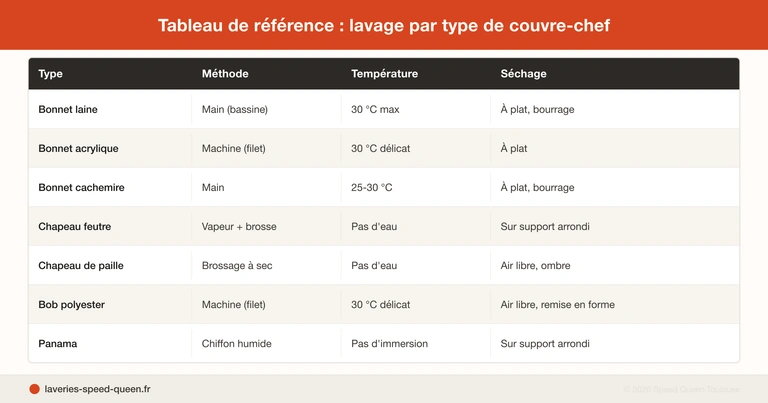
In short: each beanie and hat has its own method. Wool beanie: hand wash 30 °C, dry flat with stuffing. Acrylic beanie: machine 30 °C in a mesh bag. Straw hat: never use water, dry brush only. Felt: steam + brush. Polyester bucket hat: machine 30 °C in a mesh bag.
At a glance
Check the label — the material dictates everything: no water for straw, hand wash for wool, machine for acrylic.
30 °C maximum — no beanie or hat requires a higher temperature.
Mesh laundry bag for the machine — protects the shape and limits friction in the drum.
Dry with stuffing — a rolled towel inside keeps the shape during drying.
Never tumble-dry — heat distorts all headwear, especially wool and felt.
Why beanies and hats need special treatment
Beanies and hats are not like other garments. They have a three-dimensional shape that a standard wash can destroy in minutes. Jeans bounce back after spinning — a misshapen beanie or crushed hat never fully regains its original form.
Three factors make these items vulnerable:
- Structured shape: hats (felt, straw, panama) are moulded or woven to hold a rigid form. Water and mechanical agitation break this structure.
- Sensitive fibres: wool felts under heat and friction, straw swells and warps on contact with water, felt loses its density if soaked.
- Non-textile parts: visors, leather sweatbands, ornaments — these elements cannot withstand the same treatment as the main fabric.
Understanding the care label symbols on the tag is the first step for any headwear.
Reference table: washing by headwear type
| Type | Method | Temperature | Drying | Frequency |
|---|---|---|---|---|
| Wool beanie | Hand (basin) | 30 °C max | Flat, stuffed | Every 2 weeks |
| Acrylic beanie | Machine (mesh bag) | 30 °C delicate | Flat | Every 2 weeks |
| Cashmere beanie | Hand | 25-30 °C | Flat, stuffed | Every 2-3 weeks |
| Felt hat | Steam + brush | No water | On rounded support | As needed |
| Straw hat | Dry brushing | No water | Air-dry, shade | As needed |
| Polyester bucket hat | Machine (mesh bag) | 30 °C delicate | Air-dry, reshape | After each heavy use |
| Panama | Damp cloth | No immersion | On rounded support | As needed |
| Cotton cap | Hand or machine (mesh bag) | 30 °C | On upturned bowl | Every 2 weeks |
For a dedicated cap guide, see our article washing a cap.
Wool beanie: step-by-step hand washing
Wool is a protein fibre made of keratin. Its microscopic scales open under heat and moisture — if they interlock through friction, that is felting, an irreversible shrinkage. For a wool beanie, hand washing remains the safest method.
Fill a basin with warm water (30 °C max) — no hotter. The difference between 30 and 40 °C can be enough to trigger felting on fine wool.
Add a wool-specific detergent — free from protease enzymes that degrade keratin. One teaspoon is enough for a basin.
Submerge the beanie and press gently — use slow pressing motions. Do not rub, wring or pull on the stitches.
Soak for 10 minutes maximum — prolonged soaking weakens fibres and encourages felting. Wool absorbs water quickly.
Rinse at the same temperature — a thermal shock (hot then cold water) causes felting. Rinse at 30 °C, change the water 2-3 times.
Blot in a terry towel — lay the beanie flat in the towel, roll it up and press gently. Never wring wool.
Drying a wool beanie
This is the critical step. A wet beanie laid flat without support will flatten and lose its rounded shape. The solution:
- Stuff the inside with a rolled towel or an inflated balloon the size of your head.
- Place the stuffed beanie on a dry towel, flat, away from any heat source.
- Turn it over halfway through drying so air circulates on both sides.
- Allow 12 to 24 hours of drying depending on wool thickness.
For more on shrinkage risk, see our guide preventing shrinkage.
Merino or cashmere beanie
Merino or cashmere beanies are washed exactly like a standard wool beanie, but with even more care: water at 25-30 °C max, wool/silk-specific detergent, zero friction. Cashmere is finer (14-16 microns vs 20-40 microns for standard wool) and therefore more vulnerable. See our full guide to
washing wool without felting
.
Acrylic beanie: machine washing
Acrylic is a synthetic fibre that mimics wool but does not felt. It is the easiest beanie to care for — and the most common in shops.
In the machine
Place the beanie in a mesh laundry bag. Delicate or synthetics programme at 30 °C. Standard liquid detergent. Spin at 600 rpm max. Acrylic dries quickly and does not distort in the drum.
Detergent and softener
Acrylic handles most liquid detergents. Softener is possible but not essential — it adds a soft feel but can attract static. For more: softener, useful or not?
Drying
Flat on a towel or on an airer. Tumble-drying is not recommended: heat does not felt acrylic, but it can soften the synthetic fibres and permanently distort the beanie.
Static electricity
Acrylic is particularly prone to static in winter. A white vinegar rinse (1 tablespoon in the final rinse) can help reduce the problem.
Straw hat: never use water
A straw hat is not washed. Straw (whether wheat, raffia or woven paper) is a rigid plant material that reacts very badly to water. When wet, straw swells, softens and warps — and as it dries, it hardens in its new twisted shape.
Routine care
- Regular brushing: use a soft-bristle brush (clothes brush or soft toothbrush) to remove dust from the weave.
- Gentle vacuuming: the brush nozzle of your vacuum, set to minimum power, removes dust effectively without risking damage.
- Airing: after each wear, leave the hat in the open air (not in direct sunlight) to let sweat evaporate.
Stains on straw
- Light stain: dab with a barely damp cloth (wrung out thoroughly). Dry immediately with a hairdryer on low heat, held 20 cm away.
- Stubborn stain: mix baking soda↗ with a few drops of lemon juice to form a paste. Apply to the stain, let dry completely, brush off. This method works on most organic stains without deeply wetting the straw.
- Sweat stain on the inner band: the sweatband (often cotton or synthetic) is the only part you can clean with water. Dab with a cloth soaked in diluted white vinegar↗.
- Never immerse — straw warps irreparably on prolonged contact with water.
- Never machine-wash — the woven structure will not survive drum agitation.
- Never expose to prolonged direct sunlight — straw yellows and becomes brittle under intense UV.
- Do not lay wet flat — if the hat was caught in rain, place it on an upturned bowl to hold the shape while drying.
Felt hat: steam and brush
Felt is compressed and matted wool — the fibres have already undergone controlled felting to create the material. Water and excessive heat risk continuing this felting uncontrollably, distorting the hat.
Routine care
- Brush in the direction of the nap with a soft-bristle brush (hat brush or clothes brush). Always in the same direction, usually anticlockwise.
- Use steam to refresh the felt: hold a garment steamer or kettle steam 15 cm from the hat. Steam softens the fibres without wetting them.
- Brush again after steaming to smooth the nap.
Stains on felt
- Fresh stain: dab immediately with a dry cloth to absorb. Never rub — you will push the stain deeper.
- Dry stain: dab with a very slightly damp cloth. Steam-dry and brush.
- Grease stain: sprinkle with fuller’s earth↗, let absorb for 2-3 hours, brush off. Fuller’s earth is an absorbent clay that draws out grease without water.
Quality felt deserves professional cleaning
If your felt hat is a quality model (Borsalino, Stetson, or local artisan), stubborn stains justify a visit to a professional hatter rather than a risky home clean. The cost is modest compared to the hat’s price and the risk of damage.
Polyester or cotton bucket hat: machine washing
The bucket hat is the easiest headwear to wash. Most bucket hats are polyester, cotton or a cotton-polyester blend — tough materials that handle the machine without issue.
- Mesh laundry bag: place the bucket hat in a bag to protect its shape from rubbing against the drum and other garments.
- Delicate programme 30 °C: sufficient for a lightly worn bucket hat. For a very dirty one (beach, hiking, festival), a normal cycle at 30 °C is fine.
- Standard liquid detergent: avoid powder detergent, which can leave residue in the seams.
- Spin at 600 rpm: higher speeds can distort the hat, especially if it has a rigid structure.
- Drying: reshape by hand straight from the machine. Place on an upturned bowl or stuff with newspaper. Air-dry.
Panama: delicate cleaning
A genuine panama is hand-woven from toquilla fibres (Carludovica palmata), a South American palm. It is not straw but a finer, more supple plant fibre. Its high price (50 to several thousand euros for a fine Montecristi) warrants meticulous care.
Routine care
- Gentle brushing: soft-bristle brush in the direction of the weave.
- Spot cleaning: dampen a clean cloth (not wet, just damp), dab dirty areas. Reshape by hand immediately.
- Sweat stain: mix water and white vinegar (50/50), apply to the inner band with a cloth. Dab, do not rub.
Reshaping
If your panama is slightly misshapen:
- Hold it above kettle steam for 30 seconds (at 15 cm distance).
- Reshape by hand while still warm and pliable.
- Place on a rounded support (upturned bowl of the right size) and let dry completely.
Washing frequency: adapt to the type of headwear
Washing frequency depends on two factors: material and intensity of use. The scalp secretes sebum and sweat — a beanie worn daily in winter absorbs these directly.
| Type | Daily use | Occasional use | Warning sign |
|---|---|---|---|
| Wool/cashmere beanie | Every 2 weeks | Once a month | Odour, felted appearance |
| Acrylic beanie | Every 2 weeks | Once a month | Odour, loss of elasticity |
| Polyester/cotton bucket hat | After each heavy use | Every 3-4 wears | Stains, odour |
| Felt hat | Brush after each use | Monthly steaming | Visible stains |
| Straw hat | Brush after each use | Monthly brushing | Visible dust |
For a full guide on the washing frequency of all garments, see our dedicated article.
Drying: the key to keeping the shape
Drying is the most important step for headwear. Poor drying distorts more than washing itself.
Knitted beanies (wool, acrylic)
Flat on a dry towel, stuffed inside with a rolled towel. Turn over halfway through. 12-24 hours depending on thickness.
Structured hats (felt, panama)
On a rounded support of the right size (upturned bowl, balloon). Never lay flat — the brim warps under the weight of the wet hat.
Bucket hats and caps
Stuff with newspaper or a towel, place on an upturned bowl. Reshape by hand straight out of the wash.
Universal rule
Always air-dry in the shade. Direct sunlight yellows white wool, breaks straw and fades dyes. No tumble dryer — heat distorts everything.
For more on drying techniques, see our complete drying guide.
Stain removal for beanies and hats
The most common stains on headwear are sweat (inner band), makeup (foundation on the brim) and food stains.
Sweat stain
The sweatband is the most exposed area. Sweat salts leave white or yellow rings.
- On a washable beanie: the normal wash is enough. If the rings persist, soak the beanie for 30 minutes in warm water with 2 tablespoons of baking soda per litre.
- On a non-washable hat (felt, straw): dab the band with a cloth dampened with diluted white vinegar (1 part to 2 parts water). For stubborn sweat stains, see our dedicated guide.
Makeup stain
Foundation and sunscreen migrate from the forehead to the hat brim. Dab with a little diluted washing-up liquid, rinse with a damp cloth. See our guide to removing makeup stains.
Grease stain
Fuller’s earth or baking soda sprinkled on, left to absorb for 2-3 hours, then brushed off. Works on all materials without water. For stubborn grease stains, see our grease stain guide.
Storage and preservation
Proper storage extends the life of headwear just as much as proper washing.
Hats: on a hat stand or in a box — never stacked on top of each other, never hung by the brim (guaranteed distortion).
Beanies: folded flat in a drawer — not hung on a hook for months, which stretches the stitches.
Moth protection for wool and cashmere — lavender sachets, cedar wood. Moths attack the keratin in animal fibres.
Dry, airy location — moisture encourages mould on straw and felt, and odours on synthetic fibres.
Wash before long-term storage — sebum residue attracts moths and yellows fibres over time.
Common mistakes to avoid
- Washing a straw hat with water — straw swells, softens and warps irreparably.
- Tumble-drying a wool beanie — heat causes irreversible felting and significant shrinkage.
- Wringing a beanie to squeeze out water — you break the fibres and permanently distort the stitches.
- Washing in hot water (40 °C+) — wool and cashmere cannot tolerate more than 30 °C. Even acrylic distorts at high temperatures.
- Drying on a radiator — direct heat distorts all materials and can yellow wool.
- Rubbing a stain on felt — you push the stain deeper and damage the felt surface. Always dab.
Beanies and hats at the laundromat
Professional laundromat machines are perfectly suited to acrylic, cotton beanies and polyester bucket hats. The advantage of a larger drum: the beanie has space and suffers less friction than in a small overloaded domestic machine.
For wool or cashmere beanies, hand washing remains preferable — even with a wool programme, the professional drum creates stronger agitation than a small domestic machine on such a lightweight item.
As an Amazon Associate, we earn a small commission on purchases made through the affiliate links in this article — at no extra cost to you. This helps us maintain this site and produce free guides.
Our laundromats in Blagnac, Croix-Daurade and Montaudran have professional machines with a 30 °C delicate programme, ideal for bucket hats and synthetic beanies. Payment CB sans contact ou espèces. See our prices.
Sources and references
- Textile care symbols — complete guide
- Washing a cap: complete guide
- Washing a wool jumper without felting
- Preventing shrinkage
- Complete drying guide
- How often to wash clothes
- White vinegar and laundry: uses and limits
- Baking soda and laundry
- Wool felting — irreversible interlocking of keratin scales under heat + moisture + friction
- Toquilla fibre (Carludovica palmata) — material of the genuine panama, a fine and supple plant fibre