In short: Ski clothing should be washed by layer: waterproof membranes (Gore-Tex, etc.) at 30 °C with liquid detergent and no softener or conditioner; fleece at 30 °C on a delicate cycle; merino wool on cold, wool programme. Never use fabric softener on membranes — it clogs the micropores and destroys waterproofing. Wash and dry everything before storing for the season.
At a glance
30 °C delicate cycle for membranes — Gore-Tex, Dermizax, eVent: never above 30 °C, never with fabric softener.
Zero softener on all technical fabrics — it clogs membrane micropores and kills breathability in synthetics.
Low-heat tumble dry for 20 min to reactivate the DWR — moderate heat reactivates the factory water-repellent treatment on membrane jackets.
Merino wool: 30 °C, wool cycle — merino can handle the machine if the programme is right, but not vigorous agitation.
Always store clean and completely dry — sweat and sunscreen degrade technical treatments during summer storage.
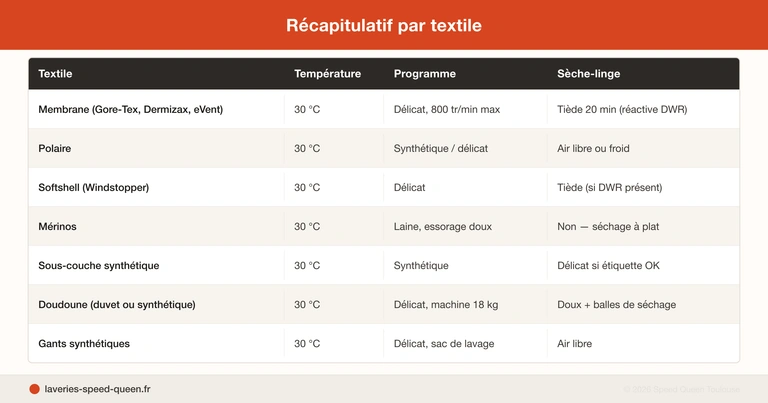
Quick-reference table by fabric
For ski gear, the baseline is 30 °C for almost every piece, with spin speed capped at 800 rpm for membranes.
| Fabric | Temperature | Programme | Tumble dryer | Softener |
|---|---|---|---|---|
| Membrane (Gore-Tex, Dermizax, eVent) | 30 °C | Delicate, 800 rpm max | Low heat 20 min (reactivates DWR) | Prohibited |
| Fleece | 30 °C | Synthetics / delicate | Air-dry or cool | Prohibited |
| Softshell (Windstopper) | 30 °C | Delicate | Low heat (if DWR present) | Prohibited |
| Merino | 30 °C | Wool, gentle spin | No — dry flat | Prohibited |
| Synthetic base layer | 30 °C | Synthetics | Delicate if label allows | Prohibited |
| Puffer jacket (down or synthetic) | 30 °C | Delicate, 18 kg machine | Low + dryer balls | Prohibited |
| Synthetic gloves | 30 °C | Delicate, laundry bag | Air-dry | Prohibited |
| Merino beanie / neck gaiter | 30 °C | Wool, laundry bag | No — dry flat | Prohibited |
| Ski socks (merino/synthetic) | 30 °C | Wool if merino dominant | Air-dry | Prohibited |
Why each ski fabric needs its own protocol
One cycle does not fit all layers: merino felts quickly, fleece loses insulation above 40 °C and membranes clog with softener.
A complete ski outfit layers three fabric types with opposing properties. Each layer serves a precise technical role, and what benefits one can destroy another. For a broader approach, see our complete sports clothing care guide.
Base layer
In direct contact with the skin — merino, polyester or polyamide. Its role: wick sweat away. These fibres work by capillary action, transporting moisture from the skin outward. Fabric softener deposits a greasy film that blocks this mechanism. Merino requires gentle agitation (wool cycle), while synthetics handle a normal cycle.
Mid-layer
Fleece, softshell, lightweight puffer. Its role: insulate by trapping air. Fleece works thanks to its textured structure that creates air pockets. Excessive heat (>40 °C) fuses these microfibres and destroys insulation. High-heat drying is this layer's main enemy.
Outer shell
Jacket and trousers with membrane (Gore-Tex, Dermizax, eVent). Its role: block water and wind while letting sweat escape. The membrane contains billions of micropores 20,000 times smaller than a water droplet but 700 times larger than a vapour molecule. Softener, excess detergent or high heat clog or deform these pores.
Outer shell: membrane jackets and trousers
For a membrane jacket, strictly apply 30 °C on a delicate cycle, then low-heat tumble dry for 20 minutes to restore water repellency.
Gore-Tex, Dermizax, eVent: the membrane protocol
Waterproof-breathable membranes are the most technical — and most expensive — part of ski gear. Gore-Tex explicitly recommends machine washing: contrary to popular belief, not washing your jacket damages it more than washing it. Dirt, sebum and sunscreen embed in the membrane and permanently clog the micropores if not removed.
The protocol is precise. Close all zips, including pocket and vent zips. Fold down the zip flap on the main zip. Detach the snow skirt if removable. Turn the jacket inside out. Wash at 30 °C on a delicate programme with spin limited to 800 rpm max. Standard liquid detergent is fine — no need for special membrane detergent, despite what some care-product manufacturers claim. At a Speed Queen laundromat, the professional detergent is automatically dosed: this is an advantage, because overdosing is the second leading cause of membrane degradation after softener.
Fabric softener destroys membranes
This is non-negotiable. The cationic agents in fabric softener deposit a hydrophobic greasy film on the outer surface of the membrane. This film clogs the micropores responsible for breathability. The jacket remains waterproof (water doesn’t get through), but neither does sweat: you end up soaked from the inside. At Speed Queen laundromats, detergent and softener are dispensed automatically with each cycle — ideal for everyday laundry, but for sensitive technical membranes, consider running a preliminary rinse cycle and using the machine immediately afterwards to minimise softener residue.
For ski trousers with a membrane, the protocol is identical. Close zips, ankle Velcro tabs and waistband press studs. Turn inside out. The inner snow gaiters should be tucked inside the trousers to prevent them catching in the drum.
Reactivating the DWR (Durable Water Repellency)
The DWR is the chemical treatment applied to the outer face of the fabric that makes water bead into droplets instead of soaking into the outer layer. When the DWR wears off, water doesn’t breach the membrane — you stay dry — but the outer fabric absorbs water, the jacket becomes heavy and cold, and breathability drops because condensation forms on the outside of the membrane.
Low-heat tumble dry, 20 minutes
After washing, place the jacket in the tumble dryer on a low-heat setting (not hot) for 20 minutes. Moderate heat reactivates the factory DWR by realigning the fluoropolymer coating molecules. Most people skip this step, yet it makes all the difference. Professional tumble dryers at laundromats are ideal: their temperature control is more precise than domestic appliances.
Bead test
After drying, pour a few drops of water on the fabric. If they bead up and roll off, the DWR is working. If the water spreads and wets the fabric, the original DWR is spent and you need to re-proof.
Re-proofing if needed
Two options: waterproofing spray (Nikwax TX.Direct Spray-On, Grangers Performance Repel) applied to the clean, dry garment, or wash-in (Nikwax TX.Direct Wash-In) added during a rinse cycle. After application, tumble-dry on low heat for 20 minutes to activate the new treatment. Re-proofing is generally needed after 15-20 washes or when the bead test fails despite tumble drying.
Mid-layer: fleece and softshells
Wash fleece and softshells at 30 °C inside out, without softener, to preserve the insulating microfibres and water-repellent finishes.
Fleece is a textured polyester whose thermal efficiency depends on the micro-pockets of air trapped between fibres. Anything that flattens or fuses these fibres reduces insulation. Wash at 30 °C on a synthetics or delicate programme, inside out, no softener. Normal spin is acceptable — fleece dries very quickly anyway.
Softshells (supple jackets with integrated membrane, such as Schoeller or Windstopper) are washed like rigid membranes: 30 °C, delicate programme, no softener. Their outer layer often has a DWR that benefits from the same low-heat tumble-dry as hardshells.
For a complete fleece care guide, see our dedicated article: how to machine-wash a fleece blanket. The same principles apply to ski mid-layers: no heat, no softener, turn inside out. For ski puffer jackets, see our complete puffer jacket washing guide.
End of season is the ideal time to wash your ski fleeces along with the rest of your technical fabrics. A thorough wash before storage removes sweat salts that, over several months, degrade the polyester fibre structure and reduce insulating power.
Base layers: merino and synthetic thermals
Treat merino on a wool programme at 30 °C with gentle spin at 400-600 rpm, and wash synthetic base layers at 30 °C on a synthetics cycle.
Base layers sit closest to the skin: they accumulate the most sweat, sebum and bacteria. Washing them is the priority at season’s end. But merino and synthetics are not washed the same way at all. For a broader approach to sportswear care, see our complete sportswear care guide. You can also consult our coat and parka washing guide for non-membrane outer layers.
Merino wool: wool programme, 30 °C
Merino is a natural fibre whose surface scales lock together under heat and mechanical agitation — this is felting. Use the wool programme: it reduces drum speed and extends pauses between agitation phases. 30 °C max. Merino is naturally antibacterial thanks to residual lanolin, but at season's end a wash is essential to remove accumulated salts and sebum. Very gentle spin (400-600 rpm). Flat drying recommended — the tumble dryer distorts merino knit even at low temperature.
Synthetic (polyester, polyamide): 30 °C synthetics programme
Synthetic base layers are mechanically tougher but trap odours in their porous structure. Wash at 30 °C on a synthetics programme, inside out. Normal spin is fine. Tumble-dry on delicate if the label allows. The advantage of professional machines at a laundromat: their larger water volume rinses bacteria embedded in synthetic fibres more effectively — this is the weak point of domestic machines for this type of fabric. See our guide on [sportswear care](/blog/entretien-vetements-sport/) for details.
An important point for merino/synthetic blends (very common in ski base layers: 60% merino, 40% polyester): always follow the protocol for the most delicate component. In this case, the wool programme, since merino is the dominant and most sensitive fibre.
Ski puffer jacket: a special case
A ski puffer jacket should be washed in an 18 kg machine at 30 °C, then gently dried with dryer balls↗ until all internal moisture is gone.
A ski puffer jacket — whether filled with natural down or synthetic insulation (PrimaLoft, Coreloft, Thermoball) — requires a large-capacity machine. The filling takes up enormous volume when wet, and a machine that’s too small prevents proper rinsing.
At a laundromat, use the 18 kg machine. Delicate programme, 30 °C, very gentle spin. When drying, add dryer balls to redistribute the filling and prevent clumping. Complete drying is critical: filling that’s still damp will develop mould within days of storage.
Our complete laundromat puffer jacket washing guide details the step-by-step protocol, including the difference between natural down and synthetic fill. If your ski puffer has a waterproof outer membrane, combine the puffer protocol (18 kg machine, dryer balls) with the membrane protocol (no softener, low-heat tumble dry to reactivate the DWR).
Accessories: gloves, beanies, neck gaiters
Wash textile accessories at 30 °C in a laundry bag, but keep helmets and goggles out of the machine — hand-clean only.
Ski accessories are often forgotten at season’s end. Yet they accumulate as much sweat as base layers, concentrated on a small surface area.
Ski gloves. Check the label — many technical gloves (with membrane or leather) cannot be machine-washed. Fully synthetic gloves without a membrane can be washed at 30 °C on a delicate cycle in a laundry bag. Gloves with a Gore-Tex insert follow the membrane protocol. Leather gloves should be hand-cleaned with mild soap and treated with leather cream after drying. See our care label symbols guide to decode the pictograms.
Beanies and neck gaiters. Most are made from acrylic, polyester or merino. Wash at 30 °C in a laundry bag to prevent stretching. Wool programme for merino, synthetics for the rest. Flat drying for merino, delicate tumble dry for synthetics.
Ski socks. Often a merino/synthetic blend with reinforced zones. Turn inside out. Wool programme at 30 °C if merino is dominant. Fully synthetic socks handle the standard synthetics programme. Air-drying is recommended to preserve elasticity.
Helmet and goggles. No machine. Clean the helmet’s inner foam with a damp cloth and mild soap. Clean goggles with a dry microfibre cloth on the outer lens surface — never touch the inner surface (anti-fog coating). Air-dry, open, away from direct sunlight.
Store clean for next season
Before summer storage, every piece must be washed, completely dry and stored in a ventilated area for roughly 6 months of inactivity.
Storage is as important as washing. Technical clothing stored dirty for six months suffers damage that washing cannot reverse in September.
Sweat contains salts and fatty acids that attack fibres and surface chemical treatments. Sunscreen residue — ubiquitous on collars, cuffs and neck gaiters after a week of skiing — contains oil-based UV filters that permanently clog membrane micropores if left to dry and polymerise over months. Sebum and dead skin cells attract moths, which attack merino wool and natural down.
Wash and fully dry every piece before storing. Store in a dry place, away from direct light (UV degrades membranes and DWR). Puffer jackets should be hung or placed in a roomy storage bag — never compressed in a stuff sack for months, as the filling permanently loses its loft. Membrane jackets are stored on a hanger, zips open, to avoid permanent creases on the membrane. ADEME recommends a ventilated storage space to prevent mould growth on textiles.
Mistakes to avoid
- Softener on membranes — clogs micropores, destroys breathability. The damage is cumulative and partially irreversible.
- Washing membranes above 30 °C — heat deforms the membrane's micropores and lifts the seam tape on waterproof jackets.
- Air-drying a membrane jacket without tumble drying — the DWR cannot reactivate without heat. The jacket will be clean but water will no longer bead.
- Storing dirty — sweat, sunscreen and sebum degrade membranes, DWR and merino fibres during summer storage.
- Washing everything together — jacket zips abrade merino base layers. Merino felts if agitation is too intense. Separate the 3 layers into 3 separate washes.
- Compressing a puffer jacket for long-term storage — the filling loses its loft and insulating power if compressed for months.
As an Amazon Associate, we earn a small commission on purchases made through the affiliate links in this article — at no extra cost to you. This helps us maintain this site and produce free guides.
End of ski season? Wash your technical gear before storing it. Our laundromats in Blagnac and Croix-Daurade have machines from 9 à 18 kg with automatically dosed detergent and softener — ideal for most of your ski gear. Professional tumble dryers with temperature control to reactivate the DWR on your jackets. Open 7j/7 de 7h à 22h, payment CB sans contact ou espèces. See our prices.
Methodology and sources
- This content is based on official Gore-Tex care recommendations for waterproof-breathable membranes (gore-tex.com/care).
- Care symbols are interpreted according to the ISO 3758 standard, maintained by GINETEX (lien externe), the international textile care labelling body.
- Data on the environmental impact of washing and storage are based on publications by ADEME (French Agency for Ecological Transition) on textile care.
- Operational protocols are cross-referenced with our internal guides: sportswear care, drying guide and care label symbols.