In a nutshell: Ski suits and jackets are machine washable at 30 °C on a delicate cycle, with liquid detergent and no fabric softener. Softener clogs the membrane micropores and destroys breathability. After washing,
tumble drying on low for 20-30 minutes reactivates the DWR water-repellent treatment
. Re-waterproof every 5-10 washes with a dedicated spray or wash-in product.
At a glance
30 °C, delicate cycle, 800 rpm max spin — check the label, but 30 °C suits virtually all ski suits.
Liquid detergent only — powder clogs membranes and taped seams.
Zero fabric softener — it blocks the membrane micropores. A single wash is enough to compromise breathability.
Tumble dry on low 20-30 min — reactivates the factory DWR. The most important and most overlooked step.
Re-waterproof every 5-10 washes — spray or wash-in (Nikwax, Grangers) when water no longer beads up.
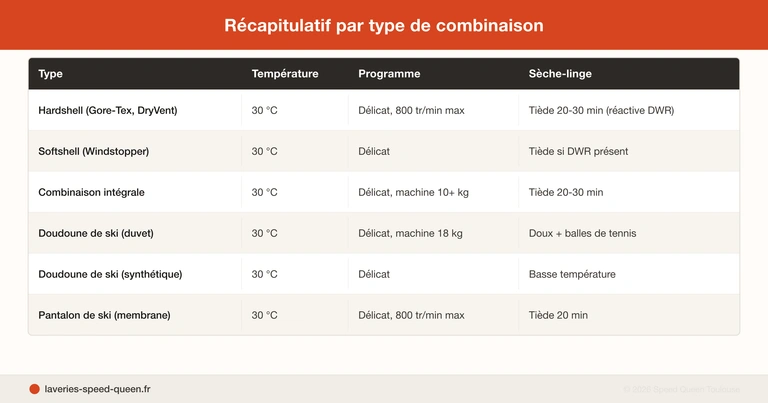
Summary by suit type
| Type | Temperature | Cycle | Tumble dryer | Softener |
|---|---|---|---|---|
| Hardshell (Gore-Tex, DryVent) | 30 °C | Delicate, 800 rpm max | Low 20-30 min (reactivates DWR) | Forbidden |
| Softshell (Windstopper) | 30 °C | Delicate | Low if DWR present | Forbidden |
| One-piece suit | 30 °C | Delicate, 10+ kg machine | Low 20-30 min | Forbidden |
| Ski puffer jacket (down) | 30 °C | Delicate, 18 kg machine | Low + tennis balls | Forbidden |
| Ski puffer jacket (synthetic) | 30 °C | Delicate | Low temperature | Forbidden |
| Ski pants (membrane) | 30 °C | Delicate, 800 rpm max | Low 20 min | Forbidden |
Why washing your ski suit is essential
Not washing your suit damages it more than washing it. Dirt, body oils and sunscreen permanently degrade membranes if left to build up.
It is a persistent myth: many skiers think washing their ski jacket will ruin it. The opposite is true. Membrane manufacturers (Gore-Tex first among them) explicitly recommend regular machine washing. Here is why:
Dirt clogs the membrane
Gore-Tex membrane micropores measure 0.2 microns — 20,000 times smaller than a water droplet. Dust, neck and wrist sebum, and sunscreen residue infiltrate these pores and gradually block them. Breathability drops. Washing clears the pores.
Sweat degrades treatments
Sweat contains salts, urea and fatty acids that chemically attack surface treatments (DWR) and interior finishes. Storing an unwashed suit for 6 months (between seasons) multiplies the damage: acids have time to corrode the coatings.
Sunscreen is aggressive
Chemical UV filters (oxybenzone, octinoxate) in sunscreen are mild solvents that degrade DWR treatments. Sunscreen residue on the collar, cuffs and face area (mask-to-collar transfer) must be removed at the end of the season.
For a comprehensive approach to caring for all ski textiles (base layers, fleeces, merino as well as jackets), see our complete guide to washing ski gear.
Before washing: preparing the suit
Proper preparation takes 2 minutes and prevents problems (broken zip, torn Velcro, damaged membrane).
Close all fastenings
This is the first and most important step:
- Zips: pocket, ventilation and main zips on the jacket; fly and side zips on the pants. An open zip catches on other garments in the drum and can tear fabric or break the slider.
- Storm flap: fold down the flap that covers the main zip. It protects the zip from drum abrasion.
- Velcro: close all cuff and waist Velcro. An open Velcro pad catches fibres from other items and collects lint that reduces grip.
- Snaps: close them to prevent them from hitting the drum.
Turn inside out
Turn the suit inside out to protect the outer face (the one with the DWR treatment). Drum agitation creates micro-friction with other items — by turning inside out, the tougher inner lining takes the friction.
Empty pockets
Check every pocket: ski pass, tissues, ear warmers, energy bars. A laminated ski pass can scratch the membrane. A forgotten tissue disintegrates and covers everything in white fibres.
Machine washing: the protocol
30 °C, delicate cycle, liquid detergent, no softener, 800 rpm max spin. This protocol suits 95% of ski suits.
Temperature and cycle
Why 30 °C and not more:
- Taped seams (seam tape) that ensure seam waterproofing soften above 40 °C. A 60 °C wash can peel these tapes and create leaks.
- Membranes (Gore-Tex, Dermizax, DryVent) are designed to withstand 30 °C without deformation. Above that, micropores can deform irreversibly.
- DWR (water-repellent treatment) is better preserved at low temperatures.
A delicate (or synthetic) cycle is recommended for its gentle agitation and moderate spin. Spin should not exceed 800 rpm — beyond this, centrifugal force can stretch membranes and seams.
Choosing a detergent
Standard liquid detergent
A standard liquid detergent works perfectly. The surfactants lift dirt and grease without attacking the membrane. At a Speed Queen laundromat, the automatically dosed professional detergent is suitable.
Technical detergent (optional)
Nikwax Tech Wash or Grangers Performance Wash are formulated to leave no residue. They are good but not essential — a standard liquid detergent does the same job if rinsing is thorough.
Powder detergent
Powder does not fully dissolve at 30 °C. Undissolved grains become embedded in taped seams and membrane micropores, impairing breathability and waterproofing.
Fabric softener
Fabric softener deposits a greasy film (cationic surfactants) that blocks membrane micropores. The suit stays waterproof but perspiration can no longer escape — you end up soaked from the inside. A single wash with softener is enough to compromise breathability.
Fabric softener destroys membranes
This is the most important point in this article. The cationic agents in fabric softener bind to the membrane micropores and block them. The suit stays waterproof (water does not get in), but perspiration can no longer escape. Result: you are wet from the inside, and you think your suit is “leaking”. At a Speed Queen laundromat, detergent and softener are dosed automatically — for technical membranes, run a pre-rinse to reduce softener residue from the previous cycle.
Extra rinse
If your machine allows it, run an extra rinse cycle. Detergent residue in membranes reduces breathability in the same way as softener (to a lesser degree). A thorough rinse eliminates product traces.
At the laundromat, the professional rinse uses a large volume of water (50-60 litres) that effectively removes residue. This is an advantage over low-water domestic machines that sometimes rinse inadequately.
Drying and DWR reactivation
Tumble drying is not optional — it is the step that reactivates the water-repellent treatment on your suit.
Why the tumble dryer matters
DWR (Durable Water Repellency) is a chemical treatment applied to the outer face of the fabric. It makes water bead into droplets instead of soaking into the outer layer. When the DWR is active, the suit stays light and dry. When it wears off, the outer fabric absorbs water (wetting out), the suit becomes heavy and cold, and breathability drops because condensation forms on the outer side of the membrane.
The moderate heat of the tumble dryer realigns the DWR coating molecules and restores the beading effect. The principle is the same as an iron “activating” a heat-transfer badge.
Drying protocol
Tumble dry on low, 20-30 minutes
Low heat programme (not hot, not intensive). The temperature must stay moderate — too hot damages taped seams and can deform the membrane. 20-30 minutes is enough to reactivate DWR across the entire surface.
Beading test
After drying, sprinkle a few drops of water on the outer fabric. If they bead and roll off, the DWR is working. If the water spreads and wets the fabric, the original DWR is spent — time to re-waterproof.
Alternative: air drying
If the manufacturer advises against tumble drying (rare but possible), air dry on a hanger in a ventilated area. The DWR will not be reactivated — you will need to apply a waterproofing spray more often.
Professional tumble dryers at Speed Queen laundromats provide more precise temperature control than domestic models. This is an advantage for DWR reactivation, which requires moderate and consistent heat.
Re-waterproofing: when and how
Factory DWR wears out after 10-20 washes or 30-50 days of skiing. Re-waterproofing restores the water repellency for several seasons.
When to re-waterproof
The beading test (water drops on the fabric) is the best indicator. If water no longer beads after a low-heat tumble dry, the factory DWR is spent. In practice, re-waterproofing is usually needed:
- After 5-10 washes if the suit is used intensively.
- After 2-3 seasons under normal use.
- Immediately if you notice the outer fabric absorbing water (wetting out) and the suit becoming heavy in rain or slush.
Two methods
| Method | Application | Advantage | Disadvantage |
|---|---|---|---|
| Spray (TX.Direct Spray-On, Grangers) | Spray onto the clean, dry garment | Targeted application (wear zones), quick | Less even coverage, uses more product |
| Wash-in (TX.Direct Wash-In, Grangers) | Add to a rinse cycle in the machine | Even coverage, complete treatment | Also treats inner lining (unnecessary), slower |
After application (spray or wash-in), tumble dry the suit on low for 20 minutes to activate the new treatment. Without this heat step, the product does not bond properly and water repellency will be poor.
By suit type: the differences
The basic protocol is the same for all (30 °C, no softener), but each type has its specifics.
Hardshell Gore-Tex (jacket and pants)
Hardshells are the most technical and most expensive garments. The protocol described in this article applies fully. Key points:
- Gore-Tex recommends machine washing — it is explicit in their care guide.
- Seams are taped (seam tape) — strictly respect the 30 °C limit.
- Low-heat tumble drying is recommended by Gore-Tex to reactivate DWR.
- Standard liquid detergent is sufficient — no need for specialist detergent.
For a detailed guide covering all ski textiles, see our article washing your ski gear.
Softshell (Windstopper, Schoeller)
Softshells are more flexible and more breathable than hardshells, but less waterproof. They often have a light DWR that benefits from tumble dryer reactivation.
- Same protocol: 30 °C, delicate, liquid detergent, no softener.
- Normal spin acceptable (softshell is mechanically tougher than a thin membrane).
- Tumble dry on low if DWR is present, otherwise air dry.
Ski puffer jacket
Ski puffer jackets (down or synthetic fill) have specific drying requirements. The fill tends to clump into wet masses that need to be broken up.
- Washing: 30 °C, delicate, liquid detergent, no softener.
- Drying: tumble dry on a gentle cycle with 2-3 clean tennis balls. The balls beat the jacket and break up fill clumps.
- Machine capacity: a thick ski puffer requires a high-capacity machine (minimum 10 kg, ideally 18 kg) for proper agitation.
For a complete guide, see our article washing a puffer jacket in a machine.
One-piece suit
One-piece suits wash exactly like two-piece sets, with one additional constraint: volume. An adult one-piece suit requires a high-capacity machine to be properly agitated.
- Domestic machine: possible if it holds at least 8-9 kg, but agitation will be tight.
- Laundromat machine: machines of 9 à 18 kg are ideal — the suit has the space needed to move freely in the drum.
Storage between seasons
Proper storage after washing extends the suit’s lifespan by several seasons.
After washing and complete drying (DWR reactivated), store the suit:
On a broad hanger
Hang the suit on a wide-shoulder hanger in a ventilated wardrobe. The membrane needs air to maintain its breathability. Do not compress the suit in a bag or box.
In a dry, temperate space
Avoid attics (excessive summer heat), basements (humidity) and garages (temperature fluctuations, fuel odours). A wardrobe in a living space is ideal.
Not in a sealed plastic bag
A sealed plastic bag traps residual moisture and encourages mould growth. If you need to protect the suit from dust, use a breathable fabric cover.
At a Speed Queen laundromat
High-capacity machines (9 à 18 kg) at our Speed Queen laundromats in Toulouse and Blagnac are ideal for ski suits. The 30 °C delicate cycle with automatically dosed detergent respects membranes. Professional dryers offer precise temperature control for DWR reactivation.
For sensitive technical membranes, run an extra rinse cycle after the main wash to remove as much product residue as possible.
Our laundromats are open 7j/7 de 7h à 22h. Payment by CB sans contact ou espèces.
Common mistakes
- Using fabric softener — blocks membrane micropores. Destroys breathability, even after a single wash.
- Using powder detergent — undissolved grains at 30 °C embed in taped seams and the membrane.
- Exceeding 30 °C (or the label temperature) — taped seams soften and peel above 40 °C.
- Skipping the low-heat tumble dry — without DWR reactivation, the outer fabric absorbs water and the suit loses performance.
- Storing the suit unwashed at the end of the season — sweat and sunscreen degrade technical treatments during summer storage.
- Compressing in a plastic bag — residual moisture encourages mould. Hang on a hanger in a ventilated wardrobe.
As an Amazon Associate, we earn a small commission on purchases made through the affiliate links in this article — at no extra cost to you. This helps us maintain this site and produce free guides.
At a Speed Queen laundromat, high-capacity machines and professional dryers are ideal for ski suits. 30 °C delicate cycle, automatically dosed detergent, temperature-controlled dryers to reactivate DWR. Check our prices or discover our laundromats in Toulouse and Blagnac.
Sources and references
- Gore-Tex, How to wash and care for your GORE-TEX outerwear, gore-tex.com, accessed 23 March 2026
- Nikwax, How to clean and waterproof ski jackets, nikwax.com, accessed 23 March 2026
- Grangers, Ski clothing care guide, grangers.com, accessed 23 March 2026
- ISPO, Membrane care: why washing is essential, ispo.com, accessed 23 March 2026
- Washing your ski gear: the guide by textile
- Washing a puffer jacket in a machine
- Fabric softener: useful or not?
- Sportswear care
- Washing a coat or parka
- Preventing shrinkage in the wash