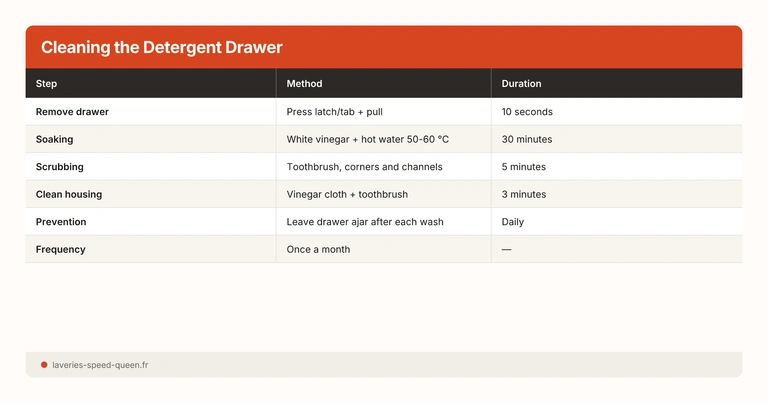
In short: the detergent drawer gets grimy from overdosing detergent, fabric softener residue, and trapped moisture. Remove it (press the latch or tab), soak for 30 minutes in hot white vinegar, scrub with an old toothbrush, and clean the cavity inside the machine. Once a month is enough. To prevent build-up: dose correctly and leave the drawer slightly open after every wash.
Quick Checklist
30-minute white vinegar soak — dissolves limescale, detergent residue and mould.
Scrub corners and channels — an old toothbrush reaches the spots nothing else can.
Clean the cavity too — the drawer isn't the only grimy part; the slot inside the machine is just as bad.
Frequency: once a month — more often if you have hard water or use a lot of fabric softener.
Prevention: leave the drawer ajar — keeping it slightly open between washes stops mould from forming.
Why the Detergent Drawer Gets Grimy
The detergent drawer is one of the most neglected parts of a washing machine. Yet it comes into direct contact with detergent, fabric softener and water — three ingredients that, combined with heat and moisture, create the perfect environment for residue build-up.
The Three Main Causes
1. Overdosing detergent. Most households use 30 to 50% more detergent than the recommended dose. The excess doesn’t fully dissolve and leaves a white or greyish film in the drawer and channels. This film hardens cycle after cycle, forming an increasingly thick crust. For proper detergent dosing, follow the instructions on the packaging — factoring in your water hardness and how soiled the laundry is.
2. Fabric softener. Fabric softener is a viscous emulsion that leaves a greasy film in its compartment. This film traps dust, textile fibres and limescale deposits. The softener compartment is almost always the dirtiest of the three (pre-wash, main wash, softener).
3. Residual moisture. After a cycle, the drawer stays damp. If you close it straight away (as most people do), the moisture can’t evaporate. Within days, mould starts growing in the damp recesses. It’s the same logic as the washing machine door seal: trapped moisture equals mould.
Consequences of a Grimy Drawer
A dirty drawer isn’t just unsightly. Built-up residue can:
- Block drainage channels — detergent no longer flows properly into the drum, reducing wash effectiveness.
- Contaminate your laundry — mould and bacteria from the drawer get carried into the drum with the detergent. This is a common cause of laundry that smells bad after washing.
- Cause overflows — a partially blocked channel forces water back up into the drawer, which then overflows onto the floor.
- Damage the machine over time — residue that builds up in the internal channels may eventually require disassembly to remove.
Removing the Drawer: Brand-by-Brand Guide
All detergent drawers are removable, but the locking mechanism varies between manufacturers.
Samsung
Pull the drawer towards you. Press the blue tab (or the button marked 'PUSH') in the centre of the fabric softener compartment while continuing to pull. The drawer unclips. On recent models (EcoBubble), the tab is sometimes grey.
Bosch / Siemens
Pull the drawer all the way out. Press the plastic latch inside the fabric softener compartment (at the back, small rounded piece), then pull the drawer towards you. On older series, you may just need to pull firmly without a latch.
LG
Pull the drawer towards you. Press the lever marked 'PUSH' in the fabric softener compartment (often blue or transparent). On steam models, the latch may be in the main compartment.
Whirlpool / Indesit
Pull the drawer all the way out, then press the two side tabs while pulling. If your model doesn't have side tabs, look for a button in the central compartment.
Miele
Pull the drawer towards you. Lift the front slightly while pulling. On some models, an unlock button is located underneath the drawer, accessible when pulled halfway out.
Electrolux / AEG / Zanussi
Pull the drawer towards you. Press the 'PUSH' button (usually in the fabric softener compartment) while pulling. The mechanism is similar to Samsung's.
Your model isn't on the list?
The principle is universal: pull the drawer towards you and look for a latch, button or tab in one of the compartments. If nothing works, check your machine’s manual (often available as a PDF on the manufacturer’s website by searching for the model number).
Full Clean: The White Vinegar Method
White vinegar↗ is the most effective product for cleaning a detergent drawer. Its acetic acid dissolves limescale, kills mould and cuts through fabric softener residue. It’s also the safest option — it won’t attack plastic or rubber seals.
What You Need
- A basin or sink
- 200 ml of white vinegar (8-14% acetic acid)
- Hot water (50-60 °C)
- An old toothbrush
- A clean cloth
- Optional: baking soda↗ for stubborn residue
Step by Step
1. Remove the drawer using the method for your model (see above).
2. Soak. Fill the basin with hot water (50-60 °C) and add 200 ml of white vinegar. Submerge the drawer completely. Leave to soak for at least 30 minutes — 1 hour for a heavily encrusted drawer. The acetic acid works during soaking to soften and dissolve the residue.
3. Scrub. Take the drawer out and scrub each compartment with the toothbrush. Focus on:
- The corners and angles — where residue accumulates most.
- The drainage holes (small holes at the bottom of each compartment) — use a toothpick if needed.
- The fabric softener siphon — this small removable piece (on some models) unclips and can be cleaned separately.
4. Stubborn residue. If crusts resist the vinegar, sprinkle baking soda directly onto the encrusted areas, then scrub with the damp brush. The gentle abrasion of baking soda helps dislodge residue mechanically.
5. Rinse. Rinse the drawer thoroughly under clean water.
6. Dry. Wipe with a clean cloth and leave to air-dry completely before putting back.
Cleaning the Drawer Cavity (Inside the Machine)
The drawer is only the visible part. The cavity — the slot into which the drawer slides — collects the same residue, and it’s often even grimier because it’s never cleaned.
How to Clean the Cavity
- With the drawer removed, inspect the cavity with a torch. You’ll likely see detergent residue on the walls, black marks (mould) on the ceiling, and limescale around the water inlet nozzles.
- Soak a cloth in white vinegar and wipe all accessible surfaces — walls, ceiling, floor of the cavity.
- Use the toothbrush for hard-to-reach areas, especially the water inlet nozzles (the small holes through which water enters to flush detergent into the drum).
- Wipe with a clean damp cloth to remove any vinegar residue.
Blocked water inlet nozzles
If the water inlet nozzles (on the ceiling of the cavity) are blocked by limescale, water can no longer flush detergent into the drum properly. The result: detergent stays in the drawer and your laundry doesn’t get washed properly. To unblock the nozzles, soak them with white vinegar and leave for 1 hour, then gently scrape with a toothpick.
Black Residue = Mould: Heavy-Duty Treatment
If your drawer has black, gel-like residue or dark ingrained stains, it’s mould. White vinegar works in most cases, but for stubborn or recurring mould, you can use a stronger treatment.
Option 1: Sodium Percarbonate
Sodium percarbonate releases active oxygen on contact with water, killing mould and whitening surfaces. Dissolve 2 tablespoons of percarbonate in 1 litre of hot water (50-60 °C), submerge the drawer and leave to soak for 1 to 2 hours. Scrub and rinse.
Option 2: Diluted Bleach
For highly resistant mould, bleach is the most powerful disinfectant. Dilute 50 ml of bleach in 1 litre of cold water (bleach is more effective cold). Soak the drawer for 15-20 minutes. Rinse very thoroughly — bleach residue can discolour your laundry on the next wash if rinsing is insufficient.
- NEVER mix vinegar and bleach — the chemical reaction releases chlorine gas (Cl2), which is toxic. If you use both, rinse thoroughly between treatments.
- Wear gloves — even diluted bleach irritates the skin. Concentrated vinegar can too with prolonged contact.
- Ventilate the room — when using bleach, open a window or turn on ventilation.
Prevention: Avoiding Build-Up
Monthly cleaning is the baseline, but prevention significantly reduces how often you need to clean.
Dose your detergent correctly
Overdosing is the number-one cause of build-up. Follow your detergent's instructions, adjusting for water hardness and soil level. See our dosing guide.
Leave the drawer ajar
After every wash, pull the drawer out 2-3 cm so air circulates and moisture evaporates. This is the single most effective way to prevent mould. Same logic applies to the machine door.
Cut back on fabric softener
Fabric softener is the main culprit behind drawer build-up. It's often unnecessary and leaves a greasy film every cycle. If you insist on using it, stick strictly to the recommended dose.
Run a hot empty cycle monthly
Run a cycle at 60-90 °C with nothing in the drum (or add a cup of white vinegar) once a month. The heat and vinegar clean the internal channels, including the drawer's. This also benefits the overall machine clean.
Liquid vs Powder Detergent: Impact on Build-Up
Liquid and powder detergent don’t affect the drawer in the same way:
- Liquid detergent: leaves a viscous film that attracts mould. The drawer needs cleaning more frequently.
- Powder detergent: can leave undissolved granular residue (especially at low temperatures). But powder is less prone to mould because it doesn’t create a damp film.
- Pods/capsules: don’t pass through the drawer (they go directly into the drum). The drawer stays cleaner, but the internal channels can still get clogged if you add fabric softener to its compartment.
For help choosing, see our guide on which detergent to pick.
Recommended Cleaning Frequency
| Situation | Frequency |
|---|---|
| Normal use, soft water | Once a month |
| Heavy use or hard water | Twice a month |
| Regular fabric softener use | Twice a month |
| Visible black residue | Immediately, then switch to monthly |
| Drawer overflowing | Immediately (blocked channel) |
The 3 Compartments: What Are They For?
A standard detergent drawer has three compartments, usually marked with symbols:
- Compartment I (or 1) — Pre-wash. Only used when you select a programme with a pre-wash cycle (very dirty laundry). Rarely used day-to-day.
- Compartment II (or 2) — Main wash. This is where you put your detergent (liquid or powder).
- Compartment with a flower symbol — Fabric softener. Don’t exceed the MAX line. The softener is released during the final rinse.
If you put detergent in the wrong compartment, it will be released at the wrong point in the cycle. Detergent in the softener compartment, for example, won’t be released until the final rinse — meaning your laundry won’t actually be washed.
Connection to Overall Machine Maintenance
Cleaning the drawer is part of a broader washing machine maintenance routine that includes several complementary actions. To keep your machine in good working order, combine drawer cleaning with:
- Cleaning the door seal — same mould issue caused by residual moisture.
- Full machine cleaning — drum, heating element, drain filter.
- Regular descaling — especially in hard water areas.
These four actions combined, carried out monthly, keep your machine in optimal condition and extend its lifespan by several years. They also prevent bad odours — a clean machine produces laundry that smells fresh.
Special Case: Drawer That Won’t Dry (Machine in a Humid Room)
If your washing machine is in a humid room (basement, unheated garage, bathroom without ventilation), the drawer will tend to develop mould faster, even when left ajar. In this case:
- Remove the drawer completely between washes and place it on top of the machine or beside it.
- Wipe the cavity with a dry cloth after every wash.
- Ventilate the room as much as possible — a dehumidifier↗ can help in extreme cases.
As an Amazon Associate, we earn a small commission on purchases made through affiliate links in this article — at no extra cost to you. This helps us maintain this site and produce free guides.
At Speed Queen laundromats, detergent drawers don’t exist: detergent is automatically dosed and injected directly into the drum. Zero residue, zero mould, zero build-up. Our laundromats in Blagnac, Croix-Daurade and Montaudran are open 7 days a week. Payment contactless card or cash. See our prices.
Sources and References
- Deep-cleaning your washing machine
- Cleaning the washing machine door seal
- Descaling your washing machine
- Detergent dosage: complete guide
- Is fabric softener useful?
- Which detergent to choose?
- Laundry smells bad after washing: causes and fixes
- White vinegar and laundry: uses and limits
- Sodium percarbonate for laundry
- Fungal growth in humid environments — conditions for Cladosporium and Aspergillus proliferation in household appliances