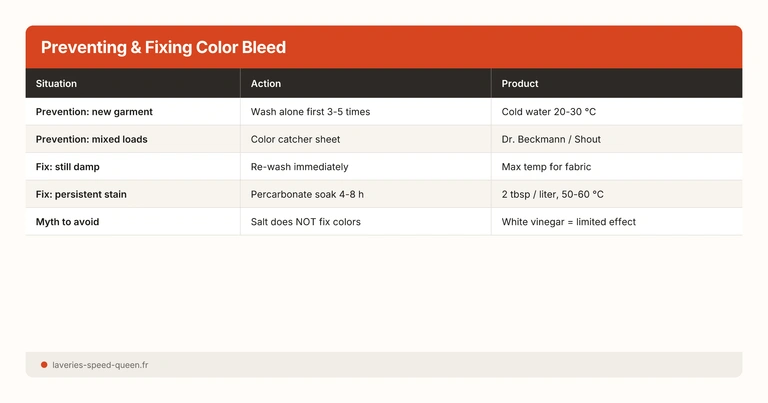
In short: color bleeding happens when dye transfer occurs — loose dye molecules migrate from one garment to another in the wash water. To prevent it: first wash separately, cold water, white vinegar, color-catcher sheets, proper sorting. To fix it: rewash immediately without drying, then soak in sodium percarbonate if needed. Salt does not set dye — that is a myth.
At a Glance
Do not dry — heat permanently sets the transferred dye. Act while the laundry is still damp.
Rewash immediately — one cycle at the max temperature for the fabric, with no other items.
Percarbonate for soaking — 2 tbsp per litre of hot water, 4-8 hours.
Prevention: first wash separately — every new dark-colored garment should be washed alone for the first 3-5 washes.
Salt is a myth — it does not set dye on garments that have already been industrially dyed.
Why Clothes Bleed Color
Dye transfer is a physicochemical phenomenon: dye molecules that are insufficiently bonded to the fibres of a garment dissolve in the wash water and migrate to other fabrics. Three main factors explain it.
Excess unfixed dye
During manufacturing, fabric is dyed by immersion in a dye bath. Some of those dye molecules bond chemically to the fibres (via covalent bonds for reactive dyes on cotton, ionic bonds for acid dyes on wool). But a residual fraction simply sits on the surface with no stable bond. That fraction is what bleeds.
Cheap garments or those dyed with fast processes often carry more residual dye. Dark colors (red, navy, black) contain more pigment, so more potential residue.
Hot water and agitation
Hot water increases dye solubility: at 60 °C (140 °F), a garment releases 2 to 3 times more pigment than at 30 °C (86 °F). The mechanical agitation of the machine amplifies the effect by rubbing fibres against each other, dislodging surface dye molecules.
This is why washing temperature is a key factor: a cold wash (20-30 °C / 68-86 °F) dramatically limits bleeding.
Overloading the machine
An overloaded machine compresses the laundry. Prolonged contact between a bleeding garment and a light-colored one promotes direct dye transfer — through physical contact as much as through dissolution in the water. Respect the recommended load for your machine.
Prevention: 6 Anti-Bleeding Habits
First wash separately
Every new dark-colored garment (red, navy, black, purple) should be washed alone — or with similar colors — for the first 3 to 5 washes. This is the single most effective rule.
Cold water (68-86 °F / 20-30 °C)
Wash colors at 30 °C (86 °F) maximum. Cold water reduces dye solubility by 50 to 70 % compared to a 60 °C wash. The simplest trade-off between cleaning power and color preservation.
White vinegar on the first wash
Add 100 ml (3.4 fl oz) of white vinegar to the fabric softener compartment. The acetic acid helps set certain dyes (acid dyes on wool, direct dyes on cotton). Limited but non-zero effect.
Color-catcher sheet
Place an absorbent sheet in the drum. Its cationic polymer traps stray dye molecules before they bond to other fabrics. Especially useful for mixed loads (lights + darks).
Proper color sorting
Separate whites / lights / darks / blacks. Sorting your laundry is the first line of defense. A garment that bleeds in a load of the same color causes no visible damage.
Reduced load
Do not overload the machine — clothes need room to tumble freely. An 80 % load is the right benchmark. More space = less direct contact = less dye transfer.
The white cloth test
Before the first wash of a garment you are unsure about, do this test: dampen a white cloth and rub it for 30 seconds on an inner seam. If the cloth picks up color, the garment will bleed in the machine. Wash it separately.
Fixing White Laundry That Has Bled
Whites are the most affected by dye transfer — and fortunately, the easiest to fix. Three methods, from gentlest to strongest.
Method 1: sodium percarbonate (most effective)
Sodium percarbonate is an oxygen-based bleaching agent. Dissolved in hot water, it releases hydrogen peroxide (H2O2) and sodium carbonate. The hydrogen peroxide oxidizes the chromophores — the parts of the dye molecule responsible for its color — rendering them colorless.
Protocol:
- Dissolve 2 tablespoons of percarbonate per litre (quart) of hot water (50-60 °C / 120-140 °F). The water must be hot to activate the release of H2O2.
- Submerge the discolored white items. Make sure they are fully covered.
- Soak for 4 to 8 hours (overnight for severe cases).
- Rinse, then machine wash at 60 °C (140 °F).
- Check the result before putting anything in the dryer.
Effectiveness: excellent on white cotton and linen. Percarbonate is safe for white natural fibres.
Method 2: washing soda + hot water
Washing soda↗ (sodium carbonate) is alkaline (pH approx. 11.5). In hot solution, it helps dissolve dye that has redeposited on the fibres.
Protocol:
- Dissolve 3 tablespoons of washing soda per litre (quart) of hot water (60 °C / 140 °F).
- Submerge the items for 2 to 4 hours.
- Machine wash at 60 °C (140 °F).
Effectiveness: good as a complement to percarbonate. On its own, washing soda is less effective because it does not oxidize the chromophores — it only facilitates the mechanical detachment of the transferred dye.
Method 3: diluted bleach (last resort)
Bleach (sodium hypochlorite) is a powerful oxidizer. It destroys chromophores through chlorine-based oxidation.
Protocol:
- Dilute 100 ml (3.4 fl oz) of bleach in 5 litres (1.3 gal) of cold water.
- Submerge white cotton items only (never synthetics, never colored fabrics).
- Soak for 30 minutes maximum — beyond that, bleach attacks cellulose fibres.
- Rinse thoroughly, then machine wash.
Limitations: bleach yellows synthetics, destroys protein fibres (wool, silk), and weakens cotton over time. Percarbonate is preferable in the vast majority of cases.
Fixing Colored Laundry That Has Bled
This is more delicate: you need to remove the transferred dye without destroying the garment’s original color. Strong oxidizers (concentrated percarbonate, bleach) are off-limits.
Method 1: white vinegar (light bleeding)
White vinegar is a mild acid (pH approx. 2.5) that helps dissolve redeposited dye without attacking the original color.
- Soak the garment in a 50/50 mix of cold water and white vinegar↗ for 1 to 2 hours.
- Rinse and machine wash at 30 °C (86 °F).
Effectiveness: decent for light, recent bleeding. Ineffective on dye that has been heat-set.
Method 2: bay leaves (traditional method)
This traditional method uses tannins from bay leaves, which have an affinity with certain textile dyes.
- Boil 10 bay leaves in 2 litres (2 quarts) of water for 20 minutes.
- Let cool to 40 °C (104 °F), strain, then submerge the garment for 1 hour.
- Rinse and machine wash.
Effectiveness: limited. Results are variable and not reproducible. This method may work on direct dyes but is ineffective on modern reactive dyes.
Method 3: milk (for protein fibres)
Milk contains casein, a protein with an affinity for certain dyes. This method is sometimes suggested for silk and wool.
- Submerge the garment in whole milk for 2 to 3 hours.
- Rinse with cold water, then wash gently.
Effectiveness: weak and not scientifically proven. Worth trying as a last resort on delicate fabrics that cannot withstand percarbonate or concentrated vinegar.
Comparison Table of Fixing Methods
| Method | Effectiveness | Compatible Fabrics | Soak Time | Notes |
|---|---|---|---|---|
| Sodium percarbonate | Excellent | White cotton, white linen | 4-8 hours | The gold standard for whites. Hot water required. |
| Washing soda | Good | White cotton, white linen | 2-4 hours | Best as a complement to percarbonate. Less effective alone. |
| Diluted bleach | Very good | White cotton only | 30 min max | Last resort. Yellows synthetics, damages fibres. |
| White vinegar (50/50) | Decent | Colors, synthetics | 1-2 hours | For light, recent bleeding. Safe for colors. |
| Bay leaves | Variable | Cotton, linen | 1 hour | Traditional method. Results not reproducible. |
| Whole milk | Weak | Silk, wool | 2-3 hours | Not scientifically proven. Last resort for delicate fabrics. |
| Immediate rewash | Good | All fabrics | Normal cycle | First reflex. The damper the laundry, the better it works. |
The Salt Myth: No, It Does Not Set Dye
This is one of the most persistent laundry beliefs: “add salt to the machine to set colors.” The idea is false for industrially dyed garments.
Where does this myth come from?
In artisanal dyeing, salt (NaCl) is used as a dye bath exhausting agent. Its role is to modify the ionic charge of the solution to promote the migration of dye from the bath into the fibre. In other words, salt helps the dye enter the fibre during the dyeing process.
But once the garment is dyed, dried, and sold, the chemical bonds between the dye and the fibre are already formed. Adding salt to your washing machine does not create new bonds — it simply increases the salinity of the wash water.
What the science says
No published study demonstrates that adding salt to wash water reduces bleeding in industrially dyed garments. Reactive dyes (used on cotton) form covalent C-O or C-N bonds with cellulose — these bonds are stable and are not strengthened by sodium chloride.
What actually works
- Cold water (86 °F / 30 °C max) — reduces dye solubility
- White vinegar — helps set certain acid dyes (wool, silk)
- Color-catcher sheets — trap stray pigments in the water
- Separate washes — sorting remains the most reliable prevention
Salt: useful for dyeing, useless for washing
If you want to dye a fabric at home, yes, salt is an essential component of the dye bath. But if your goal is to preserve the colors of garments that are already dyed, salt is ineffective. Use cold water and white vinegar — these are the two real allies for color preservation.
At the Laundromat: An Edge Against Dye Transfer
Professional laundromat machines have a little-known advantage against dye transfer: their greater water volume. A professional machine uses 50 to 60 litres of water versus 40 to 50 litres for a domestic machine. More water means greater dilution of bleeding pigments — each fibre is exposed to a lower concentration of transferred dye.
Additionally, the rinse cycle on professional machines is more efficient: the water-to-laundry ratio is better, which eliminates more residual pigments.
For the first washes of new garments, the laundromat is a smart choice: the larger water volume reduces the risk of dye transfer.
Commercial Anti-Bleeding Products
Several specialized products are available on the market:
- Color-catcher sheets (Shout Color Catcher, Carbona Color Grabber, Dr. Beckmann): contain a cationic polymer that captures anionic dye molecules in solution. Proven effective on light bleeding. Limitations: they do not protect against heavy bleeding.
- Dye-transfer stain remover (e.g., Rit Color Remover): formulated with a reducing agent (sodium dithionite) that breaks chromophores. Effective on whites; use with caution on colors.
- Sodium percarbonate: a generic, inexpensive product that is highly effective on whites. Widely available in supermarkets and online.
Mistakes to Avoid
- Putting color-bled laundry in the dryer — heat permanently sets the transferred dye. Act while the laundry is still damp.
- Mixing vinegar and percarbonate — the acid (vinegar, pH 2.5) neutralizes the base (percarbonate, pH 10.5). Use them at separate stages, never together.
- Using bleach on synthetics — sodium hypochlorite irreversibly yellows polyester and nylon.
- Rubbing the affected area — friction pushes the transferred dye deeper into the fibres instead of pulling it out.
- Believing in salt — adding salt to the machine does not set the colors of garments that are already dyed. It is a myth from artisanal dyeing.
- Waiting to act — the longer you wait, the more the transferred dye forms stable bonds with the victim garment's fibres. The first few hours are decisive.
Preventing Dye Transfer Day to Day
Beyond the 6 habits already detailed, here are complementary practices:
- Turn dark garments inside out — friction occurs on the inside, not on the visible dyed surface
- Use a liquid detergent — powder detergents sometimes contain bleaching agents that accelerate color loss
- Avoid the dryer for vibrant colors — heat accelerates dye degradation over time
- Dry in the shade — UV from sunlight degrades the chromophores in dyes, causing gradual fading
The drying guide covers best practices by fabric type.
As an Amazon Associate, we earn a small commission on purchases made through affiliate links in this article — at no extra cost to you. This helps us maintain this site and produce free guides.
Our laundromats in Blagnac, Croix-Daurade and Montaudran are equipped with professional machines offering a larger water volume — an advantage against dye transfer. Detergent included, machines from 8 to 18 kg. Payment contactless card or cash. Check our prices.
Sources and References
- How to sort your laundry
- Sodium percarbonate: laundry guide
- White vinegar and laundry: uses and limits
- Washing temperature guide
- Drying guide
- Textile dye chemistry — covalent bonding of reactive dyes on cellulose, ionic bonding of acid dyes on protein fibres
- Role of sodium chloride in industrial dyeing — dye bath exhaustion agent, not a post-dyeing fixative