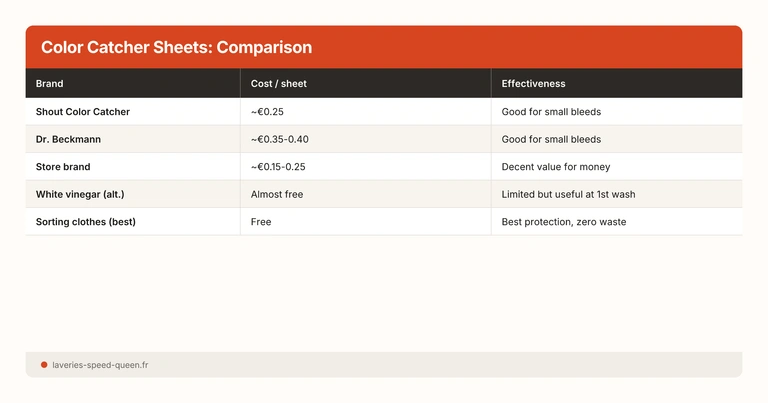
Color catcher sheets contain PVP (polyvinylpyrrolidone), a polymer that traps dye released into the wash water. They are effective against minor bleeding accidents but overwhelmed by heavy dye bleeding (new raw denim, first wash of a bright red garment). Cost: 0.15 to 0.40 USD per sheet, single use only. Sorting laundry by colour remains the most reliable, economical, and eco-friendly method.
At a Glance
Real but limited protection -- catches minor dye bleeding, not heavy colour runs.
PVP = the active ingredient -- polyvinylpyrrolidone binds free dye before it redeposits on other fabrics.
0.15-0.40 USD per sheet -- single use, not reusable. Up to 80 USD/year if used every wash.
Does not replace sorting -- new raw denim bleeds too much for one sheet. Sorting is still the foundation.
White vinegar on the 1st wash -- free alternative to help set colours. Limited but useful effect.
How Color Catcher Sheets Work
To understand what color catcher sheets do (and don’t do), you first need to understand the phenomenon they combat: dye bleeding.
Dye Bleeding: Where the Colour in the Water Comes From
When a dyed garment is immersed in warm water, some of the dye detaches from the fibre and migrates into the wash water. This is dye bleeding. All textile dyes bleed to some extent during the first few washes — this is normal and expected by manufacturers.
Dye bleeding depends on three factors:
The type of dye — reactive dyes (the most common on cotton) are chemically bonded to the fibre and bleed very little. Direct dyes and surface pigments (like the indigo on denim) are not chemically bonded and bleed significantly more.
Temperature — hot water accelerates the migration of dye molecules out of the fibre. A wash at 60 degrees C causes 3 to 5 times more bleeding than a wash at 30 degrees C for the same garment.
The age of the garment — new garments contain excess dye (intentional, to compensate for wear) that gradually releases over the first few washes. After 3 to 5 washes, most garments stop bleeding significantly. Exception: raw (unwashed) denim can bleed for 15 to 20 washes.
PVP: The Science Behind the Sheet
The active ingredient in color catcher sheets↗ is PVP (polyvinylpyrrolidone) — a water-soluble synthetic polymer used in chemistry, pharmaceuticals, and cosmetics since the 1950s.
How it works: PVP has a strong affinity for organic dye molecules. When a garment releases dye into the wash water, the dye molecules float freely. The PVP on the sheet captures and binds them to its polymer chains through weak bonds (Van der Waals forces, hydrogen bonds). The dye is trapped on the sheet instead of redepositing on neighbouring fibres.
It is essentially a molecular trap: PVP attracts free dye more strongly than textile fibres do, redirecting the dye onto the sheet rather than onto your white shirt.
The visible proof: after washing, the sheet comes out coloured (pink if a red garment bled, blue if jeans lost indigo). This colouring is direct proof the sheet captured pigments. The more coloured the sheet, the heavier the bleeding was.
PVP Beyond the Laundry
PVP (polyvinylpyrrolidone) is a polymer found everywhere in daily life. It appears in eye drops (humectant), hair products (fixative in hairsprays), pharmaceutical tablets (binder), and even in some wines (fining agent for clarification). It is a non-toxic, well-studied polymer with no health risk — no concerns about the safety of color catcher sheets.
Real Effectiveness: What Color Catchers Do and Don’t Do
Color catcher sheets are neither a miracle nor a gimmick. Their effectiveness depends directly on the intensity of the dye bleeding they face.
What Color Catchers Do Well
Color catchers are effective in the following scenarios:
Light bleeding in mixed loads — a pair of dark socks forgotten in a whites load, a navy T-shirt mixed with light colours. The bleeding is minor and the sheet captures all the released pigments.
Everyday washes after sorting — even with careful sorting, garments of similar colours (navy + burgundy, grey + khaki) can produce slight transfers. The sheet eliminates this residual risk.
Moderately worn garments — after 3-5 washes, most garments only bleed marginally. The sheet captures these residual traces without difficulty.
What Color Catchers Don’t Do
Color catchers are overwhelmed in the following scenarios:
New raw denim — unwashed denim releases a massive amount of indigo during its first washes. Indigo is a surface pigment (not chemically bonded to the fibre) that migrates in large quantities. A single sheet cannot absorb all that pigment.
First wash of a bright red garment — red dyes (based on azo dyes) are notorious for intense initial bleeding. The first wash releases excess dye that saturates the sheet.
High-temperature washes — a wash at 60-90 degrees C causes maximum bleeding. The sheet captures pigments, but the volume of released dye can exceed its absorption capacity.
Rescue after an accident — if your whites have already turned pink, the sheet will not undo the damage. It prevents transfer but does not reverse it. To rescue colour-stained laundry, you need sodium percarbonate↗.
| Scenario | Bleeding Level | Sheet Effectiveness |
|---|---|---|
| Everyday wash after proper sorting | Very low | Excellent (full protection) |
| 1 dark garment forgotten in whites | Low to medium | Good (prevents visible transfer) |
| Mix of various colours at 40 degrees C | Medium | Fair (reduces transfer, does not eliminate it) |
| New raw denim with whites | High | Insufficient (sheet saturated) |
| Bright red new garment at 60 degrees C | Very high | Overwhelmed (heavy bleeding) |
Brand Comparison
Several brands sell color catcher sheets. Their active ingredient is the same (PVP), but the concentration and textile substrate vary.
Dr. Beckmann — Colour Catcher
The long-established market reference. Dr. Beckmann sheets use a high-density PVP non-woven fabric, giving them a higher trapping capacity. They are slightly thicker than competitors.
- Average price: 7-9 USD / box of 22 sheets (0.32-0.41 USD/sheet)
- Strength: high trapping capacity, effective on moderate bleeding
- Weakness: the highest price on the market
Shout Color Catcher
The most popular brand in the US, positioned on an attractive value-for-money basis. The sheets are thinner than Dr. Beckmann but the PVP is well dosed.
- Average price: 5-8 USD / box of 24-72 sheets (0.10-0.30 USD/sheet)
- Strength: excellent value for money, widely available (supermarkets, Amazon)
- Weakness: slightly less effective than Dr. Beckmann on significant bleeding
Store Brands (Target, Walmart, Aldi)
Store brands offer sheets at a reduced price, often manufactured by the same subcontractors as the big brands. The PVP concentration is generally slightly lower.
- Average price: 3-5 USD / box of 20-30 sheets (0.10-0.25 USD/sheet)
- Strength: lowest price, easy to find
- Weakness: trapping capacity sometimes insufficient for medium-level bleeding
The Yearly Cost
At 3-4 washes per week (150-200 washes/year), systematic use of color catcher sheets costs between 30 and 80 USD per year depending on the brand. By comparison, sorting laundry is free, and a bottle of white vinegar costs less than 1 USD. The cost-benefit question deserves to be asked.
Alternatives to Color Catcher Sheets
Sorting Laundry: The Real Solution
Sorting laundry by colour is the most reliable, economical, and eco-friendly method to prevent colour transfer. Three categories are enough:
- Whites — pure white only, not beige or off-white
- Light colours — pastels, beige, off-white, light grey
- Dark colours — navy, black, burgundy, dark green
By separating these three categories, the risk of visible transfer is virtually zero — even without a color catcher sheet.
White Vinegar on the First Wash
White vinegar is often cited as a free alternative to color catchers. Its action is different: rather than trapping free dye, it helps fix the dye to the fibre so it bleeds less.
How it works: the acetic acid in vinegar lowers the pH of the rinse water, which strengthens the bond between certain dyes and the fibre (particularly acid dyes on wool and silk). On cotton dyed with reactive dyes, the effect is modest but measurable.
Method: add 100 ml of white vinegar↗ to the fabric softener compartment during the first 3 washes of a new brightly coloured garment. The vinegar acts during the rinse cycle and evaporates completely during drying — no residual odour.
Cold Washing
Wash temperature is the single most influential factor in dye bleeding. A wash at 30 degrees C causes 3 to 5 times less bleeding than a wash at 60 degrees C. For new brightly coloured garments, cold washing (20-30 degrees C) during the first cycles is the best prevention — more effective than a color catcher at 60 degrees C.
The First Wash Alone
The most radical method: wash each new brightly coloured garment alone (or with identical colours) for its first 2-3 washes. The excess dye is flushed out with no risk to the rest of the wardrobe. After these first washes, the garment can join the normal sorting routine.
Sorting by colour (free)
The most reliable and economical method. Three categories (whites, lights, darks) eliminate 95% of the risk. Laundry sorting guide.
White vinegar (< 1 USD/year)
100 ml in the softener compartment during the first washes. Helps set dyes. Modest but nearly free effect. White vinegar guide.
Cold washing (free)
30 degrees C instead of 60 degrees C reduces bleeding by 3-5x. The best prevention for new garments. Cold wash guide.
PVP sheets (30-80 USD/year)
Safety net alongside sorting. Effective for minor accidents. Does not replace sorting for heavy bleeding.
At the Laundromat: Sorting Is the Real Solution
At a self-service laundromat, color catcher sheets work exactly as they do at home — slip one into the drum with your laundry. But the optimal strategy at the laundromat is different.
Two Machines Beat One Sheet
Our laundromats offer machines of different capacities. The most effective strategy against dye bleeding is to run two separate machines: one for whites and light colours, another for dark colours. The cost of two machine cycles is often comparable to the cost of one cycle + the sheet, with a far superior result.
The Water Volume Advantage
Professional machines use 50 to 60 litres of water per cycle — versus 15-20 litres in a domestic machine. This volume dilutes free dye more effectively, naturally reducing the risk of transfer even in the event of light bleeding. Abundant water is the best color catcher sheet.
As an Amazon Associate, we earn a small commission on purchases made through the affiliate links in this article — at no extra cost to you. This helps us maintain this site and produce free guides.
Run two separate machines (whites + darks) rather than relying on a sheet. Our laundromats in Blagnac, Croix-Daurade and Montaudran offer machines of different capacities to suit your needs. Payment by contactless card or cash. See our prices.
Common Mistakes with Color Catchers
- Believing sheets make sorting unnecessary -- they only protect against minor bleeding. A heavily dyed new garment saturates a sheet within minutes.
- Reusing a spent sheet -- the PVP is saturated after a single wash. A used sheet captures nothing. Discard it after every use.
- Putting the sheet in the detergent drawer -- it must go in the drum, in direct contact with the water and laundry. In the drawer, it is useless.
- Using multiple sheets to compensate -- two sheets capture barely more than one. If the bleeding is heavy, the solution is sorting, not stacking sheets.
- Relying on a sheet for new raw denim -- raw denim loses too much indigo. Wash it alone, turned inside out, at 30 degrees C for the first 5 washes.
Our Honest Verdict
Color catcher sheets are neither a useless gimmick nor an essential product. They fill a precise niche: that of a safety net for mixed loads when sorting is not perfect.
When to Use Them
- You are running a mixed load (various colours together) and want to reduce the risk of residual transfer.
- You are washing a new garment for the first time and do not have the time to wash it alone.
- You are unsure about a garment (is it colourfast?) and prefer extra security.
When Not to Use Them
- On every wash out of habit — it is an unnecessary expense if your sorting is correct.
- To compensate for not sorting at all — a sheet cannot absorb the bleeding from a chaotic mix of colours.
- On heavily dyed new garments at their first wash — wash them alone or with similar colours.
The best effectiveness-to-cost ratio: systematic sorting + occasional sheet for loads where sorting is not perfect (travel, holiday laundry, laundromats). This is the strategy adopted by the majority of informed users.