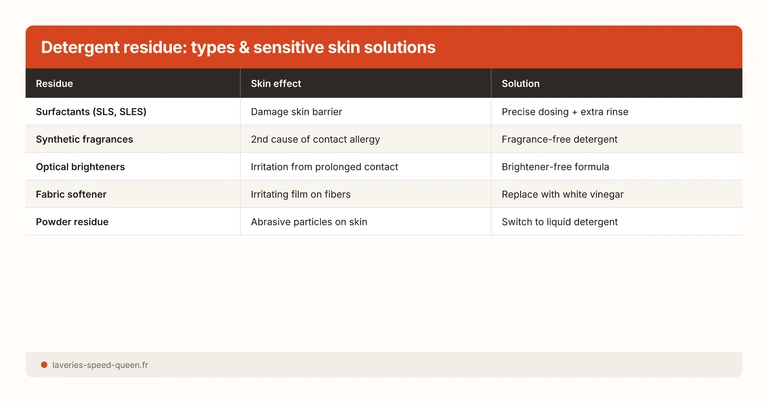
In short: Detergent residue lingers in your clothing fibres after washing — surfactants, fragrances, optical brighteners. In contact with your skin for 16 hours a day, these residues can cause irritation, dryness and allergic reactions, especially in babies and people with atopic skin. The two main causes: overdosing detergent and insufficient rinsing. The fix: dose precisely, use the extra rinse cycle, and choose a suitable detergent.
At a Glance
Dose precisely -- overdosing is the leading cause of residue. Follow the manufacturer's instructions based on your water hardness.
Rinse thoroughly -- for sensitive skin, enable the double rinse or 'rinse+' programme.
Choose a suitable detergent -- fragrance-free, dye-free, dermatologically tested.
Don't overload the drum -- an overfilled drum prevents proper rinsing.
The Invisible Problem: Residue in Every Fibre
The cumulative contact is significant: clothes and bedding expose your skin to residue for over 16 hours a day — up to 24 hours when you include sheets.
After a wash cycle, some detergent components remain trapped in the textile fibres. These are not visible traces — they are molecules adsorbed onto the surface of the threads that the rinse water failed to remove entirely.
The main residues:
Surfactants (SLS, SLES)
The cleaning agents in your detergent. They dissolve grease -- including your skin's natural lipids. That is their job. The problem arises when they stay in the fibres after rinsing: they continue to act on your skin.
Fragrances and preservatives
Synthetic fragrances are the second most common cause of contact allergy in dermatology. Some detergents contain over 20 different fragrance compounds. These volatile molecules release slowly from the fabric.
Optical brighteners
These 'whitening' agents do not actually clean: they deposit onto fibres to reflect UV light and create the illusion of brilliant white. They remain in the textile by design -- that is their function.
Your clothes are in contact with your skin approx. 16 hours a day — more for underwear, socks, and pyjamas. Bed sheets add another 7 to 8 hours. Every friction zone (collar, armpits, waistband, elastic bands) concentrates the contact between residue and skin.
What the Science Says
Recent studies point to a dose-dependent effect: the more residual surfactants are present, the greater the impact on the skin barrier and inflammation.
Rinaldi et al. (2023) — Allergy
Researchers at the University of Zurich tested the effect of common household detergents on human skin. Results published in Allergy (DOI 10.1111/all.15891 (lien externe)):
- The detergents tested disrupted skin barrier integrity — the lipid layer that protects the skin from external aggressors.
- They triggered a measurable inflammatory response, with increased inflammation markers (cytokines).
- The effect was confirmed on human skin (biopsies) and in an animal model.
This is not a rare allergic reaction: it is a direct, dose-dependent irritant mechanism. The more residue present, the more the skin barrier is compromised.
Wright et al. (2023) — Curr Allergy Asthma Rep
The Mayo Clinic team analysed the role of detergents in epithelial barrier dysfunction (Wright et al., DOI 10.1007/s11882-023-01094-x (lien externe)). Their conclusion: household detergent surfactants can worsen or trigger dermatitis in predisposed individuals, particularly:
- Infants (immature skin barrier)
- People with atopic conditions (eczema, dermatitis)
- Already compromised skin (chronic dryness, irritation)
The Three Main Causes of Residue
In practice, the most frequent combination is overdosing + short rinse + overloaded drum, even with a decent detergent.
1. Detergent Overdosing
This is the number-one cause. At home, people often dose “by eye” — and almost always too much. Manufacturers have an incentive for you to use more: the measuring cups they include are calibrated for maximum soiling.
How to dose correctly
Dosing depends on three factors: your water hardness (soft, medium, hard — check your water supplier’s website), the soil level of the laundry (light, normal, heavy), and the machine load. For lightly soiled laundry in medium-hardness water, use half the maximum dose indicated. See our wash temperature guide to select the right programme.
2. Insufficient Rinsing
The volume of water available for rinsing is a key factor. If the detergent is overdosed or the drum is overloaded, the rinse water cannot remove all residue. Professional machines at laundromats use 50 to 60 litres per cycle, providing a considerably deeper rinse.
Aggravating factors:
- Overloaded drum — compressed laundry does not rinse properly
- Quick/eco programme — reduced rinsing to save water
- Powder detergent — dissolves less effectively than liquid, especially in cold water
3. Unsuitable Detergent
Some detergents concentrate aggressive components:
- Synthetic fragrances (recognised allergens)
- Isothiazolinone preservatives (MI, MCI)
- High-concentration enzymes
For sensitive skin, these components should be avoided even with correct dosing and rinsing.
How to Protect Your Skin
The most effective protocol combines reduced dosing, an extra rinse, and loading the drum to two-thirds capacity to improve residue removal.
Precise dosing
Follow the manufacturer's instructions to the letter, factoring in your water hardness. When in doubt, dose less rather than more: slightly under-dosed laundry will be clean; overdosed laundry will retain residue.
Double rinse
Enable the 'rinse+' or 'extra rinse' option on your machine for items in direct skin contact: underwear, pyjamas, baby bodysuits, sheets. This is the single most effective step for removing residue.
Suitable detergent
Choose a detergent that is fragrance-free, dye-free, and dermatologically tested. Liquid detergents generally leave less residue than powders. Avoid pre-dosed capsules for small loads.
Don't overload
Fill the machine to two-thirds maximum. An overfull drum prevents laundry from moving freely -- and therefore from being properly rinsed. This applies to all machines. See our laundry weight guide.
Special Cases
Newborns and atopic skin require a higher standard: simple formula, systematic double rinse, and no fabric softener.
Babies (0-3 years)
An infant’s skin is thinner and more permeable than an adult’s. The skin barrier is still immature. Detergent residue crosses the epidermis more easily, causing redness, irritation and even eczema.
Baby-specific or hypoallergenic detergent -- fragrance-free, no aggressive enzymes, no sensitising preservatives.
Systematic double rinse -- for bodysuits, pyjamas, bibs, crib sheets.
Reduced dosing -- baby laundry is rarely heavily soiled (except localised food stains). Dose for 'light soiling'.
No fabric softener -- it deposits a layer on fibres that reduces absorbency and can irritate. See our guide on washing baby clothes.
Eczema and Atopic Dermatitis
People with atopic conditions already have a compromised skin barrier (filaggrin deficiency). Detergent residue worsens this fragility by dissolving the intercellular lipids that protect the skin.
Dermatologist recommendation
If you suffer from eczema or atopic dermatitis, treat your detergent like skincare:
fragrance-free, no MI/MCI preservatives, minimal dosing, double rinse
. Test a new detergent on a single garment before using it for your entire wardrobe. If in doubt, consult your dermatologist.
Contact Allergies
Allergic contact dermatitis from detergent is rare (less than 1% of cases according to patch-test studies), but it does occur. The most common allergens in detergents:
- Fragrances (fragrance mix I and II) — the leading cause
- Isothiazolinones (MI, MCI) — preservatives, declining in recent formulations
- Dyes — present in some liquid detergents
If you suspect contact allergy, a patch test from a dermatologist can identify the exact allergen. See also our article on dust mite allergies and laundry for reactions related to bedding.
The Advantage of Automatic Dosing
Calibrated dosing eliminates the most common mistake in home laundering: overdosing, the primary factor behind irritating residue.
At the laundromat: calibrated dosing, generous rinsing
At a professional laundromat, detergent and softener are dispensed automatically at a calibrated dose — no overdosing possible. The rinse volume (50 to 60 litres in a professional machine) exceeds that of a domestic machine, which reduces the amount of residue in the fibres. This is a real advantage for sensitive skin.
Mistakes to Avoid
- Doubling the dose 'for a better clean' -- excess detergent does not clean better, it stays in the fibres
- Using fabric softener on baby laundry -- it deposits a film on fibres that irritates fragile skin
- Ignoring water hardness -- in hard water, you need a slightly higher dose (but not double)
- Choosing a detergent for its scent -- the stronger the fragrance in the packet, the more synthetic perfume ends up against your skin
- Overloading the machine -- packed laundry does not rinse properly
As an Amazon Associate, we earn a small commission on purchases made through affiliate links in this article — at no extra cost to you. This helps us maintain this site and produce free guides.
For thoroughly rinsed laundry with zero risk of overdosing, our laundromats in Toulouse and Blagnac use professional automatic dosing and generous rinsing. Detergent and softener included in the price. See our prices.
The Tissue Test: A Quick Residue Diagnosis
Before switching detergents or changing your washing habits, a simple test can confirm (or rule out) residue in your textiles. No special equipment needed.
Method: take a white cloth tissue (or a clean square of white cotton) and dampen it with warm water. Rub it vigorously for 20 seconds on the inside of a garment you suspect — the armpit area of a T-shirt, the inside of the collar, or the waistband. Hold the tissue up to the light:
- Foam or bubbles: detergent surfactants are still present in the fibres. This indicates overdosing or insufficient rinsing.
- White powdery deposit: residue from poorly dissolved powder detergent, common in cold water (30 degrees C) or when the load is too compressed.
- Greasy or slippery film: fabric softener residue. Frequent on towels and sheets that have received softener for several months.
- Nothing visible: the rinsing is adequate. If irritation persists, the problem likely lies with the detergent formula (fragrances, preservatives) rather than dosing.
This test is particularly useful when you switch detergents or when a family member develops sudden irritation. Test garments in direct skin contact first: baby bodysuits, underwear, pyjamas, sheets. If the test is positive, the quickest solution is an extra rinse cycle (without detergent) before wearing the garment.
How to Test Whether Your Laundry Contains Residue
If you suspect detergent residue in your clothes, a simple test will confirm it. Fill a basin with warm water (no detergent) and submerge a clean garment. Agitate it vigorously for 30 seconds. If the water becomes foamy or cloudy, surfactant residue is still present in the fibres. A properly rinsed garment produces neither foam nor cloudiness in clear water.
For persistent cases, soak the garment for 2 hours in water mixed with 50 ml of white vinegar↗. The vinegar dissolves detergent residue trapped in the fibres. Then rinse thoroughly with clear water. This soak is especially useful for baby bodysuits, pyjamas and sheets — textiles that stay in prolonged contact with the skin.
At a professional laundromat, this problem is significantly reduced thanks to the rinse water volume (50-60 litres per cycle) and automatically calibrated detergent dosing matched to the local water. This is a practical solution for families where someone suffers from eczema or contact dermatitis.
Methodology and Sources
- Data on the skin impact of detergents comes from Rinaldi et al. (2023), Allergy (lien externe) — a study on human skin and a murine model, University of Zurich.
- The analysis of the role of detergents in epithelial barrier dysfunction draws on Wright et al. (2023), Curr Allergy Asthma Rep, Mayo Clinic (lien externe).
- Dosing and rinsing recommendations are cross-referenced with best practices from the French Society of Dermatology (lien externe) and GINETEX / ISO 3758 (lien externe) care labelling standards.
Sources and References
- Rinaldi et al. (2023), Allergy, 79(1):128-141 (lien externe) — “Household laundry detergents disrupt barrier integrity and induce inflammation in mouse and human skin”
- Wright et al. (2023), Curr Allergy Asthma Rep, 23(8):443-451 (lien externe) — “Allergies come clean: the role of detergents in epithelial barrier dysfunction”
- Norman et al. (2023), Cutis, 111(4):172-175 (lien externe) — “Is Laundry Detergent a Common Cause of Allergic Contact Dermatitis?”
- GINETEX / ISO 3758 — Textile care symbols (lien externe)
- Washing baby clothes — our dedicated guide
- Wash temperature guide