In short: faced with a faded, cut-off or missing label, do not look for a universal setting: gather the information that remains, spot the fragile elements, then decide separately on washing and then on drying. Four possible conclusions for each decision: yes, instruction traced back; possible under conditions; not advised; or impossible to confirm without further information. Composition is a clue, never permission.
The 30-second answer
When the care label is missing, the right question is not “at what temperature?” but “do I have enough information to decide safely?”. The “cold wash, delicate cycle” reflex protects many garments, but it does not cover everything: agitated wool felts, a coated piece degrades in water, and above all, knowing how to wash says nothing about drying.
The quick run-through in front of the machine:
- Trace back any information still available — composition, second label, model, invoice.
- Separate the washer decision from the tumble-dryer decision — the second is more cautious than the first.
- Spot the sensitive elements — lining, coating, membrane, trims, structure.
- Use the composition as a clue, never as absolute permission.
- Conclude with one of the four answers: yes, instruction traced back; possible under conditions; not advised; impossible to confirm without further information.
Information first — an instruction traced back to the manufacturer takes precedence over any visual estimate.
Two decisions, not one — a garment may be machine washable without being able to go in the tumble dryer.
The most fragile part governs — a lining, a coating or a trim may set the limit before the fibre does.
Composition guides, it does not authorise — touch and appearance are only a bundle of clues.
Doubt has an answer — "impossible to confirm" is a valid conclusion, one that leads to hand washing or a professional.
What is left of the label
Before giving up, look at what remains: there is almost always more information than you think. Distinguish five situations:
- Composition readable, symbols faded — you know the fibres, but not the instructions. This is the most favourable case: the composition guides a cautious setting.
- Symbols readable, composition faded — follow the symbols, which are the care reference; the exact fibre then matters less.
- Reference or brand still identifiable — the model often lets you find the care sheet on the manufacturer’s site.
- Second label in a seam or a lining — many garments carry one, hidden on the side or at the bottom.
- Label entirely missing — common on vintage, thrift-shop or handmade pieces.
The first useful action is to trace back the exact model in the invoice, the online purchase history or the manufacturer’s site. Care information traced back to the manufacturer takes precedence over any visual estimate.
A word on the legal framework, because it sheds light on these situations. In France, the composition label is mandatory, readable and attached to the product; the care label, however, is optional — recommended, but not required. At European level, Regulation (EU) 1007/2011 makes the composition statement mandatory, but creates no mandatory care-labelling system. In other words, a garment can perfectly well, and legally, carry no washing symbol at all. And second-hand garments are even exempt from the composition statement: a pre-owned piece may carry no textile information whatsoever.
When part of the information survives, read it as it is written. On a composition label, the fibres in a blend are listed in decreasing order of weight, and a minority fibre — up to 5 %, or 15 % for several grouped together — may appear under the mention “other fibres”. This detail matters: it is often this discreet fibre, an elastane or a lining, that sets the care limit. And if a few symbols survive, they remain the reference, without needing to decode them all here: the number inside the wash tub is a maximum temperature not to be exceeded, never a minimum; the square is read separately because it concerns drying — a circle inside the square allows tumble drying, a crossed-out symbol forbids it, and the dots mark the intensity of the process (one dot for a gentle process, in the region of 60°, two dots for a normal process, in the region of 80°).
Still have the symbols, just faded in places?
This article deals with the “missing information” case. If your symbols simply need decoding, our
complete guide to care symbols
details the five families (wash tub, triangle, square, iron, circle) and their combinations.
Composition is a clue, not permission
You cannot guess a fibre for sure at home — and even when known, composition does not on its own authorise a wash or a dry. Three principles, all from the reference bodies, frame what observation does and does not allow.
You cannot reliably identify a fibre by touch. The Canadian Conservation Institute is clear: even in a laboratory, neither the burn test nor microscope examination is conclusive on its own, and blended yarns make the analysis even harder. Finishes, dark dyes or wear mask the fibre. At home, touch, sheen, elasticity or crease produce a bundle of clues, never certainty. We therefore offer no burn test: it is a specialist method, dangerous and inconclusive on blends.
The most fragile part governs. GINETEX, which manages the care symbols, states that the instruction refers to the most fragile part of the item — dye, finish, lining, hardware, trims — and not only to the main fibre. A t-shirt “95 % cotton, 5 % elastane” is treated with the elastane in mind; a dress mostly cotton but lined with silk is treated like silk.
The symbol is a maximum, not a minimum instruction. Again according to GINETEX, a symbol indicates the maximum permitted treatment: a gentler wash and a lower temperature are always allowed. That is why, when in doubt, you step down in intensity. GINETEX adds a decisive point for our subject: the temperature must be chosen on the basis of the care label and not according to the fibre content. Composition, when you know it, therefore serves to choose a cautious setting — not to grant permission.
A test on a hidden area (inside a hem, a side seam) proves only one thing: the local colour-fastness or the reaction to a specific product. It proves neither that the garment tolerates a full cycle nor that it tolerates the tumble dryer. Do not make it say more than that.
Fabrics and blends table
The table below gives cautious guidance, applicable only to simple garments, with no other sensitive element detected. For washing, it indicates a temperature in degrees Celsius when the source allows. For drying, it gives first the visible setting (low, medium, high): no manufacturer publishes any correspondence between these settings and a temperature in degrees, and we do not invent one. The presence of a tolerant fibre never neutralises a more fragile fibre or construction.
| Fabric or blend | Washer | Temperature | Programme and spin | Tumble dryer | Heat | Watch point |
|---|---|---|---|---|---|---|
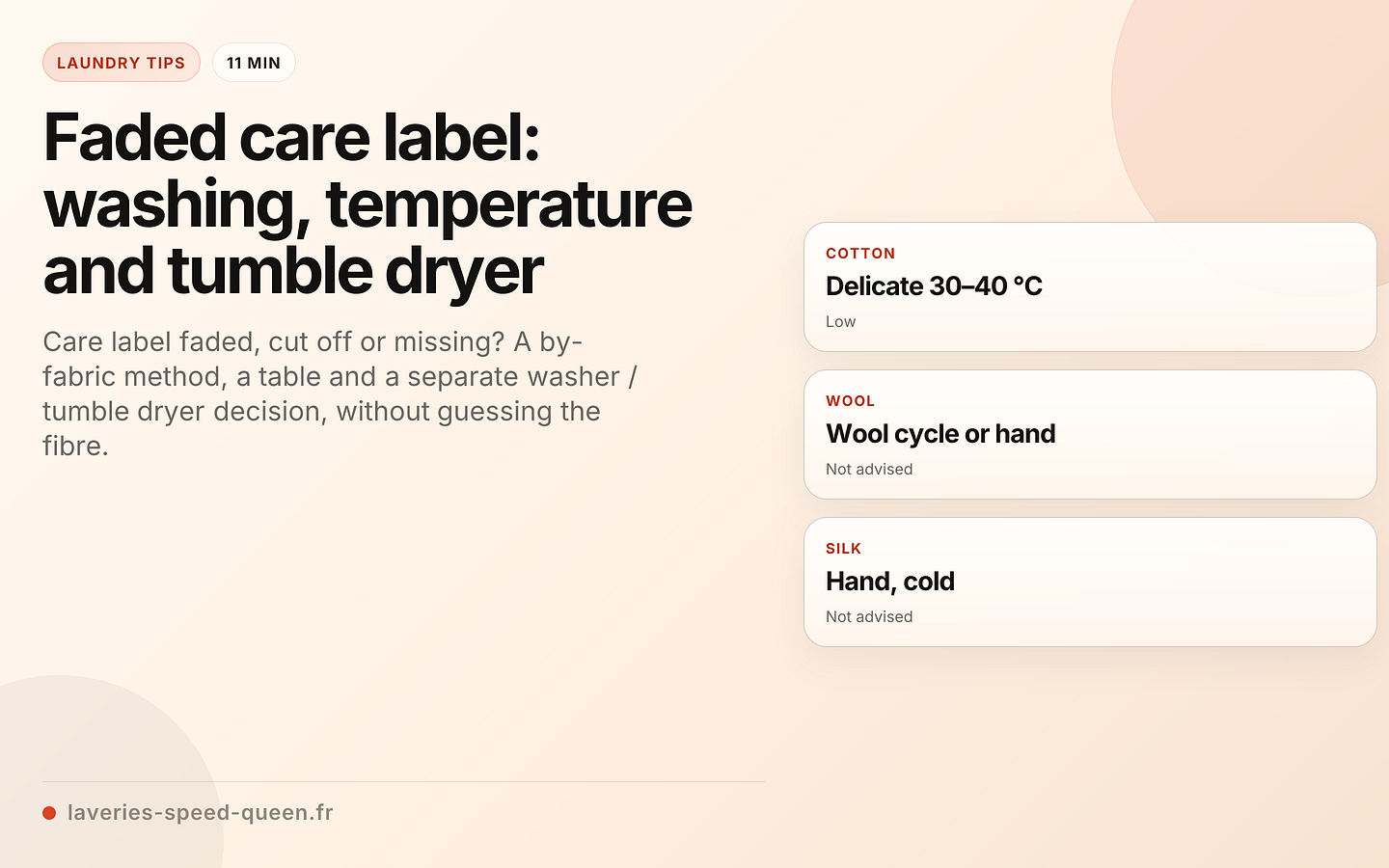
| Cotton | Possible | 30–40 °C | Normal or delicate, medium spin | Possible | Low to medium | Shrinks if never washed before; wash colours cooler |
| Linen | Possible | 30 °C | Delicate, reduced spin | Not advised | — | Tumble-dryer heat can shrink it; air dry |
| Polyester | Possible | 30 °C | Synthetics, reduced spin | Possible | Low | Distorts when hot; may retain odours if over-dried |
| Polyamide (nylon) | Possible | 30 °C | Synthetics, reduced spin | Possible with caution | Low | Low heat tolerance; sensitive to hot ironing |
| Acrylic | Possible | 30 °C | Synthetics / delicate, reduced spin | Not advised | — | Heat sensitive (distortion); dry flat |
| Viscose | Possible with caution | Cold–30 °C | Delicate, slow spin | Not advised | — | More fragile when wet: shrinks and distorts; dry flat |
| Wool | On the wool programme | Cold–30 °C, or by hand | Wool / by hand, minimal spin | Not advised | — | Felts with heat + moisture + agitation (irreversible); dry flat |
| Silk | Not advised (hand preferably) | By hand, cold | By hand, do not wring | Not advised | — | Copes poorly with agitation; dry flat, in the shade |
| Elastane (Lycra) | Possible | Cold | Delicate, reduced spin | Not advised | — | Heat destroys the elasticity; never a hot tumble dry |
| Cotton-polyester | Possible | 30 °C | Normal or delicate, medium spin | Possible | Low | Heat limited by the polyester; colours cooler |
| Cotton-elastane | Possible | 30 °C | Delicate, reduced spin | Not advised | — | The minority elastane governs: no hot tumble dry |
| Viscose-elastane | Possible with caution | Cold | Delicate, slow spin | Not advised | — | Combines wet fragility and heat sensitivity; dry flat |
| Wool-acrylic | On the wool programme | Cold–30 °C, or by hand | Wool / by hand, minimal spin | Not advised | — | Possible felting + acrylic heat sensitivity; dry flat |
| Different lining | According to the most fragile part | The lower of the two | Delicate, reduced spin | Not advised | — | The lining (often viscose or silk) may set the limit |
| Coating / waterproof | Not advised without instructions | — | — | Not advised | — | Membranes and coatings degrade; manufacturer instruction required |
| Print / flocking | Possible with caution | Cold–30 °C | Delicate, inside out | Not advised | — | Heat peels or cracks the print |
| Glued-on elements / rhinestones | Not advised (hand preferably) | By hand, cold | By hand, without rubbing | Not advised | — | The glue dissolves with heat and agitation |
| Lace | Possible with caution | Cold | By hand or in a wash bag, delicate | Not advised | — | Catches and tears; dry flat |
| Structured garment | Not advised without instructions | — | — | Not advised | — | Shoulder pads, interfacing: the machine distorts irreversibly |
To wash an uncertain piece with as little mechanical stress as possible, a fine-mesh wash bag↗ limits friction while letting the water circulate. It does not make a textile washable, but it reduces the risk once you have decided that washing is possible.
Decision tree with no label
Follow these five questions in order: each one can, on its own, halt the decision. The tree deals with washing first, then reopens the drying question separately.
- Has a manufacturer instruction been traced back? If so, follow it: it takes precedence over everything else. If not, continue.
- Does the garment have a sensitive element? A different lining, a sewn-in structure, a coating, a membrane, a print, glue, leather, hardware. If so, the most fragile part governs — and often, the answer leans towards not advised or hand.
- Is the composition known or only assumed? Known, it guides a cautious setting. Only assumed from touch, it gives no more than a clue: step down further in intensity.
- Is water washing reasonably established? If so, choose the gentlest compatible setting (low temperature, delicate or wool programme, reduced spin, wash bag). If not, hand washing or a professional.
- Is machine drying established separately? This is a new decision, not a consequence of the previous one. Without a drying instruction traced back, the default answer is air drying.
Air drying is the safe default answer
When machine drying is not established, air drying suits all textiles: flat for wool, silk and knits; hung for the rest. It takes longer, but with no risk of shrinkage or distortion.
Over at the laundromat
Once the garment’s compatibility is reasonably established, the laundromat offers concrete reference points and capacities that make the decision simpler. It changes nothing about the care limits: a professional machine does not cancel a restriction. But it makes sorting and monitoring easier.
- Choose a capacity that leaves the garment room in the drum: an uncertain piece is better handled in a light load that limits friction.
- Group together only pieces compatible with the same setting — same temperature, same programme, same colour constraints.
- Select the programme matching the textile identified as the most fragile in the load.
- For an allowed dry, start with the lowest heat and check in short bursts. Manufacturers’ instructions allow you to open the tumble dryer mid-cycle: take out the piece as soon as it is dry, and for wool, before it is completely so. If the feel changes or the garment looks smaller, stop and finish in the open air.
A piece with no label to handle with care? Our laundromats in Blagnac and Croix-Daurade offer several capacities and tumble dryers that allow controlled drying in short bursts. Choose the programme according to the most fragile fabric in your load, and check the in-store display before starting.
As an Amazon partner, we earn a small commission on purchases made through the affiliate links in this article — at no extra cost to you. It helps us keep this site running and produce free guides.
Going further
Once the information is traced back or the setting chosen, these guides go deeper into each decision:
- Care symbols: the complete guide to decode a still-readable label.
- Washing temperatures by textile to fine-tune once the fabric is known.
- 30 or 40 °C day to day for everyday laundry.
- Tumble dryer guide for drying times and settings by textile.
- Delicate textiles for fragile pieces.
- Preventing shrinkage to avoid and recover from a shrink.