In short: the key to an efficient family laundry routine is consistency, not intensity. A simple schedule (one laundry type per day) prevents pile-up. A family of 4 needs about 4-5 loads per week. The 5 golden rules: do not let laundry accumulate, sort ahead of time, fold immediately, involve the whole family, and use the laundromat for bulky items.
At a Glance
Consistency over intensity -- one load every 1-2 days beats a marathon on Sunday.
Day-by-day schedule -- Monday colours, Wednesday whites, Friday sheets. Simple and sustainable.
3 sorting baskets -- whites, colours, darks. Sorting happens throughout the week, not on laundry day.
Fold immediately -- dry laundry left in a basket wrinkles and piles up.
Laundromat for bulky items -- duvets, curtains, post-holiday catch-up.
The Problem: The Never-Ending Laundry Pile
If you feel like laundry is never done, you are right. In a household of 4, dirty laundry accumulates at a rate of 3 to 4 kg per day. After a week without washing, that is 20-25 kg — the equivalent of 3 to 4 full loads.
The real issue is not the washing itself (a cycle runs for 1-1.5 hours and requires no effort while it is running). The problem is the full chain: sorting, loading, drying, folding, putting away. Every link that stalls blocks the next. A full drying rack prevents you from starting the next load. Dry laundry left loose in a basket wrinkles and adds to the “needs ironing” pile.
The solution is not to wash faster — it is to wash more regularly and never let the process bottleneck.
The Weekly Schedule That Works
Sample Plan for a Family of 4
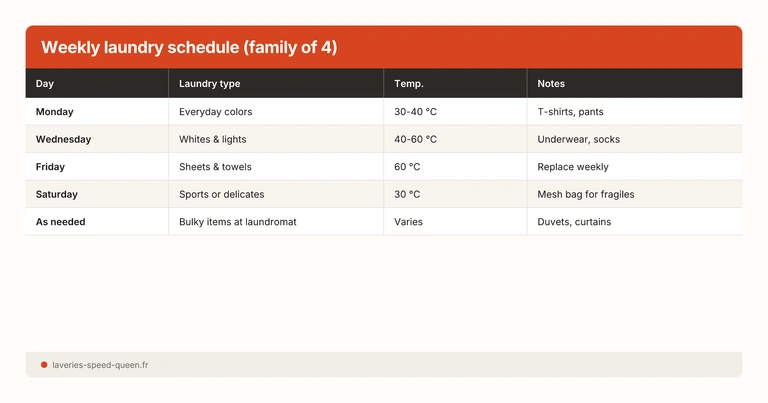
| Day | Laundry Type | Temperature | Notes |
|---|---|---|---|
| Monday | Everyday colours | 30-40 degrees C | T-shirts, trousers, lightweight jumpers |
| Wednesday | Whites and light fabrics | 40-60 degrees C | Underwear, socks, white shirts |
| Friday | Sheets and towels | 60 degrees C | Bed linen, kitchen towels |
| Saturday (optional) | Sportswear, delicates, or bulky items | 30 degrees C | Gym clothes, wool, or a laundromat session |
This schedule is not a rigid prescription — it is a template to adapt. What matters is fixing the days and sticking to them. Routine creates habit, and habit prevents accumulation.
Why One Laundry Type per Day
Washing by category (rather than by urgency) has three advantages:
- Sorting is already done — if every family member puts their laundry in the right basket throughout the week, there is nothing to sort on wash day
- The machine programme is fixed — Monday = colours at 30 degrees C, no need to think about it
- Volume is predictable — one category per day produces loads of a consistent size
For a detailed breakdown of sorting categories, see our complete guide to sorting laundry correctly.
Adjusting Frequency to Household Size
| Household | Laundry per Week | Loads per Week | Recommended Pace |
|---|---|---|---|
| 1 person | 5-6 kg | 1-2 | 1 load at the weekend, 1 midweek if needed |
| Couple | 10-12 kg | 2-3 | 2 fixed days (e.g. Tuesday and Saturday) |
| Family of 3-4 | 18-25 kg | 3-5 | 3-4 day schedule (Monday, Wednesday, Friday + optional Saturday) |
| Family of 5+ | 30-40 kg | 5-7 | Almost daily. Supplement with the laundromat (bulky items) |
For a household of 5 or more, a domestic 7-8 kg machine runs almost every day. In that case, the laundromat becomes an invaluable supplement: 10-18 kg machines handle in a single cycle what would take 2-3 domestic cycles. A Saturday morning laundromat session for sheets, towels, and duvets can free up the home machine for everyday clothes during the week.
For guidance on how often to wash each type of garment, see our dedicated guide with a complete frequency chart.
The Key Figure: 5-6 kg per Person per Week
This average (which includes clothing, underwear, socks, pyjamas, and a share of household linen) is the basis for any routine calculation. If your machine holds 7 kg, a single person needs one load per week, a couple needs two, and a family of 4 needs four to five. Add sheets and towels (3-5 kg per week for a household of 4) and you have your total volume.
The 5 Golden Rules of a Laundry Routine
1. Do Not Accumulate
The most important rule. A load every 1-2 days takes 5 minutes to prepare. Waiting until the weekend for 4-5 loads takes the entire morning. Consistency turns a chore into an automatic habit.
2. Sort Ahead of Time
Sorting should not happen on wash day -- it happens throughout the week. Three baskets in the laundry room (whites, colours, darks) let every family member sort as they go. On wash day, you just grab a basket and load the machine.
3. Fold Immediately
This is the step that stalls most often. Dry laundry left loose in a basket wrinkles, piles up, and becomes discouraging. The fix: fold and put away within 30 minutes of the drying cycle ending. Build that time into the routine.
4. Involve the Whole Family
Laundry is not one person's job. From age 5-6, a child can sort by colour. From 8-10, they can load and unload the machine. From 12, they can manage a full cycle. Gradual responsibility lightens the load for parents.
5. Use the Laundromat for Bulky Items
Duvets, blankets, curtains, post-holiday catch-up: these volumes overwhelm a domestic machine. A single laundromat session handles in 1-2 hours what would take an entire weekend at home. Save the laundromat for when your machine is not enough.
Organizing the Laundry Room: The Space That Makes the Routine
A well-organized laundry room reduces the time each laundry cycle takes. The goal: every step should be obvious and everything should be within arm’s reach.
The 3 Sorting Baskets
The minimum for a functional setup:
- Whites basket — white cotton, light underwear, white socks, white towels
- Colours basket — all coloured garments, from beige to bright red
- Darks basket — jeans, black clothing, navy, dark sportswear
If space allows, add a fourth “urgent” basket for stained items that need pre-treatment before washing. A t-shirt with a tomato sauce stain should not wait three days in the colours basket — pre-treatment is far more effective within the first few hours.
Label the Baskets
It sounds basic, but a label (even a strip of tape with a marker) is enough for every family member to sort correctly without asking. For children, use colour coding: white basket = white label, colours basket = multicolour label, darks basket = black label.
The Storage Area
Keep within arm’s reach:
- Detergent (one bottle, not three — simplify dosing)
- Stain remover (Marseille soap↗, white vinegar↗, or a spray stain remover)
- Mesh laundry bags (for lingerie, children’s socks, delicate fabrics)
- Hangers (5-10 ready to go for shirts and trousers)
The Bottleneck: Drying
Washing takes 1-1.5 hours with no human effort. Drying is the step that slows the entire chain.
Tumble Dryer
If you have a dryer, the chain flows smoothly: transfer immediately from the washer to the dryer, then fold as soon as the cycle ends. Allow 1-1.5 hours of drying time for a full load of cotton. Check our article to find out why laundry comes out damp from the dryer if you encounter this issue.
Indoor Drying Rack
Without a dryer, the drying rack is the choke point. A standard rack holds 1 load of laundry — as long as it is full, you cannot start the next load. Solutions:
- Invest in a large drying rack (or two small ones) to handle two loads in parallel
- Dry laundry in a ventilated room — not in a closed bedroom, which creates moisture problems. See our guide on indoor drying and humidity
- Use the laundromat for drying — even if you wash at home, you can dry at the laundromat to speed up the process
The Laundromat: Clearing the Bottleneck
At the laundromat, you can wash and dry in parallel. While the second wash is running, the first is already in the dryer. In 1.5-2 hours, you can process 3-4 full loads — a volume that would take 2-3 days at home with a single drying rack.
Getting Children Involved: By Age
| Age | Tasks They Can Handle | Supervision Needed |
|---|---|---|
| 3-5 years | Putting laundry in the basket, matching socks | Yes, as a game |
| 5-7 years | Sorting by colour, emptying the dryer | Yes, to check the sorting |
| 8-10 years | Loading/unloading the machine, hanging laundry | Occasional |
| 10-12 years | Folding laundry, putting it away in wardrobes | Minimal |
| 12+ years | Full cycle: sorting, washing, drying, folding, putting away | Independent with reminders |
The goal is not to exploit child labour — it is to build independence. A teenager who arrives at university halls without knowing how to run a washing machine will struggle. Laundry is a life skill, and gradual learning is the most natural way to pick it up.
The Sock Trick
Matching socks is a task that 3-to-5-year-olds love turning into a memory game. It also happens to be the most tedious task for adults. Handing socks over to the children is a win-win trade.
Practical Scenarios by Household Type
Single Person
Volume: 5-6 kg/week. Pace: 1-2 loads per week.
The simplest routine: one load at the weekend (everything except whites if you have a lot of them), and perhaps a second midweek for whites and towels. Fold and put away the same day. The laundromat is useful for duvets and occasional bulky items.
Couple Without Children
Volume: 10-12 kg/week. Pace: 2-3 loads per week.
Two fixed days are enough: one for colours (Tuesday, for example), one for whites and household linen (Saturday). If both people have staggered schedules, one can start the machine in the morning and the other can hang it in the evening. Coordination is everything.
Family of 3-4
Volume: 18-25 kg/week. Pace: 3-5 loads per week.
The 3-to-4-day schedule described above works well. The difficulty is drying (one rack is often not enough to handle 4 loads per week). Invest in a dryer or supplement with a laundromat session for sheets and towels.
Family of 5+
Volume: 30-40 kg/week. Pace: 5-7 loads, sometimes daily.
The machine runs almost every day. The schedule must be strict — each day its type of laundry — otherwise the backlog builds up fast. The laundromat is an essential supplement: a weekly session for sheets, towels, and household linen frees the home machine for everyday clothes.
When the Laundromat Complements the Routine
The laundromat is not a substitute for a home machine — it is an accelerator for situations where the home machine is not enough.
Duvets and Bulky Items
A double duvet weighs 3-5 kg and will not fit in a 7 kg machine. The 14-18 kg machines at the laundromat handle it in a single cycle, wash and dry included.
Back from Holiday
2 weeks of holiday x 4 people = 40-50 kg of dirty laundry. At the laundromat, 3-4 large machines handle everything in 2 hours instead of 4-5 days at home.
Moving House
Curtains, covers, blankets, bedding from both the old and new home: the laundromat absorbs the volume in a single session. See our guide on moving day laundry.
Machine Breakdown
A broken machine can take 1-2 weeks to repair or replace. The laundromat is the stop-gap solution that prevents a catastrophic backlog.
The Anti-Ironing Routine
Good drying technique reduces or eliminates the need for ironing. Build these habits into your routine:
- Remove laundry immediately when the cycle ends — every minute in the drum adds creases
- Shake each garment 2-3 times before hanging or putting it in the dryer
- Hang shirts and trousers on hangers rather than drying them flat
- Take laundry out of the dryer while still warm and fold within 5 minutes
For more tips, see our guide to ironing temperatures for when pressing is unavoidable.
Mistakes That Sabotage the Routine
- Waiting until the weekend to do it all -- the volume is overwhelming, drying bottlenecks everything, and Sunday is wasted.
- Overloading the machine -- a machine that is too full washes poorly and spins poorly. Laundry comes out creased and sometimes still dirty.
- Forgetting drying in the schedule -- starting a load without a plan for where to dry creates a bottleneck.
- Not folding immediately -- the basket of dry laundry 'to fold later' never gets folded. The longer it waits, the bigger it gets.
- Leaving stains to sit -- a stain treated within an hour comes out in one wash. After 3 days, it resists. Pre-treat immediately.
- Using too much detergent -- more detergent does not mean cleaner laundry. Excess product leaves residue on clothes and inside the machine. See our dosing guide.
The Schedule to Pin Up in the Laundry Room
Here is a simple template to adapt and display:
- Monday — Colours (30-40 degrees C)
- Tuesday — Rest (or extra load if the family is large)
- Wednesday — Whites and lights (40-60 degrees C)
- Thursday — Rest
- Friday — Sheets, towels, household linen (60 degrees C)
- Saturday — Sportswear, delicates, or laundromat session for bulky items
- Sunday — Rest (or catch-up if needed)
Adapt this template to your household: a couple may only keep 2 days, a family of 5+ may fill every day. The structure matters more than the exact content.
As an Amazon Associate, we earn a small commission on purchases made through affiliate links in this article — at no extra cost to you. This helps us maintain this site and produce free guides.
For bulky items — duvets, curtains, post-holiday catch-up — our laundromats in Blagnac, Croix-Daurade and Montaudran have machines from 10 to 18 kg and professional dryers. A 2-hour session handles what would take a full weekend at home. Payment contactless card or cash. Check our prices.
Sources and References
- Sorting laundry correctly
- Clothing washing frequency guide
- Folding and storing laundry
- Detergent dosage guide
- Ironing temperature guide
- Indoor drying and humidity
- How to wash a duvet
- Moving day: wash everything at the laundromat
- Average household laundry output: 5-6 kg per person per week (European textile industry data)
- Organizing your laundry room
- Domestic vs. professional machine capacity: 7-8 kg domestic, 10-18 kg laundromat