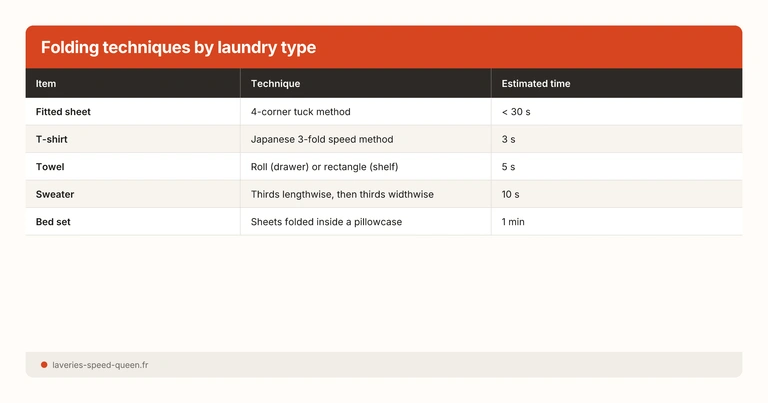
In short: folding laundry is a practical skill that saves time and space. The three essential techniques: the fitted sheet 4-corner method (nest the corners to tame the elastic), the t-shirt 3-fold (quick Japanese method) and towel rolls (space-saving and stable). For storage, vertical filing (Kondo method) in drawers and the pillowcase trick for bed linen sets are the two habits that change everything.
At a Glance
Fold immediately after drying -- warm laundry folds better and wrinkles less.
Fitted sheet: 4-corner method -- nest the elasticated corners inside one another.
T-shirt: 3-second quick fold -- Japanese method (pinch, cross, lay flat).
Vertical storage for drawers -- everything visible at a glance, no more collapsing piles.
Bed sets inside a pillowcase -- everything grouped and identifiable instantly.
Why Folding Properly Saves Time
Folding laundry properly may seem like an extra chore, but it is actually a time investment. Well-folded, well-stored laundry cuts the time spent:
- Searching for an item — in an organised drawer with vertical storage, you find any t-shirt in 2 seconds.
- Ironing — laundry folded right after drying has fewer wrinkles. Many items no longer need ironing at all.
- Putting away — when each category has a fixed spot, storing becomes automatic.
Folding takes roughly 15-20 minutes for a full load. That time is non-negotiable, but it pays for itself many times over in time saved day-to-day.
The Fitted Sheet: The 4-Corner Method
The fitted sheet is the arch-enemy of home folding. Its elastic prevents any clean crease and turns every attempt into a shapeless lump. The 4-corner method solves this.
Step by Step
Hold the sheet by two corners on the same short side — Slip your hands into two adjacent elasticated corners (for example the two top corners). The elastic should face you, the sheet hanging in front of you.
Nest the right corner into the left — Bring the right corner over the left and tuck it inside. Both corners are now nested on your left hand. You have a half-rectangle.
Pick up the other two corners and nest them — With your right hand, grab the two bottom corners (hanging down). Nest them into each other, then nest the lot into the corners already gathered on your left hand. All four corners are now stacked together.
Lay flat and fold into a rectangle — Place the sheet on a flat surface, adjust the edges to form an approximate rectangle. Fold in thirds lengthways, then in thirds widthways. You get a compact, stable rectangle.
The secret: nest, don't stack
The difference between a neatly folded fitted sheet and a ball: the corners must be nested inside one another (tucked in), not simply placed on top of each other. Nesting contains the elastic and lets the sheet lie flat. With practice, this technique takes under 30 seconds.
The T-Shirt: 3-Second Quick Fold
This Japanese method (popularised online) is spectacularly fast once mastered. It works for t-shirts, polos and short-sleeved tops.
The Technique
Lay the t-shirt face up, collar to your left — The t-shirt is flat on a surface, front facing up.
Identify three points — Point A: middle of the right shoulder. Point B: on the same vertical line as A, but at the midpoint of the t-shirt (half height). Point C: same vertical line, at the bottom (hem).
Pinch B with your left hand — Pinch the fabric at point B (middle of the t-shirt).
Pinch A with your right hand, then cross to grab C — Without releasing B, pinch the shoulder (A) with your right hand. Pull your right hand down to also grab point C (hem) — you cross your arms.
Uncross your arms and lift — Uncross your arms pulling towards you. The t-shirt folds itself. Lay it on the table and tuck the remaining sleeve underneath.
With practice, this sequence takes 3 seconds per t-shirt. Across a stack of 10 t-shirts, you save 5-7 minutes compared with the classic fold.
Classic Fold (Alternative)
If the quick method does not suit you, the classic fold is still effective:
- Lay the t-shirt face down.
- Fold the left side towards the centre (sleeve included).
- Fold the right side over the top.
- Fold in half or thirds from bottom to top.
This fold is slower but more intuitive and produces a regular rectangle, ideal for vertical storage.
Towels: Roll vs Classic
Towels take up a lot of space in the linen closet. Two folding methods exist, each with its own advantages.
Classic Fold (Shelf)
- Fold the towel in half lengthways.
- Fold in half again in the same direction (you have a long strip).
- Fold in thirds widthways.
Result: a compact rectangle that stacks neatly on a shelf. Stack towels by size (bath, hand, guest). Limit to 4-6 per pile.
Roll Fold (Space-Saving)
- Fold the towel in half lengthways.
- Fold one corner towards the centre to form a triangle at one end.
- Roll tightly from the other end.
- Tuck the triangular end inside the roll to hold it closed.
Result: a compact, self-stable roll that does not unravel. Rolls stand upright in a basket or on a shelf. This method is ideal for fluffy towels you want to display in the bathroom — the “hotel look” is guaranteed.
Comparison: the roll takes roughly 15% less space than a classic fold for the same number of towels, because it eliminates the empty gaps between folds.
Vertical Storage (Marie Kondo Method)
Vertical storage means folding each item into a compact rectangle that stands upright and filing it vertically in the drawer — like books on a shelf. It is the most efficient method for drawers.
Why It Beats Stacking
In a classic stack, you only see the top item. To reach the one at the bottom, you have to lift the entire pile — and it often collapses in the process. With vertical storage, every item is visible at a glance from above the drawer. You grab the one you want without disturbing the rest.
How to Fold for Vertical Storage
The goal is a rectangle that stands upright. For a t-shirt:
- Fold in half lengthways (left over right).
- Tuck the sleeves in.
- Fold in thirds from bottom to top: hem to middle, then middle to collar.
- The final rectangle should stand upright when you set it on its edge.
For trousers:
- Fold in half (leg on leg).
- Fold the crotch outwards.
- Fold in thirds from bottom to top.
T-Shirts & Tops
Fold into a vertical rectangle. Arrange by colour or type (plain, printed, sports). Each t-shirt visible at a glance. A standard drawer holds 15-20 t-shirts vertically versus 8-10 in a stack.
Trousers & Jeans
Fold in half (leg on leg), then in thirds or quarters. Jeans are thick -- fold in thirds only. Store upright in the drawer or on a low shelf.
Socks
Lay both socks on top of each other. Fold in half or thirds depending on length. Store upright in a row. NEVER ball socks up (the outer sock stretches and loses its elasticity).
Underwear
Knickers: fold in thirds (waistband to gusset, then in half). Store upright in a row. Bras: lay flat, cups nested (see our guide on lingerie care).
The Pillowcase Trick: Storing Bed Linen Sets
This is one of the most practical and least-known storage hacks. The idea: store the entire bed linen set (fitted sheet, flat sheet, duvet cover) inside a matching pillowcase.
How to Do It
- Fold the fitted sheet (4-corner method).
- Fold the flat sheet into a rectangle.
- Fold the duvet cover into a rectangle.
- Stack the three folded items.
- Slide the stack inside a pillowcase from the same set.
- Tuck the pillowcase opening under the stack.
Why It Works So Well
- Everything stays together — no more orphan sheets whose matching cover you cannot find.
- Identifiable at a glance — the colour or pattern of the pillowcase tells you which set it is.
- Ready to go — on sheet-change day, you grab one “package” and everything is inside.
- Neat storage — pillowcase bundles stack or stand vertically without mixing up.
Organising the Linen Closet
A simple, consistent organisation system beats a complex one you will not follow. Three principles are enough.
Principle 1: A Fixed Spot for Each Category
Assign a shelf or compartment to each linen category and never change it. Example layout for a standard linen closet:
| Location | Contents | Folding Method |
|---|---|---|
| Top shelf | Bed linen sets (in pillowcases) | Pillowcase bundle |
| Middle shelf | Bath towels | Roll or classic |
| Bottom shelf | Hand towels, washcloths | Roll or classic |
| Drawer or basket | Kitchen towels | Vertical storage |
Principle 2: FIFO Rotation
FIFO = First In, First Out. Place clean linen at the bottom or back of the existing pile, and always take from the top or front. This way, every towel and sheet gets used equally. Without rotation, the items on top wear out prematurely while those at the bottom yellow in the closet unused.
Principle 3: No Overstocking
Do not keep 15 sheet sets for one bed. Three sets are enough: one on the bed, one in the closet (ready), one in the wash. The same principle applies to towels: 2-3 sets per person. Overstocking takes up space, yellows over time and degrades (fibres weaken from being folded in the same spot for too long).
After the Laundromat: Fold on the Spot
At a self-service laundromat, the most efficient moment to fold is right after the dryer, while the laundry is still warm. Most laundromats provide a folding table — use it.
The Express Method at the Laundromat
- Take the laundry out of the dryer and place it on the table.
- Sort into categories straight on the table: t-shirts on the left, towels in the centre, underwear and socks on the right.
- Fold by category — it is faster than picking items at random. Start with the bulkiest articles (sheets, towels).
- Stack in the bag by category — items going to the same storage spot together.
Folding on the spot at the laundromat takes 10-15 minutes for a full load. That time is more than recouped at home: you just transfer the stacks straight from the bag into the closet, with no re-sorting needed.
Time saver: fold at the laundromat
Folding laundry at the laundromat right after the dryer is the most efficient approach. The laundry is still warm (fewer wrinkles, no ironing needed), you have a flat surface available (the folding table) and the waiting time is already “invested”. Back home, all that is left is putting it away — 2 minutes instead of 20.
Other Items to Fold: Specific Techniques
Shirts and Blouses
- Button every other button (maintains the shape).
- Lay face down.
- Fold one sleeve and its corresponding side towards the centre.
- Do the same on the other side.
- Fold in half or thirds from bottom to top.
To avoid creases: fold immediately after drying or after a light ironing. Hanging on a hanger is still preferable if you have the space.
Jumpers and Knitwear
Jumpers should never be hung on hangers (the weight of the fabric stretches and deforms the shoulders). Fold in thirds widthways (left sleeve + body + right sleeve), then in half or thirds lengthways. Store flat or in a low stack (3-4 maximum).
Jeans and Trousers
- Fold in half (leg on leg).
- Smooth along the seam.
- Fold in thirds from bottom to top (hem to knee, knee to waistband).
Jeans are thick — do not force the crease. A fold in half (then a roll) is an alternative for vertical storage.
Mistakes to Avoid
- Leaving laundry in a heap in the basket -- it wrinkles, picks up creases and can develop a musty smell if left too long.
- Balling up socks -- the outer sock stretches at the ankle and loses its elasticity. Fold socks flat, one on top of the other.
- Hanging heavy jumpers on hangers -- the fabric weight permanently deforms the shoulders. Jumpers should be folded and stored flat.
- Stacking more than 6 items -- tall piles collapse. Keep to 4-6 items per stack, or switch to vertical storage.
- Folding bras in half -- moulded cups lose their shape. Store flat, cups nested.
- Ignoring FIFO rotation -- without rotation, the linen at the bottom of the pile yellows and weakens without ever being used.
Recap: 3 Common Scenarios
Scenario 1 — Back from the laundromat with a full bag: Take the laundry out and sort on the table into 3-4 categories. Fold the t-shirts (quick method), the towels (rolls) and the sheets (4 corners + pillowcase). Store by category in the closet. Total time: 15-20 minutes.
Scenario 2 — Weekly sheet change: Grab the pillowcase bundle containing the clean set. Take out fitted sheet, flat sheet and cover. Make the bed. Roll the dirty set and toss it in the laundry basket. Time saved compared with hunting for separate items: 5 minutes.
Scenario 3 — Reorganising a chaotic t-shirt drawer: Empty the drawer. Fold every t-shirt into a vertical rectangle (Kondo). File upright, sorted by colour or type. You go from 8-10 visible t-shirts (stacked) to 15-20 (vertical) in the same space, each identifiable at a glance.
As an Amazon Associate, we earn a small commission on purchases made through the affiliate links in this article — at no extra cost to you. This helps us maintain this site and produce free guides.
After washing and drying at our laundromats in Blagnac, Croix-Daurade and Montaudran, use the on-site folding table to fold your laundry while it is still warm. The result: fewer wrinkles, no ironing and express storage at home. Payment contactless card or cash. See our prices.
Sources and References
- How often to wash sheets
- How to wash jeans properly
- Fluffy towels: the guide
- Ironing temperature guide
- Tumble dryer guide
- Drying laundry indoors without humidity
- Washing lingerie and bras
- First time at a laundromat
- KonMari method — vertical storage and category-based folding (Marie Kondo)
- Domestic storage ergonomics — FIFO principle applied to household linen