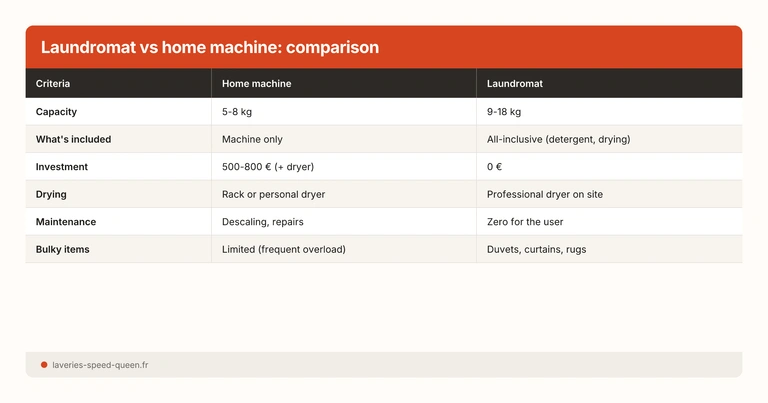
In short: A self-service laundromat offers advantages a home machine simply cannot match: commercial drums up to 18 kg, immediate drying, zero upfront investment, zero maintenance and zero breakdown risk. For bulky items (duvets, curtains, rugs), large volumes and time savings, the laundromat is the most effective solution. Many households combine both — and the laundromat perfectly complements daily life for everything that exceeds a home machine’s capabilities.
At a Glance
Laundromat = power and capacity — 9 to 18 kg drums, commercial spin cycle, immediate drying, zero maintenance for the user.
Zero investment, zero risk — no machine to buy (500-800), no repairs (150-300), no risk of water damage (2,000-5,000).
Professional wash quality — commercial machines deliver a more thorough rinse and are 30-40% more water-efficient per kg than home machines.
The ideal complement — duvets, curtains, rugs, large volumes: the laundromat handles everything a home machine struggles with.
Overall Comparison
Each solution has its strengths. This table summarises the key differences to help you choose — or combine both.
| Criterion | Home Machine | Self-Service Laundromat |
|---|---|---|
| Capacity | 5-8 kg | 9-18 kg |
| What is included | Machine only — water, electricity, detergent and drying at your expense | All-inclusive: commercial machine, water, electricity, pre-dosed detergent, drying |
| Upfront investment | 500-800 (+ 300-600 tumble dryer) | 0 |
| Drying | Drying rack or tumble dryer (300-600) | Commercial dryer on-site |
| Availability | 24/7, at home | 7 days a week during opening hours |
| Maintenance | Descaling, cleaning, repairs | Zero for the user |
| Travel | None | Round trip required |
| Bulky items | Limited (frequent overloading) | Duvets, curtains, rugs — no problem |
The True Cost of a Home Machine
The purchase price does not tell the whole story. The hidden costs of owning a washing machine at home are widely underestimated.
The expenses nobody calculates
A mid-range home washing machine costs between 500 and 800. Its average lifespan is 10 years according to ADEME data. But the purchase price is only the tip of the iceberg.
Running costs build up quietly: water, electricity, detergent, softener, descaler, wear parts. Add the mandatory maintenance (descaling, filter cleaning, door seal cleaning) or risk a premature breakdown. And when things do go wrong, repairs run between 150 and 300 per call-out — control boards, drain pumps, bearings, heating elements.
The risk most people ignore? Water damage. A burst hose, a failing seal, and the bill climbs to 2,000-5,000 (floor damage, wall damage, sometimes the neighbour’s flat below). In an apartment, this is a very real risk that many tenants underestimate.
What a laundromat includes in every cycle
A laundromat cycle includes everything: a commercial-grade machine, water, electricity, pre-dosed detergent and fast drying. No upfront investment, no maintenance, no breakdown risk. You only pay for the service you use, when you need it.
The Real Comparison
The apparent cost of a home wash cycle (water + electricity + detergent) does not reflect the true cost: machine depreciation (500-800), repairs (150-300 per breakdown), space in your home, water damage risk, time spent on maintenance. At a laundromat, all these hidden costs and risks vanish. You leave with clean, dry laundry and zero surprises.
Capacity and Types of Laundry
Capacity is where the laundromat pulls ahead. An 18 kg drum can hold a double duvet — impossible in a 7 kg home machine without overloading it.
| Item | Average weight | Home machine (7 kg) | Laundromat (9-18 kg) |
|---|---|---|---|
| T-shirts, underwear | 0.2-0.3 kg each | Perfect | Oversized |
| Double bed sheets | 1-1.5 kg each | OK (2-3 sheets max) | Comfortable |
| Single duvet | 2-3 kg | Tight (7 kg machine min.) | Comfortable (9 kg) |
| Double duvet | 3-5 kg | Too tight / overloaded | Perfect (18 kg) |
| Long curtains | 2-4 kg/pair | Possible if lightweight | Comfortable |
| Living room rug | 3-8 kg | Impossible | 18 kg machine |
For everyday laundry (clothing, underwear, small textiles), a home machine is perfectly suited. For bulky items, check our dedicated guides: how to wash a duvet, washing curtains and washing a rug.
Wash Quality
Let’s be honest: for everyday laundry (t-shirts, jeans, sheets), the difference in results between a recent home machine and a commercial machine is minimal. Both clean cotton and polyester well at 30-40 degrees C.
The difference shows up in three areas.
Water volume
Commercial machines use 30 to 40 percent more water per kilogram of laundry than home machines. More water means a more thorough rinse — particularly important for sensitive skin, allergens and heavily soiled items. The result is cleaner laundry with no detergent residue.
Spin cycle
A commercial spin reaches 1,000-1,200 rpm with a wider drum. Laundry comes out drier, cutting drying time. Recent home machines spin at 1,200-1,400 rpm but in a smaller drum — the result is similar for light loads.
Drum space
This is the key factor for bulky items. A duvet in an 18 kg drum has room to expand, tumble properly and rinse thoroughly. In a 7 kg drum, it gets compressed — both washing and rinsing are less effective.
What Independent Tests Show
Independent tests (such as Which? and Consumer Reports) show that well-rated home machines achieve excellent wash results on everyday laundry. The superiority of commercial machines lies mainly in throughput and mechanical durability (designed to run 8 to 12 hours a day), not in how well they clean a t-shirt.
Day-to-Day Convenience
This is where the home machine scores clear points — and it would be dishonest to deny it.
Home machine: comfort
Available 24/7 with no travel. Start a load in the evening, hang it to dry in the morning. No need to transport laundry, no waiting on-site. For families with young children or people with limited mobility, this is a decisive advantage.
Laundromat: overall time savings
Everything is done in 1 hour (wash + dry). No drying rack, no 12 to 24 hours waiting for laundry to dry indoors. No machine maintenance. You leave with clean, dry laundry. For people in a flat without a tumble dryer, this is a net gain.
Advantages of a home machine
- Always available — wash at any hour, even at 11 pm
- Small loads — a single stained sheet, 3 gym shirts — no need to fill a 9 kg drum
- Delicates — gentle cycles at 20-30 degrees C, reduced spin, wool/silk programmes
- No travel — no lugging laundry, no commute time
- Privacy — your laundry stays at home
Advantages of a laundromat
- Immediate drying — commercial dryer on-site, no drying rack needed
- Zero maintenance — no descaling, no machine cleaning, no repairs
- Large volumes — run 3-4 machines in parallel and wash everything in one hour
- No clutter — no machine taking up space in the bathroom
- Detergent included — automatic dosing, nothing to buy
Maintenance and Lifespan
A home machine needs regular maintenance to last 10 years. At a laundromat, maintenance is invisible to the user — it is handled by the operator.
Home machine: maintenance is on you
Filter cleaning (monthly), descaling (2-4 times/year depending on water hardness), door seal cleaning, empty hot cycle at 90 degrees C. If it breaks: repair (150-300) or replacement. Average lifespan: 10 years (ADEME).
Laundromat: zero hassle
Speed Queen commercial machines are built to last 25 years under heavy use (10,000+ cycles). Daily upkeep (cleaning, maintenance, repairs) is handled by the operator. You pay nothing extra if a machine breaks down.
When the Laundromat Is Unbeatable
In certain situations, a home machine is not an option — or the laundromat is objectively the better solution.
Duvets, curtains, rugs
Items over 5 kg need an 18 kg drum to be washed properly. In a home machine, overloading damages the drum and gives poor results. At a laundromat: duvet clean in 1 hour for around 16 all in.
Moving day and large volumes
Curtains from the old flat, sheets to freshen up, clothes that have been in storage for months. At a laundromat, load 3-4 machines at once and everything is washed and dried in 1 hour. See our moving day guide.
Students and temporary housing
In a student hall or short-term flatshare, buying a 600 machine makes no sense for 1 to 3 years. The laundromat provides an immediate service with no investment, no installation and no water-damage insurance to worry about.
Machine breakdown
Your washer breaks down on a Sunday? The laundromat is open. While you wait for a repair or delivery, the laundromat keeps you going. It is also a chance to discover how a laundromat works.
When a Home Machine Is Ideal
A home machine has its sweet spots — but the laundromat remains a valuable complement in every scenario.
Families with children
The daily volume of children's clothes, bibs, sheets and towels suits a home machine. But the laundromat remains a valuable complement for children's duvets, bulk sports kit and catching up after hectic weeks — while also sparing your home machine from overloading.
Small daily loads
A gym shirt, a shirt for tomorrow, a week's underwear. These small loads do not justify a trip to the laundromat or filling a 9 kg drum. A home machine handles these needs with no waste.
Delicate everyday items
Wool, silk, delicate low-temperature cycles with reduced spin are easy to select on your own machine. At a laundromat, programmes are more standardised and geared towards everyday fabrics.
Irregular hours
You work shifts, you work from home, you prefer to start a load at 10 pm — a home machine adapts to your schedule, not the other way round.
The Winning Combo: Using Both
Most households do not have to choose between a laundromat and a home machine. The most effective solution is to combine both — each in its area of strength.
The home machine handles everyday laundry: clothes, underwear, small textiles, regular sheets. It runs 3 to 5 times a week at a marginal cost.
The laundromat takes over when the home machine reaches its limits: duvets, curtains, rugs, moving day, spring cleaning, machine breakdown.
The Complementary Approach in Practice
Day to day: your home machine, 3-5 cycles per week. Annual cost: approx. 130 (water, electricity, detergent).
Every 2-3 months: a laundromat visit for duvets, curtains or large volumes. Annual cost: approx. 60-80 (4-6 visits).
Total: approx. 200/year for spotless laundry, without overloading your machine or giving up the comfort of washing at home.
Summary by Profile
| Profile | Recommended solution | Why |
|---|---|---|
| Student / temporary housing | Laundromat as primary | No investment, no installation, low frequency |
| Single person in a flat | Home machine + occasional laundromat | Everyday comfort, laundromat for duvets and bulky items |
| Couple without children | Home machine + occasional laundromat | 2-3 loads/week at home, laundromat for volumes |
| Family with children | Home machine + regular laundromat visits | Laundromat for duvets, rugs, large volumes — protects your machine |
| Flatshare (3-5 people) | Laundromat as primary or shared machine | High volume, rotation of loads, laundromat more practical |
| Flat with no water hookup | Laundromat exclusively | Only option without plumbing work |
To estimate the exact cost of a laundromat visit for your load, see our laundromat price guide and our Speed Queen prices.
When to Combine Both: Practical Scenarios
The theory behind the “winning combo” is simple, but how does it work in practice? Here are the situations where alternating between a home machine and a laundromat is most cost-effective.
Everyday at home, monthly at the laundromat. Run your home machine 3-5 times a week for everyday laundry (clothes, underwear, sheets). Once a month, take the items your machine cannot handle well to the laundromat: the duvet (3-5 kg, too bulky for a 7 kg drum), curtains (2-4 kg per pair but bulky), and bath towels in one big load (one 18 kg cycle washes every towel in the household at once, instead of 3 cycles at home).
Catching up after a hectic week. During the weeks when the basket overflows — a child falls ill, rain prevents drying, a sporty weekend away — the laundromat absorbs the backlog in one hour. Load 2-3 machines in parallel, sorted by temperature: that is the equivalent of 8-10 hours of home laundry compressed into 60 minutes.
Seasonal changeover. In March and October, pull out seasonal clothes and wash them before storing or wearing them. A single laundromat trip handles the entire batch (winter blankets, coats, light summer duvets). This transition wash extends the life of stored textiles — sebum and sweat oxidise fibres during months of storage if laundry is not washed before being put away.
Machine breakdown. On average, a home washing machine breaks down once every 3-4 years. Knowing you have the laundromat as a fallback prevents dirty laundry from piling up while you wait for the repair technician.
Environmental Impact: The Forgotten Factor
Beyond convenience, the environmental footprint is a strong argument in favour of the laundromat. Commercial machines use 30 to 40 percent less water and energy per kilogram of laundry than home machines, because they run at full capacity with drums optimised for efficiency.
On the energy side, commercial machines incorporate heat-recovery systems and are engineered for tens of thousands of cycles. Their exceptional lifespan (25 years under heavy use) also reduces the manufacturing footprint, amortised over far more cycles than a home machine (10 years on average according to ADEME). Choosing the laundromat for your bulky items is also a choice for the environment.
Sources and References
- ADEME, Household Appliance Consumption Data, 2025
- Which? / Consumer Reports, Washing Machine Buying Guide, accessed March 2026
- Speed Queen, SC Range Technical Documentation, commercial machine specifications
- Laundromat prices in 2026
- First time at a laundromat
- Laundromat vs dry cleaning
- Washing machine water and energy consumption
As an Amazon Associate, we earn a small commission on purchases made through the affiliate links in this article — at no extra cost to you. This helps us maintain this site and produce free guides.
Our laundromats in Blagnac, Croix-Daurade and Montaudran complement your home machine for bulky items and one-off situations. Machines 9 à 18 kg, detergent included, drying on-site. Open daily. See our prices.