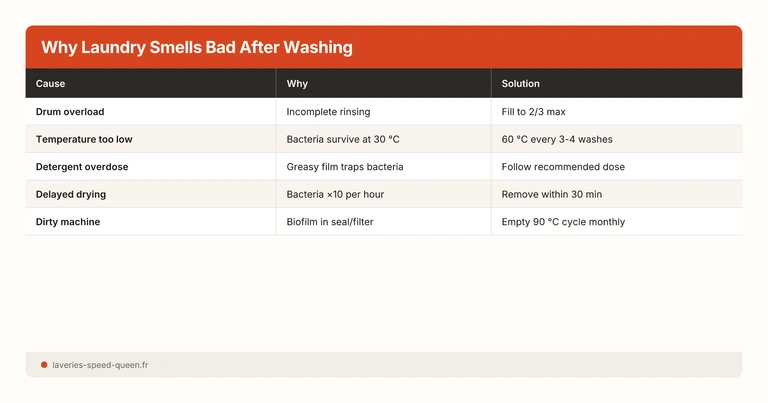
In short: Laundry that smells bad after washing is almost always a bacterial problem. The bacterium Moraxella osloensis thrives in damp fibres and produces rancid-smelling fatty acids. The 6 main causes: drum overloading, temperature too low, too much detergent, delayed drying, dirty machine, and excess fabric softener. The recovery protocol: baking soda soak, rewash at 60 °C with white vinegar in the rinse, immediate drying.
At a Glance
Main cause: bacteria — Moraxella osloensis thrives in damp conditions and produces the characteristic "wet rag" smell.
Fill the drum two-thirds max — an overloaded drum prevents proper rinsing and creates pockets where bacteria survive.
60 °C every 3-4 washes — the only temperature that kills bacteria resistant to warm cycles.
Dry immediately — every hour in a sealed, damp drum encourages bacterial growth.
Correct dosing — too much detergent creates a greasy film that traps bacteria in the fibres.
Why Laundry Smells Bad After Washing
That musty laundry smell is not a detergent problem — it is a bacteria problem. The bacterium Moraxella osloensis is the main culprit.
Researchers at Moriyama University (Japan) identified this bacterium in 2012 as the dominant cause of persistent odour on washed laundry. Moraxella osloensis colonises damp textile fibres and produces 4-methyl-3-hexenoic acid — a volatile organic compound responsible for the unmistakable “wet rag” smell everyone recognises.
The mechanism is straightforward:
- Colonisation — bacteria attach to fibres while you wear the garment (sweat, dead skin cells)
- Survival through washing — a 30-40 °C cycle does not kill all bacteria. Survivors form a biofilm: a protective layer that clings to fibres and resists subsequent washes
- Proliferation in damp conditions — after washing, laundry sits damp in the drum. Surviving bacteria multiply rapidly in this warm, humid environment
- Odour production — by metabolising organic residues (sebum, sweat, detergent residue), bacteria produce volatile fatty acids with a rancid smell
What the science says
The study by Kubota et al. (2012, Applied and Environmental Microbiology) showed that Moraxella osloensis is present in quantities 10 times higher on malodorous towels compared to odour-free towels. The bacterium survives 30 °C cycles but is eliminated at 60 °C and above.
The problem worsens over successive washes: each inadequate cycle adds another layer of bacteria to the existing biofilm. This is why the smell builds gradually and becomes increasingly difficult to eliminate.
The 6 Most Common Causes
In the vast majority of cases, the odour results from a combination of several factors. Fixing just one may not be enough.
1. Drum Overloading
A drum filled to the brim prevents water and detergent from circulating freely between fabrics. Some areas of the laundry are never properly rinsed: bacteria survive intact. The rule is to fill the drum only two-thirds of its capacity.
2. Consistently Low Temperatures
Washing exclusively at 30 °C saves energy, but this temperature does not kill Moraxella osloensis. The bacteria survive, multiply, and form an increasingly resistant biofilm. Without a regular hot cycle, the problem becomes permanent.
3. Too Much Detergent
Counterintuitive, but excess detergent makes odours worse. The surplus does not rinse out fully and deposits a greasy film on the fibres. This film traps bacteria and provides them with a nutrient base. The correct dose is what the manufacturer recommends — reduced by 30% if your water is soft (below 15 °f / about 150 ppm hardness).
4. Delay Between Washing and Drying
Forgetting laundry in the drum after the spin cycle is the most common cause of one-off bad smells. The sealed, warm, damp drum is a perfect incubator for bacteria. After 2 hours, the smell is virtually guaranteed. Ideally, remove laundry within 30 minutes of the cycle ending.
5. A Dirty Machine
The door seal, detergent drawer, and drum itself accumulate detergent residue, mould, and bacteria over time. A dirty machine contaminates laundry with every cycle. A regular machine clean (empty hot cycle at 60-90 °C with white vinegar↗, once a month) is essential.
6. Excess Fabric Softener
Fabric softener deposits cationic agents (surfactant fats) on fibres to make them feel soft. In excess, this greasy film prevents proper rinsing, traps bacteria, and blocks the breathability of fabrics. On certain materials (terry cloth, synthetics), it significantly worsens the odour problem.
The classic vicious cycle
Laundry smells bad → you add more detergent and fabric softener → residue builds up in the fibres → bacteria cling even better → the smell gets worse. The solution is not more product but better rinsing and correct dosing.
The Towel Problem
Terry cloth is the fabric most prone to odour issues. Its looped structure retains moisture and provides a massive surface area for bacteria.
Bath towels tick every risk factor:
- Terry structure — the loops increase the exposed fibre surface. More surface = more attachment points for bacteria
- Used in a damp environment — the towel is used wet, in a humid bathroom, then often left bunched up on a poorly ventilated towel rail
- Slow drying — the thickness of terry cloth holds water for a long time, giving bacteria time to multiply between uses
The protocol for towels is strict: wash at 60 °C every time, white vinegar in the fabric softener compartment (no conventional softener), and complete drying in a tumble dryer or on a rack in a well-ventilated room. For a full towel care guide, see our article on keeping towels fluffy.
The Synthetics Problem
Synthetic fibres (polyester, elastane) trap bacteria in microcavities that standard rinsing does not clean thoroughly.
Polyester has an irregular surface dotted with micro-pores where bacteria lodge and form a resistant biofilm. Unlike cotton, which absorbs water and bacteria at the surface (a normal wash removes them), synthetic fibres require thorough rinsing and powerful mechanical action to dislodge the biofilm.
This is why synthetic sportswear is particularly prone to stubborn odours. We have a full article on the subject: sportswear that smells bad: causes and solutions.
Recovery Protocol
If laundry already smells bad, a simple rewash is not enough. You need to break the bacterial biofilm before rewashing.
Baking soda soak (2 hours)
Fill a basin with warm water and add 2 tablespoons of baking soda per litre of water. Submerge the smelly laundry for 2 hours. Baking soda is an alkaline agent that neutralises the fatty acids produced by bacteria and loosens the biofilm from fibres.
Rewash at 60 °C with white vinegar
Wring out the laundry and run a 60 °C cycle with your regular detergent (normal dose, no more). Add a cup of white vinegar (150-200 ml) to the fabric softener compartment — it will act during the rinse to dissolve remaining residue and neutralise surviving bacteria.
Immediate, thorough drying
Remove the laundry as soon as the cycle ends. Tumble dryer or drying rack in a ventilated room: the key is that the laundry is dry within 4 hours. Fast drying deprives surviving bacteria of the moisture they need to reproduce.
Check and repeat if needed
Smell the laundry once dry. If an odour persists, repeat the protocol. A biofilm that has built up over several weeks may need 2 to 3 rounds to be completely eliminated.
Delicate fabrics
For fabrics that cannot handle 60 °C (silk, wool, some synthetics), extend the baking soda soak to 4 hours and rewash at the maximum temperature shown on the care label. White vinegar in the rinse is compatible with all fibres.
Prevention: 5 Daily Habits
Fixing the problem once is pointless if bad habits persist. These 5 habits prevent the smell from coming back.
1. Fill the Drum Two-Thirds Full
Always leave a fist-sized gap between the laundry and the top of the drum. The laundry needs room to tumble freely during the cycle so that water and detergent reach every fibre.
2. Alternate Temperatures
Run a 60 °C cycle every 3-4 washes to kill bacteria that survive warm cycles. Sheets, towels, and tea towels should always be washed at 60 °C. Everyday items (t-shirts, trousers) can alternate between 30 °C and 40 °C.
3. Dose the Detergent Correctly
Follow the manufacturer’s recommendations. In soft water (below 15 °f / about 150 ppm), reduce the dose by 30%. If you are unsure about your water hardness, your local water supplier can provide the information. Correct dosing prevents residue from building up in fibres.
4. Remove Laundry Immediately
Set an alarm if needed. Laundry should leave the drum within 30 minutes of the spin cycle ending. Every extra hour in a sealed, damp drum multiplies the bacterial population. If you dry indoors, ensure enough ventilation for the laundry to dry within 4 hours.
5. Maintain the Machine
Run an empty hot cycle at 60-90 °C with white vinegar once a month. Clean the door seal and the detergent drawer every 2 weeks. Leave the door ajar between cycles to ventilate the drum.
- Do not leave damp laundry in a bag or basket — even before washing, damp items (towels, sportswear) should air-dry before going into the laundry basket
- Do not close the drum door — after every cycle, leave the door ajar to ventilate and prevent condensation
- Do not rewash without treating first — rewashing smelly laundry at 30 °C with no pre-soak just redistributes the bacteria
- Do not mask with fragrance — scented beads and perfumed fabric softeners hide the smell but do not address the bacterial cause
The Laundromat Advantage
Higher water volume, immediate drying, and professional machine maintenance eliminate the three main factors behind bacterial growth.
Higher water volume
Commercial machines use 50 to 60 litres of water per cycle, compared to 15 to 20 litres in a modern home machine. This higher volume dilutes bacteria, detergent residue, and fatty acids, then flushes them out during rinsing. The result is genuinely clean laundry, not just fabric tumbled in minimal water.
Immediate on-site drying
The commercial dryer is 2 metres from the washer. No carrying laundry in a bag, no damp clothes sitting on a rack for 12 hours. The immediate transfer from washer to dryer eliminates the window for bacterial growth — the number one factor behind bad smells.
Self-cleaning machines
Professional Speed Queen machines run automatic rinse cycles between uses. No mould in the seal, no residue in the detergent tray, no biofilm in the drum. Every customer gets a clean machine.
Powerful mechanical action
Commercial drum motors generate more force. Mechanical action is what dislodges the bacterial biofilm from fibres — more effectively than temperature or detergent quantity alone. Combined with the higher water volume, this agitation reaches areas that home machines cannot rinse properly.
The Wet Laundry Test: Diagnosing the Source
If your laundry smells bad after washing, a simple test helps determine whether the machine or the drying process is the problem. Wash a small load, remove it immediately, and smell it. If it already smells bad straight out of the drum, the machine is at fault — biofilm, mouldy seal, or accumulated residue.
If the laundry smells fine out of the drum but develops an odour as it dries, the problem is the drying process. Laundry that dries too slowly (poorly ventilated room, overloaded rack, indoor drying without airflow) encourages Moraxella osloensis — the bacterium responsible for that distinctive “not-quite-fresh” smell.
At a laundromat, immediate tumble drying eliminates this risk. The laundry goes straight from the wash drum to the dryer drum — no damp waiting time. This is often why laundromat-washed clothes “smell better” than home-washed ones.
As an Amazon Associate, we earn a small commission on purchases made through affiliate links in this article — at no extra cost to you. This helps us maintain this site and produce free guides.
Laundry that still smells bad despite multiple washes? The thorough rinsing (50-60 L per cycle) and immediate drying of our professional machines eliminate the bacteria responsible for odours. Laundromats in Blagnac and Croix-Daurade, open 7 days a week from 7am to 10pm, detergent included in the price. 9 kg machine from €4.90. See our prices.
Sources and References
- Kubota H. et al., “Moraxella osloensis and Laundry Malodor”, Applied and Environmental Microbiology, 2012 — identification of Moraxella osloensis as the main cause of laundry odour
- Washing temperature guide
- White vinegar and laundry: uses and limits
- Detergent dosage guide
- Indoor drying: humidity and mould