In short: A wash cycle of 6 kg of synthetic textiles releases between 500,000 and 6,000,000 plastic microfibres (10-100 µm). Acrylic emits 5 times more than polyester. Cold water (20-30 °C) reduces release by 30-40%. Microfibre filters retain 80-90% of particles. France’s AGEC law (2020) and European ecodesign work are paving the way for mandatory filtration on new machines.
What Is a Plastic Microfibre?
These are synthetic fragments smaller than 5 mm, typically around 10-100 µm, torn from textiles by friction and agitation in the machine.
A plastic microfibre is a fragment of synthetic fibre measuring less than 5 mm long — most are between 10 and 100 µm (micrometres), thinner than a human hair. These particles come from the mechanical fragmentation of synthetic textiles during washing: friction between garments, drum agitation, and water action dislodge tiny pieces of fibre.
The main materials involved:
- Polyester: 60% of global textile production. Found in most sportswear, fleece, linings.
- Nylon (polyamide): swimwear, tights, technical clothing.
- Acrylic: jumpers, scarves, beanies, cheap throws.
Cotton, wool, and linen also release fibres during washing, but these natural fibres biodegrade within a few weeks to months. Synthetic fibres, on the other hand, persist in the environment for decades or even centuries.
How Many Microfibres Does One Wash Release?
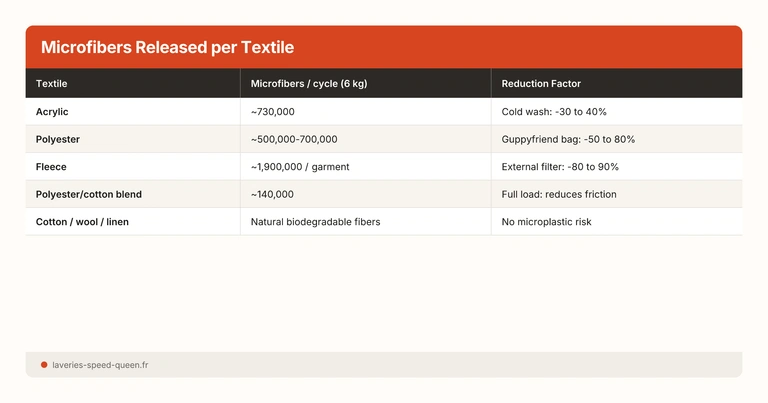
According to published protocols, a cycle of 6 kg of synthetics typically releases from several hundred thousand to several million microfibres.
Quantification studies produce figures that vary by protocol, but the order of magnitude is consistent:
The summary table below brings together the main published measurements of microfibres released per cycle.
| Study | Textile tested | Microfibres per cycle | Conditions |
|---|---|---|---|
| Napper & Thompson (2016) | Polyester | approx. 500,000 | 6 kg, 30 °C |
| Napper & Thompson (2016) | Acrylic | approx. 730,000 | 6 kg, 30 °C |
| De Falco et al. (2018) | Polyester | approx. 700,000 | 6 kg, 40 °C |
| Browne et al. (2011) | Polyester (fleece) | approx. 1,900,000 | Per garment, standard cycle |
| De Falco et al. (2018) | Polyester/cotton blend | approx. 140,000 | 6 kg, 40 °C |
Acrylic is the highest-emitting textile: it releases up to 5 times more microfibres than polyester under equivalent conditions. Fleece garments are also very high emitters due to their long, loosely-bound fibre structure.
Factors That Increase Release
The most damaging parameters are heat (40-60 °C), intensive cycles, and new or worn acrylic textiles.
Several parameters influence the amount of microfibres released with each wash:
The table below ranks the most significant factors for reducing microplastic emissions.
| Factor | Impact | Detail |
|---|---|---|
| Water temperature | ++ | Washing at 40-60 °C releases 30-40% more fibres than at 20 °C (Napper & Thompson, 2016) |
| Cycle intensity | +++ | An intensive cotton programme releases more than a delicate cycle with reduced spin |
| Textile age | ++ | New garments release more during the first washes; after 5-10 cycles, release stabilises |
| Load size | + | Incomplete loads increase relative friction between textiles |
| Detergent type | + | Powder detergents are slightly more abrasive than liquids |
| Fibre condition | ++ | Pilled or worn fabrics release more fragments |
The worst-case combination: a new acrylic garment, washed at 60 °C on an intensive cycle with a small load. The best-case combination: a broken-in polyester garment, washed cold on a delicate cycle with a full load.
Solutions to Reduce Microplastics in the Wash
The most immediate reduction combines cold washing, delicate cycles, optimised loads, and a microfibre capture device.
No single solution eliminates microplastics entirely. But several combined actions significantly reduce release:
Adjust Washing Conditions
- Wash cold (20-30 °C): -30 to 40% microfibres. See our washing temperature guide and our cold wash guide to learn which textiles tolerate it.
- Delicate cycle with reduced spin: less mechanical friction.
- Full load: garments rub against each other less when the drum is well filled. Our laundry weight guide helps you optimise loading.
Use Filtration Devices
- Wash bags (Guppyfriend type): retain 50-80% of microfibres in a fine-mesh bag
- External filters (Lint LUV-R, PlanetCare type): attach to the drain hose and capture 80-90% of fibres
- Capture balls (Cora Ball type): microfibres cling to the ball’s stalks during the cycle
Choose More Responsible Textiles
- Favour natural fibres (cotton, linen, wool) when the use case allows
- Avoid cheap fleece and acrylic garments (maximum release)
- Cotton/polyester blends release significantly less than 100% synthetic
To learn more about the environmental impact of laundry, see our guide to eco-friendly laundromat technologies. You can also discover how to wash cold to reduce your impact.
The Role of Professional Machines
At the laundromat, better-filled loads and optimised cycles limit mechanical abrasion — and therefore microfibre release.
The phenomenon is inherent to synthetic textiles themselves. However, laundromat machines offer several features that indirectly limit release:
- Optimised loads: at the laundromat, users generally fill machines well (9 or 18 kg), which reduces relative friction between textiles
- Shorter cycles: professional programmes are optimised for duration, reducing mechanical agitation time
- Filtration infrastructure: industrial drainage systems can be fitted with higher-performance microparticle filters than domestic installations
That said, the higher water volume (50-60 L versus 35-45 L in domestic machines) is neither an advantage nor a disadvantage for microplastics: it dilutes the fibres but does not reduce their total number.
European Regulation
The regulatory trajectory is moving toward mandatory filtration on new machines, but final requirements still depend on implementing legislation.
The regulatory framework is evolving rapidly, but three levels must be distinguished: restriction of intentionally added microplastics, ecodesign requirements for machines, and national obligations.
| Date | Legislation | What it changes in practice |
|---|---|---|
| 2020 | AGEC Law (France) | Establishes the principle of microfibre filtration equipment on new washing machines, with implementation via secondary legislation (Law No. 2020-105). |
| 2023 | Regulation (EU) 2023/2055 (REACH) | Reduces intentionally added microplastics and notes that laundry microfibres are a major source of unintentional release (OJEU L 238, 27/09/2023). |
| 2024-2025 | Ecodesign / ESPR work | The European Commission is preparing harmonised technical requirements for appliances, including reduction of microfibre release (ecodesign roadmaps). |
| Transitional phase | Industrial deployment | Manufacturers and operators are progressively deploying water-outlet filtration solutions while awaiting final harmonised obligations. |
In practice: it is reasonable to anticipate widespread adoption of filters, but the exact date and minimum performance level still depend on implementing legislation.
Filtration Device Comparison (Published Data)
External filters are generally the most effective (often 80-90%), provided the cartridges are rigorously maintained.
| Device | Type | Observed retention rate | Source |
|---|---|---|---|
| Guppyfriend | Wash bag | Approximately 50-80% depending on protocol, textile, and fibre size | (De Falco et al., Scientific Reports, 2020; comparative laboratory reviews) |
| PlanetCare | External drain filter | Manufacturer-claimed range of 70-90%; highly sensitive to flow rate and cartridge maintenance | (manufacturer technical documentation + published third-party test reports; peer-reviewed publications still limited) |
| Lint LUV-R | External drain filter | Approximately 80-90% on fibres measured under controlled conditions | (university comparative tests cited in microfibre literature; consistent with De Falco et al., 2019) |
Key point: external filters are generally more effective than bags, but require strict maintenance (cartridge cleaning, disposal of filtered sludge as residual waste — never down the drain).
Impact by Textile Type
Acrylic remains the highest-emitting fibre, ahead of polyester and nylon, under comparable washing parameters.
| Fibre type | Relative emission level | What the studies show |
|---|---|---|
| Acrylic | Very high | Can exceed approx. 700,000 fibres per 6 kg cycle; often the highest-emitting fibre under comparable parameters (Napper & Thompson, Marine Pollution Bulletin, 2016). |
| Polyester | High | In the range of 500,000+ fibres/cycle depending on textile construction and temperature; high variability depending on yarn twist and garment condition (Napper & Thompson, 2016; De Falco et al., 2018). |
| Nylon (polyamide) | Medium to high | Release generally lower than acrylic but significant for technical textiles and intensive cycles; sensitive to mechanical abrasion (De Falco et al., 2018). |
What You Can Do Right Now
Operational priority: 20-30 °C, drum at 80-90%, liquid detergent, and a filtration barrier for every synthetic load.
Without waiting for regulation, here are the most effective steps:
Wash cold (20-30 °C) — reduces polymer weakening and lowers fibre release (Napper & Thompson, 2016).
Fill the drum well (80-90%) — less fabric-on-fabric impact, therefore less abrasion.
Liquid detergent — generally less abrasive than powders on synthetic textiles.
Microfibre bag or filter — an immediate physical barrier while awaiting widespread regulation.
The problem of textile microplastics is real and well-documented. It will not be solved by a single action, but the combination of good washing practices, filtration, and textile choices can significantly reduce our individual contribution. To learn more about responsible care for your delicate textiles.
Want to manage your cycles without overloading your home with humidity? Our laundromats in Blagnac and Croix-Daurade have machines suited to bulky loads. Check our prices and all our locations.
As an Amazon Associate, we earn a small commission on purchases made through affiliate links in this article — at no extra cost to you. This helps us maintain this site and produce free guides.
Methodology and Sources
- The quantitative data on microfibre release comes from studies published in peer-reviewed scientific journals (Marine Pollution Bulletin, Scientific Reports, Environmental Science & Technology).
- The figures presented are orders of magnitude from controlled experimental conditions. Actual results vary depending on machine type, programme, load, and textile condition.
- Regulatory information (European Union) is based on official texts published in the Official Journal of the EU.
Sources and References
- Napper, I.E. & Thompson, R.C. (2016). Release of synthetic microplastic plastic fibres from domestic washing machines: Effects of fabric type and washing conditions. Marine Pollution Bulletin, 112(1-2), 39-45.
- De Falco, F. et al. (2018). Microfiber Release to Water, Via Laundering, and to Air, via Everyday Use: A Comparison between Polyester Clothing with Differing Textile Parameters. Scientific Reports, 8, 14591.
- De Falco, F. et al. (2019). The contribution of washing processes of synthetic clothes to microplastic pollution. Scientific Reports, 9, 6633.
- Browne, M.A. et al. (2011). Accumulation of Microplastic on Shorelines Worldwide: Sources and Sinks. Environmental Science & Technology, 45(21), 9175-9179.
- AISE — International Association for Soaps, Detergents and Maintenance Products: www.aise.eu (lien externe)
- Regulation (EU) 2023/2055 of the European Parliament on microplastics