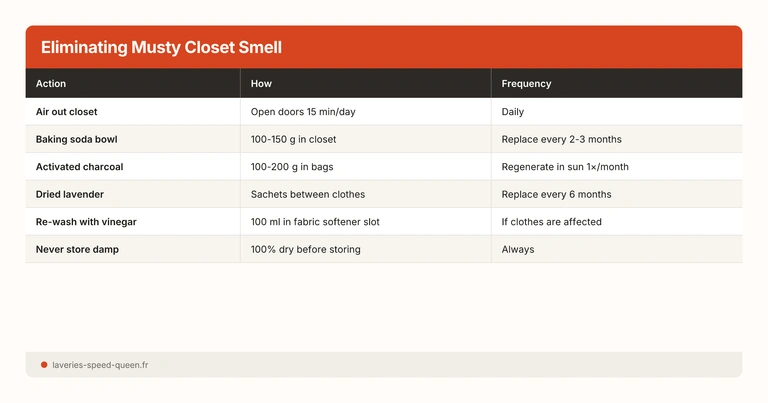
In short: musty closet smell comes from humidity, poor ventilation and clothes stored before fully dry. Solutions: air out the closet, install absorbers (baking soda, activated charcoal, lavender), and rewash affected clothes with white vinegar. Prevention: never store damp laundry and leave space between garments.
At a Glance
Main cause: humidity + stagnant air -- micro-organisms thrive in confined, damp spaces.
Never store damp laundry -- this is the number-one cause of musty closet smell.
Air out for 15 minutes a day -- simply opening the closet doors refreshes the air.
Baking soda in a dish -- a simple, effective odour and moisture absorber. Replace every 2-3 months.
Rewash with vinegar if the smell is embedded -- 100 ml of white vinegar in the softener compartment.
Why Closets Smell Musty: The Chemistry
A musty smell is not just an “old” odour. It is the result of measurable biological activity. Micro-organisms — bacteria and microscopic mould — grow on surfaces and textiles in a damp, poorly ventilated environment. By metabolising available organic matter (sweat residue, sebum, skin flakes), they produce volatile organic compounds (VOCs): short-chain fatty acids, aldehydes and sulphur compounds.
It is exactly the same mechanism that makes laundry smell bad after washing — except here, microbial growth happens during storage, not during the wash cycle.
The Three Necessary Conditions
A musty smell develops when three conditions are present simultaneously:
- Humidity: above 60 % relative humidity, mould grows. At 70-80 %, growth accelerates significantly.
- Poor ventilation: a permanently closed closet does not renew its air. VOCs accumulate, moisture stagnates.
- Organic matter: sweat, sebum and dead skin residue on clothes feed micro-organisms — even on washed laundry, trace amounts are enough.
Remove just one of these three conditions, and the smell will not develop.
Common Causes Inside a Closet
Clothes stored before fully dry
This is the number-one cause. A garment that feels dry to the touch may still contain 5-10 % residual moisture -- enough to support microbial growth in a confined space. Clothes taken from the tumble dryer while still warm and immediately put away are especially at risk.
Closet permanently shut
A closet with solid doors (no louvres) that stays closed for weeks creates a stagnant micro-climate. Moisture from clothes and ambient air accumulates, VOCs are not evacuated. The problem worsens in winter when indoor air is more humid.
Cold exterior wall (condensation)
A closet against an uninsulated exterior wall (north-facing wall, bare concrete) creates a cold spot. Air moisture condenses on the cold surface -- just like condensation on a window. The back of the closet stays permanently damp.
Overpacked closet
A closet filled to 100 % prevents air from circulating between garments. Central zones (between stacks of jumpers, behind thick coats) become pockets of stagnant moisture where mould thrives.
First Step: Empty and Air Out
Before any absorber or treatment, you need to break the current cycle. A closet that has smelled musty for weeks needs a complete reset.
Remove everything -- clothes, boxes, accessories. Lay it all on the bed or a drying rack to air.
Open the doors wide for 6-12 hours -- if possible, also open the room window to create a draught.
Wipe all surfaces -- shelves, back and sides with a cloth dampened with diluted white vinegar (1 part vinegar to 2 parts water). The acetic acid kills surface mould and neutralises odours.
Inspect the back of the closet -- black or green spots = mould. If the wall is damp to the touch, the problem is structural (condensation or water ingress) and needs fixing at the source.
Let everything dry fully -- do not put anything back until all surfaces are completely dry.
Visible mould = address it first
If you see mould patches (black, green, white) on the closet walls or on clothes, diluted vinegar alone is not enough. Clean with a 50/50 water and white vinegar mix and let dry completely. If mould returns quickly, the problem is linked to structural humidity in the wall — you need to address insulation or ventilation in the home.
Treating Clothes That Have Absorbed the Smell
A garment that has absorbed the musty smell for weeks will not regain its freshness by airing alone. The VOCs are trapped in the fibres — you need to rewash.
Method 1: White Vinegar Wash
White vinegar is the most effective and simplest solution for neutralising musty odours.
- Sort the musty laundry as usual (colour, fabric, temperature).
- Pour 100 ml of white vinegar↗ into the fabric softener compartment.
- Add your regular detergent to the detergent drawer.
- Run the normal cycle appropriate for the textile.
Vinegar is acidic (pH 2-3) and neutralises the alkaline VOCs produced by bacteria. It evaporates completely during rinsing — the laundry will not smell of vinegar.
Method 2: Baking Soda Soak
For very stubborn odours that have been embedded for months.
- Fill a basin with warm water (30-40 degrees C).
- Add 2 tablespoons of baking soda per litre of water.
- Submerge the clothes and soak for 2 hours.
- Rinse, then machine wash with detergent + vinegar in the softener compartment.
Baking soda neutralises volatile fatty acids and absorbs odour molecules. Machine washing after soaking ensures a thorough rinse.
Method 3: Hot Cycle for Sturdy White Fabrics
For white cotton sheets, towels and household linens that smell musty, a cycle at 60 degrees C with regular detergent is usually enough. The heat destroys the micro-organisms causing the odour and the surfactants in the detergent flush out residues.
The tumble dryer is not enough
Running a musty garment through the tumble dryer without rewashing just heats the VOCs — the smell stays or returns within hours. The dryer removes moisture but not the chemical compounds causing the odour. Wash first, then dry.
Odour Absorbers: What Actually Works
Baking soda in a dish
100-150 g of baking soda in an open dish at the bottom of the closet. Baking soda absorbs residual moisture and chemically neutralises volatile fatty acids. Replace every 2-3 months. Simple, cheap, effective for prevention.
Dried lavender sachets
Lavender contains linalool, a volatile compound that gives a pleasant scent and has a documented repellent effect against clothes moths. Hang 2-3 sachets in the closet. Replace when the scent fades (every 3-6 months). Gently crush the flowers to reactivate the fragrance.
Activated charcoal
The most powerful adsorbent -- 1 g of activated charcoal provides 500 to 1,500 m2 of adsorption surface. Place 100-200 g in a breathable fabric bag. Regenerate in direct sunlight for 2-3 hours every month. Particularly effective against mouldy odours.
Cedar wood
Red cedar shavings or blocks release thujone, a compound that repels moths and has a pleasant scent. Lightly sand the surface with fine sandpaper every 3-4 months to refresh the smell. Cedar also has mild antifungal properties.
What Does NOT Work (or Barely Helps)
- Air freshener sprays -- mask the smell with synthetic fragrances without treating the cause. They add VOCs to a confined space.
- Room fragrances and scented candles -- same logic: masking, not treating. The fragrance mixes with the musty smell and often creates something worse.
- Fridge deodoriser in a closet -- designed for a small, cold, sealed volume, not a ventilated wardrobe. Negligible effectiveness.
- Essential oils on clothes -- risk of staining fabrics (essential oils are greasy, coloured substances). Temporary effect that does not treat the cause.
Prevention: Never Have This Smell Again
Prevention is more effective than treatment. Eliminate the conditions that cause the smell, and it will not return.
Rule 1: NEVER Store Damp Laundry
This is the most important rule — and the one most often broken. A garment must be perfectly dry before being put away. This includes:
- Clothes taken from the tumble dryer while still warm — let them cool and check they are dry to the touch.
- Clothes air-dried when indoor drying is slow (winter, damp room) — wait until they are completely dry, even if it takes 24-48 hours.
- Clothes worn in the rain — do not put them straight back in the closet. Let them air-dry first.
Rule 2: Leave Space Between Garments
An overpacked closet prevents air circulation. The practical rule: you should be able to slide your hand easily between two garments on the rail. If the hangers are so tight they compress the clothes, there are too many.
For drawers: do not pack t-shirt or jumper stacks too tightly. Leave 2-3 cm between the top of the pile and the top of the drawer.
Rule 3: Air Out Regularly
- Doors open 15 minutes a day — in the morning, when airing the bedroom, open the closet doors too.
- Louvred doors: if renovating, consider slatted doors that provide permanent passive ventilation.
- Mechanical ventilation: in older homes without an extraction system, ambient humidity is often too high. A humidity-controlled extractor solves the problem at source.
Rule 4: Treat the Back of the Closet
If the closet is against a cold exterior wall:
- Insulate the back: a 2 cm polystyrene or cork board glued to the back of the closet eliminates the cold spot and condensation.
- Portable dehumidifier: rechargeable silica gel packets (100-200 g) absorb moisture silently and without electricity. Regenerate in the oven (120 degrees C, 2 hours) when saturated.
- Electric dehumidifier: if the problem is severe (ambient humidity above 70 %), a small Peltier dehumidifier↗ (USD 20-30) in the room is more effective than treating the closet alone.
Special Case: Musty Smell After Moving House
Clothes taken out of moving boxes almost always smell musty. Cardboard absorbs moisture and slowly releases it in a confined space — combined with darkness and lack of air, conditions are perfect.
The solution is simple: air all clothes on a drying rack or temporary rail for 24-48 hours before putting them in the new closet. If the smell persists, rewash using the white vinegar method above.
Special Case: Seasonal Clothing Stored Long-Term
Winter clothes stored all summer (and vice versa) are particularly vulnerable. Six months in a closet or storage box is enough for the musty smell to develop, even on clean laundry.
Wash before storing for the season -- sebum and sweat residue feeds micro-organisms during storage.
Store in breathable covers -- not airtight plastic bags that trap moisture. Use non-woven fabric covers (garment bags) or cotton bags.
Add an absorber sachet -- lavender sachet, activated charcoal or silica gel in each storage box.
Air out once a quarter -- if possible, open storage boxes and covers for a few hours every 3 months.
Wash again when bringing out of storage -- even if the laundry was clean when stored, a quick wash before wearing eliminates residual odours.
When Rewashing Is Not Enough: Professional Washing
If the musty smell persists despite a white vinegar wash and baking soda soak, the problem may be your machine itself. A washing machine with a bad smell (bacterial biofilm in the drum, door seal, detergent drawer) transfers odours back onto laundry every cycle.
Check your machine: if it smells sour or musty when you open the door, it needs a thorough clean. A cycle at a professional laundromat with regularly maintained machines can “reset” your laundry.
As an Amazon Associate we earn a small commission on purchases made through the affiliate links in this article — at no extra cost to you. This helps us maintain this site and produce free guides.
Our professional machines at Blagnac, Croix-Daurade and Montaudran are cleaned daily. A 60 degrees C cycle on our machines eliminates even the most stubborn musty smells. Check our prices.
Sources and References
- Volatile organic compounds (VOCs) — short-chain fatty acids, aldehydes and sulphur compounds produced by bacterial and fungal metabolism
- Activated charcoal — porous adsorbent, specific surface area 500-1,500 m2/g, regeneration via UV exposure