In short: Yes, always wash new and secondhand clothes before wearing them. New textiles contain chemical residues from manufacturing (finishing agents, unfixed dyes, formaldehyde). Clothes from resale apps or thrift stores may carry bacteria, detergent residues or skin cells from the previous owner. A 30-40 degrees C cycle with detergent is enough for new items; 40-60 degrees C for secondhand.
At a Glance
Always wash before wearing -- new, resale or thrift: no exceptions.
New: a gentle cycle is enough -- 30-40 degrees C to remove surface chemical residues.
Secondhand: wash hotter -- 40 degrees C minimum, 60 degrees C if the label allows.
Baby clothes and underwear: top priority -- sensitive skin and direct contact.
Why Wash New Clothes
A first cycle at 30-40 degrees C removes most finishing agents and surface dyes before prolonged contact with your skin.
What Is on a New Garment
A new garment is not clean. It has been handled, packaged, shipped and tried on in-store. But the real concern is the chemical residues left from manufacturing.
Finishing agents
Textiles are treated with finishes to make them smooth, wrinkle-resistant or shrink-proof. These include formaldehyde-based resins, industrial softeners and anti-static agents. They give the garment its 'new' look in the shop but are not meant to stay on your skin.
Unfixed dyes
Even after dyeing, some colour remains on the surface and is not chemically bonded to the fibre. This excess can transfer to skin (especially when sweating) and cause irritation in sensitive people. A first wash removes this surplus.
Formaldehyde in Textiles
Formaldehyde is classified as carcinogenic by the IARC (International Agency for Research on Cancer, Group 1). In the textile industry, it is used in anti-wrinkle and anti-shrink resins, mainly on cotton-polyester blend shirts and “no-iron” sheets.
REACH Regulation
EU REACH regulation (entry 72, Annex XVII) limits formaldehyde concentration in textiles to 75 mg/kg for articles in contact with skin, and 16 mg/kg for articles intended for children under 3. The OEKO-TEX Standard 100 certification imposes even stricter limits. A first wash reduces the residual concentration by 60 to 80 % according to studies.
Azo Dyes
Certain azo dyes can release aromatic amines classified as carcinogenic. EU Directive 2002/61/EC (incorporated into REACH, entry 43) bans azo dyes releasing more than 30 mg/kg of any of 22 regulated amines. In practice, textiles sold in Europe comply — but items imported without certification (marketplaces, direct purchases from outside the EU) are not always tested.
PFAS in New Textiles
PFAS (per- and polyfluoroalkyl substances), nicknamed “forever chemicals”, are used in water-repellent and stain-resistant treatments on many textiles: waterproof jackets, sportswear, “easy care” trousers and some work uniforms. These compounds are extremely persistent in the environment and in the body.
Regulatory agencies have identified textiles as a significant source of PFAS exposure through skin contact and inhalation of microfibres. In 2023, the EU began a process to restrict PFAS broadly under REACH, including textile applications.
A first wash does not remove all PFAS (unlike formaldehyde, PFAS are designed to resist washing). But it reduces the concentration of free surface residues — those that migrate most easily to the skin on first wear. For garments with water-repellent treatment (labelled “waterproof”, “water-repellent” or “DWR”), washing before use is especially worthwhile.
The sweat test
Sweat (acidic, pH 5-6) accelerates the migration of dyes and chemical residues to the skin. This is why irritation often appears in friction and sweat zones: armpits, neck, waist. Washing the new garment removes surface substances before they migrate through perspiration.
Which New Clothes to Wash First
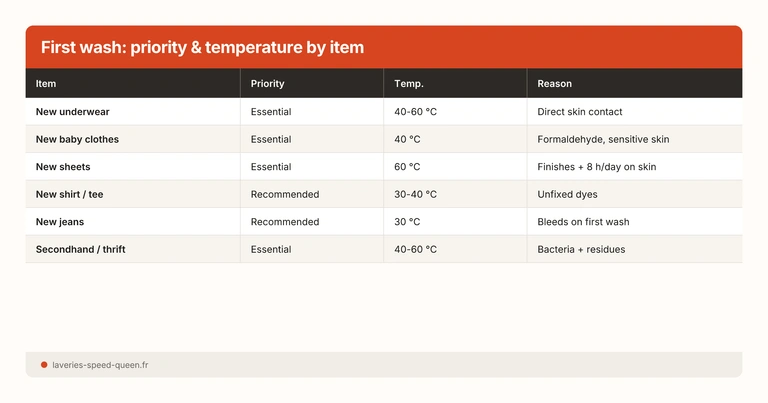
| Item | Priority | Reason | Temperature |
|---|---|---|---|
| Underwear | Essential | Direct contact with mucous membranes, tried on in-store | 40-60 degrees C |
| Baby clothes | Essential | Immature skin, stricter formaldehyde threshold (16 mg/kg) | 40 degrees C |
| Sheets and towels | Essential | Industrial finishes (stiff feel), prolonged skin contact | 60 degrees C |
| T-shirts, shirts | Recommended | Anti-wrinkle resins, surface dyes | 30-40 degrees C |
| Jeans | Recommended | Unfixed indigo dye (bleeds onto skin and furniture) | 30 degrees C inside out |
| Jackets, coats | Optional | Little direct skin contact | Per care label |
Secondhand: Resale Apps, Thrift Stores, Vintage Markets
For secondhand items, the practical minimum is 40 degrees C with detergent, and 60 degrees C whenever the label allows for items in direct skin contact.
Why It Matters Even More
Secondhand clothes have been worn, washed (or not) and stored under unknown conditions. Unlike new clothes where the risk is chemical, the risk with secondhand clothing is also biological.
Biological residues
Skin cells, sweat, sebum, detergent or softener residues from the previous owner. Even if washed before sending, a secondhand garment retains traces in the fibres. Skin bacteria (Staphylococcus, Micrococcus) survive several days on textiles at room temperature.
Dermatological risks
Dermatophytes (fungi causing skin mycoses), scabies (Sarcoptes scabiei survives 48-72 hours on textiles off the body), lice. These risks are low but real, especially for items worn close to the body. A 60 degrees C wash eliminates these organisms.
Bed bugs
Bed bugs (Cimex lectularius) can hide in seams and folds of clothing. According to the CDC, they die at 49 degrees C held for 20 minutes. A 60 degrees C machine cycle eliminates them, as does 30 minutes in a tumble dryer at normal temperature. When receiving a parcel from a resale app, do not place the clothes on your bed before washing.
The Secondhand Market
Secondhand clothing is no longer a niche market. Resale platforms have millions of users, and thrift stores and clothing swaps are everywhere.
It is a positive trend for the environment — provided you wash items correctly before wearing them.
How to Wash Secondhand Clothes
1. Inspect before washing
Check seams, armpits and collar. Look for stains, odours and any signs of mould. Old stains should be pre-treated before washing.
2. Wash at the right temperature
40 degrees C minimum for everyday clothes. 60 degrees C for items in direct skin contact (underwear, sheets, towels) if the label allows.
3. Use detergent
A water-only cycle is not enough. Detergent contains surfactants that dislodge skin and sebum residues embedded in fibres, and enzymes that break down organic matter.
4. Dry properly
Tumble drying at normal temperature (60 degrees C or above) provides additional disinfection. For delicate textiles, air-drying in sunlight is a natural alternative (UV has a bactericidal effect).
Secondhand Sources Compared
| Source | Main risk | Recommended wash |
|---|---|---|
| Resale apps (Vinted, Poshmark, Depop) | Unknown storage, condition hard to verify | 40-60 degrees C, visual inspection on receipt |
| Thrift store / consignment | Handled in-store, tried on by multiple people | 40 degrees C minimum |
| Clothing swap with friends | Lower risk (known source) | 30-40 degrees C per label |
| Flea market / vintage fair | Long-term storage, dust, possible moisture | 40-60 degrees C + check for mould |
Special Cases
The absolute priorities are new sheets/towels at 60 degrees C, baby clothes on receipt, and new jeans washed separately at 30 degrees C.
New Sheets and Towels
New sheets and towels are stiff and barely absorbent due to industrial finishes (silicones, starches, softening agents). A first wash at 60 degrees C removes these finishes and opens the cotton fibres, immediately improving comfort and absorption. Towels become softer from the first cycle.
New Baby Clothes
Infant skin is 20-30 % thinner than adult skin and its barrier function is immature. The REACH threshold for formaldehyde in baby textiles is four times stricter than for adults (16 mg/kg vs 75 mg/kg). Always wash all new baby clothes before use.
Baby programme and detergent
Delicate programme at 40 degrees C, fragrance-free hypoallergenic detergent. No softener on the first wash — it deposits a film on fibres that reduces absorption. For bodysuits, bibs and pyjamas, washing before use is not optional.
New Jeans
Jeans dyed with indigo bleed consistently on the first washes. Indigo is a surface dye that does not penetrate deep into the fibre — that is what creates the characteristic fading over time. Result: unwashed new jeans can transfer colour onto skin, shoes, seats and other clothes.
First wash: 30 degrees C, turned inside out, alone or with similar dark items.
First Wash: Which Programme?
The simple rule: 30-40 degrees C for new, 40-60 degrees C for secondhand depending on fibre and skin-contact level.
New garment (shop)
Normal or delicate programme per the label. 30-40 degrees C. The goal is to remove surface chemical residues -- there is no soil to clean. A short cycle is enough.
Secondhand (resale, thrift)
Normal programme at 40 degrees C minimum. 60 degrees C if the label allows and the textile touches skin directly. Dual goal: hygiene (biological residues) + removing the previous owner's detergent/softener residues.
Mistakes to Avoid
- Wearing new clothes straight away -- chemical residues migrate through sweat, especially in friction zones
- Rinsing with water only, no detergent -- water alone does not remove finishing agents or surface dyes (surfactants are needed)
- Placing a resale purchase on the bed -- risk of transferring bed bugs or mould to bedding
- Washing new items with already-worn laundry -- unfixed dyes from new garments can bleed onto your other clothes
- Skipping new sheets -- finishing agents make them water-repellent and prevent absorption of night-time perspiration
As an Amazon Associate we earn a small commission on purchases made through the affiliate links in this article — at no extra cost to you. This helps us maintain this site and produce free guides.
A first wash at the laundromat is simple: detergent included, automatic dosing calibrated for local water, and machines set for every programme. Our laundromats in Blagnac and Croix-Daurade are open 7 days a week. Check our prices.
Secondhand Protocol: The Full Hygiene Checklist
Buying secondhand online (resale apps, vintage platforms) and in thrift stores now represents a significant share of wardrobes. This way of shopping is positive for the environment and your wallet, but it requires a systematic hygiene protocol that many new buyers overlook.
On Receiving the Parcel or Returning from the Thrift Store
Never place the garment on the bed or sofa before washing. This single action carries the highest risk of transferring bed bugs. Open the parcel in the hallway or laundry area. Inspect seams, folds and inner pockets: small black spots (bed bug droppings) or live insects are warning signs. If the garment smells musty or shows mould stains, it may need pre-treatment before a standard wash.
The Wash: Temperature and Programme
Wash at 40 degrees C minimum for everyday cotton and polyester clothes. For items in direct skin contact (underwear, t-shirts, leggings), go to 60 degrees C if the label allows — this temperature eliminates virtually all bacteria, fungi and mites. For delicate items that only tolerate 30 degrees C (silk, wool, viscose), follow up with 30 minutes in the tumble dryer at normal temperature if the fabric permits — dry heat is effective against organisms that survive a cold wash.
Special Case: Leather, Fur or Non-Washable Items
Some thrift store finds cannot go in the machine (leather jacket, fur coat, structured dress with padding). Place them in an airtight plastic bag in the freezer for 72 hours — the intense cold (-18 degrees C) kills bed bugs and most mites. Then air the item outdoors for 24 hours. For deeper cleaning, professional dry cleaning is the safest option for these materials.
Organising the First Wash in Batches
When you return from a shopping spree or receive several resale parcels, the first wash can feel like a chore. Here is how to organise efficiently.
Sort purchases into three groups: items that bleed (new jeans, unwashed dark clothes) to wash separately; items in direct skin contact (underwear, t-shirts) to wash first; and outerwear (jackets, coats) that can wait. This organisation prevents colour-transfer surprises.
For bulk secondhand buys (5-10 items), the laundromat is often more practical than a home machine. You can run one machine at 40 degrees C for everyday clothes and a second at 60 degrees C for items needing a stronger wash (secondhand sheets, towels, underwear). In one hour, everything is washed, dried and ready to wear — without tying up your home machine for half a day.
Methodology and Sources
- Data on textile chemical residues comes from EU REACH regulation (EC 1907/2006, Annex XVII, entry 72) and OEKO-TEX Standard 100 certifications.
- Washing recommendations align with GINETEX care symbols (ISO 3758).
- Information on dermatological risks comes from contact dermatitis publications and professional dermatology societies (American Academy of Dermatology).
Sources and References
- REACH Regulation — Formaldehyde in textiles (entry 72, Annex XVII) (lien externe)
- OEKO-TEX Standard 100 — Harmful substance limits (lien externe)
- Directive 2002/61/EC — Azo dyes (incorporated into REACH, entry 43) (lien externe)
- PFAS — exposure and health risks, regulatory review consulted March 2026
- CDC — Bed Bugs: Prevention and Control (lien externe)