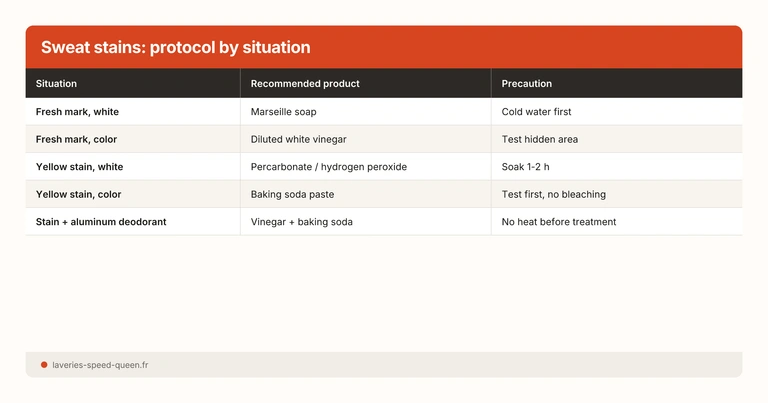
In short: a sweat stain is not treated the same way as a coffee or grease stain. The key is to distinguish a fresh mark from an old yellow stain, then separate the white case from the colour case. The most important point: avoid applying heat before pre-treatment, or you risk setting the stain further.
What this article covers
This page deals with localised marks, mostly under the arms. If the entire garment has yellowed or dulled, the right guide is whitening yellowed laundry. If you want a broad overview of every stain family, start from tough stain solutions.
Quick Answer
Don't start with hot water — on an untreated yellow mark, heat can make it harder to remove.
White ≠ colour — whites tolerate oxygenated treatments better.
Fresh sweat ≠ old yellow mark — one responds to light treatment, the other often needs soaking.
Deodorant and aluminium matter — underarm marks often come from the sweat + antiperspirant combination.
No tumble dryer before checking — otherwise the stain can become permanent.
Quick Diagnosis: Which Situation Are You In?
| Situation | What it means | Next step |
|---|---|---|
| Fresh, localised mark | Not yet heavily oxidised | Light pre-treatment then normal wash |
| Yellow mark under the arms | Old stain or likely sweat + deodorant reaction | Targeted protocol by colour and fabric |
| Entire garment yellowed | No longer just a localised problem | Switch to whitening yellowed laundry |
| Delicate or stretch fabric | Risk of damaging the fibre or elastane | Slow down, test, avoid aggressive treatments |
What You’re Actually Trying to Remove
Yellow marks are not simply dried sweat. They are often oxidised organic residues mixed with sebum and sometimes components from antiperspirant deodorants, particularly aluminium-based ones.
Fresh sweat
A light stain, usually not yet strongly discoloured. It responds better to quick, gentle treatment.
Old yellow mark
The stain has already reacted with the fabric and sometimes with the deodorant. It requires a more patient approach.
White fabric
Whites often accept more effective oxygenated solutions, provided the care label allows them.
Coloured fabric
The main risk is not just the stain itself, but also discolouration or a halo from an overly aggressive product.
The Factor Most Guides Overlook: Deodorant
Yes, antiperspirant can play an important role, though it does not explain every sweat stain. Multiple dermatology and cleaning sources confirm that yellow underarm marks frequently appear when perspiration reacts with certain antiperspirant ingredients, especially aluminium compounds.
The chemistry behind yellowing
Aluminium chlorohydrate (AlCl₃) found in antiperspirants reacts with sweat proteins (urea, amino acids) to form an insoluble yellow organometallic complex. This complex bonds to cotton cellulose via ionic bonds — which is why yellow marks resist normal washing. Sodium percarbonate (active oxygen) works because it oxidises and breaks down this aluminium-protein complex. This does not mean aluminium explains every sweat stain, but if the marks concentrate under the arms and yellow over time, the sweat + antiperspirant combination is the most credible hypothesis.
White Deodorant Marks on Clothes
White deodorant marks are a separate problem from yellow stains. Where yellowing is a chemical reaction between sweat, sebum, and aluminium oxidising in the fibre, a white mark is a physical deposit: solid residues of wax, talc, silicones, or aluminium salts sitting on the fabric surface. The distinction matters because the solutions are completely different.
Why Stick Deodorant Leaves More Marks Than Spray
Not all deodorants are equal when it comes to white marks. Stick antiperspirant is the format that leaves the most: its waxy base (stearyl alcohol, hydrogenated coconut oil) carries the aluminium salts and deposits a thick layer on the skin. When fabric touches it, this layer transfers mechanically — especially if the garment is put on before the product has fully dried.
Roll-on also leaves marks, but generally less visible ones since its formula is more liquid. Spray is the least problematic format for white marks: the particles are fine and dry quickly, reducing mechanical transfer onto fabric. That said, spray doesn’t eliminate the risk entirely — too much product or insufficient drying can still leave marks.
Solutions by Fabric Condition
On dry fabric (emergency, no machine available): rub the mark with a nylon stocking rolled into a ball or a piece of denim. The friction dislodges wax and talc particles without wetting the fabric. This works well on cotton, polyester, or viscose. It’s not suitable for very delicate fabrics like silk, where rubbing risks snagging.
On washable fabric (garment going into the machine): dab the area with undiluted white vinegar using a clean cloth. Let it sit for 15 minutes to dissolve the greasy residue, then machine wash at 30-40 °C according to the care label. Vinegar is acidic (pH approx. 2.5), which helps break down aluminium salt deposits without damaging the fibre.
On black or dark fabric — this is where white marks are most visible. Use a damp sponge with a little Marseille soap↗ (real soap, no additives). Rub gently along the grain of the fabric, rinse with clean water, then air dry. Marseille soap is gentle enough not to create a halo on dark colours.
Prevention: Two Simple Habits
The most effective way to prevent white marks is to let your deodorant dry for 2 to 3 minutes before putting on your shirt. Most transfers happen in the first 60 seconds after application, when the product is still wet. If you’re in a rush, a clear spray significantly reduces the problem compared to a traditional stick.
Don’t confuse the two problems: a white mark (mechanical deposit, easy to treat) is not a yellow stain (chemical reaction, more stubborn). If your underarm marks are yellow and resist normal washing, you’re dealing with oxidation — go back to the detailed protocols earlier in this article. If your sportswear also builds up stubborn odours on top of marks, check our sportswear care guide for treatment specific to synthetic fibres.
White or Coloured: Don’t Treat Everything the Same Way
| Case | Safest approach | Main risk |
|---|---|---|
| White cotton t-shirt | Pre-treatment + active oxygen if care label allows | Setting the mark with heat before pre-treating |
| Coloured shirt | Test on a hidden area, gentler protocol | Creating a faded spot or halo |
| Delicate fabric | Mild soap or light local treatment | Weakening the fibre by scrubbing too hard |
| Old, set-in mark | Measured soaking rather than aggressive scrubbing | Damaging the fabric without removing the stain |
The Right Protocol for Each Situation
1. Fresh, Still-Light Stain
If the area is still fresh or not deeply embedded, keep it simple. Marseille soap or a mild pre-treatment often makes more sense than a cocktail of products.
Dampen the area without using heat.
Rub gently with a suitable soap or a light pre-treatment.
Let it sit for just a few minutes.
Then wash normally according to the care label.
2. Old Yellow Mark on Compatible Whites
When the stain is already yellow and set in, switch to an oxygenated approach. This is where active-oxygen treatment becomes more effective than plain baking soda.
One useful benchmark: sodium percarbonate↗ really becomes more convincing from around 40 °C, with at least one hour of soaking on compatible whites.
The real role of active oxygen
Active oxygen is not “the miracle product for every stain”. However, on an old yellow mark — especially on white or colourfast fabric — it is often more logical than a simple vinegar rinse or a light baking soda paste. If you need product details, switch to
the complete percarbonate guide
rather than explaining everything here.
3. Coloured or Sensitive Fabric
This is where you need to slow down. Many online guides recommend the same recipes for all fabrics. That’s exactly what creates faded patches or marks that look worse than before.
- Always test on a hidden area before using a stronger treatment.
- Avoid layering products on the same garment without a clear plan.
- Don't use heat on a fragile colour.
- Don't tumble dry until the mark is gone.
- Be careful with wool, silk, and elastane blends — oxygenated treatments or aggressive scrubbing can wear them out.
The 4 Mistakes That Make These Stains Almost Irreversible
Applying heat too soon
Hot washing or tumble drying before pre-treatment: the surest way to set the mark even deeper.
Scrubbing too hard
On a fine shirt or knit, you can damage the fibre before you even improve the stain.
Treating white and colour alike
The white t-shirt protocol does not automatically apply to a navy shirt or a delicate dress.
Confusing odour with yellowing
A garment that smells bad does not always need the same treatment as one that's yellowed under the arms.
When the Stain Becomes a Whitening Problem, Not Just Stain Removal
If your white t-shirt has generally dulled or yellowed, you’re no longer just dealing with a “localised mark”. You’ve moved into the broader problem of whites that have yellowed over time.
In that case, the useful article is no longer exactly this one but rather a full whitening guide. Here, we mainly treat localised sweat marks, not an entire garment that has gone dull.
Don't mix up the two issues
If the whole garment has lost its whiteness, head to whitening yellowed laundry. If the issue is a localised mark under the arms, this guide is the right starting point.
What If the Stain Persists After a First Attempt?
Don’t suddenly escalate the aggressiveness. The right reflex is often to repeat a logical protocol, not to jump straight to something harsher without checking the care label.
- If the fabric is white and compatible -> a more serious oxygenated protocol;
- If the fabric is coloured -> local test + patience;
- If the stain has already been exposed to heat -> results are less certain;
- If the fabric is already showing wear -> better to save the garment than “win” another 10% of stain removal.
The Role of Drying in Setting Stains
A point that is often overlooked: tumble-dryer heat sets sweat stains just as it sets all organic stains. If you tumble dry a garment without checking that the marks have gone, the heat literally cooks the sweat proteins into the fibres, making the stain permanent.
Make this a systematic habit: when clothes come out of the machine, inspect the underarms and collar of each garment before putting it in the dryer. If a trace remains, re-treat with white vinegar↗ and rewash. It’s better to run another cycle than to permanently set a recoverable stain.
At a laundromat, this habit is even more important because professional dryers run hotter than domestic ones. The upside is that the higher water volume in a professional wash (50-60 litres) flushes out perspiration residues more effectively during rinsing. Pre-treat with vinegar at home, and the professional machine wash will do the rest.
Methodology and Sources
This article deliberately distinguishes three things that most online guides conflate: fresh sweat, an oxidised yellow mark, and overall yellowing of whites. The goal is to avoid the lazy advice of “vinegar or baking soda for everything” and to refocus the reader on the right choice: fabric type, stain age, colour, and the risk of heat-setting.
- Wecasa, Comment enlever les taches de transpiration des vêtements ?, modified 8 January 2026, accessed 15 March 2026
- Nivea, Comment enlever les taches jaunes de transpiration ?, published 5 February 2025, accessed 15 March 2026
- Ma Vie Éco, Percarbonate de soude — Enlever des traces jaunes sur les vêtements, accessed 15 March 2026
- Related guides: whitening yellowed laundry, sodium percarbonate and laundry, removing deodorant stains
As an Amazon Associate, we earn a small commission on purchases made through affiliate links in this article — at no extra cost to you. This helps us maintain this site and produce free guides.
For a complete stain removal overview, see tough stain solutions. If your white garment has yellowed overall, continue with whitening yellowed laundry. And if you want to understand when percarbonate is genuinely useful, also read
our complete percarbonate guide
. For stubborn stains, our professional laundromat machines provide a higher water volume and auto-dosed detergent for better results.