In short: The key to removing tough stains is pre-treating before the machine cycle. Blood and protein stains: cold water only (heat sets them permanently). Grease and oil: hot water + dish soap. Red wine: salt immediately, then wash at 40 °C. Universal rule: never tumble dry until the stain is completely gone.
At a Glance
Act fast — a fresh stain is 10 times easier to remove than a dried one.
Cold water by default — unless stated otherwise, always start with cold water. Heat sets proteins (blood, milk) and certain pigments permanently.
NEVER dry before checking — dryer heat permanently bonds any residual stain into the fibres.
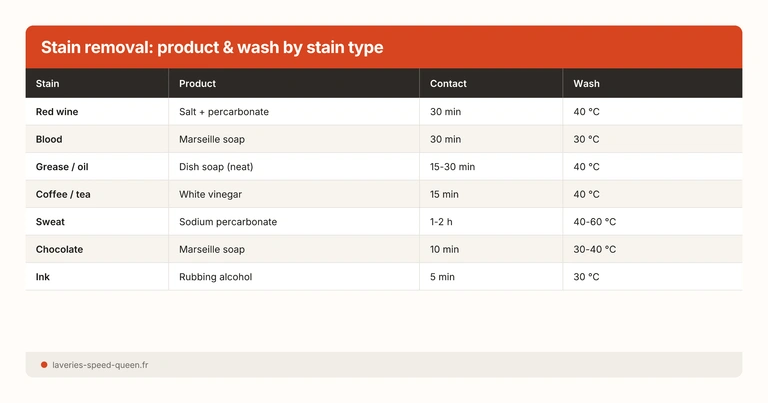
Quick Reference Table
Most stains need 10 to 30 minutes of pre-treatment and a 30-40 °C wash; only heavy grease stains tolerate a hotter cycle.
| Stain | Main Product | Contact Time | Wash |
|---|---|---|---|
| Red wine | Salt + sodium percarbonate | 30 min | 40 °C |
| Blood | Marseille soap | 30 min | 30 °C |
| Grass | White vinegar + Marseille soap | 15 min | 40 °C |
| Grease / oil | Neat dish soap or fuller’s earth | 15-30 min (fuller’s earth: 2-4 h) | 40 °C |
| Coffee / tea | White vinegar (percarbonate if old) | 15 min (1 h if old) | 40 °C |
| Sweat | Sodium percarbonate | 1-2 h | 40-60 °C |
| Chocolate | Marseille soap | 10 min | 30-40 °C |
| Makeup | Makeup remover oil + Marseille soap | 10 min | 30 °C |
| Ink | Rubbing alcohol (90 %) | 5 min | 30 °C |
| Urine | White vinegar + baking soda | 30 min | 40-60 °C |
| Mould | Sodium percarbonate (or bleach on whites) | 1-2 h soak | 60 °C |
| Vomit | White vinegar + baking soda (odour), Marseille soap (stain) | 30 min | 40-60 °C |
Detailed Techniques
Before any method, follow this reflex: identify the stain family, apply the right product locally, and wait for the recommended contact time before machine washing.
Red wine
Fine salt immediately on the fresh stain to absorb the liquid (salt creates an osmotic effect that draws wine out of the fibres). Rinse with cold water — never hot, heat sets the tannin. Prepare 1 litre of warm water + 1 tablespoon of sodium percarbonate, soak for 30 minutes. Wash at 40 °C. For dried stains: soak in warm milk for 30 minutes — the casein in milk binds to the tannin and lifts it out.
Blood
Cold water only — this is the absolute rule. Haemoglobin coagulates above 40 °C and sets the stain irreversibly (the same principle as an egg cooking). Rub with damp Marseille soap, leave for 30 minutes. Rinse with cold water. Wash at 30 °C maximum. For old stains: soak for 2 hours in cold salted water (2 tablespoons of salt per litre) before applying Marseille soap.
Grass
Rinse with cold water to avoid setting the chlorophyll. Apply neat white vinegar to the stain, rub with Marseille soap, leave for 15 minutes. Wash at 40 °C. The acetic acid in vinegar dissolves green pigments (chlorophyll and xanthophyll) without attacking the fibres. Jeans tip: vinegar also works on grass-stained knees — rub without soaking.
Grease and oil
Neat dish soap applied directly to the stain, undiluted. Rub gently from the edge towards the centre to avoid spreading. Leave for 15-30 minutes. Rinse with warm water (heat helps dissolve grease). Wash at 40 °C minimum. For mechanical grease stains (engine oil, tar): apply butter or margarine to the stain, leave for 15 minutes (grease dissolves grease), then treat with dish soap.
Coffee and tea
Rinse immediately with cold water — coffee and tea contain tannins like wine, and heat sets them. Soak the stain in diluted white vinegar (1 part vinegar to 2 parts water), leave for 15 minutes. Wash at 40 °C. Old stains: make a paste of sodium percarbonate (2 tablespoons + a little hot water), apply to the stain, leave for 1 hour. The released hydrogen peroxide bleaches the coffee pigments.
Sweat (yellow marks)
Yellow marks are caused by mineral salts and urea that bond to textile fibres over time. Sodium percarbonate: dissolve 2 tablespoons in 1 litre of hot water (50-60 °C). Submerge the stained area for 1-2 hours. The active oxygen released oxidises and bleaches the residue. Wash at 40-60 °C. Prevention: aluminium-based antiperspirants worsen yellowing — wear an undershirt if possible.
Chocolate
Chocolate combines fat (cocoa butter) and sugar — you need to tackle both. Scrape off the excess when dry (don't spread it). Rub with damp Marseille soap: its alkaline surfactants encapsulate both fat and sugar. Leave for 10 minutes. Rinse with cold water, then wash at 30-40 °C. Milk chocolate stains worse than dark (more dairy fat).
Makeup (foundation, lipstick)
Makeup is a mixture of pigments, oils, and waxes — you need a fatty solvent followed by a surfactant. Step 1: apply makeup remover oil (or vegetable oil: olive, coconut) to the stain. Dab with a clean cloth to absorb the dissolved pigments. Step 2: rub with Marseille soap to remove the oily film. Wash at 30 °C. Check the result before tumble drying.
Ink (ballpoint pen, felt-tip)
Rubbing alcohol (90 %) applied on a cotton pad or clean cloth — dab the stain without rubbing (rubbing spreads the ink). Isopropyl alcohol dissolves the resins and ink pigments in seconds. Change the pad as soon as it picks up colour. Leave for 5 minutes, then wash at 30 °C. Caution: always test on a hidden area first — alcohol can strip dye from delicate fabrics (dyed silk, artisan-dyed cotton).
Permanent marker ink
Permanent markers contain acrylic resins that lock the pigment in. Rubbing alcohol (90 %) + patience: dab, wait 2 minutes, repeat. It often takes 3-4 passes. If the stain persists, try acetone-free nail polish remover (gentler on fibres). Success rate depends on the fabric: 80 % on cotton, 50 % on synthetics, virtually impossible on silk.
The Golden Rule: Check Before Tumble Drying
If any trace remains after washing, re-apply the pre-treatment and run another cycle immediately — a single dryer pass can set the stain permanently.
Take it out and inspect
After washing, always check that the stain is gone before putting clothes in the dryer. Heat permanently bonds residual stains into the fibres. If the stain persists, repeat the pre-treatment and re-wash. See our drying guide for best practices.
Mistakes to Avoid
- Hot water on blood — permanently sets the stain by cooking the proteins (haemoglobin)
- Rubbing a fresh stain — pushes the pigment deeper into the fibres instead of absorbing it
- Mixing bleach and vinegar — produces toxic chlorine gas (respiratory hazard)
- Drying before checking — dryer heat permanently bonds any residual trace into the fabric
- Over-dosing stain remover — unrinsed product leaves white halos on dark fabrics
As an Amazon Associate, we earn a small commission on purchases made through affiliate links in this article — at no extra cost to you. This helps us maintain this site and produce free guides.
Done with the pre-treatment? Our professional laundromat machines finish the job effectively. Discover our 3 laundromats in Toulouse and Blagnac, detergent included, open daily. Check our prices to choose the right machine.
Summary: Which Temperature for Each Stain Type
A practical rule of thumb: blood and makeup stay at 30 °C, wine/grass/coffee at 40 °C, and grease can go up to 60 °C after degreasing.
| Stain Type | Pre-Soak Water | Wash Temperature | Why |
|---|---|---|---|
| Blood | Cold only | 30 °C max | Heat sets proteins |
| Red wine | Cold | 40 °C | Avoids cooking the tannin |
| Grease / oil | Warm | 60 °C | Heat dissolves fat |
| Grass | Cold | 40 °C | Cold limits green pigment setting |
| Sweat | Warm | 40 °C | Warmth helps dissolve salts and residue |
| Coffee / tea | Cold | 40 °C | Prevents tannin from bonding to fibres |
| Makeup | Warm | 30 °C | Protects fibres and limits pigment embedding |
Simple rule: when in doubt about the stain type, always start with cold water. Heat sets most protein stains (blood, egg, milk).
Old and Set-In Stains
Need the detailed guide for yellow sweat marks?
We have covered this topic in a dedicated article:
how to remove yellow sweat stains without mistakes
. It distinguishes fresh sweat, old marks, whites vs colours, and the role of deodorant in yellowing.
A stain that has dried, been washed, and then tumble dried is the hardest to treat. The heat has polymerised the pigment molecules into the fibres — the process is partially irreversible.
Long Soak Method
For old stains, a prolonged soak remains the best option:
- Prepare a bath with 2 tablespoons of sodium percarbonate↗ in 2 litres of hot water (50-60 °C).
- Submerge the garment and soak for 4 to 8 hours (overnight if possible).
- Gently rub the stained area after soaking.
- Wash normally at the highest temperature the care label allows.
- Check the result before tumble drying. If the stain persists, repeat the soak.
Sodium percarbonate releases active oxygen in solution, which lifts organic pigments without attacking the fibres. It works on most organic stains (food, drinks, sweat). It is ineffective on ink, paint, or dye stains.
When a Stain Is Permanent
Some stains are irreversible once set by heat:
- Rust — requires a specific rust remover (oxalic acid); percarbonate is not enough
- Dye transfer (colour run) — a white garment turned pink by accident can be treated with percarbonate, but the result is never perfect
- Iron scorch marks — the fibres are charred, no product can restore them
Treating Stains on Delicate Fabrics
Standard stain removal techniques (rubbing, percarbonate, hot water) do not apply to fragile textiles. Silk, cashmere, and wool require a gentler approach.
Silk and Viscose
Dab the stain with a damp cloth soaked in diluted white vinegar↗ (1 part vinegar to 3 parts water). Never rub — wet silk is fragile and tears easily. Rinse with cold water and wash on a delicate cycle at 30 °C maximum.
Wool and Cashmere
Use Marseille soap↗ rubbed dry onto the stain, then rinse with cold water. Avoid percarbonate and concentrated vinegar on wool — they weaken the fibres. For grease stains, sprinkle talcum powder and leave for 4-6 hours to absorb the grease before washing.
Coloured Cotton
Always test the stain remover on a hidden area first (inner hem, seam). Cotton dyed with reactive dyes holds up well, but artisanal dyes or vintage garments may bleed when exposed to percarbonate or alcohol.
Why Certain Products Work
Understanding the chemistry of stain removal helps you pick the right product first time.
Marseille soap — an alkaline surfactant. It encapsulates fats and lifts them from the fibre. Effective on blood (proteins), chocolate (fat + sugar), and general soiling.
Sodium percarbonate — it breaks down into sodium carbonate and hydrogen peroxide on contact with hot water. The released oxygen oxidises organic pigments and bleaches them. This is why it works on red wine, coffee, and sweat stains.
Dish soap — designed to dissolve food grease. It contains powerful surfactants that break fats into micelles that are soluble in water. The most effective product for grease, oil, and butter stains.
White vinegar — diluted acetic acid. It neutralises alkaline stains (limescale, soap residue) and dissolves certain plant pigments (grass, fruit). Warning: never mix with bleach (releases toxic chlorine gas).
Rubbing alcohol (90 %) — a solvent that dissolves ink pigments, resins, and some adhesives. It evaporates quickly without leaving residue. Always test on a hidden area as it can strip delicate dyes. Effective on ballpoint ink, felt-tip, and marker stains.
Tablecloths and Household Linen: The Most Common Stains
Tablecloths, tea towels, and curtains face specific assaults: wine, cooking grease, candle wax, tomato sauce. Here is how to treat each one before machine washing.
Red and white wine
Fine salt immediately to absorb, then cold water. Never rub with heat. Machine wash: 60 °C for cotton, 40 °C for linen. If the stain has dried, soak in warm milk for 30 min before washing.
Candle wax
Let it harden completely, then scrape off as much as you can. Place the fabric between 2 sheets of paper towel and press with a warm iron to absorb the remaining wax. Then machine wash at 40-60 °C.
Tomato sauce and grease
Dab with neat dish soap, leave for 15 min, rinse with cold water. Grease needs a detergent that emulsifies lipids — the professional detergent at the laundromat is dosed for exactly that.
Coffee and tea
Rinse immediately with cold water. If the stain has dried, soak in diluted white vinegar for 15 min. Machine wash at 60 °C. Coffee is a tannin like wine: heat before treatment sets it permanently.
In every case, treat the stain as quickly as possible. The longer it dries, the deeper it penetrates the fibres. If you cannot wash immediately, soak the area in cold water and keep the fabric damp until you can wash it.
When Pre-Treatment Is Not Enough: The Power of a Commercial Machine
Some stains resist home pre-treatment. A professional laundromat machine offers three decisive advantages.
Higher water volume
A professional machine uses 50-60 litres of water per cycle, compared with 40-50 litres for a domestic machine. This extra volume dilutes stain residues more effectively and flushes them away during rinsing.
Intensive mechanical action
The professional drum's mechanical action (rigid suspension, 350 G extraction) agitates the fabric more vigorously than a domestic machine. This mechanical action dislodges particles embedded in the fibres.
Pre-dosed professional detergent
The automatically injected detergent is more concentrated than consumer detergents. It contains enzymes and surfactants tailored to organic stains (blood, grease, protein) and tannin stains (wine, coffee, tea).
For stubborn stains, run a cycle at the highest temperature the care label allows. If the stain persists, run a second cycle with pre-treatment — never tumble dry while the stain remains, as the heat would set it permanently.