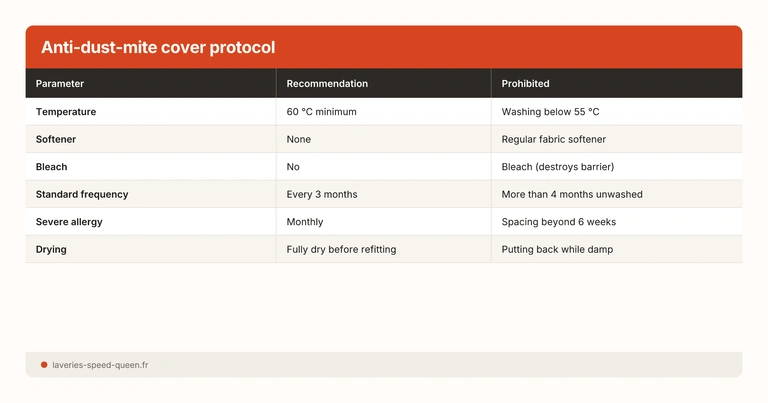
In short: an anti-dust-mite mattress cover should be washed at 60 degrees C minimum, with no softener and no bleach, every 3 months (or monthly for severe allergy). Drying must be complete before putting the cover back — a damp cover creates the ideal environment for mites. For large sizes, professional laundromat machines are often necessary.
At a Glance
60 degrees C minimum -- below this, mites and their eggs partially survive.
No softener -- it clogs the barrier fabric and reduces anti-mite effectiveness.
No bleach -- it destroys the barrier fabric after a few washes.
Complete drying mandatory -- a damp cover put back on encourages mite proliferation.
Frequency: every 3 months -- monthly for severe allergy, fortnightly during flare-ups.
Why Wash a Cover That Is Supposed to Block Mites?
This is the most common question — and the most widespread misconception. The anti-dust-mite cover is a physical barrier: a tightly woven fabric (pores under 10 microns) that prevents mites and their droppings from passing from inside the mattress to your face.
But this barrier only works one way. The outer surface of the cover is in direct contact with your sheet and, by extension, with everything that settles each night:
- Skin flakes: a person sheds 1-1.5 g of dead skin per day, some of which passes through the sheet and settles on the cover. This is the primary food source for mites.
- Perspiration: 0.5-1 litre of water per night, creating a humid environment that mites thrive in (they flourish between 20-25 degrees C and 60-80 % relative humidity).
- Dead mites and droppings: allergenic proteins (Der p 1, Der f 1) accumulate on the surface even when the barrier stops live mites from passing through.
Without regular washing, the cover surface itself becomes an allergen reservoir — which partly negates its benefit.
The cover protects the mattress, not itself
Do not confuse the cover’s function (blocking mites from the mattress) with its cleanliness. The cover must be washed regularly to remain effective — just as a filter must be cleaned to keep filtering.
Washing Protocol: Step by Step
1. Remove and Shake
Remove the cover from the mattress and shake it vigorously outdoors or on a balcony. This step removes surface dust and flakes, reducing the soil load for the wash. If you are allergic, wear a mask during this step — you will be dispersing allergens into the air.
2. Check Weight and Capacity
A mattress cover weighs between 0.8 and 2 kg depending on size and fabric thickness.
| Mattress size | Cover weight (dry) | Recommended machine capacity |
|---|---|---|
| Single (90x190) | 0.8-1.2 kg | 7 kg minimum |
| Double (140x190) | 1.2-1.5 kg | 8 kg minimum |
| Queen (160x200) | 1.5-1.8 kg | 9 kg minimum |
| King (180x200) | 1.8-2.2 kg | 10 kg or laundromat |
The issue is not so much weight as volume. An unfolded mattress cover takes up a lot of space in the drum. If the cover is compressed to the point where it cannot unfold during the cycle, water will not circulate properly and the wash will be ineffective.
3. Set the Machine: 60 degrees C, Cotton Programme
Temperature: 60 degrees C minimum
This is the critical threshold for reliably killing mites, their eggs and denaturing the allergenic proteins (Der p 1, Der f 1). At 40 degrees C, some mites survive and allergens remain partially active.
Detergent: standard liquid, no softener
Use a standard liquid detergent. Softener deposits a film on the weave that reduces air permeability and can compromise the barrier. Softener fragrances may also worsen allergy symptoms.
Programme: normal cotton
The cotton programme at 60 degrees C provides enough agitation and cycle length. No pre-wash needed if the cover is washed regularly. An extra rinse is recommended to remove all detergent residue.
What not to add
No bleach (destroys the barrier fabric), no softener (clogs the weave), no essential oils (potential irritation). Sodium percarbonate is compatible if the cover is white -- it works well at 60 degrees C.
4. Drying: The Critical Step
Complete drying is as important as the wash itself. A damp cover put back on the mattress creates a warm, humid micro-climate between the sheet and the mattress — exactly the conditions mites seek to breed (25 degrees C, 70 % humidity).
- Tumble dryer: hot programme (if the label allows). The dryer heat has an additional benefit: it finishes off any residual mites.
- Air drying: lay the cover flat or on a drying rack in a well-ventilated area. Allow 6-12 hours depending on thickness and ambient humidity.
- Dryness test: run your hand over the entire surface, including seams and corners. If any spot still feels cool to the touch, the cover is not dry enough.
- Never put a still-damp cover back on -- residual moisture between cover and mattress creates a perfect incubator for mites.
- Do not rely on the mattress to absorb moisture -- the mattress itself takes hours to dry and can develop internal mould.
- Do not cut drying short -- if time is tight, it is better to sleep one night without the cover than to put a damp cover back on.
Wash Frequency: Adapt to Allergy Severity
| Situation | Frequency | Rationale |
|---|---|---|
| Prevention (no diagnosed allergy) | Every 3-4 months | Basic hygiene maintenance, clearing accumulations |
| Moderate allergy (seasonal rhinitis) | Every 2 months | Regular reduction of allergen load |
| Severe allergy (chronic rhinitis, asthma) | Monthly | Strict allergen control — allergist recommendation |
| Acute allergic episode | Every 2 weeks | Maximum exposure reduction during flare-up |
The rest of the bedding follows the same rhythm: sheets weekly, mattress protector monthly, pillows every 3-4 months.
The cover alone is not enough
An anti-dust-mite cover is one element of a broader mite-control protocol. Other pillars: weekly sheet washing at 60 degrees C, daily bedroom airing (15 minutes with the window open), ambient humidity kept below 50 % (dehumidifier if needed), regular vacuuming of the mattress and bed base.
What Destroys the Anti-Mite Treatment
The anti-mite barrier fabric works because its weave is very tight (pores under 10 microns). Certain washing errors degrade this weave and gradually render the cover useless.
- Bleach -- sodium hypochlorite attacks the fibres of the tightly woven barrier fabric. After 5-10 bleach washes, the fabric loses density and allergens pass through.
- Diluted bleach soaking -- even diluted, bleach remains a chlorinated oxidising agent that weakens the synthetic and natural fibres of the barrier fabric.
- Regular softener use -- the film deposited by cationic surfactants gradually clogs the fabric pores, reducing breathability without improving the barrier.
- Temperatures above 90 degrees C -- some barrier fabrics are polyester or blended. Above 90 degrees C, synthetic fibres can deform and pores widen.
- Excessive spin speed -- above 800 rpm, repeated mechanical forces can stretch the barrier fibres over time.
The Size Question: Why the Laundromat Is Often Necessary
Mattress covers in 160x200 and 180x200 sizes present a logistical challenge for home machines. The issue is not weight (1.5-2 kg) but volume: an unfolded cover takes up considerable drum space.
Home Machine vs Laundromat Machine
| Criterion | Home machine (7-8 kg) | Laundromat machine (12-18 kg) |
|---|---|---|
| Single cover (90x190) | OK alone | OK |
| Double cover (140x190) | Tight — alone, no other items | OK, room for other items |
| Queen cover (160x200) | Often too tight | OK |
| King cover (180x200) | Too bulky | OK |
| 60 degrees C cycle | Available | Available |
| Water volume | Approx. 50 litres | Approx. 80-120 litres |
The higher water volume in laundromat machines ensures better rinsing — important for completely removing detergent residues that could irritate an allergy sufferer’s airways.
Complementary Bedding Care
Washing the cover is part of a wider mite-control protocol in the bedroom.
Sheets: weekly wash at 60 degrees C -- sheets are the first layer of skin contact. A weekly 60 degrees C wash eliminates accumulated mites and allergens.
Mattress protector: monthly at 60 degrees C -- the protector sits between the sheet and the cover. Monthly washing maintains the full protection stack.
Pillows: every 3-4 months -- pillows accumulate large amounts of skin flakes and perspiration.
Duvet: twice a year -- the duvet is protected by its cover but still needs washing.
Vacuum the mattress: monthly -- vacuum the bare mattress (upholstery attachment) while the cover is being washed, to remove surface mites and debris.
Common Mistakes to Avoid
- Putting the cover back while still damp -- the most common and most counterproductive mistake. Residual moisture encourages exactly what you are trying to avoid.
- Using softener -- the film clogs the weave and reduces the barrier's effectiveness.
- Washing at 40 degrees C out of caution -- caution for the fabric becomes a health risk. Most anti-mite covers are designed to withstand repeated 60 degrees C washes.
- Using bleach to disinfect -- bleach destroys the treatment and the fibres. 60 degrees C alone provides effective mite disinfection.
- Washing too rarely -- a never-washed anti-mite cover accumulates more surface allergens than a standard sheet.
- Forgetting the rest of the bedding -- the cover alone is not enough if sheets, pillows and duvet do not follow the same hygiene schedule.
When to Replace the Anti-Mite Cover
Even with correct care, an anti-dust-mite cover has a limited lifespan. Repeated 60 degrees C washes eventually stretch the barrier fibres.
- Average lifespan: 3-5 years, depending on fabric quality and wash frequency.
- Signs it needs replacing: fabric feels thinner to the touch, zip no longer closes properly, seams starting to open, allergy symptoms worsening despite regular washing.
- Simple test: hold the cover up to a light source. If light visibly passes through the fabric, the weave is too stretched to block allergens effectively.
Anti-Mite Covers at a Professional Laundromat
Professional laundromat machines offer three concrete advantages for washing large anti-dust-mite covers:
- Drum volume: 12-18 kg capacity, allowing the cover to unfold and circulate freely in the water — essential for effective washing and rinsing.
- Water volume: 80-120 litres per cycle vs 50 litres for a home machine. More water means better rinsing and fewer detergent residues.
- Professional dryer: laundromat dryers have greater capacity and heating power, enabling faster complete drying — reducing the time the mattress is left unprotected.
As an Amazon Associate we earn a small commission on purchases made through the affiliate links in this article — at no extra cost to you. This helps us maintain this site and produce free guides.
Our laundromats in Blagnac, Croix-Daurade and Montaudran have 12-18 kg machines with a 60 degrees C programme, ideal for mattress covers of all sizes. Check our prices.
Sources and References
- Dermatophagoides pteronyssinus and D. farinae — house dust mites, thermal elimination threshold 55-60 degrees C
- Allergenic proteins Der p 1, Der f 1 — cysteine proteases found in mite droppings, primary trigger for allergic rhinitis and asthma