In short: Wash baby clothes at 40 °C for everyday items and 60 °C for bodysuits, sheets, and heavily soiled bibs. Use a fragrance-free, allergen-free detergent (baby detergent or Marseille soap). Overdosed fabric softener can leave an irritating film on fibres. At a Speed Queen laundromat, detergent and softener are dispensed automatically at professional doses: the generous rinse (50-60 L) keeps residue to an absolute minimum. An extra rinse is still recommended for the most reactive skin.
At a Glance
Always wash new clothes first — manufacturing residues must be removed before first wear.
40 °C for clothing, 60 °C for hygiene items — bibs, sheets, and meal towels go up to 60 °C.
Extra rinse — removes detergent residue that irritates skin.
Fabric softener: dosage matters — overdosing leaves an irritating chemical film. At a Speed Queen laundromat, it's dosed automatically and the professional rinse (50-60 L) removes most residue.
Wash Frequency by Item
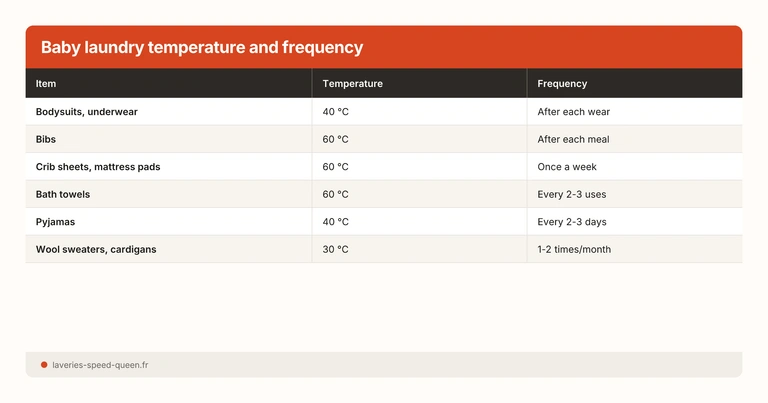
Bodysuits and worn clothing should be washed after every use, while baby sheets should be changed at least once a week.
| Item | Frequency |
|---|---|
| Bodysuits, underwear | After every use |
| Bibs | After every meal |
| Cot sheets, mattress protectors | Once a week |
| Bath towels, washcloths | Every 2-3 uses |
| Pyjamas | Every 2-3 days |
| Everyday outfits | After every use |
| Wool jumpers, cardigans | After 2-3 uses |
| Comforter / stuffed toy | At least once a month |
Temperatures by Item
The most reliable rule of thumb is 40 °C for everyday items and 60 °C for hygiene textiles like bibs, meal towels, and sheets.
| Item | Temperature | Why |
|---|---|---|
| Bodysuits, pyjamas | 40 °C | Sufficient for daily cleaning, preserves fibres and colours |
| Bibs, meal towels | 60 °C | Greasy food stains, enhanced hygiene |
| Baby cot sheets | 60 °C | Kills dust mites and bacteria (prolonged contact every night) |
| Blankets, sleep sacks | 40 °C | Preserves filling and fibres |
| Stuffed toys | 30 °C delicate | Protects the toy (at least once a month against dust mites) |
Washing New Clothes: Non-Negotiable
A first wash at 40 °C before the first wear removes manufacturing residues found on new bodysuits, pyjamas, bonnets, and sheets.
Always wash before the first wear
New clothes contain manufacturing residues: finishes, dyes, and sometimes formaldehyde used during shipping. A single wash at 40 °C is enough to remove them. See our guide on washing new and second-hand clothes for more details.
This applies to everything: bodysuits, pyjamas, sheets, towels, bonnets, socks. Even baby shower gifts.
Sensitive Skin and Eczema
If your baby has eczema, always use an extra rinse and avoid overdosing detergent to reduce skin irritation.
Precautions for reactive skin
Infant eczema is common in young children. Poorly rinsed laundry or laundry treated with too much product is a frequent aggravating factor (source: French Society of Dermatology).
Extra rinse every time — if your machine offers it, always enable it. It removes detergent residue trapped in fibres after a standard rinse. For more on how residue affects sensitive skin, see our guide on detergent residue and sensitive skin.
Fabric softener with caution — overdosed softener deposits an irritating chemical film on atopic skin. At a Speed Queen laundromat, automatic dosing and the generous rinse (50-60 L) greatly reduce residue. If eczema persists, request an additional pre-rinse cycle.
Wash new clothes before use — manufacturing residues (finishes, dyes) are particularly irritating for atopic skin.
Choose organic cotton next to skin — breathable, soft, and grown without pesticides. Avoid pure synthetics (polyester) directly against the skin.
Don't overdose detergent — too much detergent leaves residue that irritates sensitive skin. At a Speed Queen laundromat, the professional detergent is automatically dosed, eliminating this risk.
Common Baby Stains
Always rinse in cold water first, then rub with Marseille soap↗ for 10 minutes before washing at 40 °C (or 60 °C on white cotton if heavily soiled).
Babies produce very specific stains. The rule: act fast and always start with cold water.
Milk and spit-up
Rinse immediately in cold water (hot water sets milk proteins). Rub with Marseille soap, leave for 10 minutes, then wash at 40 °C.
Puree and compote
Remove the excess, rinse in cold water. Rub with Marseille soap. For heavily coloured purees (carrot, beetroot), soak for 30 minutes in warm water with 1 teaspoon of sodium percarbonate. More tips in our stain removal guide.
Faeces and urine
Rinse in cold water immediately. Rub with Marseille soap, leave for 10 minutes. Wash at 60 °C for white cotton, 40 °C for colours.
Cloth Nappies
For cloth nappies, run a cold pre-wash followed by a main cycle at 60 °C, with a load of roughly 15 to 20 nappies in a 9 kg machine.
If you use cloth nappies, here are the essential rules for effective washing without damaging them.
Storage and washing
Store soiled nappies dry in a ventilated bucket (no soaking — it breeds bacteria). Run a cold pre-wash to rinse out residues, then a main wash at 60 °C. A 9 kg machine handles 15 to 20 nappies comfortably.
What NOT to use
Fabric softener coats fibres and reduces nappy absorbency. At a Speed Queen laundromat, it's dosed automatically at controlled levels: run a pre-rinse to limit residue on the nappies. No vinegar in the rinse — it damages elastics over time. No bleach — it degrades fibres. Use a simple detergent, without glycerin or essential oils.
Recommended Fabrics for Baby
Choose organic cotton next to the skin, and save synthetics for outer layers like jackets or snowsuits.
Organic cotton
The best choice against baby's skin: soft, breathable, and durable through frequent washes at 40-60 °C. Grown without pesticides, which limits irritating residue.
Bamboo
Very soft and naturally hypoallergenic. More delicate than cotton: wash at 30-40 °C max and avoid high-heat tumble drying.
Synthetics: avoid direct skin contact
Polyester and nylon don't breathe, trap perspiration, and release microplastics during washing. Fine as an outer layer (jacket, snowsuit). Against baby's skin, stick to cotton.
Choosing the Right Detergent
Pick a gentle, lightly scented detergent and respect the dosage — overdosed residue is a leading cause of irritation in infants.
At the laundromat: detergent and softener included
Our Speed Queen machines automatically dispense professional detergent and softener, included in the price. The detergent is gentle and free from harsh fragrance. Automatic dosing prevents overdosing, a common cause of irritation on sensitive skin. The professional rinse (50-60 L of water) removes the vast majority of residue. You don’t need to bring anything. See our
eco-friendly laundromat guide
.
At home: choose wisely
Go for simple, lightly scented detergents. Products labelled “baby” aren’t always the best — read the ingredients rather than the marketing. Avoid detergents containing harsh enzymes or synthetic fragrances.
How to evaluate a baby detergent
Before choosing, check three things: the full INCI list (no fragrance, no MIT/MCIT, no dye), the manufacturer’s recommended dosage, and any certifications (Ecocert, Nature & Progres). Prefer detergents with the fewest ingredients — the shorter the list, the lower the irritation risk.
Organising Laundry with a Baby
The most efficient approach is to sort into 2 loads (60 °C heavily soiled and 40 °C everyday) then run two machines in parallel to finish in a single trip.
A baby generates a lot of laundry. Here’s how to stay on top of it efficiently.
Sorting at home
Use 2 baskets: one for heavily soiled items (stained bodysuits, bibs, sheets) that will go at 60 °C, and one for the rest (pyjamas, outfits, sleep sacks) at 40 °C. Sorting is done — load straight into the machine at the laundromat.
At the laundromat: 2 machines at once
Run the 60 °C load in one machine and the 40 °C load in another, simultaneously. Both finish together, and you move straight to drying. See our guide to preparing for your first laundromat visit.
The Comforter: A Special Case
The comforter is the most handled, chewed, and dragged-around object in the house. It accumulates saliva, bacteria, and dust mites. Wash it at least once a month, at 30 °C on a delicate cycle. Place it inside a closed pillowcase to protect the seams. See our delicate fabrics guide.
Pushchair Covers and Accessories
The pushchair is one of the most exposed baby items: biscuit crumbs, spilled puree, spit-up, sweat, outdoor dust, and rain. Textile covers and accessories (footmuffs, pushchair sleeping bags, inner canopies) need regular cleaning to stay hygienic against your child’s skin.
Checking whether the cover is removable
Not all pushchairs let you easily remove the covers — it depends on the brand and model. On models like the Babyzen Yoyo, Cybex Libelle or Eezy, Joie Litetrax or Tourist, and Chicco Goody, seat and canopy covers typically come off via poppers, zips, or Velcro. For other models, always check the user manual — some covers are stitched directly to the frame and shouldn’t be forced off. If you’ve lost the manual, it’s almost always available as a PDF on the manufacturer’s website.
Pre-treatment
Before putting the cover in the machine, remove visible debris:
- Brush or wipe crumbs, dried puree, and food residue with a damp cloth or soft brush.
- Spit-up: blot the excess, then rub with damp Marseille soap. Rinse in cold water (as with milk stains, hot water sets the proteins).
- Set-in stains: apply Marseille soap or sodium percarbonate↗ paste, leave for 15 minutes, then gently brush before washing.
Programme and detergent
Wash pushchair covers at 30-40 °C on a delicate cycle. Most covers are made of polyester or poly-cotton blends, sometimes with a water-repellent coating that can’t handle high temperatures. Use the same hypoallergenic detergent↗ as for the rest of your baby laundry — no harsh fragrance, no irritating enzymes. Enable the extra rinse if your machine allows it, as the cover will be in direct contact with your child’s skin.
Drying
Air drying is recommended for pushchair covers. Many covers have plastic structures, foam reinforcements, or rigid elements that can’t withstand tumble-dryer heat. Lay the cover flat or drape it over a drying rack in a well-ventilated spot. Make sure it’s completely dry before putting it back — a damp cover re-fitted on the pushchair will quickly develop mould, especially if the pushchair is stored in a garage or a poorly ventilated hallway.
Non-removable parts and harnesses
For non-removable textile parts (inner canopy, fixed padding), clean the surface with a damp sponge and a little Marseille soap. Rinse with a clean sponge and air dry.
Harnesses and safety straps must never go in the machine — washing can weaken the woven webbing. Wash them by hand in a basin of warm water with a mild soap. Don’t wring them — blot excess water with a towel and air dry in a flat, extended position.
Wash frequency
Wash pushchair covers every 1 to 2 months under normal use. Wash immediately after spit-up, illness (gastroenteritis, cold), or heavy soiling. During illness, a 40 °C wash with an extra rinse is particularly important to eliminate bacteria and viruses that build up on textile surfaces. For more on managing allergens in your baby’s environment, see our guide to dust mite allergies and laundry.
Mistakes to Avoid
- Not washing new clothes — manufacturing residues remain on the fabric and irritate the skin
- Overdosing fabric softener at home — leaves an irritating chemical film, reduces absorbency of bibs and towels. At the laundromat, automatic dosing and professional rinsing limit this risk
- Overdosing detergent — unrinsed detergent residue is a common cause of skin irritation
- Hot water on milk stains — heat sets the proteins and makes the stain permanent
- Mixing with heavily soiled laundry — baby sheets and work overalls in the same load is a no
- Incomplete drying — risks odours, mould, and bacteria on laundry that touches baby skin
As an Amazon Associate, we earn a small commission on purchases made through affiliate links in this article — at no extra cost to you. This helps us maintain this site and produce free guides.
Need to wash baby clothes effectively? Our laundromats in Blagnac and Croix-Daurade offer machines with detergent and softener included, automatic dosing, and a generous professional rinse — ideal for sensitive skin. 9 kg machines from just 4.90 euros. See our prices.
Methodology and Sources
- Dermatological recommendations are consolidated from resources of the French Society of Dermatology (lien externe): for infants (particularly under 3 months), a hypoallergenic fragrance-free detergent and an extra rinse are recommended to limit surfactant residue in contact with skin.
- The “exposure” framework integrates ANSES guidance on chemical substances in clothing textiles, alongside indoor air quality concerns, to reduce chemical residue on textiles in prolonged contact with baby skin.
Sources and References
- Laundry sorting and temperature guide
- Washing temperatures guide
- ANSES — indoor air quality (bio contaminants) (lien externe)
- ANSES — Chemical substances in clothing textiles, footwear, and leather goods (lien externe)
- French Society of Dermatology (SFD) (lien externe)
- Washing a baby carrier wrap
- Washing a baby car seat cover
- Washing children’s toys (plastic and fabric)
- Washing a travel cot
- Washing school uniforms