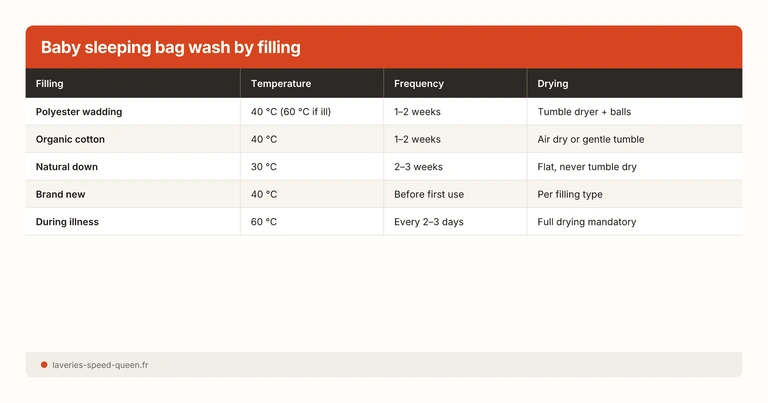
The sleeping bag is one of the most important baby items to wash correctly. In direct contact with your baby’s skin for 10 to 12 hours every night, it accumulates sweat, dead skin cells, spit-up and dust. Wash it every 1 to 2 weeks at 40 °C (60 °C during illness), with a fragrance-free detergent and an extra rinse. No fabric softener. Tumble dry on low heat for wadding filling, flat dry for down. And above all: always wash a new sleeping bag before the first use.
At a Glance
40 °C on a delicate programme — preserves the filling and seams. 60 °C only during illness.
Wash every 1-2 weeks — more often with spit-up or heavy sweating.
Fragrance-free detergent, no softener — the thick filling retains residue longer than a thin garment.
Extra rinse every time — essential to flush detergent from the filling.
New sleeping bag = mandatory wash — remove manufacturing residues before first contact with baby.
Why Proper Washing Matters
A baby sleeping bag is not just another piece of bedding. It is the textile that spends the most time in direct contact with baby’s skin — more than daytime clothes. Over a 10-12 hour night, baby sweats, sheds dead skin cells and, for younger babies, sometimes spits up. These secretions accumulate in the fabric and filling.
Without regular washing, the sleeping bag becomes a breeding ground for dust mites (which feed on dead skin and thrive in the humidity from sweat) and bacteria. For a baby prone to eczema or allergies, this is a direct aggravating factor. See our guide on dust mite allergy and laundry to understand the link between dust mites and disrupted sleep.
Washing Frequency
Frequency depends on baby’s age, the season and the condition of the sleeping bag.
| Situation | Recommended frequency |
|---|---|
| Normal use (0-12 months) | Once a week |
| Normal use (12-36 months) | Every 10-14 days |
| Frequent spit-up (reflux) | As soon as soiled (sometimes 2-3 times per week) |
| During illness (stomach bug, bronchiolitis) | Every 2-3 days at 60 °C |
| Summer / hot weather | Every 5-7 days (increased sweating) |
| With an intermediate fitted sheet | Every 10-14 days |
Practical tip: keep two sleeping bags in rotation. While one is being washed and dried (which easily takes half a day), the other is available for bedtime. This is the best way to never be caught out.
Temperature and Programme by Care Label
The sleeping bag’s care label is your primary guide. But here are the general guidelines.
40 °C: The Standard Temperature
The vast majority of sleeping bags (polyester wadding, cotton, jersey) wash at 40 °C on a normal or delicate cycle. This temperature effectively cleans daily soiling (sweat, sebum, milk traces) without degrading the filling or seams.
The delicate or synthetics programme is preferable to the cotton programme: the gentler agitation preserves the seams that hold the filling in place. An overly aggressive programme can cause the wadding to migrate to one side of the sleeping bag, creating empty areas and overstuffed zones.
60 °C: When Necessary
Increase to 60 °C in the following situations.
- Illness (gastroenteritis, bronchiolitis, flu): viruses and bacteria are destroyed at 60 °C.
- Heavy soiling (vomiting, diarrhoea): hygiene takes priority over filling preservation.
- Dust mites: if your baby is prone to dust mite allergies, a monthly wash at 60 °C kills dust mites and their allergens (Der p1, Der f1).
Check that your sleeping bag’s label permits 60 °C. Most polyester wadding models can handle it. Tightly-woven organic cotton models too. However, some sleeping bags with delicate prints or decorative elements (embroidery, appliques) may deteriorate at this temperature.
What Should NOT Go Above 40 °C
- Natural down sleeping bags — down is fragile. Above 40 °C, the feathers can break and lose their loft. Wash at 30-40 °C with a special down detergent, then dry flat.
- Sleeping bags with heat-bonded elements — some decorations (transfers, thermal labels) peel off above 40 °C.
- Merino wool sleeping bags — rare, but they exist. Wool felts from 40 °C onwards. Wash cold on a wool programme.
Choosing the Right Detergent
Choosing detergent for the sleeping bag follows the same rules as for all baby laundry — with an added demand due to the thickness of the filling.
Why the Filling Complicates Rinsing
The wadding filling of the sleeping bag is a residue trap. Unlike a thin jersey bodysuit, the 1-2 cm layer of wadding absorbs detergent and holds on to it during rinsing. It takes more water and more time to flush out the surfactants.
This is why the extra rinse is even more important for the sleeping bag than for regular baby clothes. And it is also why detergent overdosing is particularly dangerous: the excess stays trapped in the filling and contacts baby’s skin all night long.
Selection Criteria
What you need
Hypoallergenic detergent, fragrance-free, dye-free, free from MIT/MCIT preservatives. Strict dosing per the manufacturer's recommendations (or slightly below for sleeping bags). Extra rinse every time.
What to avoid
Fabric softener (irritating chemical film that reduces breathability), scented pods, detergent with essential oils (allergens), overdosing. Never use bleach — it degrades fibres and filling.
Gentle alternatives
Marseille soap flakes (2 tablespoons for a 7 kg machine), Ecocert-certified fragrance-free baby detergent. White vinegar (2 tablespoons in the softener compartment) softens fibres without residue.
For a full guide on choosing detergent for sensitive skin, see our article on detergent residue and sensitive skin.
Washing by Filling Type
Not all sleeping bags are the same. The filling determines the washing and especially the drying precautions.
Polyester Wadding (Most Common)
This is the filling in 80-90% of sleeping bags sold. Polyester wadding is tough, hypoallergenic, dries quickly and handles machine washing well.
- Temperature: 40 °C standard, 60 °C allowed on most models.
- Programme: delicate or synthetics. Moderate spin (800-1,000 rpm) is preferable to maximum spin to avoid compressing the filling.
- Drying: tumble dryer on delicate permitted. Add 2-3 clean tennis balls to the drum: as they bounce against the sleeping bag, they break up clumps of wadding and redistribute the filling evenly. Without the tennis balls, the wadding tends to clump in corners.
- Drying time: 45-90 minutes in tumble dryer, 6-12 hours air drying.
Organic Cotton (Filling and Shell)
Some premium sleeping bags use organic cotton for both filling and shell. Cotton is heavier, absorbs more water and dries more slowly.
- Temperature: 40 °C standard. Cotton handles 60 °C, but check that seams and finishes allow it.
- Programme: cotton delicate. Cotton tolerates stronger agitation than polyester.
- Drying: air drying preferred (tumble dryer may cause slight shrinkage). Lay flat on a drying rack, not on a line (the weight of the water deforms the sleeping bag). Turn every 3-4 hours.
- Drying time: 12-24 hours air drying depending on the season.
Natural Down (Rare for Babies)
Down sleeping bags are exceptional for infants (mainly used in winter, premium models). Down requires special care.
- Temperature: 30-40 °C maximum. Above this, feathers break and lose their loft.
- Detergent: use a special down detergent (enzyme-free, neutral pH). Enzymes in standard detergents degrade the keratin in feathers.
- Drying: tumble dryer on delicate with tennis balls mandatory to separate clumps of down. Drying may require 2-3 full cycles. Poorly dried down develops mould rapidly. See our guide to washing a feather duvet — the principles are identical.
Machine capacity matters
A thick sleeping bag (TOG 2.5 or 3.5) absorbs a lot of water and takes up volume in the machine. In a 5-7 kg domestic washer, it occupies almost the entire drum — the filling cannot spread out properly during washing and rinsing. Result: uneven cleaning and detergent residue trapped in compressed areas. A 9 kg minimum machine (at a laundromat) provides the space needed for water to circulate freely around the filling.
New Sleeping Bag: First Wash Is Mandatory
Like all baby bedding items, a new sleeping bag must be washed before first use. This is not an optional recommendation — it is a health necessity for your baby.
What a New Sleeping Bag Contains
New textiles go through numerous manufacturing and shipping stages that leave chemical residues.
- Manufacturing finishes: anti-crease agents, stiffening agents that give the fabric its “crisp” feel in the shop.
- Excess dyes: unfixed dyes migrate during the first wash. On baby’s skin, these free molecules are potential irritants.
- Residual formaldehyde: used as an anti-mould agent during shipping and storage. ANSES classifies it as a skin and respiratory irritant.
- Handling residue: packaging, storage, in-store try-ons.
The First Wash Protocol
- Remove all labels, ties and packaging.
- Wash at 40 °C with your fragrance-free baby detergent.
- Activate the extra rinse — this is particularly important for the first wash.
- Dry completely before use.
- Smell the result: if the sleeping bag still has a “new” (chemical) smell, repeat the wash.
Baby shower gifts
Sleeping bags received as baby shower gifts must be washed before use, even if they are new and wrapped. You do not know the storage conditions, and manufacturing residues are present regardless of the product’s origin.
Stain Removal: Common Stains
Baby sleeping bags are exposed to specific stains: milk spit-up, night sweats and sometimes more serious accidents.
Spit-Up and Milk
Milk stains (breast milk or formula) contain casein, a protein that coagulates with heat. The absolute rule: cold water first, never hot.
- Rinse the area immediately under cold running water.
- Rub with damp Marseille soap↗.
- Leave for 10-15 minutes.
- Wash the full sleeping bag in the machine at 40 °C.
For dried stains, soak the area in warm water with a teaspoon of sodium percarbonate for 30 minutes before washing.
Sweat and Yellowing
Night sweats leave yellowish marks, especially on white or light-coloured sleeping bags. The mechanism is the same as for yellow marks on clothes: sebum and mineral salts from sweat oxidise on contact with air, creating a yellow discolouration.
Treatment: soak the sleeping bag for 1-2 hours in a sodium percarbonate solution (1 tablespoon per litre of water at 40 °C) before machine washing. The percarbonate releases active oxygen that whitens the marks without damaging the fibres.
Mould Stains (Poorly Dried Sleeping Bag)
If a sleeping bag was stored while still damp, black or green mould spots can appear. See our guide to removing mould stains for the full protocol. In short: sodium percarbonate soaking (4-8 hours), then 60 °C wash. If the stains persist, the sleeping bag must be replaced — mould spores in the filling are a respiratory risk for baby.
Drying: The Critical Step
Drying is often the most neglected step, yet it is the one that causes the most problems.
Why Complete Drying Is Non-Negotiable
Filling that is still damp when the sleeping bag goes back on baby poses two risks.
- Mould: damp filling in an enclosed space (in the cot, under the covers) is an ideal environment for mould proliferation. Spores are a recognised respiratory allergen.
- Bacteria: residual moisture promotes bacterial multiplication. Laundry that smells bad after washing is often laundry that did not dry quickly enough.
How to Check the Filling Is Dry
The outer fabric of the sleeping bag dries much faster than the inner filling. Do not rely on how the surface feels. Press the filling firmly between your hands, especially in corners and seams: if you feel the slightest coolness or dampness, continue drying.
Tumble Dryer vs Air Drying
| Criterion | Tumble dryer (delicate programme) | Air drying (flat) |
|---|---|---|
| Drying time | 45-90 minutes | 6-24 hours depending on filling and season |
| Filling redistribution | Excellent (with tennis balls) | Moderate (turn manually every 3-4 h) |
| Shrinkage risk | Low on delicate | None |
| Suitable for down | Yes (delicate programme mandatory) | Yes but very slow (24-48 h) |
| Convenience | Very convenient (single cycle) | Requires space and time |
Tennis balls: mandatory in the tumble dryer
Place 2-3 clean tennis balls (or wool dryer balls) in the tumble dryer drum with the sleeping bag. As they bounce against the filling, they break up clumps of wadding or down and redistribute the stuffing evenly. Without the balls, the filling clumps in corners and seams, creating cold spots for baby.
When to Replace the Sleeping Bag
Even well maintained, a sleeping bag has a limited lifespan. Here are the signs it is time to replace it.
- Filling no longer recovers its volume after washing and drying. Compressed wadding no longer insulates against the cold.
- Recurring mould stains despite washing. Spores persist in the filling.
- Worn or torn fabric: the sleeping bag no longer fulfils its insulation function.
- Wrong size: baby has outgrown it (feet touch the bottom, the neck opening gapes).
- Over 50 washes: most manufacturers recommend replacement after 50-80 wash cycles.
As an Amazon Associate, we earn a small commission on purchases made through the affiliate links in this article — at no extra cost to you. This helps us keep this site running and produce free guides.
Baby’s sleeping bag won’t fit in your domestic machine? Our laundromats in Blagnac, Croix-Daurade and Montaudran have 9 to 18 kg machines with detergent included and high-performance professional rinsing. Ideal for thick sleeping bags, duvets and all baby laundry. Payment by contactless card or cash. View our prices.