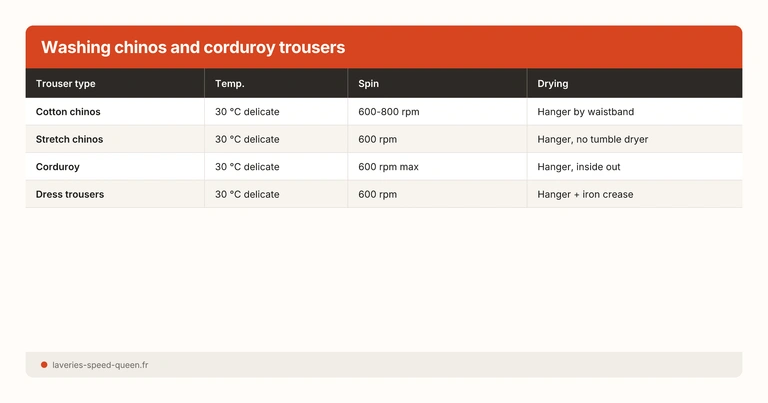
In short: chinos and corduroy should be machine washed at 30 °C on the delicate cycle, always turned inside out. Use liquid detergent (not powder — grains lodge in corduroy ribs and the chino weave). Spin: 600 rpm maximum. Hang dry — the tumble dryer accelerates shrinkage and crushes corduroy ribs.
At a glance
Turn inside out — protects the chino color and the corduroy ribs from drum friction.
30 °C delicate cycle — reduced agitation, higher water volume. Keeps shrinkage near zero.
Liquid detergent only — powders leave white residue in corduroy ribs and tight chino weave.
Spin at 600 rpm maximum — higher speeds risk permanent false creases and crushed corduroy ribs.
Hang dry on a hanger — suspend by the waistband. No tumble dryer (shrinkage + wrinkling).
Chinos and corduroy: cotton cousins
Chinos and corduroy are both cotton (or cotton-elastane) trousers that share the same enemy in the wash: shrinkage and deformation. But their structures differ, and each has its own weak points.
Chinos: a twill weave
Chinos are made from twill — a diagonal weave that gives the fabric its drape and durability. The smooth twill surface reveals flaws easily: false creases, iron shine, and abrasion fading. Chino cotton is usually piece-dyed (the whole fabric is dyed after weaving), making it more prone to fading than denim (where only the warp is dyed).
Classic chino colors (khaki, beige, navy, burgundy, gray) are especially vulnerable to color loss from repeated hot washes.
Corduroy: raised ribs
Corduroy is a fabric with a surface of parallel ribs — rows of raised fibers that give the fabric its distinctive texture. These ribs are the fragile part: drum friction and strong spinning flatten them, creating a shiny, worn look that does not go away.
Unlike chinos with a flat surface, corduroy has a textured surface that also traps powder detergent residue between the ribs. Hence the importance of liquid detergent.
For a more detailed guide on all velvet types (plush, corduroy, pinwale, silk), check our article on washing velvet.
Dress pants: a third case
Some dress pants (suit trousers, creased trousers) can also go in the machine, but with extra precautions.
Cotton chinos
30 °C delicate. Sturdy fabric but prone to fading. Liquid detergent, spin 600-800 rpm. Hang dry. Stretch (elastane) tolerates the machine but not the tumble dryer (heat degrades elasticity).
Corduroy
30 °C delicate, inside out mandatory. Liquid detergent (no powder in the ribs). Spin 600 rpm max. Hang dry, no tumble dryer. Brush in the direction of the pile once dry to lift the ribs.
Dress pants (wool blend)
30 °C wool/silk cycle. The most delicate of the three. Wool-specific detergent, spin 400 rpm or no spin at all. Dry flat to prevent stretching. Steam iron to re-form the crease.
Dress pants (polyester/viscose)
30 °C delicate. Synthetic fabric that wrinkles less but is heat-sensitive. Spin 600 rpm. De-wrinkles well hung in bathroom steam. Low-heat tumble dry is tolerated but not recommended.
Before washing: preparation
Check the care label
Even though most chinos and corduroy are machine washable, always check the care label. Some dress pants (especially those with wool or silk in the blend) require dry cleaning. The circle symbol (no basin) means dry clean only.
Turn inside out
This is the first thing to do for every pair of trousers — chinos, corduroy, or dress pants. Turning protects:
- Color — drum friction causes surface abrasion that fades the dye, especially on dark colors.
- Corduroy ribs — contact with the drum and other garments crushes the raised fibers.
- Finish — some chinos have a surface treatment (water-repellent, stain-resistant) that wears faster in direct drum contact.
Close fly and button
An open zipper can scratch other clothes in the drum. A closed button keeps the waistband shape during washing, preventing the waist from warping.
Empty the pockets
Check every pocket: a forgotten tissue disintegrates into white micro-lint that sticks to everything else. Coins can damage the drum and the drain filter. A leaking pen is a disaster.
Pre-treat stains before washing
The 30 °C delicate cycle does not have the power of a 60 °C cotton cycle to dislodge stains. Treat before washing:
- Grease stains (oil, sauce, dressing): sprinkle with talc or cornstarch, let absorb for 30 minutes, brush gently.
- Liquid stains (coffee, wine, juice): blot with a cloth soaked in cold water and Marseille soap↗. For red wine, check our dedicated wine stain guide.
- Mud/dirt stains: let dry completely, brush off the maximum, then wash normally.
Corduroy: never rub a stain. Rubbing flattens the ribs and creates a visible mark (shine) even after the stain is cleaned. Always blot, from the edge toward the center, with a soft cloth.
Machine washing: detailed settings
Cycle
Delicate cycle (or “mixed textiles” if your machine does not have a delicate option). The delicate cycle is characterized by:
- Reduced agitation — the drum turns slower with pauses. Less friction = less surface abrasion.
- Higher water volume — the trousers float more, reducing fabric-to-fabric and fabric-to-drum contact.
- Longer soak phases — the detergent has time to work chemically rather than relying on mechanical action.
Temperature
30 °C for all three trouser types (chinos, corduroy, dress pants). This temperature offers the best balance between cleaning effectiveness and fabric preservation.
At 30 °C:
- Shrinkage is virtually zero (even for 100% cotton).
- Colors are preserved — pigments migrate far less in cold/warm water.
- Elastane (stretch) keeps its elasticity — heat degrades elastic fibers.
At 40 °C:
- Cotton can shrink 3 to 5% on the first wash. On size 32 chinos with a 32-inch inseam, that is 1-1.5 inches of length lost.
- Dark colors start to fade after 10-15 washes.
For more on temperature impact, check our washing temperature guide.
Detergent
Liquid detergent, dosed according to the load. Powder detergent is not recommended for two reasons:
- Undissolved grains at 30 °C leave white marks in corduroy ribs and in the tight chino weave.
- The oxygen-based bleaching agents in most powder detergents can lighten dark colors over repeated washes.
For dark-colored trousers (navy, black, burgundy), “dark colors” or “black” detergents are a good choice — they contain color-fixing agents.
No fabric softener on corduroy — it glues fibers together and reduces rib definition. On chinos, softener is optional but unnecessary. White vinegar in the rinse (100 ml) is an alternative that softens without residue.
Spin
- Cotton chinos: 600-800 rpm. The twill handles moderate spin without creating false creases.
- Corduroy: 600 rpm maximum. A stronger spin crushes the ribs and creates permanent marks.
- Dress pants: 400-600 rpm, or no spin at all for thin fabrics. False creases from strong spin are very visible on creased trousers.
Drying: hanger, no tumble dryer
The tumble dryer is the enemy of structured trousers. Heat accelerates cotton shrinkage, deforms elastane, and drum rotation creates random false creases that are then very difficult to iron out.
Drying method
- Shake the pants after spinning to relax the fibers and reduce creases.
- Hang by the waistband on a clip hanger (trouser hanger clips hold the waist in shape). If you do not have a clip hanger, fold the pants in half at the waist and drape over a wide hanger.
- Keep the pants inside out during drying. The inside dries first from air contact, which is faster.
- Dry indoors or in shade. Direct sunlight fades colors — especially noticeable on khaki and beige.
The weight of water smooths creases
An advantage of hang-drying: the weight of residual water in the fabric pulls downward, naturally smoothing creases. This is why it is important to hang the pants immediately after spinning — if you leave them balled up in the drum for 30 minutes, false creases set.
Ironing: rules by fabric
Cotton chinos
- Temperature: cotton setting (150 °C) with steam.
- Inside out or press cloth: for dark colors, iron on the inside or use a press cloth (damp white cotton fabric). Direct iron contact creates shiny spots (shine) on dark twill.
- The crease: if you want a center crease, align both legs with inner and outer seams matched, and press the iron along the crease. Steam sets the shape.
Corduroy
- Never iron directly on the ribs. The iron crushes the ribs and creates irreversible shine.
- Iron inside out only, iron at low-medium temperature (synthetic setting, 110-130 °C) with steam.
- The ideal tool: a garment steamer held 3-5 cm from the surface, which smooths the fabric from a distance without crushing the ribs.
Dress pants
- Temperature according to composition (wool: wool setting; polyester: synthetic setting; blend: lowest setting).
- Press cloth mandatory for fine fabrics.
- Re-form the crease: the crease on dress pants is the finishing mark. Align the legs, match the seams, iron with steam focusing on the crease edge.
For a complete guide to ironing temperatures by fabric, check our article on ironing by fabric and temperature.
Keeping the crease: myth and reality
The center crease on trousers (smart chinos or suit pants) is a matter of finish, not structure. It does not “hold” through the machine — it is re-created during ironing after each wash.
Tips for a lasting crease
- Starch: a light starch spray before ironing slightly stiffens the fabric and holds the crease longer. Apply on the inside, let dry 1 minute, iron.
- White vinegar: spray a water-vinegar mix (50/50) on the crease edge before ironing. The acetic acid locks fibers in position.
- Clip hanger storage: pants hung upside down by the hems lose the crease less than pants folded in a drawer.
Common stains on chinos and corduroy
Trousers are exposed to specific stains from daily wear.
Grass stains (knees)
Common on light chinos (khaki, beige). Chlorophyll is a resistant pigment. Treat with 70% rubbing alcohol on a cotton pad, blotting (not rubbing). Leave for 15 minutes, then wash normally. Our grass stain guide covers the full method.
Grease stains (food, bike oil)
Sprinkle with talc or cornstarch immediately. The powder absorbs grease in 20-30 minutes. Brush, then apply a drop of dish soap directly on the stain (dish soap is an excellent degreaser). Leave for 10 minutes, rinse with cold water, then machine wash.
Mud stains
Let dry completely — wet mud spreads if you rub. Once dry, brush off the maximum dry. The residual stain usually comes out in a 30 °C machine wash.
Mistakes to avoid
- Washing at 40 °C or higher — cotton shrinks 3-5% on the first wash at 40 °C. On chinos, that is 1-1.5 inches of length lost.
- Powder detergent on corduroy — undissolved grains lodge in the ribs and leave visible white marks.
- Spin above 600 rpm for corduroy — centrifugal pressure crushes the ribs and creates a permanent shiny look.
- Tumble dryer — shrinkage + false creases + crushed ribs (corduroy). Hang drying on a hanger is mandatory.
- Iron directly on corduroy — the soleplate contact crushes ribs irreversibly. Inside out only or garment steamer.
- Rubbing a stain on corduroy — rubbing lays down the fibers and creates a visible mark (shine). Always blot.
Washing frequency
Trousers do not need washing after every wear — unless stained or after heavy sweating. Here are the benchmarks:
- Cotton chinos: 3 to 5 wears. The twill is a dense fabric that holds odors poorly. Air the pants for 24 hours between wears.
- Corduroy: 3 to 5 wears. The ribs trap dust — brush after each wear to remove surface particles.
- Dress pants: 3 to 6 wears (worn with underwear and a shirt layer underneath, they stay relatively protected from direct sweat).
Each wash wears the fabric: cotton loses color, ribs flatten gradually, stretch relaxes. Washing at the right frequency extends the lifespan of the trousers. For a complete breakdown by garment, check our how often to wash clothes guide.
The stretch chino case (elastane)
Most modern chinos contain 2 to 5% elastane (Lycra, Spandex) for comfort and freedom of movement. This component is invisible but changes the care rules:
- No tumble dryer: heat degrades elastane — the fabric loses elasticity and the pants “bag” at the knees and seat.
- 30 °C maximum: heat accelerates elastane aging.
- No bleach: chlorine destroys elastic fibers.
A well-maintained stretch chino (30 °C, air dry) keeps its elasticity for dozens of washes. Poorly maintained (40 °C + tumble dryer), it deforms in 5-10 washes.
As an Amazon Associate, we earn a small commission on purchases made through the affiliate links in this article — at no extra cost to you. This helps us maintain this site and produce free guides.
Dress pants, chinos, corduroy — all wash at 30 °C delicate in our machines. Our laundromats in Blagnac, Croix-Daurade and Montaudran offer delicate programs with adjustable spin. Payment by contactless card or cash. Check our prices.
Sources and references
- Washing velvet in the machine — full guide
- Washing temperature guide
- Laundry care label symbols
- Ironing guide by fabric and temperature
- How often to wash clothes
- Fabric softener: useful or not?
- White vinegar for laundry
- Preventing shrinkage in the wash
- Twill weave (twill) structure and washing behavior — mechanical properties of woven cotton
- Corduroy weave — effect of mechanical friction on raised fibers (Textile Research Journal)