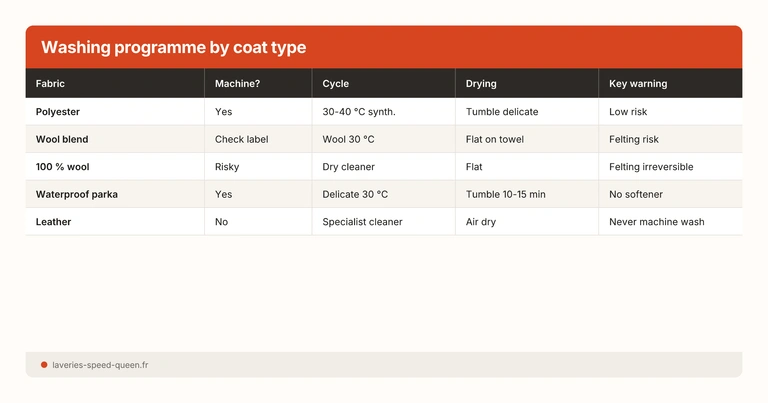
In short: most polyester or synthetic coats can be machine washed at 30-40 °C without issue. Wool blend coats often accept the wool cycle at 30 °C (check the label). Waterproof parkas are washed at 30 °C without fabric softener. Leather or 100% virgin wool coats are best handled by a dry cleaner. The absolute rule: the care label decides.
At a glance
Label first — it determines whether the coat goes in the machine or to the dry cleaner.
Polyester/synthetic — 30-40 °C synthetic cycle. The easiest.
Wool blend — 30 °C wool cycle IF the label allows it.
Waterproof/parka — 30 °C delicate, NO fabric softener.
Leather = dry cleaner — never in the machine.
By fabric: the right treatment
| Fabric | Machine? | Cycle / temp | Drying | Key precaution |
|---|---|---|---|---|
| Polyester / synthetic | Yes | Synthetic 30-40 °C | Tumble dryer delicate or hanger | Easiest, low risk |
| Wool blend (50-60%) | Depends on label | Wool 30 °C | Flat on towel | Risk of felting if temp is too high |
| 100% wool / cashmere | Risky | Dry cleaning recommended | Flat | Felting is irreversible |
| Waterproof parka (DWR) | Yes | Delicate 30 °C | Tumble dryer low heat 10-15 min | NO fabric softener |
| Gore-Tex / membrane | Yes | Delicate 30 °C, technical detergent | Tumble dryer low heat to reactivate | Technical detergent required |
| Puffer jacket (down/synthetic) | Yes | Delicate 30 °C | Tumble dryer with tennis balls | Dedicated puffer guide |
| Leather / faux leather | No | Damp cloth | Air dry | Specialist leather cleaner if needed |
Before washing: pre-treat collar and cuffs
On any regularly worn coat, the collar, cuffs, and pocket linings concentrate dirt (sebum, makeup, sunscreen). If you wash without pre-treating, these areas come out still gray.
- Collar and cuffs: gently rub with damp Marseille soap↗ or a drop of dish soap. Leave for 10 minutes before the machine wash.
- Pocket linings: turn out and brush out debris (crumbs, sand, dust) dry. Pre-treat visible stains.
- Isolated stains: apply the product suited to the fabric (Marseille soap on cotton/polyester, leather product on leather) rather than washing the entire coat for a single stain.
Polyester / synthetic coat: the simplest case
Polyester is the easiest fabric to machine wash. The fibers are resistant to moderate heat, agitation, and common detergents.
- Cycle: synthetic or normal cotton, 30-40 °C.
- Spin: 800-1000 rpm with no issues.
- Detergent: standard, normal dose. Fabric softener is fine (unless the coat has a DWR treatment — see the parka section below).
- Drying: tumble dryer on delicate or on a hanger. Polyester dries fast and does not shrink.
- Frequency: 2-3 times per season for a daily-wear coat. During the season, air for 24 hours to let odors and moisture dissipate.
Wool coat: the critical precaution
Felting is irreversible
Wool felts when it simultaneously experiences heat, agitation, and a pH change. The scales on wool fibers open under heat and permanently interlock — the garment shrinks and thickens irreversibly. That is why the wool cycle exists: it reduces drum agitation and maintains low temperature.
If the label allows machine washing
- Wool cycle at 30 °C, reduced spin (400-600 rpm).
- Detergent: wool/delicate detergent or liquid Marseille soap. Never a detergent with protease enzymes — they attack wool’s keratin.
- No fabric softener: wool is naturally soft. Softener leaves an unnecessary film.
- Drying: flat on a terry towel, never hung (the weight of the water deforms shoulders and sleeves). Reshape by hand before drying. Allow 24-48 hours.
If the label says “dry clean only” or you are unsure
Option 1: dry cleaning (perchloroethylene or hydrocarbon solvent). The safest method for virgin wool and cashmere.
Option 2: hand washing in a cold-water bath (max 20 °C) with a dab of gentle shampoo (neutral pH). Soak 15 minutes without rubbing. Rinse gently in cold water. Press dry between two towels — never twist. Dry flat.
For more, see our guides on preventing shrinkage and delicate fabrics.
Specific fabrics: detailed protocols
Beyond the main categories in the table, certain fabrics require special treatment.
Waxed cotton (Barbour, Fjallraven type)
Waxed cotton never goes in the machine. Drum agitation and detergent surfactants dissolve the protective wax — the garment loses its water resistance irreversibly.
- Cleaning: damp sponge + mild soap (no detergent). Scrub dirty areas, rinse with cold water, and air dry.
- Re-waxing: reapply textile wax (Barbour Wax Thornproof, Fjallraven Greenland Wax) once a year or when the fabric no longer beads water. Apply with a hairdryer on clean fabric to melt the wax into the fibers.
Gore-Tex and technical membranes
Membrane garments (Gore-Tex, eVent, Sympatex) are machine washable but require a residue-free technical detergent (Nikwax Tech Wash, Grangers Performance Wash). Standard detergents leave surfactants that clog the membrane micropores and block breathability.
- Cycle: delicate 30 °C, gentle spin (600 rpm max).
- Double rinse recommended to remove all residue.
- Drying: tumble dryer on low heat 15-20 minutes to reactivate the DWR.
Boiled wool
Boiled wool is already intentionally felted — so it is more stable than regular wool. It can be machine washed on the wool cycle at 30 °C with a wool-specific detergent. Spin should remain gentle (400 rpm). Dry flat. Boiled wool generally does not shrink, but washing at too high a temperature can alter the felt density.
Faux fur
Faux fur (polyester, acrylic) can be machine washed at 30 °C on the delicate cycle. Low spin (400 rpm). Never tumble dry — heat melts and flattens synthetic fibers. Air dry on a wide hanger and gently brush the fur once dry to restore volume.
Waterproof parka: the fabric softener issue
No fabric softener
The cationic agents in fabric softener clog the membrane pores and neutralize the DWR water-repellent treatment. The result: a parka that absorbs water instead of repelling it. Learn more about fabric softener.
Technical detergent
Use a detergent specifically designed for technical garments (Nikwax Tech Wash, Grangers) or pure Marseille soap. Standard detergents can leave residue that affects breathability.
Reactivate DWR in the dryer
After washing, a short tumble dry (low heat, 10-15 min) helps reactivate the DWR treatment. You can also use a reproofing spray after drying.
How to tell if the DWR is still active
Perform the water drop test: pour a few drops of water on the outer fabric. If water forms beads that roll off, the DWR is working. If water spreads and wets the fabric, the treatment is worn and needs reactivation (low-heat tumble dry 15 min) or renewal (reproofing spray such as Nikwax TX.Direct or Grangers Performance Repel).
DWR wears naturally over time, from friction (backpack straps, seat belts) and especially from repeated washing with standard detergents — hence the importance of technical detergent.
Reproofing: when and how to reactivate
After each wash (even with technical detergent), the DWR loses some effectiveness. Two methods:
- Tumble dryer method: after washing and spinning, put the parka in the dryer on low heat for 15-20 minutes. Moderate heat reorganizes the DWR molecules on the fabric surface. This is the simplest method and often sufficient.
- Reproofing spray: on a clean, dry garment, spray a DWR product (Nikwax TX.Direct Spray-On, Grangers Performance Repel) across the entire outer surface. Air dry. Ideal for high-wear areas (shoulders, hood).
- Wash-in (added to the rinse): wash-in products (Nikwax TX.Direct Wash-In, Grangers Clothing Repel) go directly into the machine rinse compartment. Coverage is more even than a spray. Recommended for premium technical garments.
Frequency: reactivate DWR after every wash. Apply a new treatment (spray or wash-in) every 3-5 washes or when the water drop test shows water no longer beads.
Leather coat: never in the machine
Leather (cowhide, lambskin, nubuck, suede) cannot tolerate prolonged immersion or mechanical agitation. In the machine, it warps, cracks, and irreversibly loses its suppleness.
- Routine cleaning: damp cloth (not soaked) + leather-specific soap. Wipe, do not rub.
- Grease stains: sprinkle with talc or fuller’s earth↗, let absorb for 4-6 hours, brush gently.
- Conditioning: after cleaning, apply a nourishing cream or leather balm. Leather is a skin — without moisturizing, it cracks.
- Suede / nubuck: brush dry with a crepe brush. For stains, rub with a suede eraser. Water leaves watermarks — avoid it.
- If the coat is very dirty or stained: specialist leather dry cleaner. Not a regular dry cleaner — ask if they treat leather specifically.
End-of-season storage: the full checklist
A coat stored dirty attracts moths (wool keratin + sebum residue = a feast for larvae) and yellows (oxidation of sweat residue). Proper storage preserves the shape, color, and lifespan of the garment.
- Wash or clean before storing — never store dirty. A coat stored with sweat residue will develop odors and yellow stains over the summer (see our guide on yellowing).
- Breathable garment bag in cotton or non-woven fabric. Not a plastic dry-cleaning bag — it traps moisture and blocks airflow, promoting mold and musty odors.
- Natural moth repellents: dried lavender sachets, cedar blocks, or moth pouches in the closet. Replace every 6 months. No naphthalene (toxic, persistent odor, classified as potentially carcinogenic).
- Suitable hangers: wide, padded hangers for structured coats (wool, blazers). Thin wire hangers create permanent shoulder deformation. For puffer jackets, a wide hanger is enough — the padding naturally regains its shape.
- Location: dry, ventilated, out of direct light. UV fades fabrics, especially dark colors and dyed wool. Ideal temperature is 15-25 °C with relative humidity under 60%.
- Waterproof parkas: store uncompressed (not in a vacuum bag). Prolonged compression can damage the membrane and DWR. Hang on a wide hanger in a breathable bag.
Why a large machine helps
A long coat or thick parka needs space in the drum to tumble freely. Crammed into a domestic 7 kg machine, the coat does not wash properly (water and detergent cannot circulate) and the spin is unbalanced.
A 9 kg machine works for a standard coat. For a very bulky parka or a long lined coat, an 18 kg machine at a laundromat delivers much better results.
Mistakes to avoid
- Washing wool above 30 °C — felting is irreversible. Even 40 °C can be enough to trigger the process.
- Using fabric softener on a waterproof — destroys the DWR treatment.
- Hanging a wet wool coat — the weight of water deforms it. Dry flat on a towel.
- Putting a leather coat in the machine — warping and cracking are irreversible.
- Spinning at maximum speed — 600-800 rpm is enough. Spinning at 1200+ can damage seams and closures.
- Storing a coat without washing at end of season — sweat, sebum, and dust residue attract moths and cause yellowing during storage.
As an Amazon Associate, we earn a small commission on purchases made through the affiliate links in this article — at no extra cost to you. This helps us maintain this site and produce free guides.
A coat too bulky for your home machine? Visit our laundromats with 9 and 18 kg machines — enough space for a proper wash and dry without compressing the garment. Detergent included, everything done in approx. 1 hour. Payment by contactless card or cash.
Sources and references
- How to wash a puffer jacket in the machine
- Preventing shrinkage in the wash
- Delicate fabrics: silk, cashmere, lace
- How to wash ski gear
- Fabric softener: useful or not?
- Laundry care label symbols guide
- Whitening yellowed laundry
- Laundromat vs. dry cleaning: when to choose what
- How often to wash clothes by garment
- Nikwax, Guide to Cleaning and Waterproofing Outdoor Clothing
- Gore-Tex, Product Care Instructions (gore-tex.com)