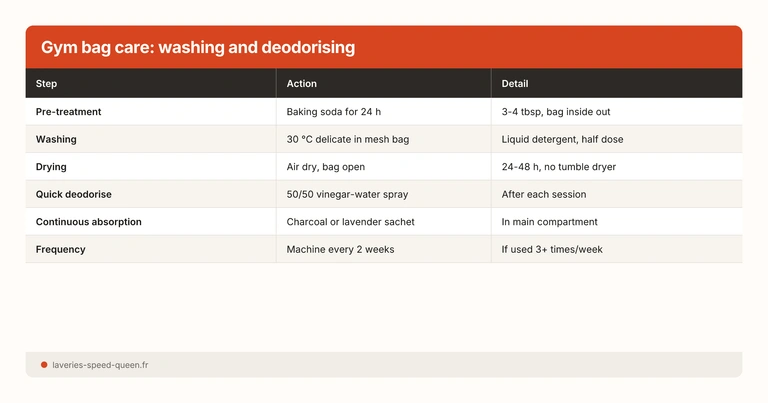
In short: a gym bag is machine-washable at 30 degrees C on a delicate cycle, inside a mesh laundry bag. Pre-treatment: baking soda sprinkled inside for 24 hours to neutralize odors. Air-dry with the bag open and inside out — never tumble dry. Between washes: white vinegar spray or activated charcoal. Frequency: every 2 weeks with regular use.
At a Glance
Empty and turn inside out — check all pockets. Crumbs, forgotten tissues and trapped moisture feed bacteria.
Baking soda pre-treatment — 3-4 tablespoons sprinkled inside, 24 hours. Absorbs odors and moisture.
30 degrees C delicate in a mesh bag — the mesh protects straps, zippers and reinforcements. Liquid detergent, half dose.
Air-dry with the bag open — no tumble dryer (plastics, heat bonds). Complete drying: 24-48 hours.
Deodorize between washes — white vinegar spray (50/50 water), lavender sachet or activated charcoal in the compartment.
Why Your Gym Bag Smells Bad
The smell in a gym bag is not caused by sweat itself. Human sweat is initially nearly odorless — it is 99% water, with traces of salt, urea and minerals.
The smell comes from bacteria. Human skin naturally carries millions of bacteria (staphylococci, corynebacteria) that feed on sweat components. By breaking down the fatty acids and proteins in perspiration, these bacteria produce volatile fatty acids — mainly isovaleric acid and propionic acid — that create the characteristic “locker room” smell.
The problem with a gym bag is that it creates an ideal environment for these bacteria:
- Moisture — sweaty clothes, a damp towel, gym shoes after a workout create high humidity inside the bag.
- Warmth — the closed bag in a locker, car trunk or closet stays at room temperature or higher.
- Nutrients — residual sweat, dead skin, leftover hygiene product residue are all food sources for bacteria.
- Darkness — no UV rays to limit bacterial growth.
Under these conditions, bacteria double their population every 20 to 30 minutes. In 6 hours (the time between a morning workout and the evening), an initial bacterial population of 1 million can reach billions. That is why the smell builds so fast and so strong.
The Fabric Traps Bacteria
Synthetic fibers used in gym bags (polyester, nylon) have a structure that traps bacteria more effectively than cotton. Polyester is hydrophobic — it repels water but retains body oils and bacteria in its crevices. That is why a polyester gym bag develops odor faster and stronger than a cotton canvas bag.
This is the same phenomenon that makes sportswear hard to deodorize: synthetics retain bacteria even after washing if conditions are not right.
Before Washing: Pre-Treatment
Step 1: Empty Completely
Remove everything from the bag: clothes, towel, water bottle, energy bars, headphones, padlock, hair ties. Check every pocket — gym bags often have 5 to 8 compartments (front pocket, side pockets, shoe compartment, inner zip pocket). A forgotten tissue, a crushed granola bar or a damp sock at the bottom of a compartment can keep odors alive despite washing.
Step 2: Turn Inside Out
Turn the bag completely inside out to expose the inner seams and the bottom — the areas that accumulate the most sweat, dead skin and bacteria. The inside of the bag is the dirty part; turning it out lets detergent work directly on it.
Step 3: Baking Soda Pre-Treatment
This is the step that makes the difference between a wash that eliminates the odor and one that only reduces it temporarily.
Sprinkle 3 to 4 tablespoons of baking soda inside the turned-out bag. Baking soda is an alkaline buffer (pH 8.3) that neutralizes the volatile fatty acids responsible for the smell. It also absorbs residual moisture.
Leave for 24 hours — it is a long time, but necessary for the baking soda to penetrate the fibers and neutralize the acids. If 24 hours is not possible, a minimum of 8 hours (overnight) still gives good results.
Before putting the bag in the machine, shake out the excess baking soda. You do not need to remove it all — residual baking soda dissolves in the wash water and boosts the detergent’s action.
Baking soda does not mask the odor — it neutralizes it. Scented sprays and chemical deodorizers cover the smell with a stronger fragrance, but the bacteria and acids remain in the fibers. Baking soda chemically reacts with the volatile acids to form odorless salts. This is real deodorizing, not cosmetic.
Machine Washing
Mesh Laundry Bag: Mandatory
A gym bag is not a garment — it has straps, zippers, plastic buckles and often a rigid bottom. In the drum, these elements can:
- Scratch the door glass (metal buckles).
- Tangle with other items (straps).
- Break (zippers caught in drum holes).
- Damage the door seal.
Place the turned-out bag in a large mesh laundry bag↗ with a fine weave. The mesh contains the straps and hard parts while letting water and detergent circulate.
If the bag is too large for a mesh bag, tie the straps together with an elastic band and close all zippers before putting it in the drum.
Cycle and Temperature
30 degrees C delicate cycle. Gym bags are made with materials that do not tolerate heat:
- Polyester warps above 40 degrees C.
- Heat-bonded seams (glued instead of stitched) can come apart at high temperatures.
- Foam reinforcements (straps, back panel) lose their structure with heat.
- Printed elements (logos, reflective strips) are often heat-bonded and peel off in hot water.
The delicate cycle provides reduced agitation that protects the zippers and rigid parts of the bag.
Detergent
Liquid detergent, half dose. The bag is not a bulky textile that absorbs a lot of detergent — half a dose is enough for the volume of fabric.
No powder detergent: granules can get stuck in seams, inner pockets and bag crevices, leaving white traces.
To boost deodorizing, add 100 ml of white vinegar to the rinse compartment. Vinegar complements the baking soda by eliminating residual bacteria (its acidic pH of 2.5 is hostile to microorganisms).
Spin
600 rpm maximum. The rigid parts of the bag (bottom, reinforcements) cannot handle the centrifugal force of a powerful spin. Zippers and buckles also risk breaking or warping.
Washing by Material
Polyester (most common)
30 degrees C delicate in a mesh bag. Polyester is hydrophobic — it repels water but retains oils and bacteria. Baking soda pre-treatment is particularly important for polyester. Fast air-drying (2-4 hours).
Nylon (Cordura, ripstop)
30 degrees C delicate in a mesh bag. Nylon is more durable than polyester but equally heat-sensitive. Cordura (ballistic nylon) bags are very tough but heat-bonded seams remain the weak point. Do not wring to remove water.
Cotton canvas
30 degrees C normal cotton cycle (canvas is robust). Cotton absorbs water and dries more slowly than synthetics — allow 24-48 hours of air-drying. Advantage: cotton retains odors less than polyester.
Leather / faux leather
DO NOT machine-wash. Leather swells, warps and cracks when it dries. Faux leather (PU) peels off. Clean by hand with a damp cloth and Marseille soap. For mixed bags (canvas + leather), hand-clean only.
Drying: Patience and Ventilation
Drying is a critical step for gym bags. A poorly dried bag becomes a bacterial breeding ground again within days.
Method
- Hang the bag inside out, all zippers open, in a well-ventilated area. Air must circulate inside the bag to dry the seams and corners.
- If possible, place the bag near an open window or a fan. Air circulation speeds up drying and prevents moisture stagnation.
- Do not store the bag until it is perfectly dry — touch the inner seams and the bottom to check. If those areas are still damp, keep waiting.
Drying Time
- Polyester / nylon: 12 to 24 hours outdoors (synthetics dry fast).
- Cotton canvas: 24 to 48 hours (cotton absorbs a lot of water).
- In humid weather or indoors without ventilation: double these times.
Tumble Dryer: No
The tumble dryer is not suitable for gym bags. The heat:
- Warps plastic reinforcements (bottom, frame).
- Melts heat-bonded elements (logos, reflective strips, glued seams).
- Degrades strap and back panel foam.
- Breaks plastic zippers under heat and mechanical impact.
Between Washes: Deodorizing and Prevention
Machine washing every 2 weeks is the recommended frequency for regular use. Between washes, several methods maintain the bag’s freshness.
White Vinegar Spray
Prepare a spray with 50% water + 50% white vinegar↗ in a spray bottle. After each gym session, spray the inside of the bag (3-4 sprays is enough) and let it dry with the bag open. Vinegar kills surface bacteria and neutralizes odor-causing acids. The vinegar smell disappears in 20-30 minutes.
Activated Charcoal
Place an activated charcoal sachet (available at health stores or online, about 5-10 dollars) in the main compartment between uses. Activated charcoal is an extremely porous material (1 gram = 500 to 3,000 square meters of internal surface area) that adsorbs odor molecules. One sachet lasts 2 to 3 months. Regenerate it by placing it in the sun for 2 hours (UV rays dislodge adsorbed molecules).
Lavender Sachets
Dried lavender has mild antibacterial properties (thanks to linalool and linalyl acetate) in addition to its fragrance. Place a fabric sachet filled with dried lavender in the bag. It adds a pleasant scent and limits bacterial growth. Replace the lavender every 2-3 months when the fragrance fades.
The Golden Rule: Never Close a Damp Bag
The number one factor for odor is trapped moisture. If you take away one thing from this article, let it be this: never close your gym bag with damp clothes inside. Take out the sweaty clothes as soon as possible. If you cannot wash them immediately, put them in a separate plastic bag and leave the gym bag open.
Shoe Compartment: The Critical Point
Most modern gym bags have a separate shoe compartment. It is the compartment that smells the worst — gym shoes combine foot sweat (the area of the body that sweats the most: 250,000 sweat glands per foot) and the darkness of the compartment.
Compartment Care
- Wipe the inside of the compartment with a cloth soaked in white vinegar after each use.
- Sprinkle baking soda in the compartment once a week and shake it out the next day.
- Never store shoes while still damp in the compartment. Let them air-dry before storing.
Recommended Washing Frequency
Frequency depends on usage intensity:
- 3+ sessions per week: machine wash every 2 weeks. Deodorize (vinegar spray) after each session.
- 1-2 sessions per week: machine wash every 4 weeks. Deodorize after each session.
- Occasional use: machine wash when the smell appears. Store the bag open, never closed in a closet.
These frequencies assume you remove damp clothes from the bag after each session and leave the bag open to dry. If clothes sit in the bag for 6+ hours after a workout, double the washing frequency.
Mistakes to Avoid
- Washing without emptying pockets — a tissue disintegrates into lint. A forgotten granola bar melts and sticks. Check all compartments.
- Washing without a mesh bag — straps tangle, buckles scratch the door glass, zippers get caught in drum holes.
- Washing above 30 degrees C — heat-bonded seams come apart, plastic reinforcements warp, prints peel off.
- Tumble dryer — heat melts bonded elements and warps plastic reinforcements.
- Closing the bag with damp clothes inside — the number one cause of odor. Bacteria double every 20-30 minutes in a warm, moist environment.
- Using scented spray instead of washing — the fragrance masks the smell but bacteria remain. The odor returns in hours, stronger.
The Gym Bag at the Laundromat: The Solution for Large Bags
Oversized gym bags (hockey bags, ski bags, large duffel bags) do not always fit in a domestic 7-8 kg machine. The large-capacity machines at a laundromat (10 to 18 kg) are the solution for these bulky items.
The principle stays the same: mesh bag, 30 degrees C delicate, liquid detergent. But the large drum capacity lets the bag float freely in the water — washing is more effective because detergent penetrates all areas of the bag more thoroughly.
It is also the solution if you have multiple bags to wash at once (a sporty family): one 10 kg cycle washes 3 to 4 gym bags with efficiency impossible in a domestic machine.
As an Amazon Associate, we earn a small commission on purchases made through the affiliate links in this article — at no extra cost to you. This helps us maintain this site and produce free guides.
Large gym bags do not fit in a domestic machine. Our laundromats in Toulouse and Blagnac have 10 to 18 kg machines with a delicate cycle — ideal for bulky bags. Payment by card or contactless. Check our prices.
Sources and References
- Bacterial decomposition of sweat and volatile fatty acid production — cutaneous microbiome (Journal of Investigative Dermatology)
- Activated charcoal adsorption properties — specific surface area and molecular trapping capacity (Carbon Journal)