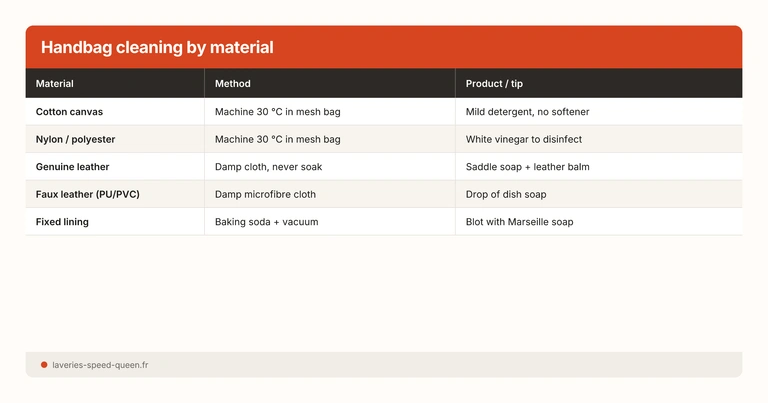
In short: a canvas or nylon handbag can be machine-washed at 30 °C inside a mesh bag. Leather must never touch water — clean it with a damp cloth and saddle soap. Faux leather wipes clean with a damp microfibre cloth and a drop of dish soap. The lining responds well to baking soda and vacuuming. Storage: tissue paper, a dust bag, never stacked.
At a glance
Canvas / nylon = machine at 30 °C -- in a mesh bag, delicate cycle, no fabric softener. Air-dry only.
Leather = never submerge -- damp cloth + saddle soap, then nourishing balm.
Faux leather = damp microfibre cloth -- a drop of dish soap is enough. No leather balm.
Lining = baking soda + vacuuming -- dab stains with Marseille soap.
Storage = tissue paper + dust bag -- keeps the shape and protects the material.
Why handbag cleaning matters
A handbag goes everywhere with its owner: public transport, the office, restaurants, the car floor. A study from the University of Arizona (Charles Gerba, 2012) found that the exterior of a handbag harbours an average of 10,000 bacteria per cm2 — more than the average public toilet seat. The interior lining is even more contaminated: crumbs, make-up residue and coins handled by dozens of hands.
Beyond hygiene, regular cleaning preserves the material. Unconditioned leather dries out and cracks. Canvas accumulates stains that become permanent if left untreated. Faux leather peels and flakes prematurely without cleaning.
Identify the material first
The cleaning method depends entirely on the material. Using the wrong approach can ruin a bag in minutes — a leather bag submerged in water is beyond repair; faux leather treated with greasy leather balm softens and cracks.
Canvas (cotton)
Thick, hard-wearing fabric used by brands like Longchamp (Le Pliage), Vanessa Bruno and many tote bags. Machine-washable at 30 °C in a mesh bag. Handles Marseille soap well. The easiest material to maintain.
Genuine leather
Tanned animal hide (cowhide, lambskin, buffalo). Must never be submerged in water. Clean with a damp cloth + saddle soap. Needs a nourishing balm after every clean to stay supple.
Faux leather (PU / PVC)
Synthetic coating that imitates leather. Easier to wipe clean (a damp cloth is enough) but more fragile over time. Never use leather balm -- the fatty agents attack the polyurethane. No solvents either.
Nylon / technical polyester
Lightweight, water-resistant fabrics (Kipling, Eastpak, Fjallraven). Machine-washable at 30 °C in a mesh bag. Dry quickly. Tolerate white vinegar for disinfection.
How to identify the material
Check the interior label (sewn into a pocket or under a flap). It will list the composition: “genuine leather”, “polyurethane (PU)” for faux leather, “cotton” for canvas, “polyamide / nylon” for synthetics. If in doubt, the fingernail test is reliable: genuine leather shows a light mark that fades; faux leather does not mark or reveals the backing fabric underneath.
Step 1 — Empty and prepare the bag
Before any cleaning, the bag must be completely emptied and prepared.
Empty everything -- wallet, keys, make-up, phone. Open every pocket, including hidden zip pockets.
Turn upside down and shake -- over a bin, flip the bag to dislodge crumbs, dust and debris from the bottom.
Vacuum the corners -- use the narrow nozzle of your vacuum to reach corners, seams and the bottom of pockets.
Remove detachable accessories -- shoulder strap, charm, keyring. Metal parts can scratch the bag during cleaning.
Photograph the stains -- useful for tracking how well the treatment works and knowing exactly where to focus.
Step 2 — Clean the lining
The interior lining is the dirtiest part of the bag. It collects make-up residue, pen marks, crumbs and bacteria. Cleaning the lining is just as important as cleaning the outside.
If the lining is removable
Some bags (notably high-end travel bags) have a removable lining. In that case, take it out and wash it separately at 30 °C on a delicate cycle with your regular detergent. Air-dry only.
If the lining is fixed (most common)
- Turn the lining inside out as far as possible by pulling it through the opening. The goal is to expose as much surface as you can.
- Sprinkle baking soda↗ over the entire lining surface. Baking soda absorbs odours and loosens grime. Leave for 15 to 20 minutes.
- Vacuum the baking soda with the narrow nozzle.
- Dab stains with a damp cloth and a little liquid Marseille soap. For ink stains, use a cotton pad soaked in rubbing alcohol. For make-up, apply a drop of dish soap with your finger.
- Rinse by dabbing with a clean damp cloth (not soaked — avoid wetting the bag’s structure).
- Let dry with the bag open and the lining turned out, in a well-ventilated spot.
Anti-odour tip
If the lining smells bad (stale perfume, musty smell), place an open sachet of baking soda inside the closed bag for 24 to 48 hours. Baking soda absorbs odours without leaving chemical residue. You can also add a few drops of lavender essential oil on a piece of cotton placed inside the bag.
Step 3 — Clean the exterior by material
Canvas (cotton)
Canvas is the easiest material to maintain. It can handle machine washing and mechanical scrubbing.
Machine wash (recommended for a deep clean):
- Place the bag in a mesh laundry bag↗ and close all zips.
- Run a delicate cycle at 30 °C with a reduced dose of detergent — no fabric softener.
- Gentle spin (400 rpm max).
- Air-dry by stuffing the bag with paper towels to hold its shape.
Hand wash (for bags with a frame or leather trim):
- Fill a basin with warm water and Marseille soap↗.
- Scrub the canvas with a soft brush (clean nail brush) in circular motions.
- Focus on high-contact areas: handles, bottom, corners.
- Rinse with a clean damp cloth. Air-dry.
For stubborn stains on canvas (grease, ink), see our specific stain-removal guides.
Genuine leather
Leather is a premium material that demands specific precautions. The absolute rule: never submerge in water.
- Gather your supplies: clean microfibre cloth, saddle soap (or very diluted Marseille soap), leather-nourishing balm.
- Lightly dampen the cloth (wring it out thoroughly — the cloth should be barely moist).
- Apply saddle soap to the cloth (not directly to the leather).
- Rub in circular motions across the entire surface, concentrating on stained or worn areas.
- Wipe with a second cloth, clean and dry, to remove soap residue.
- Let dry at room temperature, away from any heat source (radiator, hairdryer) and direct sunlight.
- Apply a nourishing balm once the leather is completely dry. The balm restores lost oils and maintains suppleness.
For light-coloured leather (beige, white), micellar water or make-up remover milk is a gentle, effective alternative. Apply with a cotton pad, rub gently, wipe clean. The emollient agents cleanse without drying out the hide.
Faux leather (PU / PVC)
Faux leather (polyurethane or PVC) mimics the look of leather but is cleaned differently. It is easier to maintain day-to-day but more sensitive to chemicals.
- Damp microfibre cloth with a drop of mild dish soap.
- Wipe the entire surface with light motions. Faux leather does not need vigorous scrubbing.
- Rinse with a clean damp cloth (plain water).
- Dry immediately with a dry cloth — do not let water sit in the seams.
What destroys faux leather
Never use leather balm or shoe polish on faux leather — fatty agents (beeswax, mink oil) soften the PU coating and speed up cracking. Also avoid acetone, nail polish remover, rubbing alcohol and any harsh solvent. Faux leather is not leather — it does not need conditioning, just keeping clean and dry.
Nylon and technical polyester
Nylon bags (Kipling, Eastpak, Fjallraven Kanken) and polyester bags are the simplest to care for.
- Machine wash: mesh laundry bag, 30 °C, delicate cycle, no fabric softener. Softener reduces breathability and water repellency in technical fabrics.
- Drying: air-dry only. Nylon and polyester melt at high temperatures — never use a tumble dryer.
- Disinfection: spray a 50/50 mix of water and white vinegar over the entire surface and let it air-dry.
Zippers and metal hardware
Zippers are often overlooked during cleaning, yet they are a common source of jams and premature wear.
Cleaning: run an old damp toothbrush along both rows of teeth to remove fibres and accumulated dust. This is often the reason zips “stick”.
Lubrication: if the zip still sticks after cleaning, rub the teeth with a pencil (graphite is an effective dry lubricant) or run a piece of candle wax along the teeth. Avoid liquid lubricants (WD-40, oil) — they stain the surrounding fabric.
Metal hardware (buckles, clasps, snap hooks): wipe with a dry cloth. If the metal is tarnished, a cloth dampened with white vinegar↗ followed by a dry wipe restores shine. For gold-plated fittings, use only water — acids attack the plating.
Recommended cleaning schedule
| Maintenance type | Everyday bag | Occasional bag |
|---|---|---|
| Exterior wipe (damp cloth) | Once a week | Before each use |
| Interior vacuuming | Once a month | Once a season |
| Full clean (exterior + lining) | Every 2-3 months | Once a season |
| Nourishing balm (leather only) | Every 3 months | Twice a year |
| Zipper cleaning | Every 2 months | When the zip sticks |
Storage and care
Good storage extends a bag’s lifespan by years. Poor storage habits are the number-one cause of deformation and premature ageing.
Stuff with tissue paper
Tissue paper holds the bag's shape without adding weight. Do not use newspaper -- printing ink can stain a light-coloured lining. Replace the tissue paper each season as it absorbs ambient moisture.
Dust bag (cloth cover)
Store each bag in its original dust bag or a cotton pillowcase. The fabric protects from dust while letting leather breathe. Never use a plastic bag -- plastic traps moisture and encourages mould.
Store upright, never stacked
The weight of one bag on another deforms leather and crushes corners. Store your bags upright with a little space between each. Wardrobe shelves are ideal -- not drawers or the bottom of a chest.
Away from sunlight and heat
Direct sunlight fades leather and faux leather within weeks. Heat (radiators, attics in summer) dries out leather and cracks faux leather. Store in a cool, dry and dark place.
Special cases
Ink stain on a leather bag
Ink stains on leather are among the trickiest. Leather is porous and absorbs ink fast.
Fresh ink (less than 30 min): dab immediately with a cotton pad soaked in make-up remover milk. The milk emulsifies the ink without drying out the leather. Repeat with a fresh pad until the stain disappears.
Dried ink: apply a thin layer of unscented moisturiser to the stain and leave for 30 minutes. The cream softens dried ink and makes extraction easier. Wipe with a clean cloth. If the stain remains, consult a leather specialist — harsh solvents risk discolouring the leather.
Stubborn tobacco or perfume odour
Leather bags absorb odours stubbornly. Leather is essentially skin — porous and absorbent.
- Place the open bag inside a large bin liner with 3-4 tablespoons of baking soda (in a bowl, not directly on the leather).
- Seal the bin liner and leave for 48 hours.
- Remove the bag and air it outdoors for 24 hours.
- If the odour persists, repeat. Baking soda absorbs the volatile compounds responsible for smells.
Foundation or lipstick stain
Foundation and lipstick contain pigments and oils that stain fabric and faux leather quickly.
On the lining: apply dish soap directly to the stain, massage with your fingertip, leave for 10 minutes, then dab with a damp cloth. Dish soap emulsifies the fats in make-up.
On leather: make-up remover milk only — never dish soap on leather.
Mistakes to avoid
- Submerging a leather bag in water -- leather warps, stiffens and can crack irreversibly as it dries.
- Using leather balm on faux leather -- the fatty agents soften the PU coating and accelerate cracking.
- Drying with a tumble dryer or hairdryer -- direct heat warps the bag and dries out leather. Air-dry only.
- Storing in a plastic bag -- plastic traps moisture and stops leather from breathing. Mould is guaranteed.
- Stacking bags -- the weight deforms leather and crushes corners and structure.
- Using acetone or nail polish remover -- these solvents damage leather, faux leather and canvas alike.
As an Amazon Associate we earn a small commission on purchases made through the affiliate links in this article — at no extra cost to you. This helps us maintain the site and produce free guides.
Canvas and nylon bags can go in the machine. Our laundromats in Blagnac, Croix-Daurade and Montaudran have machines with a 30 °C delicate cycle, perfect for bags inside a mesh laundry bag. Detergent included, contactless payment accepted. Prices.
Sources and references
- University of Arizona — Charles Gerba (2012), bacteria on handbag surfaces
- Leather care and saddle soap best practices