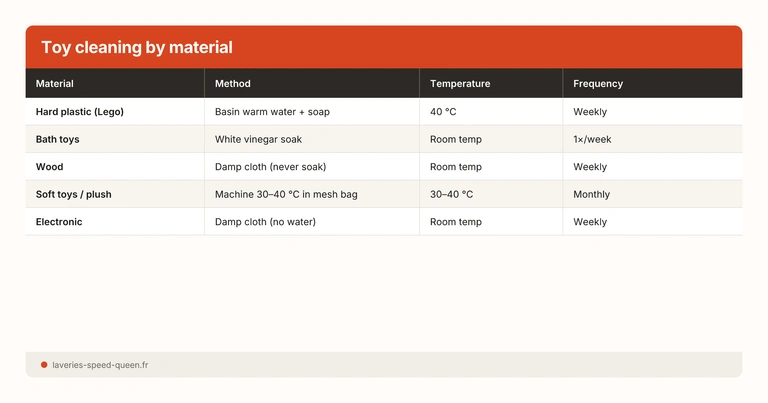
In short: hard plastic — basin of hot water
- dish soap. Bath toys — white vinegar once a week against mould. Wood — damp cloth only (never soak). Soft toys and fabric — washing machine at 30-40 °C in a mesh laundry bag. In daycare, shared toys are cleaned daily. After illness, systematically sanitise every toy the child has handled.
Why regular toy cleaning matters
Young children put everything in their mouths — it is a normal exploratory reflex until about age 3. A toy handled daily collects bacteria, viruses, food residue, dust and sometimes mould (bath toys). Several paediatric studies show that toys are significant vectors for gastro-intestinal and respiratory virus transmission, especially in group settings.
What accumulates on a toy
- Bacteria: staphylococci, streptococci, faecal coliforms (from hands after toilet visits)
- Viruses: gastroenteritis, colds, flu — some viruses survive several hours on plastic
- Mould: mainly inside bath toys with holes (rubber ducks, squirting animals)
- Allergens: dust mites on soft toys, pollen and dust on all toys
- Food residue: sugar, milk, puree — the perfect breeding ground for bacteria
Hard plastic toys
Hard plastic toys (Lego, Duplo, Playmobil, figurines, toy cars, plastic puzzles) are the easiest to clean.
Basic method: basin of hot water
Soak
Basin of hot water (40 °C) with a few drops of dish soap. Submerge the toys for 15-20 minutes. Hot water loosens food residue and finger grease.
Scrub
Use an old toothbrush for crevices, joints and small parts. The grooves in Lego bricks and figurine joints collect invisible grime.
Rinse
Rinse under running water to remove all soap residue. A child who mouths the toy should not ingest detergent.
Dry
Spread on a clean towel and air-dry. Never put toys away damp in a closed toy box -- mould is guaranteed.
Machine method: small pieces
Small hard plastic pieces (Lego, beads, small figurines) wash very well in a washing machine:
- Place pieces in a fine-mesh laundry bag (or a pillowcase tied shut)
- Add other clothes to the machine to cushion impacts
- Select a delicate 30 °C cycle
- No tumble dryer — pieces could warp
- Spread on a towel to dry
This method is ideal for large Lego or Duplo collections: hundreds of pieces cleaned in a single cycle, zero effort.
Battery-powered or electronic toys
Toys containing batteries or electronics must never be submerged. Clean them with a damp cloth (not soaked) plus a few drops of white vinegar↗. For crevices, use a cotton bud dipped in white vinegar. Remove batteries before cleaning to avoid moisture contact.
Bath toys: the mould problem
Bath toys — especially those with a hole (rubber ducks, squirting animals, suction-cup letters) — are mould’s favourite playground.
Why mould takes hold
The hole at the bottom lets bathwater in. Between baths, stagnant water in a warm, dark environment (bathroom) creates perfect conditions for black mould growth (Aspergillus, Penicillium). A Swiss study published in Biofilms and Microbiomes (2018) found up to 75 million bacteria per cm2 inside rubber bath ducks.
Weekly cleaning protocol
After every bath: squeeze toys to expel water, shake them and store with the opening facing down in a hanging mesh bag (not in a closed container).
Once a week: soak all bath toys in a solution of white vinegar (1 part) and water (2 parts) for 1 hour. Squeeze toys with holes to push the solution inside.
Rinse thoroughly under running water. Squeeze several times to flush vinegar from inside toys with holes.
Dry with the opening facing down on a clean towel or in a hanging mesh bag.
Inspect monthly: squeeze each toy over a white bowl. If black or green residue comes out, the toy is contaminated inside. Treat with undiluted vinegar or discard.
The radical prevention: seal the holes
The most effective solution against internal mould is to seal the hole with a dab of hot glue (glue gun) before the first use. Water can no longer get in, so mould cannot establish itself. The toy still floats and can be surface-cleaned normally.
When to throw away a bath toy
If you squeeze a bath toy and black residue comes out despite vinegar treatment, throw it away. Black mould inside a toy with a hole is impossible to eliminate completely once established. A child who mouths the toy or squirts the water ingests mould spores. The cost of a new rubber duck (GBP 2-5 / USD 2-5) does not justify the health risk.
Wooden toys
Wood is a beautiful material for children’s toys, but it requires specific care. The golden rule: never soak.
Why wood must not be soaked
Wood is porous — water penetrates the fibres, causes swelling, creates cracks on drying and encourages internal mould. A wooden toy soaked in water will never be the same: rough surface, splinters, warping.
Cleaning method
- Wipe with a slightly damp cloth (wrung out thoroughly)
- Disinfect with a cloth dampened with white vinegar (not soaked)
- Dry immediately with a dry cloth
- Air for a few hours before storing
For varnished or painted wooden toys, cleaning is simpler because the varnish protects the wood. A damp cloth with mild soap is enough. For unvarnished (raw) wooden toys, be even more sparing with water.
Preventive care
Every 3-6 months, apply a thin coat of food-grade linseed oil or coconut oil to unvarnished wooden toys. The oil nourishes the wood, protects it from moisture and makes the surface easier to clean. Use only food-safe oils — the child will mouth the toy.
Soft toys and fabric toys
Soft toys, comforters, fabric dolls and cloth books can go in the washing machine — and they regularly need it.
Recommended washing schedule
| Toy type | Frequency | Temperature | Note |
|---|---|---|---|
| Comforter (bed companion) | 1-2 times a month | 30-40 °C | In contact with the face, saliva and nasal secretions |
| Play soft toys | Once a month | 30-40 °C | More often if the child mouths them |
| Decorative soft toys (shelf) | Every 2-3 months | 30 °C | Collect dust and dust mites even without handling |
| Cloth books | 1-2 times a month | 30 °C | Handled and mouthed frequently |
| Dressing-up costumes | After each extended use | 30 °C | Perspiration + extended skin contact |
| Play blanket / activity mat | Once a week | 40-60 °C | Floor contact + drool + spit-up |
Machine-wash protocol
Check the label -- most modern soft toys carry a 30 °C machine-wash symbol. Antique or handmade soft toys often need hand-washing.
Mesh laundry bag is essential -- protects eyes, buttons and sewn-on accessories. Alternative: a pillowcase tied shut.
Delicate cycle at 30-40 °C -- spin at 600-800 rpm max. A vigorous spin deforms the stuffing.
Hypoallergenic detergent -- detergent residue stays in the stuffing and sits against the child's skin. Avoid scented detergents.
No fabric softener -- makes stuffing less fluffy and can irritate sensitive skin.
Drying -- tumble-dry on low if the label allows (stuffing dries better). Otherwise, hang to air-dry and gently press to reshape.
The comforter conundrum: managing separation
Washing a toddler’s comforter can trigger a real meltdown. The classic solution: own two identical comforters and rotate them. While one is in the wash, the other is on duty. Start the wash during nap time or after bedtime.
If the child has only one comforter and refuses to part with it, a 30-minute quick cycle can be an acceptable compromise for lightly soiled items.
Daycare and group-setting protocol
In group settings, virus and bacteria transmission through toys is a major hygiene concern. Health-authority recommendations are stricter than for home use.
Daily cleaning
All toys handled during the day are cleaned in the evening: surfaces wiped with white vinegar or an approved no-rinse disinfectant (EN 14476 standard).
Weekly soft toys
Fabric toys belonging to the daycare go into the washing machine once a week at 40 °C minimum. Personal comforters are washed by parents.
After illness
When a child is ill (gastroenteritis, flu, hand-foot-mouth disease), every toy they have handled is isolated and sanitised before going back into circulation.
Bath toys
In many daycares, bath toys with holes are banned. Only solid hard-plastic toys without cavities are allowed for water play.
After illness: full sanitisation
When a child is ill (gastroenteritis, flu, bronchiolitis, hand-foot-mouth disease), their toys become potential vectors for siblings or visitors. Here is the sanitisation protocol.
Plastic toys
Wash in hot water (60 °C if the plastic can handle it, 40 °C otherwise) with dish soap. Rinse and air-dry. For toys that cannot take heat, a spray of white vinegar left for 15 minutes is an alternative.
Soft toys and fabric
Machine-wash at the highest temperature the label allows (ideally 60 °C). If the label limits to 30 °C, add a textile disinfectant to the cycle. Tumble-dry on high if possible — the dryer heat finishes off remaining germs.
Wooden toys
Wipe with a cloth soaked in undiluted white vinegar. Leave for 15 minutes. Wipe with a dry cloth. White vinegar is an effective natural disinfectant against most common viruses.
The freezer: your dust-mite ally
For soft toys you cannot machine-wash (too fragile, electronic components), place them in an airtight bag and put them in the freezer for 24-48 hours. The cold kills dust mites (but not bacteria). Remove the toy, let it return to room temperature, then vacuum to remove the dead mites. This is the recommended method for children with dust-mite allergies.
Summary table by material
| Material | Method | Product | Frequency | Never |
|---|---|---|---|---|
| Hard plastic | Hot-water basin or machine at 30 °C | Dish soap | Once a week | Dishwasher (warping) |
| Soft plastic (bath) | White vinegar soak | White vinegar 1:2 | Once a week + rinse after every bath | Drying with hole facing up |
| Wood | Damp cloth (wrung out) | White vinegar or mild soap | Once a week | Soaking, submerging |
| Fabric / soft toy | Machine 30-40 °C, mesh bag | Hypoallergenic detergent | 1-2 times a month | Fabric softener, scented detergent |
| Electronic | Damp cloth | White vinegar | Once a week | Any submersion |
Mistakes to avoid
- Soaking wooden toys -- wood swells, cracks and develops mould. Use only a wrung-out cloth.
- Ignoring bath toys -- internal mould is invisible but real. Treat with vinegar weekly or seal the holes with glue.
- Using bleach on baby toys -- residue is ingested when the child mouths the toy. White vinegar is equally effective and safe.
- Forgetting to remove batteries -- before any wet cleaning of a battery-powered toy, remove the batteries. Moisture corrodes contacts and can cause a short circuit.
- Storing damp toys -- in a closed toy box, toys that are still damp develop mould within days. Dry completely before storing.
- Neglecting decorative soft toys -- soft toys on a shelf collect dust and dust mites even if the child does not handle them daily. Wash every 2-3 months.
As an Amazon Associate we earn a small commission on purchases made through the affiliate links in this article — at no extra cost to you. This helps us maintain the site and produce free guides.
Need to wash a big load of soft toys, comforters or children’s fabrics? Our laundromats in Blagnac, Croix-Daurade and Montaudran have 9 and 18 kg machines with automatically dosed hypoallergenic detergent — perfect for a big fabric-toy clean. Contactless payment accepted. See our prices.
Sources and references
- Hamner et al. — Biofilms and Microbiomes (2018), “Microbial communities in bath toys”
- Paediatric hygiene guidelines for daycare settings