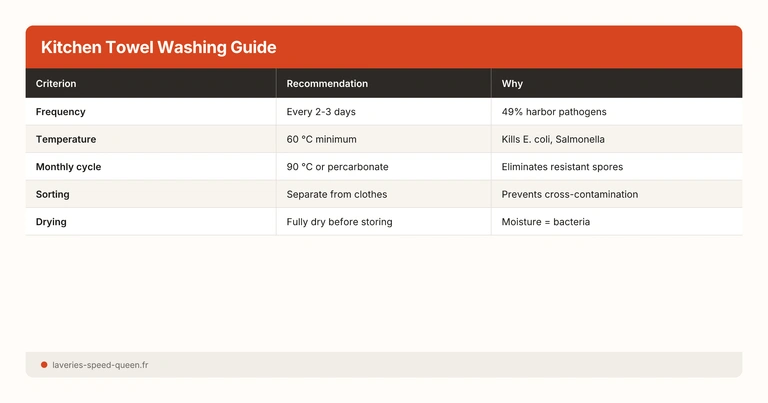
In short: kitchen towels are one of the most contaminated items in the home. Studies show that 49 % harbour pathogenic bacteria (E. coli, Salmonella) after one month of use. Wash them every 2-3 days at 60 °C minimum, separate from body linen. A monthly 90 °C cycle or a soak in sodium percarbonate kills resistant bacteria and whitens yellowed towels.
At a glance
Every 2-3 days -- beyond that, pathogenic bacteria multiply exponentially.
60 °C minimum -- the temperature that kills E. coli, Salmonella and Staphylococcus aureus.
Never with everyday clothes -- food-borne bacteria must not cross-contaminate your garments.
Full drying mandatory -- a damp towel folded in a drawer equals a bacteria and mould incubator.
90 °C or percarbonate monthly -- to eliminate resistant bacteria and restore whiteness.
Why kitchen towels are a hygiene problem
The kitchen towel is one of the most contaminated textiles in your home — far more so than bath towels or bed sheets. It is not a question of personal cleanliness: it is biology.
What the science says
A study conducted by the University of Mauritius and presented at ASM Microbe 2018 (the American Society for Microbiology congress) analysed 100 kitchen towels used for one month. The results are stark:
- 49 % harboured pathogenic bacteria
- 36.7 % contained coliforms (including E. coli)
- 14.3 % contained Staphylococcus aureus
- Damp towels had significantly more bacteria than dry ones
- Households with children and meat consumption had higher contamination rates
A complementary study published in the Journal of Food Protection (2014) showed that kitchen towels are responsible for cross-contamination between foods: a towel used to wipe a counter contaminated by raw meat can transfer bacteria to hands, then to other foods.
Why towels are a perfect incubator
Bacteria need three things to thrive:
- Moisture — The towel is constantly damp after each use (drying hands, dishes, surfaces).
- Nutrients — Food residue, grease, proteins, sugars — everything passing through the kitchen ends up in the towel’s fibres.
- Warmth — The kitchen is often the warmest room in the house (cooking, oven, hob).
Under these conditions, a bacterial population doubles every 20 minutes. In 24 hours, a single bacterium can theoretically produce billions of descendants.
Washing frequency: the 2-3 day rule
Change the towel immediately if...
It has been in contact with raw meat or raw fish
It was used to mop up a contaminated liquid (raw egg, meat juices)
It smells bad (a sign of advanced bacterial growth)
It has stayed damp for more than 24 hours without drying
Under normal use (drying clean dishes, wiping washed hands), a kitchen towel can be used for 2 to 3 days maximum before washing. Beyond that, the bacterial load becomes problematic, even if the towel looks visually clean.
Practical recommendation: keep a rotation of 6-8 towels. Change every 2 days, wash the batch in a single 60 °C load at the end of the week. This system is simple, economical and hygienically sound.
Multi-use towels: the trap
The biggest hygiene risk is the towel that does everything: dry hands, dry dishes, wipe the counter, grab a hot pan. Each use adds different bacteria, and cross-contamination becomes inevitable.
Solution: assign different towels to different tasks. One for hands (hung on a hook, never laid on the counter), one for dishes, one for surfaces. Different colours make it easy to tell them apart.
Wash temperature: why 60 °C is the minimum
Temperature is the decisive factor for kitchen-towel hygiene. Here is what each threshold eliminates:
| Temperature | Bacteria killed | Bacteria surviving | Verdict |
|---|---|---|---|
| 30 °C | Very few | E. coli, Salmonella, S. aureus, moulds | Insufficient |
| 40 °C | Some fragile bacteria | E. coli, Salmonella, S. aureus | Insufficient |
| 60 °C | E. coli, Salmonella, most pathogens | Some resistant spores | Recommended (regular cycle) |
| 90 °C | All bacteria, including spores | None | Ideal (monthly cycle) |
A 60 °C programme is the best compromise for a regular wash: it kills dangerous pathogens without wearing fibres out prematurely. The 90 °C programme is reserved for the monthly deep-disinfection cycle.
By fabric: adapt the programme
Cotton (the classic)
The best choice for hygiene. Cotton handles 60 °C routinely and 90 °C monthly. Absorbs well but dries slowly -- hang it up quickly after use. White cotton towels tolerate percarbonate and diluted bleach.
Microfibre
Dries fast (a hygiene advantage), but may not tolerate more than 40-60 °C depending on the brand. Never use fabric softener -- it clogs microfibres and reduces absorbency. Use a reduced detergent dose.
Linen
Naturally antibacterial thanks to its dense fibre structure. Dries faster than cotton. Handles 60 °C without issue. Linen creases easily -- not a problem for a towel, but avoid the tumble dryer, which stiffens it.
Cotton terry (towelling style)
Very absorbent but dries slowly -- a hygiene drawback. Wash at 60 °C, tumble-dry if possible. Ideal for drying dishes but less suited to wiping surfaces.
Whitening yellowed or greyed towels
Over time, even regularly washed towels take on a yellowish or grey cast. This is not residual dirt: it is the build-up of grease residue, limescale and detergent that binds to fibres.
Method 1 — Sodium percarbonate (gentlest)
Sodium percarbonate is an active-oxygen bleaching agent, effective and gentle on fibres.
- Dissolve 2 tablespoons of percarbonate per litre of 60 °C water
- Submerge the towels and soak for 4-6 hours (or overnight)
- Rinse and machine-wash at 60 °C
Percarbonate whitens white towels and revives the colours of coloured ones (provided you do not exceed the dose).
Method 2 — Diluted bleach (white towels only)
Bleach is the most powerful disinfectant, but it weakens fibres over time. Reserve it for extreme cases.
- Dilute 1 capful of bleach in 5 litres of cold water
- Soak for 30 minutes maximum
- Rinse thoroughly and machine-wash
Never mix bleach and vinegar — the combination produces chlorine gas, which is toxic.
Method 3 — Boiling (traditional)
Boil the towels in a large pot of water for 10-15 minutes. Add 1 tablespoon of baking soda or percarbonate for a whitening boost. This is the oldest and most effective method: 100 °C for 10 minutes sterilises fibres completely.
Smelly kitchen towels: diagnosis and fix
A kitchen towel that smells bad is a towel colonised by bacteria or mould. The odour is an alarm signal: do not ignore it, and above all, do not use the towel to dry dishes or hands.
Causes of the smell
- Bacteria — Bacteria break down food residue and produce malodorous compounds (volatile fatty acids, ammonia, hydrogen sulphide).
- Mould — A towel that does not dry fully between uses develops mould in its fibres. The musty smell is distinctive.
- Rancid grease residue — Lipids trapped in fibres oxidise over time and produce a rancid odour.
The decontamination protocol
- Baking-soda soak — 2 tbsp of baking soda per litre of warm water, at least 2 hours. Baking soda neutralises the acids responsible for the smell.
- White vinegar↗ rinse — Soak the towels in pure white vinegar for 30 minutes. The acetic acid destroys bacteria and mould.
- 90 °C wash — The hottest cycle available, with detergent. This is the shock treatment.
- Full tumble-dry — The heat of the dryer finishes off surviving micro-organisms.
If the smell persists after this treatment, the towel is irrecoverably contaminated. Replace it.
Separating laundry: a non-negotiable rule
- Never wash kitchen towels with body linen -- food-borne bacteria (E. coli, Salmonella) would contaminate your underwear and t-shirts.
- Never wash kitchen towels with bath towels -- same cross-contamination risk, and bath towels are often washed at 40 °C, which is too low for kitchen bacteria.
- Kitchen towels + household linen at 60 °C = OK -- you can wash kitchen towels with sheets, mattress protectors and towels washed at 60 °C.
- Towel that touched raw meat = isolated wash -- do not even mix it with other kitchen towels. Wash it alone or pre-treat with white vinegar before adding it to the batch.
Pre-treating common kitchen-towel stains
Kitchen towels collect a variety of stains over the days. Here is how to treat the most common ones before putting them in the machine.
Grease stains
Apply dish soap directly to the stain and leave for 15 min. Dish soap is the best emulsifier for cooking grease. Then wash at 60 °C.
Tomato-sauce stains
Rinse in cold water, apply Marseille soap. Lycopene (the red pigment) responds to white vinegar or percarbonate if the stain has dried.
Coffee or tea stains
White vinegar for 15 min or lemon on a fresh stain. Tannins bond with cotton fibres.
Yellow / grey build-up
This is not a single stain but accumulated residue. Percarbonate soak for 4-6 hours or boiling with baking soda.
Washing at a laundromat: ideal for big batches
If you have built up a large pile of kitchen towels (moving house, spring clean, after a dinner party), the large-capacity machines at a laundromat are ideal. A 9 kg machine can hold 15-20 towels, and professional 60 °C programmes deliver superior agitation and rinsing compared with a domestic machine.
The added bonus: commercial tumble dryers dry cotton towels in 20-30 minutes, versus 1-2 hours in a home machine. Fast, thorough drying limits bacterial regrowth.
Everyday best practices
Beyond washing, a few daily habits drastically reduce the bacterial load on your kitchen towels:
- Hang the towel after every use — on a hook or bar, not piled on the counter. A spread-out towel dries 3-5 times faster than a folded one.
- Never leave a towel in a ball — moisture trapped inside creates a perfect micro-environment for bacteria.
- Wash your hands before using the towel — a reflex that cuts contamination at the source.
- Use paper towel for raw meat — a disposable sheet of kitchen roll is safer than a cloth towel for wiping surfaces that have touched raw meat. Bin it after use.
- Replace towels regularly — a cotton kitchen towel has a useful life of 1-2 years under heavy use. Beyond that, the fibres are worn, absorb less and retain more bacteria.
As an Amazon Associate we earn a small commission on purchases made through the affiliate links in this article — at no extra cost to you. This helps us maintain the site and produce free guides.
Our laundromats in Blagnac, Croix-Daurade and Montaudran have professional machines with 60 °C programmes and high-performance dryers. Perfect for washing a big batch of kitchen towels and household linen in a single cycle. Contactless payment accepted. See our prices.
Sources and references
- University of Mauritius / ASM Microbe 2018 — bacterial contamination of kitchen towels
- Journal of Food Protection (2014) — cross-contamination via kitchen textiles