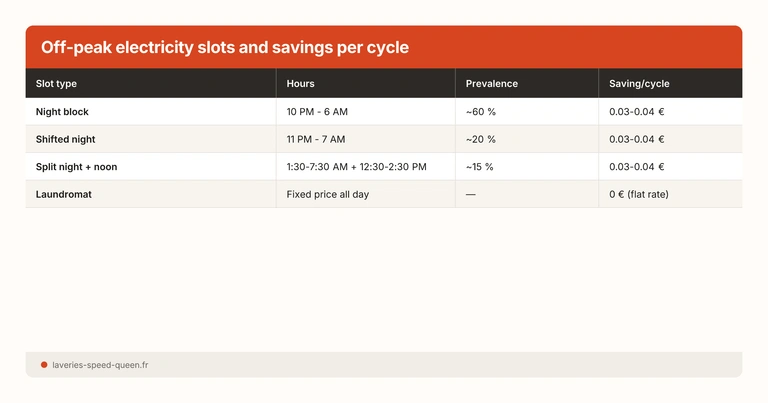
Running your washing machine during off-peak electricity hours (overnight on Economy 7 / time-of-use tariffs) saves 20-40 % on the electricity cost per cycle — roughly GBP 0.04-0.12 per wash. Over 220 cycles a year, that is GBP 8-26 saved. The real payoff comes from shifting washing machine + tumble dryer + dishwasher + water heater to off-peak: combined savings of GBP 80-150 per year. At a laundromat the price is fixed whatever the hour — no off-peak calculation needed.
At a glance
Off-peak windows vary -- check your bill or smart-meter app. UK Economy 7: typically midnight-7 am.
Saving per cycle: GBP 0.04-0.12 -- modest alone, but significant when combined across all heavy appliances.
Delayed start -- set it so the cycle finishes 30 min before your alarm. Wet laundry left sitting breeds odours.
Night noise in flats -- reduce spin speed, use an anti-vibration mat, keep the machine level.
At a laundromat: fixed price -- open 7 am-10 pm, same price any time. No scheduling needed.
How off-peak electricity tariffs work
The principle
Off-peak (or time-of-use) tariffs charge a lower rate for electricity consumed during periods of low demand — typically overnight. The UK’s Economy 7 gives you 7 hours of cheap electricity, usually midnight to 7 am. In the US, many utilities offer TOU plans with off-peak windows from 9 pm to 7 am.
The goal for the grid: smooth demand by incentivising households to shift non-urgent consumption (water heating, laundry, drying) to off-peak hours. The goal for you: pay less by adapting your habits.
Typical off-peak windows
| Tariff type | Off-peak window | Note |
|---|---|---|
| UK Economy 7 | Midnight - 7 am (7 hrs) | Most common UK off-peak tariff |
| UK Economy 10 | Various (10 hrs total, split) | Less common, includes afternoon block |
| US TOU (typical) | 9 pm - 7 am | Varies by state and utility |
| EU night tariff | 10 pm - 6 am (varies by country) | Common in France, Belgium, Spain |
How to find your off-peak hours: check your latest electricity bill (the windows are listed) or use your supplier’s app / smart-meter dashboard.
Rate comparison
| Country | Peak rate | Off-peak rate | Saving |
|---|---|---|---|
| UK (Economy 7) | ~0.30 GBP/kWh | ~0.10 GBP/kWh | ~67 % |
| US (TOU average) | ~0.20 USD/kWh | ~0.08 USD/kWh | ~60 % |
| EU average | ~0.30 EUR/kWh | ~0.18 EUR/kWh | ~40 % |
Note that peak rates on TOU tariffs are often higher than standard flat rates. To make the tariff worthwhile, you need to shift at least 40-50 % of your consumption to off-peak hours.
Real savings on the washing machine
Cost per cycle
A washing machine consumes between 0.3 and 1.2 kWh per cycle depending on temperature and programme. Water heating accounts for 75-85 % of this consumption.
| Programme | Consumption | Peak cost (0.30 GBP/kWh) | Off-peak cost (0.10 GBP/kWh) | Saving per cycle |
|---|---|---|---|---|
| 30 °C cotton | 0.35 kWh | GBP 0.11 | GBP 0.04 | GBP 0.07 |
| 40 °C cotton | 0.60 kWh | GBP 0.18 | GBP 0.06 | GBP 0.12 |
| 60 °C cotton | 1.00 kWh | GBP 0.30 | GBP 0.10 | GBP 0.20 |
| Eco 40 °C | 0.40 kWh | GBP 0.12 | GBP 0.04 | GBP 0.08 |
| Quick 30 °C | 0.25 kWh | GBP 0.08 | GBP 0.03 | GBP 0.05 |
Annual savings
An average household runs roughly 220 wash cycles per year. At an average temperature of 40 °C, the annual saving on the washing machine alone is about GBP 20-26. Modest — but it is a “free” gain that only requires a change of habit.
The real lever: combine all appliances
The benefit of a time-of-use tariff becomes clear when you shift all heavy consumers to off-peak.
| Appliance | Annual consumption | Annual saving (off-peak vs peak) |
|---|---|---|
| Water heater (150 L) | 800-1,200 kWh | GBP 50-80 |
| Tumble dryer (150 cycles) | 400-600 kWh | GBP 25-40 |
| Washing machine (220 cycles) | 100-200 kWh | GBP 15-26 |
| Dishwasher (250 cycles) | 200-300 kWh | GBP 15-25 |
| Total | 1,500-2,300 kWh | GBP 105-171 |
After deducting any standing-charge premium for the TOU tariff, net savings land at GBP 80-150 per year. That is significant — the equivalent of 2-3 months of electricity bills.
The delayed start: how to use it
How it works
The delayed start (or “start delay”) is a feature found on virtually all washing machines sold in the last 10 years. It lets you load the machine, select the programme and postpone the start by 1-24 hours depending on the model.
While waiting, the machine draws virtually nothing (1-2 W standby). The cycle starts automatically at the programmed time and runs as normal.
The timing trick
The trap with delayed start: setting the cycle too early at night. If the cycle ends at 3 am and you do not unload until 7 am, the laundry sits wet in the drum for 4 hours. Bacteria develop in damp laundry within 2-3 hours, producing unpleasant odours.
The right approach: calculate the delay so the cycle finishes 30 minutes before your alarm.
Timing example
Cotton 40 °C programme: duration 1 h 45 min. Your alarm is at 7:00 am. You want the cycle to end at 6:30 am. Required start: 6:30 - 1:45 = 4:45 am. If you load the machine at 9 pm and set a delay of 8 hours (9 pm + 8 h = 5 am, close to 4:45 am), the cycle will finish around 6:45 am — you unload the machine as soon as you wake up.
Smart / connected machines
Connected washing machines (Samsung SmartThings, LG ThinQ, Bosch Home Connect) let you programme the exact finish time from your smartphone. Some even detect your off-peak window automatically via a smart meter and optimise the start time. A genuine convenience — but these machines cost GBP 100-200 more than an equivalent non-connected model.
Night-time noise: solutions for flats
The legal framework
In most countries there is no law banning the use of a washing machine at night. However, building regulations and tenancy agreements often include a quiet-hours clause between 10 pm and 7 am. The noise from a washing machine on spin (65-78 dB) may constitute a noise nuisance if it is audible in adjacent flats.
In a house, the issue obviously does not arise — you can wash at any hour without disturbing anyone.
How loud is a washing machine?
| Cycle phase | Noise level | Equivalent |
|---|---|---|
| Water filling | 35-45 dB | Whisper |
| Wash (gentle rotation) | 45-55 dB | Normal conversation |
| Rinse | 45-55 dB | Normal conversation |
| Spin (1,200 rpm) | 65-75 dB | Vacuum cleaner |
| Spin (1,400 rpm) | 72-78 dB | Powerful vacuum |
The main problem is the spin — the last 5-10 minutes of the cycle. The rest of the wash is relatively quiet.
Anti-noise solutions
Reduce the spin
Drop the spin to 800 rpm for overnight washes. Laundry will be damper in the morning, but noise falls by 10-15 dB -- a very noticeable difference. Air-drying will take 2-3 hours longer.
Anti-vibration mat
A dense rubber mat under the machine (GBP 15-25) absorbs vibrations transmitted through the floor and walls. The most effective fix for noise reaching downstairs neighbours. Reduces perceived noise by 3-5 dB next door.
Level the machine
A poorly levelled machine vibrates and 'walks' during spin -- noise and vibrations are amplified. Adjust the feet with a spirit level. All 4 feet must touch the floor firmly. Re-check after every move.
Night / quiet programme
Some machines offer a 'night' or 'quiet' programme that automatically lowers spin speed and extends wash phases to compensate. Check whether your model has one.
- Do not skip the spin entirely -- washing without spinning leaves laundry saturated (80 % moisture). It will take 24-48 hours to dry and develop odours. A spin of 600-800 rpm is the minimum, even at night.
- Beware of unlevelled machines on tiles -- tiles transmit vibrations more than laminate or vinyl. An anti-vibration mat is almost mandatory on a tiled floor in a flat.
The tumble-dryer factor
The tumble dryer is the biggest beneficiary of off-peak shifting — its consumption (2-4 kWh per cycle) is 3-5 times higher than the washing machine’s. Saving per cycle: GBP 0.10-0.40, or GBP 15-40 per year over 150 cycles.
The problem: the tumble dryer is even louder than the washing machine (65-80 dB continuously, no quiet phase). In a flat, running the dryer overnight is often incompatible with neighbourly peace.
The logical alternative: air-drying — either outdoors or indoors. Saving: 100 % of the dryer’s electricity.
Lowering the temperature: a more powerful lever than off-peak
A fact many people miss: lowering the wash temperature saves more than shifting the wash to off-peak.
| Strategy | Saving per cycle (vs 60 °C at peak) | Annual saving (220 cycles) |
|---|---|---|
| 60 °C off-peak (instead of peak) | GBP 0.20 | ~GBP 44 |
| 40 °C at peak (instead of 60 °C) | GBP 0.12 | ~GBP 26 |
| 40 °C off-peak (combined) | GBP 0.24 | ~GBP 53 |
| 30 °C off-peak (optimum) | GBP 0.27 | ~GBP 59 |
The most effective move is to combine both: wash at 30-40 °C during off-peak hours. The combined saving can reach GBP 0.27 per cycle, or roughly GBP 59 per year.
At a laundromat: no off-peak, fixed price
At a Speed Queen self-service laundromat, the model is different.
Same price whatever the hour
Laundromat machines run at a fixed price — the same at 7 am as at 9 pm. There is no peak / off-peak split. The displayed price is the final price, detergent and softener included.
The advantage: you wash whenever suits you, with no maths and no delayed start. No scheduling constraints, no damp laundry sitting in the drum overnight.
Our opening hours
Our laundromats are open 7 days a week, 7 am to 10 pm. Come in the morning before work, at lunchtime, in the evening after 8 pm or at the weekend — the price is identical.
The quietest slots (least waiting): weekdays 10 am-4 pm and Sunday morning. The busiest slots: Saturday morning and Sunday afternoon.
The laundromat's economy of scale
At a laundromat, the energy cost is built into the per-wash price. Professional Speed Queen machines use less water and energy per kilo of laundry than domestic machines — better efficiency thanks to higher capacity (9-18 kg) and professional engineering. You do not pay for electricity, water and detergent separately — everything is included in one transparent price.
The right strategy for your situation
House
Take full advantage of off-peak: washing machine and dryer overnight, delayed start to finish before your alarm. No noise constraints. Maximum saving of GBP 30-50/year on the laundry duo alone.
Flat
Off-peak washing is possible with reduced spin and an anti-vibration mat. Avoid running the dryer overnight (too noisy). Alternative: wash off-peak, air-dry. Or use a laundromat for bulky loads.
Student / small flat
A TOU tariff is rarely worthwhile if your total electricity consumption is low. A laundromat is often cheaper and more practical than buying a washing machine plus paying for an off-peak tariff.
Large family
A TOU tariff pays for itself with 4-5 loads per week plus dryer and dishwasher. Programme a nightly schedule (washer 4-6 am, dryer 6-8 am). Use a laundromat for duvets and blankets.
Laundromat off-peak: it exists too
The concept of off-peak does not just apply to your electricity tariff. In a laundromat, busy vs quiet slots affect your comfort and efficiency, even though the machine price stays the same.
Quiet hours at a Speed Queen laundromat are typically weekday mornings (8-10 am) and early afternoons (1-3 pm). During these slots you have your pick of machines, no wait for dryers and a calmer environment for folding. Saturday morning (9 am-noon) is the busiest slot — avoid it if you prefer peace and quiet.
An under-appreciated advantage of laundromats vs washing at home: the electricity is included in the machine price. You do not need to worry about peak vs off-peak on your personal contract. Whether you come at 8 am or 6 pm, the cycle costs the same. The only “off-peak” benefit in a laundromat is the comfort of more machines available and less waiting.
The laundromat: the ideal complement for bulky items
These off-peak savings apply to everyday laundry (clothing, sheets, towels). For duvets, curtains, rugs and blankets, a laundromat is the most practical solution: no off-peak scheduling needed, professional 9-18 kg machines available any time, wash + dry done in 1 hour. It is also the only way to properly wash a double duvet — no domestic machine offers the drum volume required.
As an Amazon Associate we earn a small commission on purchases made through the affiliate links in this article — at no extra cost to you. This helps us maintain the site and produce free guides.
No desire to calculate off-peak hours or set a delayed start? Our laundromats in Blagnac, Croix-Daurade and Montaudran offer a fixed price all day, detergent included, 9-18 kg machines. Open 7 days, 7 am-10 pm. Contactless payment accepted. See our prices.
Sources and references
- Ofgem (UK) — Economy 7 and time-of-use tariffs
- US Department of Energy — time-of-use rate programmes
- Appliance energy consumption data (EU energy labels)