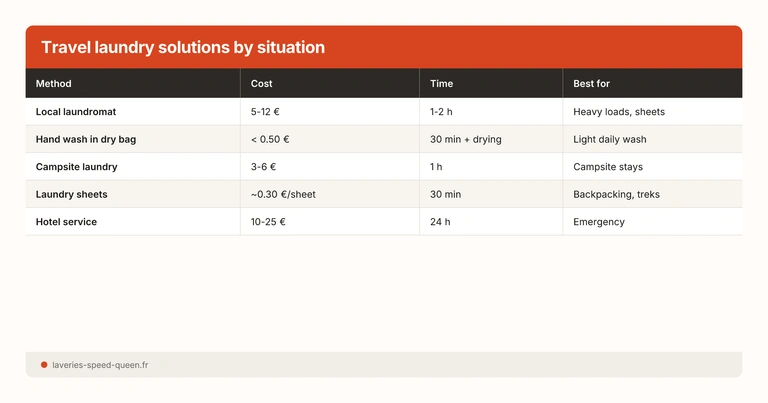
Doing laundry on the road doesn’t have to be stressful. Whether you’re living the vanlife, camping or backpacking, solutions exist: laundromats abroad, hand-washing by soaking in a dry bag, ultra-compact laundry sheets. The secret: quick-drying fabrics (merino, technical synthetics), a lightweight laundry kit (under 200 g), and a regular routine every 3-4 days to stop dirty clothes piling up. When a big load accumulates, a local laundromat sorts it out in about an hour.
At a Glance
Ultra-compact laundry kit -- laundry sheets, 10 L dry bag, bungee line and 6 clothespins (under 200 g total).
Merino or synthetic clothing -- wearable 3-5 days, dries in 2-4 hours vs 12-24 h for cotton.
Soak for 15-20 min -- hand-washing on the road relies on soaking, not intense scrubbing.
Wring in a microfibre towel -- roll and press to remove 60-70% of water, halving drying time.
Local laundromat for big loads -- sheets, towels, jeans: a laundromat is the most efficient solution.
Finding a Laundromat Abroad
A laundromat is the most efficient option when you’re travelling. It washes and dries a week’s worth of clothes in about an hour, at a reasonable cost. The challenge is knowing how to find one in an unfamiliar country.
Google Maps: The Search Terms You Need
Searching for “laundromat” only works in English-speaking countries. Every country has its own term, and Google Maps doesn’t always translate well. Here are the keywords that return reliable results.
| Country / Region | Search Term | Average Price per Cycle |
|---|---|---|
| France | Laverie automatique | 4-8 EUR |
| UK, USA, Australia | Laundromat / Laundrette | 3-7 EUR / 2-5 USD |
| Spain, Latin America | Lavanderia automatica | 3-6 EUR |
| Italy | Lavanderia self-service | 4-7 EUR |
| Germany, Austria | Waschsalon | 3-6 EUR |
| Portugal, Brazil | Lavandaria self-service | 3-5 EUR |
| Japan | Coin laundry | 200-400 JPY (1.50-3 EUR) |
| South Korea | Ppallae-bang | 3,000-5,000 KRW (2-4 EUR) |
Dedicated Apps
Beyond Google Maps, several apps list laundromats worldwide. Laundromap is the most comprehensive, with reviews and photos. Wash & Fold covers North America. In Asia, search “laundry” on Grab or Gojek — these super-apps often list nearby laundry services.
Local tip: in countries where laundromats are rare (Southeast Asia, Africa), accommodations often offer a laundry-by-the-kilo service. The price is typically 1-3 USD per kilogram, with next-day return. This is the most common approach in Thailand, Vietnam, Cambodia and Indonesia — and it’s often cheaper than a laundromat.
What to Know Before You Walk In
Laundromats operate differently from country to country. A few practical points.
Payment methods
In Europe, most accept coins and increasingly contactless payment. In the US and Japan, quarters (25 cents) and 100-yen coins are often still essential. Always keep spare change on hand.
Detergent included or not
In France (Speed Queen, Wash'n Dry), detergent is often included. Abroad, it rarely is: bring your own laundry sheets or buy a single dose from the on-site dispenser (0.50-1 EUR).
Cycle duration
A wash cycle runs 25-45 minutes depending on the machine and programme. Drying adds 30-50 minutes. Allow 1-2 hours total. Bring a book or take advantage of the Wi-Fi if available.
Hand-Washing: The Soaking Technique
Hand-washing is the everyday solution for the lightweight traveller. No washboard needed: the principle relies on prolonged soaking in a detergent solution, which does the work for you.
The Essential Kit
Everything fits in a corner of your backpack.
- 10-15 litre dry bag: doubles as a soaking basin. Waterproof compression sacks (Sea to Summit, Osprey) serve both purposes. A sturdy bin liner works too.
- Pre-dosed laundry sheets: compact (30 g for 50 sheets), no leak risk, biodegradable for sensitive water sources. Alternatives: Marseille soap↗ flakes, single-dose liquid detergent sachets.
- Bungee clothesline with hooks: 3 metres is enough. Twisted-spiral models let you wedge clothes in without pegs.
- 6 lightweight clothespins: plastic or aluminium. Optional with a twisted line.
- Microfibre towel: used for roll-wringing (see below).
Total kit weight: roughly 150-200 g — negligible even in an ultralight hiking pack.
The Washing Protocol
Soaking is the key. Warm water and detergent do the work while you do something else.
- Fill your dry bag or a sink with warm water (30-40 C). Warm water dissolves detergent better and lifts sweat and sebum more effectively.
- Add one laundry sheet (or a small amount of liquid soap). Swirl to dissolve.
- Submerge the clothes, knead for 1-2 minutes to saturate every piece.
- Soak for 15-20 minutes. During this time the detergent penetrates the fibres and dissolves grime. For heavily soiled items (hiking socks, underwear after a day on the trail), extend to 30 minutes.
- Rub the critical zones between your hands: collars, underarms, crotch. That’s where sebum and sweat concentrate.
- Rinse twice in clean water. A poor rinse leaves detergent residue that accelerates yellowing and attracts dust.
Washing at altitude and in cold water
In the mountains or while wild camping, water is often cold (10-15 C). Detergent dissolves poorly and works more slowly. Compensate with a longer soak (30-45 minutes) and more frequent agitation (every 10 minutes). Laundry sheets dissolve better than bar soap in cold water.
Marseille Soap on the Road
Marseille soap is an excellent travel companion. A 100 g block lasts weeks, never leaks, takes up no space, and works equally well for laundry, body wash and stain pre-treatment. Rub the soap directly on soiled areas before soaking for a boosted stain-removing effect. For more details, see our Marseille soap laundry guide.
Drying Clothes in a Van or Campervan
Drying is the real challenge for vanlifers. A small enclosed space, limited ventilation and sometimes humid weather: the conditions are perfect for laundry that takes forever to dry — and develops a musty smell.
The Towel-Wringing Technique
Before any drying attempt, wring properly. The difference between good wringing and sloppy wringing is 4 to 8 hours less drying time.
- Lay the garment flat on your fully spread microfibre towel.
- Roll everything into a tight sausage from bottom to top.
- Press firmly on the roll, pushing with your hands or standing on it. The microfibre towel draws water out of the garment by capillary action.
- Unroll and repeat if needed using a dry section of the towel.
This technique removes 60-70% of residual water, cutting drying time in half. A synthetic t-shirt properly wrung this way dries in 2-3 hours in open air, versus 6-8 hours without this pre-wringing step.
Drying Inside the Van
Van drying is a balance between ventilation and moisture production. A wet pair of jeans releases about 1 litre of water as it dries — in a 5-8 m3 space, that’s enough to cover the walls with condensation.
Create airflow
Open two opposite openings (roof vent + side window) to create a natural draught. Air circulates and carries moisture outside. Without airflow, humidity stagnates and condenses on the coldest surfaces.
USB fan
A small 10 cm USB fan aimed at the clothes speeds drying by 30-40%. Consumption: 2-5 W, meaning 10-25 hours of runtime on a 100 Ah auxiliary battery. The best bang-for-buck drying investment for van life.
Heating helps
If you have a diesel heater (Webasto, Truma), the hot dry air dramatically speeds up drying. Caution: never drape clothes directly on a heater -- fire risk. Hang on a line nearby instead.
Drying Outdoors
When the weather cooperates, outdoor drying is the fastest and most effective. String your line between two trees, along the van, or on the windscreen (suction cup). A few rules.
- In the shade if possible: direct sun dries fast but fades colours and degrades UV coatings on technical garments. For white cotton, however, sun is your friend — it naturally bleaches residual stains.
- Turn garments halfway through drying for even results.
- Watch the wind: a gust easily carries off a lightweight t-shirt. Clothespins are not a luxury.
Laundry Sheets: The Traveller’s Product
Laundry sheets have become a must-have among travellers. Their format is unbeatable: a pack of 50 sheets weighs 30 g and fits in a jeans pocket.
How They Work
Each sheet contains concentrated, pre-dosed surfactants. On contact with water, the sheet dissolves in seconds and releases the detergent. No measuring, no leak risk in your backpack.
Pros and Cons
| Advantage | Limitation |
|---|---|
| Ultra-light (30 g / 50 sheets) | Stain-removing power lower than standard liquid detergent |
| Zero leak risk | Less effective in very cold water (< 15 C) |
| Pre-dosed (no waste) | Higher cost per wash (0.20-0.40 EUR vs 0.10-0.15 EUR) |
| Carry-on luggage friendly | Sensitive to humidity (store dry) |
| Often biodegradable | Limited in-store availability (online purchase recommended) |
For a detailed comparison, see our laundry sheet review. On the road, they handily replace liquid detergent for hand-washing and laundromat use.
Doing Laundry at a Campsite
Camping offers more options than pure vanlife because many campsites have a laundry room. But quality varies enormously from one site to another.
Campsite Laundry Rooms
Most campsites rated 3 stars and above in Europe offer a laundry room with washers and dryers. Prices are usually posted: expect 3 to 6 EUR per machine (wash or dry), or 6 to 12 EUR for a full cycle. Machines are often modest capacity (5-7 kg), sufficient for a family’s holiday laundry.
What to check before you arrive: consult the campsite website or call to confirm machines are available and working. In peak season, laundry rooms are in high demand — start your load early in the morning (before 8 am) or late in the evening (after 8 pm) to avoid queues.
Washing at the Sanitary Block
When there’s no machine, the campsite’s sanitary block gives you access to hot water, decent-sized sinks, and sometimes a dedicated laundry basin. It’s the ideal spot for the hand-washing method described above.
Be courteous: don’t hog a sink for an hour, don’t leave detergent residue in the basin, and don’t drain soapy water into natural areas. Use biodegradable detergent if washing outdoors.
Drying at the Campsite
Camping makes drying much easier. You have space, open air and often sun. String your line between two trees or use the communal drying rack if the site has one. In dry, breezy conditions, a synthetic t-shirt dries in 1-2 hours, jeans in 4-6 hours.
- Don't dry on the tent -- wet clothes weigh down the tent fabric, warp the poles and can cause water ingress. Use a line next to the tent instead.
- Bring clothes in at dusk -- overnight dew re-moistens partially dry laundry. Take everything down before nightfall.
- Watch for tree resin -- under pines, resin drips in sticky drops that are impossible to remove. Check where you string your line.
The Hotel Hack: Washing in Your Room
In a hotel you have a basin, a bathtub, hot water and towels. That’s everything you need to wash a batch of lightweight items (underwear, t-shirts, socks).
The Method
Plug the basin or bathtub. Fill with warm water. Add a laundry sheet or a small squeeze of shower gel (in a pinch — shower gel washes but rinses less cleanly). Submerge the clothes, knead, soak for 15-20 minutes. Rinse twice in clean water. Wring in a hotel towel (that’s what they’re there for). Hang on the shower rail, the heated towel rack or wardrobe hangers.
Pitfalls to Avoid
Don’t wash slow-drying items (jeans, thick sweatshirts) the night before you leave. A wet pair of jeans in a backpack means 1 kg of extra water and a guaranteed musty smell the next day. Save heavy pieces for the laundromat or the hotel’s laundry service.
Hotel laundry service
Most 3-star-plus hotels offer a laundry service. Prices are steep (3-8 EUR per item), but it’s convenient for shirts, trousers or technical garments you can’t hand-wash. Some hotels also have a self-service machine for guests — ask at reception.
Laundry Budget on the Road
Laundry costs are often forgotten in travel budgets. Yet over several weeks they add up.
| Method | Cost per Wash | Over 4 Weeks (2 washes/week) |
|---|---|---|
| Hand-wash (laundry sheets) | 0.20-0.40 EUR | 1.60-3.20 EUR |
| Laundromat (Europe) | 5-12 EUR (wash + dry) | 40-96 EUR |
| Laundry service (Southeast Asia) | 1-3 EUR per kg | 8-24 EUR |
| Hotel laundry service | 3-8 EUR per item | 48-128 EUR (8 items/week) |
| Campsite laundry room | 6-12 EUR (wash + dry) | 48-96 EUR |
The optimal strategy combines daily hand-washing (underwear, t-shirts, socks) with a laundromat visit every 7-10 days for heavy items (trousers, jumpers, towels). Over a month, that works out to 15-30 EUR — far less than laundromat-only or service-only approaches.
Minimising Laundry: The Traveller’s Wardrobe
The best way to simplify travel laundry is to have less to wash. Experienced travellers carry 5-7 days’ worth of clothes maximum, regardless of trip length.
Fabrics to Prioritise
Merino wool
Naturally antibacterial and odour-resistant. A merino t-shirt can be worn 3-5 consecutive days without smelling. Dries in 3-4 hours. Washes easily by hand in cold water. High upfront cost (40-80 EUR per piece) but superior lifespan.
Technical synthetics
Odour-treated polyester or nylon. Dries in 1-3 hours (the fastest). Lightweight and packable. Less odour-resistant than pure merino but fine for 2-3 days of wear. Affordable (15-30 EUR). See our guide to caring for technical sportswear.
Cotton: best avoided for travel
Cotton absorbs 27 times its weight in water, takes 12-24 hours to dry, and is heavy when wet. A wet pair of jeans weighs 1.5 kg. Save cotton for stays where you have machine access, not for your backpack.
The Standard Travel Wardrobe for 2-4 Weeks
For a 2-to-4-week trip with washing every 3-4 days, here’s the functional minimum.
- 3 tops: 2 merino or synthetic t-shirts + 1 polyester button-up (evenings / photos)
- 2 bottoms: 1 convertible trousers (shorts/long) + 1 pair of shorts
- 5 underwear: merino or synthetic (daily rotation, wash every 5 days)
- 3 pairs of socks: merino (wearable 2 days each)
- 1 fleece or jacket: worn as an outer layer, washed rarely
- 1 rain shell: waterproof, no washing required
With this base you wash a batch of 2-3 items every 2-3 days — 10 minutes of hand-washing, 2-4 hours of drying. Simple and effective.
As an Amazon Associate we earn a small commission on purchases made through the affiliate links in this article — at no extra cost to you. This helps us maintain the site and produce free guides.
Back from a trip with a mountain of dirty laundry? Our laundromats in Blagnac, Croix-Daurade and Montaudran have professional machines from 9 to 18 kg — perfect for emptying an entire backpack in a single cycle. Detergent included, payment by contactless card or cash. See our prices.