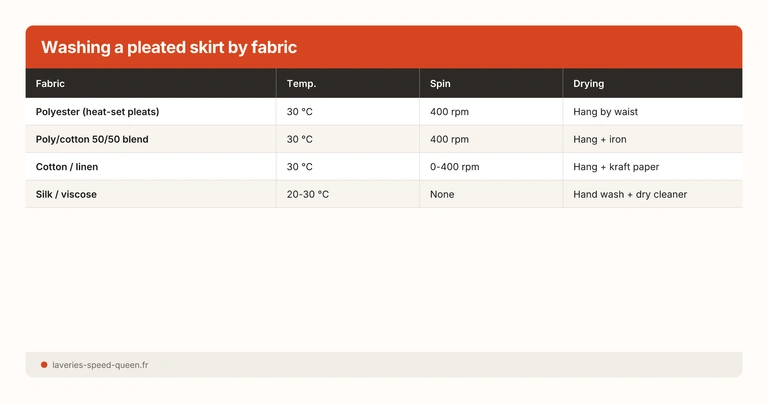
In short: A pleated skirt is machine washed at 30 °C, delicate cycle, in a closed mesh laundry bag, with spin reduced to 400 rpm max. Drying is done hanging by the waist — never flat, never in the tumble dryer. Polyester pleated skirts have heat-set pleats that withstand washing well. Cotton or silk pleats need more care, and pleated silk often belongs at the dry cleaner.
At a glance
Mesh bag mandatory — fold the skirt along the pleats, place in a closed fine-mesh bag.
30 °C, delicate cycle — reduced agitation, gentle liquid detergent, no powder.
400 rpm spin max — centrifugal force crushes pleats. Better a damp skirt than distorted pleats.
Hang dry by the waist — water weight realigns the pleats. Never flat, never tumble dryer.
Polyester = resilient pleats — heat-set at the factory, they survive machine washing without issue.
Silk pleated = dry cleaner — too delicate for the machine, take to a professional.
Heat-set vs non-set pleats: the fundamental distinction
Before putting your pleated skirt in the machine, you need to understand a technical distinction that determines the entire washing protocol: the type of pleats.
Heat-set pleats (polyester, synthetics)
Pleated skirts made of polyester and synthetic fibers (polyamide, acrylic) have heat-set pleats. During manufacturing, the fabric is mechanically folded then heated to very high temperatures (180-220 °C) for several minutes. This heat alters the molecular structure of the thermoplastic fibers: they “memorize” their new shape.
The result is a permanent pleat, locked into the fabric’s very structure. A 30 °C wash can’t undo a pleat set at 200 °C — the safety margin is enormous. That’s why polyester pleated skirts are the easiest to care for: they keep their pleats cycle after cycle.
Non-set pleats (cotton, linen, silk, viscose)
Natural fibers (cotton, linen, silk) and some artificial fibers (viscose, lyocell) are not thermoplastic. Their pleats are created by mechanical pressure, starch, or chemical finish, but they’re not “locked” into the fiber. Water and wash agitation gradually relax the pleats.
For these materials, each wash erodes the pleats a little. The washing protocol must therefore be especially gentle, and re-forming ironing is often needed after each cycle.
How to identify your fabric
The composition label is your best ally. Look for the polyester percentage:
- 100% polyester or majority polyester (>60%): heat-set pleats, machine wash without worry
- Polyester/cotton blend (50/50): partially set pleats, intermediate precautions
- 100% cotton, linen, silk, or viscose: non-set pleats, very delicate wash or hand wash
Machine washing: detailed protocol
Step 1 — Prepare the skirt
- Check pockets and remove all items
- Turn the skirt inside out — protects the visible surface from friction
- Fold the skirt following the pleats — carefully align each pleat
- Slide into a mesh laundry bag↗ with fine mesh and close it
The right mesh bag
Choose a bag sized appropriately: the skirt shouldn’t be compressed (pleats get crushed) or too loose (it twists). A rectangular bag of 40 x 50 cm suits most pleated skirts. Zipper-closure bags are more reliable than drawstring bags — the drawstring can open during the cycle.
Step 2 — Set the machine
- Cycle: delicate, wool, or silk (depending on your machine)
- Temperature: 30 °C max
- Spin: 400 rpm or less. On some machines you can disable spin completely — ideal for silk and viscose
- Detergent: liquid, gentle, no aggressive enzymes. Avoid powder detergents which can leave residue in fabric folds
- No softener on polyester — it leaves a film that weighs down pleats. On cotton, softener is acceptable but not necessary
Step 3 — The wash
Don’t overload the drum. The pleated skirt needs room to move without being compressed by heavy garments. Ideally wash it with lightweight textiles (t-shirts, blouses) and avoid jeans or towels that weigh down the cycle.
Hand washing: for fragile fabrics
For pleated skirts in silk, viscose, or fine cotton, hand washing is often the safest method.
- Fill a basin with cool to lukewarm water (20-30 °C)
- Add a dose of gentle liquid detergent (or mild shampoo, which works great on silk)
- Submerge the skirt without creasing — keep it aligned with the pleats
- Press gently in the water without rubbing or wringing. Soak 10 minutes
- Rinse with cold water, still without wringing
- Drain by gently pressing the skirt between two bath towels — the towels absorb excess water without distorting the pleats
Drying: the critical step
Drying is the moment when pleats re-form — or get lost. It’s the most important step in the process.
Hanging by the waist: the only right method
Immediately after washing (don’t leave the skirt in a ball in the drum), hang it by the waistband on a clip hanger. The weight of the water in the fabric naturally pulls the pleats downward, realigns them, and re-forms them.
A few rules:
- Use a wide-jaw clip hanger that won’t mark the fabric
- Smooth each pleat by hand before hanging — take 30 seconds to align pleats from top to bottom
- Air dry in a ventilated spot, out of direct sun (UV fades colors)
- Never dry flat — the skirt would rest on its pleats and crush them
- Never tumble dry — agitation and heat are the enemy of pleats
- Never tumble dry — drum agitation distorts pleats irreversibly, even on heat-set polyester.
- Never flat — the weight of wet fabric crushes pleats against the drying surface.
- Never hand-wring by twisting — twisting creates permanent false creases on cotton and linen.
- Never leave in a ball in the drum — remove and hang immediately after the cycle. Every minute counts.
Drying time
Polyester dries quickly (2-4 hours hanging). Cotton and linen take longer (4-8 hours). Silk dries in 3-5 hours. Don’t iron until the fabric is fully dry — ironing damp fabric can set false creases.
Ironing pleats: re-forming techniques
If some pleats have shifted despite precautions, ironing can re-form them. Here are the three most effective techniques.
Technique 1 — Kraft paper
This is the professional dry cleaner’s method, adapted for home use.
- Cut strips of kraft paper (or tissue paper) the width of one pleat
- Slide a strip into each pleat, along the full length
- Iron each pleat individually at low temperature (synthetic, 110-130 °C), with a press cloth between the iron and the skirt
- Leave the paper in place until the fabric has cooled completely
- Remove the paper gently
The kraft paper absorbs residual moisture and holds the pleat in shape during cooling. This technique produces the crispest results.
Technique 2 — Clothespins
A quicker method for polyester skirts whose pleats are already nearly intact.
- Clip each pleat with a clothespin along the hem (bottom of the skirt)
- Hang the skirt and steam each pleat (steam iron 10 cm from the fabric, or garment steamer)
- Leave the pins in place for 30 minutes while the fabric cools
Steam relaxes the fibers, and the pins hold the pleats in position while the fabric re-sets as it cools.
Technique 3 — Classic ironing
For cotton or linen skirts whose pleats are clearly undone:
- Set the iron to the appropriate temperature (cotton: 200 °C, linen: 200-230 °C)
- Work on the inside with a press cloth
- Iron each pleat individually, pressing firmly
- Use steam to penetrate the fabric deeply
This method is effective but time-consuming on skirts with many pleats (some pleated skirts have 30-60 pleats).
By fabric: the complete guide
Pleated polyester
The easiest. Machine 30 °C, mesh bag, 400 rpm spin. Heat-set pleats survive everything. Quick drying (2-4 h). Ironing rarely needed. If needed, iron at 110 °C with a press cloth. Withstands dozens of washes with no pleat loss.
Pleated cotton
Machine 30 °C, mesh bag, 400 rpm spin. Pleats aren't fixed — they fade with each wash. Systematic ironing (kraft paper technique). Starch spray after ironing to hold pleats. Pleat lifespan: 5-10 washes before getting fuzzy.
Pleated linen
Machine 30 °C or hand wash. Linen naturally wrinkles, which complicates pleat preservation. Iron at 200 °C with heavy steam and kraft paper. Pleated linen is a demanding textile — dry cleaning is recommended.
Pleated silk
Hand wash only (cold water, gentle shampoo) or dry cleaning. Silk can't handle machine, spin, or tumble dryer. Flat drying on a towel ONLY for silk (exception to the rule). Silk pleats are very fragile — take valuable pieces to the dry cleaner.
Common mistakes to avoid
Here are the most common errors that destroy pleated skirt pleats:
Washing without a mesh bag
This is mistake number one. Without a bag, the skirt twists in the drum, wraps around other clothes, and endures friction that distorts the pleats. The mesh bag is a 3-5 dollar/euro investment that saves your pleated skirts.
Spinning at high speed
A spin at 1000 or 1200 rpm generates considerable centrifugal force. The fabric is pressed against the drum walls with force that crushes pleats and creates false creases (drum marks). Even heat-set polyester can show temporary distortions after a violent spin.
Leaving the skirt in a ball after washing
Every minute the skirt sits in a ball in the drum after the cycle presses false creases into the damp fabric. Wet fabric is malleable — it takes the shape it rests in. Remove the skirt immediately and hang it.
Flat drying or tumble drying
The tumble dryer is the enemy of pleats: agitation distorts them and heat can set false creases. Flat drying crushes pleats under the weight of wet fabric. Hanging by the waist is the only method that uses gravity to re-form pleats.
Starch: an ally for non-set pleats
For cotton or linen skirts whose pleats aren’t heat-set, starch spray is a valuable tool. After ironing, spray starch on each pleat and iron lightly to set it. Starch temporarily stiffens the fibers and holds the pleat in place between washes.
The effect isn’t permanent — starch dissolves in the next wash. But it significantly extends pleat retention, especially on cotton.
Dosage: a light spray is enough. Too much starch makes the fabric stiff and uncomfortable. Two to three sprays per pleat at 20 cm distance gives a natural result.
Special cases
Sunburst pleated skirt (fan pleats)
Sunburst skirts have pleats that radiate from the waist and fan out toward the hem. Their fan shape makes folding in the bag more delicate. Fold the skirt accordion-style from the waist, stacking each pleat neatly, before sliding the whole thing into a large bag.
Long pleated skirt (maxi)
The longer the skirt, the heavier the water weight during drying — which is actually an advantage. The extra weight pulls the pleats with more force. Make sure the hanger is high enough so the hem doesn’t touch the floor.
Pleated skirt with lining
If the skirt has a lining, it may wrinkle differently from the outer fabric. Check the lining composition (often polyester or acetate) and apply the gentlest protocol of the two fabrics.
Washing at a laundromat: big machines, same program
The large-capacity machines at laundromats have the same delicate programs as home machines. The advantage: the larger drum gives the skirt more room to move without compression.
Select the delicate or wool program, 30 °C, and reduce spin if the machine allows it. The mesh bag remains essential — never wash a pleated skirt without a bag, even in a large machine.
As an Amazon Associate, we earn a small commission on purchases made through affiliate links in this article — at no extra cost to you. This helps us maintain this site and produce free guides.
Our laundromats offer delicate low-temperature programs on all machines. Ideal for washing your delicate textiles in a large drum that gives them room. Payment by contactless card or cash. Check our prices.
Sources and references
- Laundry care labels: decode all symbols
- Delicate fabrics: washing guide
- How to wash linen without damage
- How to wash a silk dress
- Prevent shrinking in the wash
- Which detergent to choose?
- Ironing temperature guide by fabric
- Textile Research Journal — heat-setting of pleats on synthetic fibers
- AFNOR NF EN ISO 3175 — textile care, professional cleaning