In short: a school uniform should ideally be washed after every school day for items next to the skin (polo, shirt). Plan 2-3 sets in rotation. Pre-treat stains (ink, grass, paint) as soon as your child gets home with white vinegar or Marseille soap. Polyester: 30 °C. Cotton: 40 °C. Wool: 30 °C wool cycle. Iron badges on the reverse with a cloth between iron and badge.
Good habits
2-3 sets in rotation — one uniform per day ideally, 5 polos/shirts for the week.
Inspect and pre-treat every evening — fresh stains come out 10 times more easily than dried ones.
Turn inside out — protects colours, badges, and prints.
30 °C for polyester, 40 °C for cotton — never exceed the label temperature.
Air-dry — preserves colours and shape better than the tumble dryer.
Recommended wash frequency
How often you wash depends on the garment type and your child’s activity level. Here are the recommendations by item:
Polo / shirt
After every school day. Worn next to the skin, it absorbs sweat and body oils. This is the item you wash most often.
Trousers / skirt
Every 2-3 days, unless visibly stained. Polyester trousers show less dirt than cotton. If the child does PE in them, wash after every session.
Jumper / cardigan
Every 3-5 days if worn over a polo or shirt. The jumper is not in direct contact with the skin, so it stays clean longer. Wash immediately if stained.
Blazer / jacket
Every 2-4 weeks in normal use. Air it regularly between washes. If stained, spot-treat without washing the whole blazer if possible.
Socks
After every day, no exceptions. Socks accumulate sweat, bacteria, and odour. Wash at 40-60 °C depending on the fabric.
Tie
Rarely washed, yet frequently stained (food at the canteen). Most ties are not machine-washable — dry-clean or spot-treat with white vinegar.
Organising the rotation
For a stress-free rotation:
- Monday evening: wash uniforms worn on Monday.
- Tuesday morning: the child wears a clean uniform from the reserve.
- Tuesday evening: Monday’s uniforms are dry and ready.
With 3 complete sets, you always have a clean uniform available, even when drying is slow (humid weather, no tumble dryer). For families with several children in uniform, an organised family laundry routine is essential.
Wash temperature by fabric
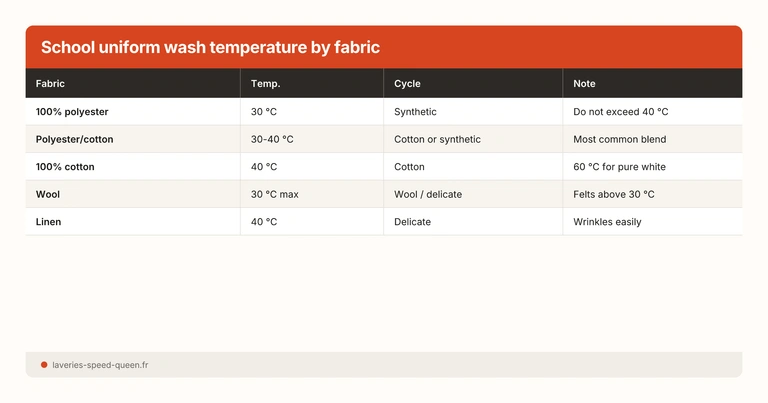
The uniform’s composition determines the wash temperature. Most modern uniforms are polyester or a polyester/cotton blend, but some schools require wool items (jumper, blazer).
| Fabric | Temperature | Programme | Notes |
|---|---|---|---|
| 100 % polyester | 30 °C | Synthetic | Dries quickly, resists creasing. Do not exceed 40 °C. |
| Polyester/cotton | 30-40 °C | Cotton or synthetic | The most common uniform blend. 30 °C is enough. |
| 100 % cotton | 40 °C | Cotton | Shrinks slightly on first wash. 60 °C for pure whites. |
| Wool | 30 °C max | Wool / delicate | Felts irreversibly above 30 °C. Gentle spin. |
| Linen | 40 °C | Delicate | Rare in uniforms. Creases heavily, needs ironing. |
For a full guide to textile temperatures, see our article on washing temperatures.
Removing common school stains
Children in uniform accumulate a predictable catalogue of stains. Here are the specific treatments for the most frequent ones.
Ink stain (ballpoint pen, felt-tip)
Ballpoint ink is solvent-based — it needs different treatment from food stains.
- Dab with a cloth soaked in rubbing alcohol or white vinegar↗.
- Place a piece of kitchen paper under the stain and a soaked cloth on top — the ink migrates to the paper.
- Replace the paper until it no longer picks up colour.
- Rinse with cold water, then machine wash.
Cold or warm milk is also effective on ballpoint ink: the casein absorbs the pigments. Soak the stained area for 1-2 hours.
For water-based felt-tips (art class), a simple cold rinse is usually enough. Full guide: ink stains.
Grass stain
Grass contains chlorophyll (a fat-soluble pigment) and tannins. Treatment must target both components.
- White vinegar — apply neat to the stain. Leave for 15 minutes.
- Marseille soap — rub the soap directly on the damp stain. The soap emulsifies the fatty chlorophyll.
- Rinse with cold water, then machine wash.
Full guide: grass stains.
Paint stain
Art classes are a major stain source. Treatment depends on the paint type.
Acrylic paint (the most common)
Fresh: comes off with cold water. It is a water-based paint that polymerises as it dries. As long as it is wet, a simple rinse works. Dry: scrape off the excess, then apply rubbing alcohol or white vinegar to soften the film. Guide: paint stains.
Gouache / watercolour
Comes off with cold water in the vast majority of cases, even when dry. Gouache remains water-soluble after drying. A light rub under cold water is enough.
Oil-based paint
Rarer in schools, but possible in secondary art classes. Requires white spirit applied to the back of the fabric. Only machine wash after removing most of the paint with solvent.
Food stain (canteen)
The most common canteen stains are ketchup and tomato sauce, chocolate, fruit juice, and grease.
- Tomato sauce — rinse with cold water, then white vinegar. Guide: tomato sauce stain.
- Chocolate — scrape off the excess, then cold water + Marseille soap↗. Guide: chocolate stain.
- Grease — dish soap, then machine wash. Guide: grease stain.
Stain-removal kit for the school bag
Slip a small bottle of white vinegar (30 ml is enough) and a few paper tissues into your child’s school bag. If a stain happens during the day, the child can dab it immediately with vinegar — this simple action multiplies the chances of successful removal.
Emergency stain-removal kit for parents
School stains don’t wait until you get home. The longer a stain dries, the deeper it penetrates the fibres. A small stain-removal kit in the school bag or at the front door lets you act immediately and greatly improves treatment success.
The school-bag kit (minimal)
Prepare a small zip bag containing a 30 ml spray bottle of white vinegar (travel-size container, from the pharmacy section) and 4-5 cotton pads or fabric squares. From about age 7-8, the child can dab a stain as soon as it happens. This simple action stops the stain from drying and setting. White vinegar effectively treats ink, grass, and tomato sauce stains — the three most common school stains.
The front-door kit (full)
Keep within easy reach in the hallway or utility cupboard:
- White vinegar in a spray bottle — the first action on any fresh stain
- Marseille soap bar — rub directly on wet grass and mud stains
- Rubbing alcohol — for ballpoint ink stains (dab, do not rub)
- Dish soap — for canteen grease stains
- Paper towel — for dabbing and absorbing before treatment
The 2-minute evening routine: as soon as the child comes home, inspect the uniform in 30 seconds. If a stain is visible, spray white vinegar, dab, and let it work during snack time. Put the uniform in the machine that evening. This daily habit prevents ingrained weekend stains and reduces the need for heavy-duty treatments.
Preserving colours and shape
School uniforms endure an intensive wash cycle — often 100-150 washes per school year for a polo. Gradual fading and loss of shape are the two most common problems.
Colour-preservation tips
- Always wash inside out — the drum mainly rubs the outer face. The reverse takes the friction, the front stays intact.
- Minimum temperature — every degree less preserves the dyes. 30 °C is enough for lightly soiled laundry.
- Colour detergent — these detergents contain dye-transfer inhibitors that prevent colour migration. See our guide how to choose a detergent.
- White vinegar as a fixative — add 50 ml of white vinegar to the softener compartment. Vinegar helps fix colours and softens the fabric without chemical residue. More details in our article on white vinegar and laundry.
- No tumble dryer — heat accelerates fading. Shaded air-drying is the best friend of colour longevity.
Preventing shrinkage
Cotton uniforms shrink slightly in the first washes (approx. 3-5 %). To minimise the risk:
- Buy one size up at the start of the year.
- Wash at the lowest possible temperature.
- Avoid the tumble dryer on high heat.
- Full guide: preventing shrinkage.
Ironing the uniform
Not all uniforms need ironing. Polyester fabrics are naturally crease-resistant. Cotton and linen, however, crease and need pressing.
By garment
- Cotton shirt/polo: iron at 150 °C (cotton setting). Press the collar, sleeves, then body.
- Polyester polo: usually needs no ironing. If needed, iron at 110 °C max.
- Trousers: iron at 150 °C for cotton, 110 °C for polyester. Form a centre crease if the school requires it.
- Wool jumper: no ironing. A garment steamer at a distance can smooth creases without contact if needed.
Badges: precautions
Heat-bonded badges (embroidery glued on with heat) are vulnerable to the iron. The thermal adhesive melts at around 130-150 °C — exactly in the cotton ironing range.
- Turn the garment inside out and iron on the reverse.
- Pressing cloth: place a thin cotton towel between the iron and the badge if you must iron the right side.
- Reduced temperature: lower the iron to 110-120 °C in the badge area.
- No direct steam on the badge — steam can soften the adhesive.
For a full ironing guide, see our article how to iron a shirt.
The laundromat for high-volume moments
Certain points in the school year generate unusually high laundry volumes. The laundromat is a practical solution.
Start of school year
New uniforms to wash before first wear (manufacturing residues, free dyes). Several sets to wash at once — the 18 kg machine is ideal.
End of year / summer holidays
All uniforms to wash and store clean for the following year. One laundromat session handles everything in a single go.
Large families
3 children x 5 polos per week = 15 polos + trousers + jumpers. A 7-8 kg home machine cannot always cope. The 18 kg laundromat machine handles the family load in a single cycle.
No machine at home
For families without a washing machine (student housing, studio flat), the laundromat is the primary solution for regular uniform care. See our first-time laundromat guide.
End-of-year tip: store clean for September
In June, wash all uniforms thoroughly before storing them for the summer. A uniform stored dirty or with sweat residue for two months will develop irreversible yellow stains, especially around the armpits and collar. Use sodium percarbonate↗ in a soak (1 tablespoon per litre of warm water, 1 hour) for white uniforms that have yellowed during the year.
Store clean, dry uniforms in a ventilated spot, away from direct light. A breathable cotton bag is better than a plastic bag, which traps moisture. Add a lavender sachet to deter moths and keep a fresh scent.
In September, wash the stored uniforms one more time before school starts to remove accumulated dust and any storage product residue. This is also the time to check sizes — a child can grow a full size in two summer months.
Mistakes to avoid
- Washing whites with colours — colours migrate and whites turn grey. Always sort.
- Exceeding the label temperature — polyester deforms above 40 °C, wool felts above 30 °C.
- Routine tumble drying — accelerates fading, shrinkage, and fibre wear. Reserve it for emergencies.
- Ironing directly on a badge — the adhesive melts and the badge peels off or warps.
- Ignoring a stain and washing anyway — the machine can set some stains (ink, grass). Always pre-treat.
- Overloading the machine — laundry must tumble freely for proper washing and rinsing. Guide: laundry weight guide.
Quick stain-removal chart
| Stain | Immediate action | Product | Time |
|---|---|---|---|
| Ballpoint ink | Dab | Rubbing alcohol or white vinegar | 15-30 min |
| Water-based felt-tip | Rinse | Cold water | Immediate |
| Grass | Dab | White vinegar + Marseille soap | 15 min |
| Acrylic paint | Rinse (fresh) / Scrape (dry) | Cold water / Rubbing alcohol | Immediate / 30 min |
| Tomato sauce | Rinse cold water | White vinegar | 15 min |
| Chocolate | Scrape + rinse | Marseille soap | 30 min |
| Grease (canteen) | Dab | Dish soap | 15 min |
As an Amazon Associate, we earn a small commission on purchases made through the affiliate links in this article — at no extra cost to you. This helps us maintain this site and produce free guides.
Our laundromats in Blagnac, Croix-Daurade and Montaudran have professional machines from 9 to 18 kg with auto-dosed detergent — ideal for back-to-school and end-of-year volumes. Payment by contactless card or cash. See our prices.
Sources and references
- Washing temperatures by fabric
- Remove an ink stain
- Remove a grass stain
- Remove a paint stain
- Remove a chocolate stain
- Remove a tomato sauce stain
- Remove a grease stain
- Family laundry routine
- How to choose a detergent
- Preventing shrinkage
- White vinegar and laundry
- How to iron a shirt
- GINETEX standards — care symbols by fibre type