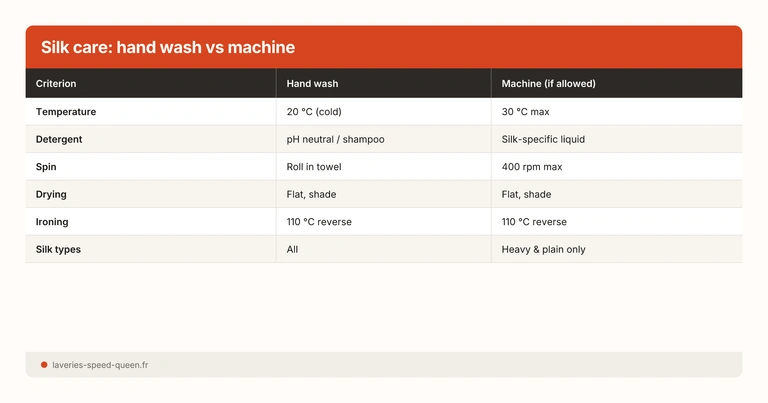
Silk is a protein fiber produced by the silkworm (Bombyx mori). Its fibroin structure gives it unmatched luster, softness, and drape — but also extreme vulnerability to heat, alkalinity, and friction. Hand washing at 20 °C with pH-neutral detergent is the safest method. In the machine, the silk/delicate cycle at 30 °C in a mesh laundry bag is possible if the label allows it. Dry flat, never in the tumble dryer.
At a glance
Hand wash = ideal method — cold water 20 °C, silk detergent, 5-10 minutes soaking without rubbing.
Machine OK if label allows — silk/delicate cycle, 30 °C max, mesh bag, 400 rpm spin.
Never hot water — above 30 °C, fibroin degrades and silk irreversibly loses its luster.
Flat drying only — rolled towel then flat. Never tumble dry, never direct sunlight.
Iron inside out at 110 °C — no direct steam on silk, press cloth recommended.
Understanding silk: why it’s so delicate
Silk is the only natural fiber made from a continuous filament — a single silkworm cocoon produces a thread 300 to 900 meters long. This filament is composed of two proteins:
Fibroin (75-80% of the fiber). This is the structural protein forming the core of the thread. Its crystalline beta-sheet structure gives it remarkable tensile strength (comparable to steel at equal diameter) and its characteristic luster — light refracts off the regular facets of fibroin crystals, creating the silky sheen.
Sericin (20-25%). This is the natural “glue” coating the fibroin that holds the thread together. Sericin gives raw silk its rough feel; it’s partially removed during industrial degumming to reveal fibroin’s softness. On finished silk, a thin residual layer of sericin protects the fiber and contributes to the silky touch.
The three enemies of silk
Silk is vulnerable to three factors that are precisely present in a poorly conducted wash:
Heat — above 30 °C, the hydrogen bonds between fibroin chains loosen. The fiber loses its crystalline structure, luster, and strength. At 60 °C, the degradation is massive and irreversible. Shrinkage can reach 8%.
Alkalinity — standard detergents have a pH of 8-10. Fibroin is a protein — like wool keratin, it’s hydrolyzed (chemically destroyed) by alkaline solutions. Protease enzymes in some detergents accelerate this degradation.
Mechanical friction — wet silk loses 15-20% of its mechanical strength. Friction against the machine drum, against other garments, or against itself causes fibrillation (surface micro-tears) that dulls the fabric and can create irreversible whitish patches.
Wet silk is fragile
Silk loses up to 20% of its strength when wet. That’s why friction and wringing are particularly dangerous during washing. Always handle wet silk with care — never wring it dry, never rub to remove stains, never hang it by the shoulders (the weight of the water distorts the fabric).
Hand washing: the ideal method
Hand washing is always preferable for silk. It eliminates the risk of excessive mechanical agitation and gives you total control over temperature and contact time with the detergent.
Preparation
Before washing, a few checks are in order:
- Read the label — check the care symbols. Some silks (especially printed, embroidered, and lined silks) can only be dry cleaned.
- Test colorfastness — dampen a hidden corner (inner hem) with cold water and press against a white cloth. If color transfers, the dress bleeds and must not be washed in water — take it to a dry cleaner.
- Turn the dress inside out — protects the visible surface from contact with your hands and the basin bottom.
The step-by-step protocol
Fill a basin with cold water (20 °C ideally, 25 °C max). Winter tap water is perfect. In summer, add a few ice cubes if the water runs warm.
Add detergent — pour a few drops of pH-neutral silk detergent or gentle shampoo (sulfate-free) into the water and mix before submerging the dress. Use sparingly: excess detergent leaves residue on silk and requires extra rinsing.
Submerge the dress and let soak for 5-10 minutes. Gently agitate the water — never the dress itself. Don’t rub, wring, or press. The detergent works by diffusion, not mechanical action.
Rinse thoroughly with cold water (same temperature as the wash to avoid thermal shock, which can contract the fiber). Change the water 3-4 times until perfectly clear.
Vinegar trick — in the final rinse, add 1 tablespoon of white vinegar↗ per liter of water. The acetic acid neutralizes any residual detergent (which is alkaline) and revives silk’s luster by tightening the fiber scales. Silk handles mildly acidic conditions well — it’s naturally stable at pH 4-6.
Why vinegar revives silk
White vinegar lowers the rinse water pH toward 5-6, which is silk’s optimal pH range. At this pH, fibroin fibers are at their most stable and brilliant. Vinegar leaves no odor after drying — acetic acid evaporates completely.
Machine washing: when and how
Machine washing isn’t forbidden for silk — but it’s reserved for garments whose label explicitly permits it (tub symbol with two bars, or “machine washable” label).
When machine washing is acceptable
- Heavy, solid-color silk (silk twill, heavy crepe de Chine, charmeuse) — these weaves are more resistant to mechanical abrasion.
- Silk blends (silk-cotton, silk-polyester) — the synthetic or plant fibers reinforce the fabric’s mechanical strength.
- Frequently worn silk blouse — hand washing after every wear isn’t always practical. A well-set machine provides acceptable results.
When to avoid the machine
- Very fine silks: silk chiffon, organza, voile, gauze — too fragile to withstand drum rotation.
- Artisan-printed silks — non-industrial dyes bleed easily.
- Embellished dresses — pearls, sequins, embroidery, applique lace: friction tears them off.
- Wild silk (tussah) — its irregular surface makes it more vulnerable to mechanical fibrillation.
The machine protocol
Silk or delicate cycle
Select the silk (or hand/delicate) cycle. The drum rotation is intermittent and slow, reducing friction. Temperature: 30 °C max.
Mesh bag mandatory
Place the dress in a fine mesh laundry bag. The bag reduces direct friction against the drum and other garments by 60-80%. Only put one silk garment per bag.
400 rpm spin max
Reduce spin to minimum (400 rpm or less). A spin at 800 or 1000 rpm compresses wet silk and causes permanent creases. Use 'no spin' option if available.
pH-neutral liquid detergent
Use a liquid detergent for silk or delicate fabrics. Never powder (residue), never fabric softener (coats fibers and dulls silk), never bleach.
Common machine mistakes
- Mixing silk and jeans — zippers, buttons, and denim rivets abrade the silk surface. Wash silk alone or with other delicates.
- Overloading the machine — silk needs room to 'float' in the water. 2-3 garments max in a domestic machine.
- Forgetting the mesh bag — without a bag, silk wraps around other garments and endures maximum friction. The bag is non-negotiable.
- Leaving in the drum after the cycle — damp silk compressed in the drum develops stubborn creases. Remove immediately.
Different silk types and their care
Not all silk fabrics wash the same way. The weave and weight determine how fragile the piece is.
| Silk type | Recommended wash | Temperature | Precautions |
|---|---|---|---|
| Crepe de Chine | Hand (machine possible) | 20-30 °C | Moderately durable. Iron inside out at 110 °C. |
| Charmeuse / Silk satin | Hand preferred | 20 °C | Very smooth surface that marks easily. No rubbing. |
| Chiffon / Organza | Hand only | 20 °C | Extremely fine and fragile. No wringing. Dry clean if unsure. |
| Taffeta | Hand (machine possible) | 20-30 °C | Stiff fabric that wrinkles easily. Iron promptly. |
| Silk twill (scarf) | Hand only | 20 °C | Prints often fragile. Test colorfastness. |
| Wild silk (tussah) | Hand only | 20 °C | Irregular surface fibrillates easily. Very delicate. |
Drying: the rolled towel method
Drying is a critical step for silk. Heat, direct sunlight, and hanging are its three enemies.
Step 1 — Absorb excess water
Lay the dress flat on a clean, dry bath towel (white or light-colored to avoid dye transfer). Roll the towel with the dress inside and press gently. The towel absorbs excess water by capillary action. Unroll and repeat with a dry towel if needed.
Never wring silk — twisting deforms the fibers and creates deep creases that ironing alone won’t smooth out.
Step 2 — Flat drying
Lay the dress flat on a dry towel or flat drying rack (mesh type). Reshape by gently stretching seams and edges.
- Complete shade — UV fades silk. A few hours of direct sun can dull a colored silk.
- Away from heat — no radiator, no hair dryer, no tumble dryer. Room temperature (18-22 °C) is perfect.
- In a ventilated area — air circulation speeds natural drying.
Silk dries relatively quickly — its low moisture absorption (11% of its weight vs. 25% for cotton) means it retains little water. Allow 2-4 hours in a well-ventilated indoor space.
Hang or lay flat?
For a long dress in heavy silk (crepe, charmeuse), you can hang it on a padded hanger once it’s nearly dry (still very slightly damp). The residual water weight is then minimal and won’t distort the fabric. For a fine silk dress (chiffon, organza), flat drying is mandatory from start to finish.
Ironing silk: temperature and technique
Silk wrinkles easily, but well-done ironing restores a flawless look.
Ironing rules
- Iron at 110 °C — “silk” or “synthetic” setting (single dot). Above 130 °C, fibroin starts to brown and the fiber breaks.
- Inside out — protects the visible surface from iron marks and excess shine (glazing).
- Slightly damp silk — iron the dress while still slightly damp. If it has dried completely, re-humidify evenly with a fine mist sprayer (held 30 cm away, not directly on the fabric).
- Continuous motion — never leave the iron stationary on silk, even for a second. Prolonged contact burns the fiber.
Steam: beware of water marks
Never direct steam directly onto silk. The hot water droplets create water marks (tide rings) that are visible in light and very difficult to remove. If using a garment steamer, hold the device at least 15 cm from the fabric and keep the steam moving constantly.
The alternative: place a press cloth (a thin, slightly damp white cotton cloth) between the iron and the silk. The press cloth distributes heat evenly and protects the silk surface from direct contact with the iron plate.
By crease type
Light storage creases
Hang the dress in the bathroom during a hot shower. The ambient steam relaxes fibers and creases disappear without ironing. Ideal for fine silk.
Wash creases
Iron at 110 °C inside out with a press cloth. Wash creases are more set because wet silk was compressed. Iron while silk is still slightly damp.
Deep stubborn creases
Locally humidify the area (mist from a distance), place a damp press cloth, and iron at 110 °C. If the crease resists, a pass with the garment steamer (at 15 cm) can help.
Stains on silk: emergency steps
Silk is the most difficult textile to de-stain. Its smooth surface absorbs liquids rapidly, and fibroin bonds easily with pigments. The absolute rule: act immediately and never rub.
Fresh stain (liquid)
- Blot immediately with a clean white, dry cloth (or paper towel). Press the cloth onto the stain — don’t wipe, don’t rub.
- Rinse the area with cold water from the back side, letting water flow gently. Cold water prevents pigment from setting.
- Wash the entire dress by hand using the protocol above. Never treat just one area without washing the whole garment — you’ll create a visible water mark (the “tide ring”).
Grease stain (oil, makeup, cream)
- Sprinkle immediately with talc, cornstarch, or fuller’s earth↗ on the stain. These absorbent powders capture grease by adsorption.
- Let sit for at least 2 hours (overnight for larger stains).
- Brush the powder off gently with a very soft brush.
- If a trace remains, hand wash with cold water and silk detergent.
Stubborn stains
For red wine, blood, makeup set-in stains, or dye transfers, silk is often a case for professional dry cleaning. A specialist dry cleaner uses appropriate solvents (perchloroethylene or green solvents) that dissolve stains without damaging fibroin. Dry cleaning is the only safe option for tough stains on silk.
- Hot water on a fresh stain — sets the pigment into fibroin. Always cold water first.
- Rubbing a stain — creates a whitish patch (fibrillation) more visible than the stain itself.
- Bleach — destroys fibroin instantly. Guaranteed hole in silk.
- Over-the-counter stain remover — most contain solvents or enzymes harsh on silk. Always test on an inner hem.
- Spot-treating without washing — cleaning one area creates a visible water mark on silk. Always wash the entire garment.
Long-term storage
Silk needs a few storage precautions to maintain its beauty over time.
Day-to-day
- Padded hanger — a wooden hanger covered with foam or fabric distributes the dress weight across the shoulders without marking the fabric. Thin wire hangers create permanent distortions.
- Breathable garment bag — a cotton or non-woven bag protects from dust while letting silk “breathe.” Plastic bags trap moisture and promote yellowing and mold.
Seasonal storage
To store a silk dress for several months:
- Wash it before storing — sweat, perfume, and cosmetic residue attacks fibroin over time, causing irreversible yellow stains.
- Wrap in acid-free tissue paper (newspaper yellows silk).
- Store flat if possible, in a drawer or box. If hanging, use a padded hanger with a breathable garment bag.
- Add cedar — cedar chips repel moths naturally, without the chemicals in traditional moth repellents (naphthalene, paradichlorobenzene) that leave a persistent odor on silk.
Silk at the laundromat: when it makes sense
The professional machines at our laundromats don’t have a specific silk program — their power is designed for high-volume everyday laundry. For a precious silk dress, hand washing at home or dry cleaning remains the best option.
However, our laundromats are ideal for washing the rest of your wardrobe while your silk dress dries quietly at home. Speed Queen professional machines handle up to 18 kg of laundry in a single cycle — you can wash a full week of everyday clothes in 45 minutes.
As an Amazon Associate, we earn a small commission on purchases made through affiliate links in this article — at no extra cost to you. This helps us maintain this site and produce free guides.
Trust your everyday laundry to our professional machines while your silk pieces dry at home. Our laundromats are open 7 days a week, with professional detergent included and payment by contactless card or cash. Check our prices.