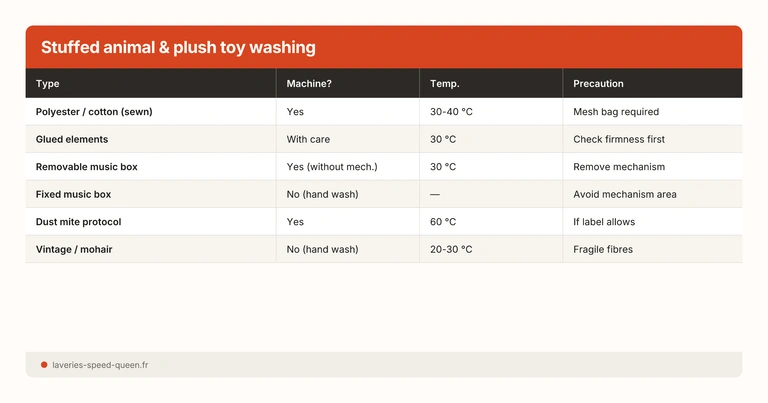
In short: Most stuffed animals and plush toys can be machine-washed at 30-40 °C inside a mesh laundry bag or a pillowcase tied shut. For children with allergies, a 60 °C cycle kills dust mites and their eggs. Check for glued-on eyes and parts before washing, and dry at low temperature or air-dry to preserve the fur.
At a Glance
Mesh bag required — protects the eyes, nose, and fragile parts during tumbling.
30-40 °C on a delicate cycle — or 60 °C for the dust-mite protocol if the care label allows.
Check for glued parts — glued eyes and noses (not sewn) risk coming off in the machine.
Gentle drying — low heat or air-dry, then brush the fur once fully dry.
Why Wash Stuffed Animals Regularly
A stuffed animal that your child hugs, chews, and drags everywhere quickly accumulates bacteria, saliva, sweat, and dust. But the main concern is dust mites (Dermatophagoides pteronyssinus).
According to the Asthma and Allergy Foundation of America (AAFA), a pillow or stuffed animal can harbour tens of thousands of dust mites after just a few weeks of use. It is their microscopic droppings (faecal pellets) that trigger allergic reactions: sneezing, nasal congestion, itchy eyes, and asthma attacks in sensitive children.
The stakes for allergy-prone children
If your child shows symptoms of a dust-mite allergy (blocked nose on waking, repeated sneezing, eczema), regular washing of stuffed animals is part of the protocol recommended by allergists — alongside anti-dust-mite covers and weekly bedding washes. See our complete dust-mite protocol.
Which Stuffed Animals Are Machine-Washable?
Before starting a cycle, examine your stuffed animal to determine whether it can handle the machine.
Machine-washable ✓
Polyester or cotton stuffed animals with synthetic filling. Eyes and noses that are sewn on (not glued). Care label indicating machine wash. This covers the majority of plush toys sold since 2010.
Wash with caution ⚠️
Stuffed animals with glued-on parts (check by tugging gently). Plush toys with a removable music box (remove the mechanism before washing). Very old toys with fragile seams (use a reinforced mesh bag).
Hand-wash only ✗
Stuffed animals with a non-removable music box or electronic components. Vintage or collectible plush toys (pre-1990). Mohair, alpaca, or real-fur toys. Toys with leather or wooden parts.
Preparation
Check the care label — branded stuffed animals always have care instructions. If in doubt, consult our guide to laundry care symbols.
Inspect the eyes and nose — tug gently. If they move, reinforce with a few stitches or hand-wash instead.
Remove detachable parts — batteries, music boxes, removable clothing, ribbons, bows.
Pre-treat visible stains — rub a little damp Marseille soap into the grubbiest areas (hands, mouth, feet).
Place in a mesh laundry bag — or a pillowcase tied securely. This is the single most important protection.
Standard Wash (30-40 °C)
Wash the stuffed animal inside a mesh bag, on a delicate cycle at 30-40 °C, with a reduced dose of gentle detergent.
This protocol suits routine maintenance of stuffed animals and plush toys. It removes dirt, sweat, and surface bacteria.
Delicate or wool cycle — short cycle with gentle tumbling. Spin speed should stay moderate (600-800 rpm).
Gentle detergent, reduced dose — avoid heavily perfumed or harsh detergents, especially for baby toys. See our guide on detergent residue and sensitive skin.
No fabric softener — it leaves a chemical film that the child will ingest while chewing the toy.
Wash with soft items — add towels or lightweight clothing to cushion impacts inside the drum.
Machine-Washing a Stuffed Animal: Step-by-Step Safe Protocol
Here is the complete protocol for machine-washing a standard stuffed animal, from start to finish.
1. Inspection and preparation: check the eyes, nose, and all seams. Gently tug each glued-on part — if it moves, reinforce with a few stitches or switch to hand-washing. Remove detachable items (clothing, ribbons, batteries, music boxes).
2. Pre-treating stains: the grubbiest areas (hands, feet, mouth) respond well to damp Marseille soap↗. Rub gently and leave for 10 minutes. For stubborn stains, a paste of baking soda (3 parts baking soda + 1 part water) works well.
3. Into the mesh bag: place the stuffed animal in a zipped mesh laundry bag. If you don’t have one, use a pillowcase tied firmly shut. The bag prevents decorative parts from catching in the drum.
4. Cycle and settings: 30-40 °C, delicate or wool cycle. Moderate spin (600-800 rpm). Reduced dose of gentle detergent — no fabric softener (children put the toy in their mouths). To minimise detergent residue, use a hypoallergenic detergent↗.
5. Drum companions: don’t wash the stuffed animal alone in a large drum. Add 2-3 towels or lightweight garments of a compatible colour. They cushion impacts and improve wash effectiveness.
6. Drying: remove the stuffed animal immediately after the cycle. Tumble-dry on a low-heat setting or hang upside down to air-dry. Brush the fur once the toy is completely dry.
Dust-Mite Protocol (60 °C)
For children with allergies, washing at 30-40 °C is not enough. Dust mites die from 55 °C upwards (source: Journal of Allergy and Clinical Immunology). A 60 °C cycle for 15 minutes eliminates live mites, their eggs, and allergenic droppings alike.
Check the care label before increasing to 60 °C. Polyester generally tolerates this temperature, but some synthetic furs may warp.
The freezer alternative
If the stuffed animal can’t tolerate 60 °C, seal it in an airtight bag (freezer bag) and place it in the freezer for 48 hours. The cold kills the dust mites but does not break down their allergenic droppings. After thawing, wash the toy at 30 °C to remove the residue. This method is recommended by the AAFA for delicate textiles.
Drying Without Deformation
Drying is the key step to restoring the original fluffy appearance.
Tumble-dry at low temperature
Use a gentle or 'cool air' programme. High heat can melt synthetic fur or distort plastic eyes. Shake the toy every 15 minutes to redistribute the filling.
Air-drying
Hang the stuffed animal upside down (clip the feet with a clothes peg) so water drains toward the head rather than pooling inside the body. Direct sunlight helps disinfect but may fade dark-coloured toys.
Final brushing
Once the toy is completely dry, brush the fur with a soft-bristle brush (a baby brush works well). Brush in the direction of the nap to restore the original fluffy look.
Washing Frequency
| Usage Type | Recommended Frequency | Temperature |
|---|---|---|
| Daily comfort toy (carried, chewed) | Every 2 weeks | 40-60 °C |
| Bed companion (sleeps with child) | Once a month | 40 °C |
| Decorative plush (shelf display) | Every 3 months | 30 °C |
| Allergy-prone child (any type) | Every 2 weeks | 60 °C required |
Special Cases
Musical or electronic stuffed animals: removing the mechanism
Stuffed animals with a music box or electronic components (sound, light, movement) require an extra step before any contact with water.
If the mechanism is removable: most modern stuffed animals have an opening secured by Velcro or a zip on the back or along a seam. Open it, remove the electronic unit (note its position), and machine-wash the toy as normal. Once fully dry, replace the mechanism and close up.
If the mechanism is sewn in and not accessible: proceed in two stages:
- Open a side seam: using a seam ripper or small scissors, open 5-8 cm of seam along the flank or back (choose a hidden spot). Remove the mechanism and any wiring.
- Wash the toy: in the machine inside a mesh bag (30-40 °C, delicate cycle) or by hand.
- Dry completely: any residual moisture inside will damage the mechanism when reassembled.
- Reinsert the mechanism: place it back in its original position and sew the seam closed with tight stitches. Use strong thread and invisible stitching.
If you’d rather not open the toy: clean the surface only with a damp cloth and Marseille soap, carefully avoiding the area around the mechanism. Dry immediately with a towel.
Giant stuffed animals (> 50 cm)
Large plush toys at the laundromat
Giant stuffed animals won’t fit in a domestic 7-8 kg machine. At a laundromat, the 18 kg machine (180-litre drum) easily accommodates plush toys of 80 cm or even 1 metre. Place it in a large mesh bag (maternity laundry bag type) and run a delicate cycle at 30 °C.
Mohair, alpaca, or wool stuffed animals
These natural fibres are very delicate and cannot withstand the machine. Hand-wash in a basin of cold water with a gentle shampoo, without rubbing. Press gently to wring out (never twist) and dry flat on a towel.
Disinfecting Without Washing
It isn’t always possible or desirable to wash a stuffed animal (electronic toy, very old plush, quick refresh between washes). Here are alternative methods to disinfect without water.
48-hour freezer method: the dust-mite killer
This is the method recommended by the AAFA for textiles that can’t withstand a 60 °C wash. Intense cold (-18 °C) kills dust mites and their eggs within 48 hours.
Place the toy in a freezer bag — airtight Ziploc-type bag or vacuum bag. Squeeze out as much air as possible.
Freeze for at least 48 hours — mites die within 24 hours, but 48 hours guarantees egg elimination too.
Thaw and clean — remove the toy and let it return to room temperature. Shake it vigorously outdoors to dislodge dead mites and droppings.
Follow-up wash recommended — the freezer kills mites but doesn't remove their allergenic droppings. A 30 °C wash after thawing eliminates these residues.
Dry baking-soda clean
Baking soda↗ absorbs odours and some grime without wetting the toy. Sprinkle generously, rub gently with your hands to work the powder in, leave for 2 to 4 hours (overnight is ideal), then vacuum thoroughly with the brush attachment. For more on this versatile ingredient, see our baking soda laundry guide.
Textile disinfectant spray
In a pinch, a textile disinfectant spray (antibacterial Febreze-type or diluted isopropyl alcohol spray) allows surface disinfection. Spray from 20-30 cm away and let air-dry. This method doesn’t replace a wash, but it can extend the interval between full cycles.
Washing Frequency by Child’s Age
The ideal washing frequency depends directly on how the child uses the stuffed animal — and that changes with age.
| Age | Typical Usage | Washing Frequency | Temperature |
|---|---|---|---|
| 0-12 months | Chewed, hugged, dragged on the floor | Every 1-2 weeks | 40-60 °C |
| 1-2 years | Transitional comfort toy, carried everywhere | Every 2 weeks | 40 °C |
| 3-5 years | Bed companion, cuddles | Once a month | 30-40 °C |
| 6+ years | Bed or decorative toy | Every 2-3 months | 30 °C |
| Allergy-prone child (any age) | Any usage | Every 2 weeks | 60 °C required |
The duplicate-toy trick: for babies, buy two identical stuffed animals from the start. Alternate them at each wash — the child is never separated from their companion, and both toys wear evenly.
Stuffed animal that lost an eye
Before throwing the toy away, try a repair. Safety eyes (with washers) are available at haberdashery shops and online. Sew securely before putting back in the machine. A loose eye coming off during a cycle can block the pump filter.
Mistakes to Avoid
- Machine without a mesh bag — eyes and decorative parts catch in the drum and come off.
- Hot water on delicate synthetic fur — some furs melt or frizz above 40 °C.
- High-heat tumble drying — deforms the filling and melts plastic parts.
- Fabric softener — leaves a chemical film that the child puts in their mouth. Unnecessary and potentially harmful.
- Forgetting to check glued-on eyes — a loose eye is a choking hazard for a small child.
- Storing while still damp — mould develops within hours in compressed filling.
As an Amazon Associate, we earn a small commission on purchases made through affiliate links in this article — at no extra cost to you. This helps us maintain this site and produce free guides.
Giant stuffed animal or big collection to wash? Our laundromats in Blagnac, Croix-Daurade and Montaudran have 9 and 18 kg machines with delicate programmes. Detergent and fabric softener included, payment contactless card or cash. Prices.
Sources and References
- Complete dust-mite protocol
- How to wash baby clothes
- Washing temperature guide
- Complete drying guide
- Detergent residue and sensitive skin
- Baking soda and laundry
- Laundry care symbols guide
- AAFA: Dust Mite Allergy — Control Indoor Allergens (lien externe)
- How to wash slippers
- Journal of Allergy and Clinical Immunology, “Effective allergen avoidance: dust mite control measures”, accessed 23 March 2026