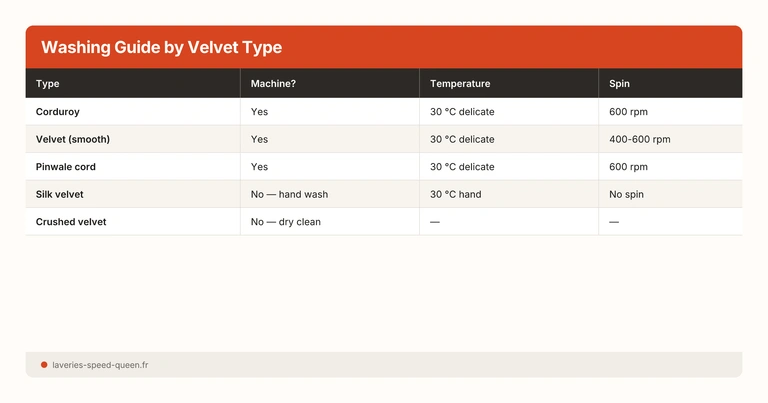
In short: velvet can be machine-washed as long as you follow three rules: turn inside out (protects the pile from the drum), 30 °C delicate cycle (reduced agitation), and spin at 400-600 RPM (no higher, or the pile gets crushed). Dry on a hanger or flat — never tumble-dry. Silk velvet must be hand-washed only. Ironing: reverse side only, or use a garment steamer.
At a glance
Turn inside out — ALWAYS — the pile is the fragile part. The reverse absorbs the friction.
30 °C delicate cycle — reduced agitation, higher water level. Use mild liquid detergent (no powder).
Spin at 400-600 RPM — higher spin crushes the pile and creates permanent marks.
Dry: wide hanger or flat — the tumble dryer is off-limits. Brush in the direction of the nap once dry.
Ironing: reverse side only — or use a garment steamer at a distance. Never iron directly on the pile.
Why velvet is a delicate fabric
Velvet is not fragile in a chemical sense — it is often made of cotton or polyester, both robust fibres. Its fragility is mechanical: it lies in the structure of its surface.
A standard fabric (woven cotton, for example) has a flat, smooth surface. Velvet, on the other hand, has a layer of upright fibres — the “pile” — that give the fabric its soft feel and rich appearance. These fibres are cut to a uniform length during manufacture.
The problem: these upright fibres are sensitive to pressure. When pressed in one direction (drum friction, high spin, direct ironing), they stay flattened. The fabric then loses its velvety look and develops shiny marks — a defect called “crushing” or “shine”.
Crushing is not a stain — it is a physical change in fibre orientation. It is far harder to fix than to prevent. That is why it matters to wash velvet correctly from the start.
Velvet types and their washability
Not all velvets wash the same way. The type of velvet (pile length and density, fibre composition) determines the treatment.
Corduroy
The most durable. The pile is organised in parallel ribs. Typical composition: cotton or cotton-polyester. Machine-washable at 30 °C delicate, spin 600 RPM. The ribs partially protect the pile from crushing.
Smooth velvet
Smooth, soft surface with very short pile. Composition: polyester, cotton, or blends. Machine-washable at 30 °C delicate, spin 400-600 RPM. More prone to marks than corduroy because the pile is uniform and short.
Needlecord (baby cord)
Corduroy with very fine ribs (similar to a textured jean). Durable, machine-washable at 30 °C. Behaves like a standard fabric while retaining a velvet look. The easiest velvet to care for.
Silk velvet / panne velvet
Very fine fabric with long, shiny pile. Hand-wash only in cold water with a silk detergent, or dry-clean. The machine, even on a delicate cycle, crushes silk pile irreversibly. Do not iron.
Upholstery velvet: a special case
Velvet used for sofas, armchairs, and sofa covers is generally thicker and denser than clothing velvet. If it is removable and the label permits machine washing, follow the same rules (30 °C delicate, inside out, low spin). Otherwise, clean the surface with steam or consult a professional.
Before washing: preparation
Check the care label
As with any textile, the care label is the reference. Look for the basin symbol: if it shows a number (30 or 40) with one or two bars beneath it (delicate cycle), the garment is machine-safe. If the label shows a circle (dry-clean only), follow that instruction.
Turn inside out
This is the non-negotiable rule for velvet. The pile, which forms the visible surface of the garment, must never be in direct contact with the drum, other garments, or the door glass. Turning inside out means the reverse (smooth base fabric) absorbs the friction, and the pile is protected.
Wash velvet alone or with similar fabrics
Avoid mixing velvet with garments that have zippers, riveted jeans, or rough fabrics. Friction against these hard surfaces crushes the pile and can create marks. Wash velvet alone or with other delicates (silk, chiffon, fine lingerie).
Use a mesh laundry bag (recommended)
For extra protection, place the inside-out garment in a fine-mesh laundry bag. The bag reduces friction against the drum and other clothes. This is especially recommended for smooth velvet, whose short pile is the most vulnerable.
Machine washing: exact settings
Programme
Select the delicate cycle (or “wool/silk” on some machines). This programme features:
- Reduced agitation — the drum turns more slowly with longer pauses.
- Higher water level — the laundry floats more, reducing fabric-on-fabric friction.
- Gentler rinse — fewer mechanical shocks.
Temperature
30 °C maximum. Cotton velvet technically tolerates 40 °C, but heat combined with mechanical agitation increases the risk of shrinkage (3-5 % for cotton) and pile crushing. Polyester is even more heat-sensitive — above 40 °C it can deform. See our washing temperatures guide for details on heat and fibre behaviour.
Spin
400 to 600 RPM maximum. This is the most critical setting for velvet. A 1000-1200 RPM spin (standard on cotton cycles) exerts considerable centrifugal pressure on the fabric — the velvet pile is pressed against the drum wall and stays flattened.
The garment will come out wetter with a low spin, but the fibres will be intact. Air-drying will simply take a little longer.
Detergent
Mild liquid detergent, free of bleaching agents and aggressive enzymes. Powder detergents are not recommended: undissolved grains lodge in the ribs of the velvet (especially corduroy) and leave visible white traces after drying.
Detergents labelled “wool and silk” or “delicates” work perfectly. Avoid fabric softener, which deposits a greasy film on the pile and can stick fibres together, reducing the velvety look.
Detergent dosage
Reduce the dose slightly compared to a standard wash. The delicate cycle uses more water, which dilutes the detergent further. Overdosing leaves surfactant residue in the velvet pile, making it stiff and dull. See our detergent dosage guide for exact quantities.
Drying: zero compromise
Drying is the most risky stage for velvet after the spin. Two absolute rules:
- No tumble dryer — the combination of heat and mechanical rotation permanently crushes the pile. Even the “delicate” or “low temperature” dryer programme is too aggressive.
- No prolonged direct sunlight — UV can fade velvet dyes, especially dark shades (black, navy, burgundy).
Hanger drying (jackets, shirts, dresses)
Use a wide hanger with padded or rounded shoulders — a thin wire hanger creates marks at the shoulders. Hang the garment still inside out in a well-ventilated, shaded spot. Smooth the fabric by hand to remove rough creases before they dry in.
Flat drying (trousers, skirts, heavy pieces)
Lay the garment flat on a clean towel or a flat drying rack. Turn it over halfway through drying so both sides dry evenly. Flat drying is preferable for velvet trousers, which can stretch under their own weight when hung wet.
Brush after drying
Once the garment is completely dry, turn it right side out and brush in the direction of the nap with a soft clothes brush or a velvet brush. Brushing lifts fibres that may have flattened slightly during drying and restores the velvet’s deep, uniform appearance.
Ironing velvet
Ironing velvet is tricky — direct contact from the iron on the pile creates permanent shiny marks (crushing).
Method 1: garment steamer (recommended)
The garment steamer is the ideal tool for velvet. It smooths the fabric at a distance (2-3 cm from the surface) using steam, with no mechanical contact with the pile. The steam relaxes creased fibres and the pile springs back naturally.
Move the steamer slowly over the garment surface, from top to bottom. The steam (100 °C+ at the nozzle) also kills bacteria and dust mites on the surface.
Method 2: iron on the reverse side
If you don’t have a steamer:
- Turn the garment inside out.
- Place a pressing cloth (thin damp fabric) between the iron and the reverse side of the garment.
- Set the iron to low temperature (synthetic setting, 110-130 °C).
- Pass the iron without pressing down — let the weight of the iron do the work.
- Never iron directly on the pile (right side).
Method 3: shower steam
For light de-creasing (a slightly wrinkled pair of trousers before going out), hang the garment in the bathroom during a hot shower (10-15 minutes). The ambient steam relaxes the fibres and light creases disappear on their own. See our article on ironing without an iron for more alternatives.
Stain removal on velvet
Stains on velvet are treated by dabbing, never rubbing. Rubbing flattens the pile and spreads the stain.
Fresh stains (liquids)
- Blot immediately with a clean white cloth (no colour — dyes from the cloth could transfer to damp velvet).
- Dab with cold water and a drop of Marseille soap↗.
- Rinse by dabbing with a clean damp cloth.
- Dry by dabbing with a dry cloth, then air-dry.
Grease stains
- Sprinkle talcum powder or cornstarch immediately.
- Leave to absorb for 30 minutes to 1 hour.
- Brush gently in the direction of the nap to remove the powder.
- If residue remains, dab with a cloth dampened with diluted dish soap.
Dry or old stains
Old stains on velvet are difficult to treat without risking pile damage. Dry cleaning is often the best option for stubborn stains on quality velvet. Dry-cleaning solvents dissolve the stain without altering the pile structure.
Commercial stain removers and velvet
Spray or stick stain removers (fabric stain-remover type) are designed to penetrate fibres and dissolve stains. On velvet, they can leave a visible ring mark — the product penetrates the pile and locally changes the way it reflects light. Always test on an inside hem or hidden seam before applying to the visible area.
Corduroy: the most common case
Corduroy is the most widespread velvet in wardrobes — trousers, jackets, shirts, skirts. Its parallel raised ribs give it greater mechanical resistance than smooth velvet.
Washing specifics
- Durability: the ribs partially protect the pile from crushing. Corduroy tolerates a slightly higher spin (600 RPM) than smooth velvet.
- Dust: the grooves between ribs collect dust and detergent residue. After washing, shake the garment or brush between the ribs.
- Shrinkage: cotton corduroy can shrink 3-5 % on the first wash at 40 °C. Stay at 30 °C.
Wash frequency
Corduroy does not need washing after every wear — frequent washing wears the fabric and gradually flattens the ribs. Wash after 3 to 5 wears (unless stained). Between washes, air the garment and brush to remove dust. See our guide on how often to wash clothes.
Silk velvet: hand-wash only
Silk velvet (and panne velvet, a crushed velvet with long pile) is the most luxurious and most fragile velvet. Its silk fibres are extremely fine and flatten at the slightest friction.
Hand-washing protocol
- Fill a basin with cold water (20-25 °C maximum).
- Add a silk-specific detergent (minimal dose — half the usual amount).
- Submerge the garment and agitate very gently with open hands (no rubbing).
- Soak for 5-10 minutes maximum (silk weakens with prolonged soaking).
- Rinse in cold water without wringing. Change the water 2-3 times until the suds disappear.
- Drain without twisting — lay the garment flat on a towel, roll the towel to absorb excess water.
- Dry flat, in the shade, away from any heat source.
For valuable silk velvet garments, dry cleaning remains the safest option. See also our full guide on delicate fabrics.
Mistakes to avoid
- Washing right side out — the velvet pile rubs against the drum and other clothes. Result: permanent shine and crush marks.
- Spin above 600 RPM — centrifugal force flattens the pile. Limit to 400-600 RPM maximum.
- Tumble dryer — even on a low-temperature programme. Rotation and heat crush the pile irreversibly.
- Iron directly on the pile — the soleplate creates permanent shiny marks (crushing). Iron on the reverse or use a steamer.
- Rubbing a stain — rubbing flattens the pile and spreads the stain. Always dab, from the edge towards the centre.
- Powder detergent — undissolved grains lodge in the ribs and leave white traces.
Refreshing velvet between washes
Velvet does not need washing after every wear. Here is how to keep it fresh between cycles:
- Brush after each wear with a soft clothes brush, in the direction of the nap. Brushing removes surface dust and fibres, and lifts slightly flattened pile.
- Air the garment for 24 hours after wearing. Hang it on a wide hanger in a ventilated spot.
- Quick steam — a short burst from a garment steamer (5-10 seconds per area) deodorises, de-creases, and revives velvet without washing.
- Lint roller to pick up pet hair and lint trapped in the velvet pile.
As an Amazon Associate, we earn a small commission on purchases made through the affiliate links in this article — at no extra cost to you. This helps us maintain this site and produce free guides.
Bulky velvet items (curtains, covers, throws) need a large-capacity drum for an effective delicate wash. Our laundromats in Blagnac, Croix-Daurade and Montaudran have machines with delicate cycles and adjustable spin — ideal for velvet. Payment by contactless card or cash. See our prices.
Sources and references
- Washing temperatures guide
- Laundry care labels explained
- How to prevent shrinking
- Delicate fabrics care guide
- Fabric softener: useful or not?
- How often to wash clothes
- Detergent dosage guide
- Velvet structure and manufacture — double-cloth weaving and pile-cutting process
- Textile Research Journal — mechanical behaviour of upright fibres under pressure (crushing)