Weighted blankets, valued for reducing anxiety and improving sleep, pose a major challenge when it comes to care. Typically weighing between 5 kg and 12 kg dry, their weight doubles once soaked with water. Most domestic washing machines (7–8 kg) simply cannot handle such a load without risking immediate bearing failure. For an effective, risk-free wash, a professional 18 kg machine is essential for any blanket over 5 kg. A delicate cycle at 30 °C is the standard for preserving bead fillings.
At a glance
18 kg machine required — for any blanket over 5 kg, a domestic machine risks damage.
30 °C maximum — to protect the beads and the technical fabric.
Delicate cycle, moderate spin — the dense weight easily unbalances the drum.
Professional low-heat drying — beads trap moisture, so thorough drying is essential.
Why your home machine is not enough
This is the most common and most costly mistake. A standard washing machine, even a good-quality one, is designed for bulky but light textiles. A weighted blanket is the exact opposite: compact but extremely dense.
The fatal wet-weight calculation
When you put a 7 kg blanket (the standard weight for an adult) into an 8 kg domestic machine, you appear to be within limits. However, as soon as the cycle begins, the blanket absorbs water. The total weight instantly jumps to 14 or 15 kg.
At this point, two major problems arise:
- Imbalance (uneven load): The blanket forms a compact mass that does not distribute evenly around the drum walls. During the spin cycle, centrifugal force exerts enormous pressure on a single point of the drum.
- Bearing wear: The suspension and bearings of a domestic machine are not designed to support such a mass in motion. A single wash session can be enough to create play in the drum or snap the rotation shaft.
Real risk of damage
Never force a weighted blanket into a domestic drum. If the blanket fills more than two thirds of the space when dry, it is too heavy for your machine. Appliance repair forums are full of accounts of bearings destroyed after a single cycle with a weighted blanket. The cost of a repair (€150–300) far exceeds the few euros of a laundromat cycle.
Blanket weight vs machine capacity: the ratio you need to know
The basic rule is simple: the machine capacity must be at least double the dry weight of the weighted blanket. This leaves room for the absorbed water and for movement inside the drum.
A 7 kg weighted blanket (the standard weight for a 70 kg adult, following the 10% body-weight rule) therefore needs a machine of at least 14 kg capacity, ideally 18 kg. An 8 kg domestic machine is simply not built to handle a wet load of 14–15 kg.
To understand why wet weight is so critical, see our dry vs wet weight guide. The glass or plastic beads do not absorb water themselves, but the blanket fabric (cotton, polyester, bamboo) absorbs like any textile. The result: a 7 kg dry blanket can reach 13 to 15 kg when wet.
The hidden danger: concentrated density
Unlike a duvet that is bulky but light, a weighted blanket is compact but extremely heavy. This concentrated density is the real danger for the machine. During the spin cycle, centrifugal force acts on the total mass. A domestic drum is not designed to keep such a dense mass balanced at high rotation speeds.
What weight fits in which machine?
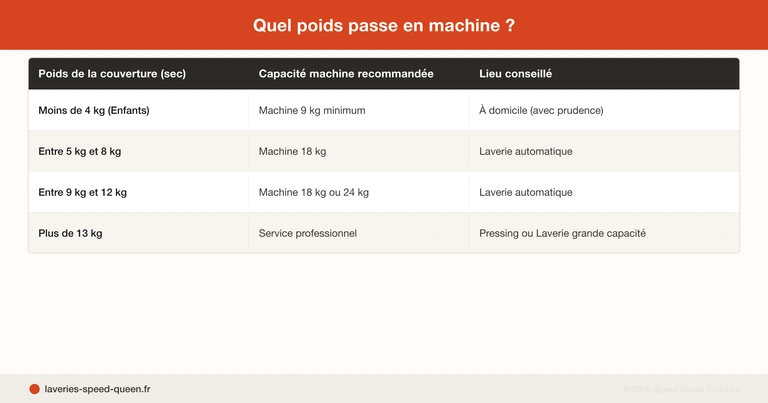
The right machine depends directly on your blanket’s dry weight. Here is a guide so you don’t get it wrong. For other heavy items, see our laundry weight guide and our duvet washing guide.
| Blanket weight (dry) | Recommended machine capacity | Suggested location |
|---|---|---|
| Under 4 kg (children) | 9 kg machine minimum | At home (with caution) |
| Between 5 kg and 8 kg | 18 kg machine | Laundromat |
| Between 9 kg and 12 kg | 18 kg or 24 kg machine | Laundromat |
| Over 13 kg | Professional service | Dry cleaner or large-capacity laundromat |
Why the 18 kg laundromat machine is often the only option
Adult weighted blankets weigh between 5 and 12 kg dry — well beyond what a 5 to 8 kg domestic machine can handle safely. Even entry-level models (4–5 kg) hit the limit of a 7 kg machine once soaked. In a laundromat, an 18 kg machine has the capacity, drum diameter and reinforced suspension needed to absorb this dense load without imbalance or mechanical wear. The professional drying that follows ensures complete evaporation between the beads — something an 8 kg domestic dryer cannot achieve in a reasonable time.
Glass beads vs plastic beads: what’s the difference?
The filling in your blanket determines how it reacts to heat and movement. There are mainly two types of beads. For a general approach to washing heavy items, see our backpack washing guide which presents similar machine-capacity challenges:
Glass beads
Denser and smaller, they give a flowing sand-like feel. They are very resistant to washing but make the blanket very heavy when wet. Be careful during drying as they retain coolness.
Plastic beads (polypropylene)
Larger than glass beads. They are sensitive to high temperatures (risk of melting or warping). Washing must stay below 30 °C.
Steel beads
Rarer and noisier, they are often sewn into reinforced pockets. They do not cope well with vigorous spin cycles which could tear the fabric through inertia.
Cycle and temperature: the strict rules
Washing a weighted blanket allows no improvisation. Here are the parameters to follow every time.
30 °C maximum, no exceptions
The temperature must never exceed 30 °C. Above that, polypropylene beads risk warping or partially melting. The technical fabric (often a polyester-cotton blend or minky) can also shrink. Glass beads withstand heat better, but the fabric containing them is no stronger.
Delicate or wool cycle
Choose a gentle cycle with reduced agitation. The “delicate”, “wool” or “hand wash” cycles on professional machines are most suitable. The drum rotation should be slow and steady to prevent the concentrated bead weight from creating a violent imbalance.
No fabric softener
Fabric softener leaves a coating on fibres that makes the fabric slippery. On a weighted blanket, this can cause the beads to shift inside their compartments and alter the even weight distribution. Use only a gentle detergent, preferably liquid (powder rinses poorly from such dense textile).
Moderate spin speed
Do not exceed 800 rpm. A faster spin creates excessive centrifugal force on such a dense load, which can damage the machine’s suspension and the blanket’s seams. If your machine allows it, opt for 600 rpm.
Double rinse recommended
The textile density easily traps detergent residue between the beads. A double rinse eliminates these residues and prevents skin irritation, especially if you use the blanket directly against your skin.
Step-by-step washing method
If you have chosen an 18 kg professional machine at one of our Speed Queen laundromats, here is how to achieve a perfect result:
Inspect the seams — check that no threads are loose. A micro-bead leak inside the machine is disastrous.
Wash the blanket alone — don't add sheets to avoid overloading the drum.
Gentle detergent, no softener — our Speed Queen machines include automatically dosed professional detergent.
Delicate cycle at 30 °C — a gentle rotation speed that respects the weighted compartments.
Moderate spin — don't try to extract all the water at 1,400 rpm. An intermediate spin preserves the structure.
Drying: a crucial step
Drying a weighted blanket is the longest step. Because of its density, moisture stays trapped between the beads.
Low-temperature tumble dryer
This is the method recommended by Gravity and most manufacturers. The rotation helps redistribute the beads evenly while air circulates.
Manual check
Every 15 minutes, take the blanket out and shake it. This prevents beads from clumping in one corner and creating pockets of residual moisture.
Flat drying (alternative)
If you are not using a dryer, spread it across several drying racks. Never hang it: the weight would strain the seams and stretch the fabric.
Removable cover: the maintenance hack
To extend the life of your blanket, most premium models come with a cover (often in minky, cotton or bamboo).
The removable cover hack
Treat your weighted blanket like a luxury duvet. Wash the cover every week with your regular sheets in a 9 kg machine. The inner blanket only needs a full wash in an 18 kg machine every 3 to 6 months. This significantly reduces mechanical wear on the beads.
Laundromat vs dry cleaner: cost comparison
Maintaining your heavy bedding yourself at a laundromat provides significant savings compared to a traditional laundry service.
| Washing option | Estimated price | Advantages |
|---|---|---|
| Speed Queen laundromat (18 kg) | ~€9.80 (detergent included) | Fast (1 h), economical, self-service |
| Professional drying (20–30 min) | ~€4.00 to €6.00 | Optimal air volume for beads |
| Traditional dry cleaner | €25.00 to €45.00 | Zero effort, but 3 to 5 day turnaround |
When not to machine-wash
Some weighted blankets should never go in a machine, even a professional one. Before loading the drum, check for these exclusion cases.
Fragile seams or loose threads. Systematically inspect the compartment seams (the lines forming the small squares that hold the beads). If a thread is loose, a seam looks slack, or you can feel beads under the seam rather than inside the compartment, do not machine-wash. A seam that fails during the cycle releases thousands of micro-beads into the drum — they block the drain filter, damage the pump and require costly repairs. Repair the seam by hand with strong thread (denim thread or doubled sewing thread) before any wash.
Blankets filled with sand or grain. Some handmade or budget models use sand, rice or other organic materials as filling. These materials break down in water, form a sludge that clogs the machine and never dry completely inside the blanket (mould risk). For these models, surface cleaning (damp cloth + mild soap) is the only option.
Blankets over 12 kg dry. Beyond 12 kg, even an 18 kg machine reaches its limits once the blanket is wet (estimated wet weight: 24 kg). The spin creates an imbalance the suspension cannot compensate for. For these very heavy models (often premium therapeutic adult blankets), only a professional dry cleaner equipped with 25 kg+ industrial machines can ensure a safe wash.
Non-removable cover with localised stains. If the stain is limited (food, spilled drink), spot cleaning is often more appropriate than a full wash. Apply damp Marseille soap↗ to the area, rub gently, rinse with a damp cloth and let dry flat. This targeted treatment avoids soaking 7–10 kg of filling for a 5 cm stain.
Mistakes to avoid
To avoid turning your wellness investment into a textile nightmare, stay away from these practices:
- Bleach: it destroys the fibres holding the beads in place.
- Dry cleaning: the chemicals can degrade plastic beads.
- Hanging to dry: the weight of the water can tear the blanket's casing.
- Ironing: direct heat melts the beads or the synthetic technical fabric.
- Ignoring a small hole: repair any tear before washing, otherwise you'll find thousands of micro-beads in the machine.
- Too much fabric softener: it can make the fabric slippery and cause the filling to shift.
En tant que Partenaire Amazon, nous percevons une petite commission sur les achats effectués via les liens partenaires de cet article — sans surcoût pour vous. Cela nous aide à maintenir ce site et à produire des guides gratuits.
Votre couverture lestée est trop lourde pour votre machine domestique ? Nos laveries de Blagnac, Croix-Daurade et Montaudran disposent de machines 18 kg conçues pour les charges lourdes. Lessive et adoucissant inclus, paiement CB sans contact ou espèces. Consultez nos tarifs pour planifier votre visite.
Maintenance schedule and between-wash care
Caring for a weighted blanket is not limited to quarterly washes in an 18 kg machine. Between washes, a few simple habits extend the freshness and lifespan of your blanket.
Air the blanket outdoors once a month for 2–4 hours, in the shade (not in direct sunlight to avoid degrading synthetic fibres). Fresh air and indirect UV light eliminate some of the bacteria and dust mites that accumulate in the filling.
For mild odours between washes, sprinkle baking soda↗ over the entire surface, leave for 4–6 hours, then vacuum thoroughly with the upholstery attachment. Baking soda absorbs perspiration and humidity odours without wetting the blanket.
If your blanket has a removable cover, wash the cover every week with your sheets — it is the main barrier against soiling. The inner blanket then only needs a wash every 3–6 months in an 18 kg machine, significantly reducing mechanical wear on the beads and seams.
Sources and references on weighted bedding care
For this guide we drew on technical recommendations from market leaders and textile experts:
- Official care guide from Gravity Blankets (glass bead washability).
- Technical specifications from Speed Queen Professional machines (imbalance management).
- Studies on the density of weighted bedding textiles.
- Washing protocols for synthetic materials and polypropylene beads.
For further reading on bedding care, see our complementary guides: