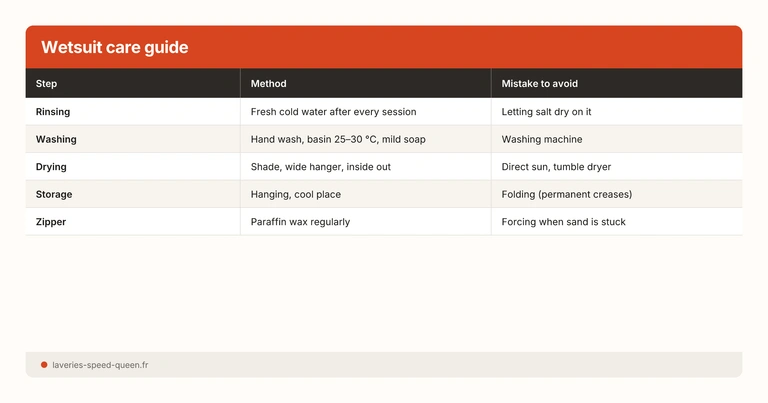
In short: a neoprene wetsuit should never go in a washing machine. Rinse it in cold fresh water after every session to remove salt, chlorine and sand. Hand wash in a basin of lukewarm water (max 30 °C) with a neoprene cleaner or mild soap. Dry in the shade on a wide hanger, never in sunlight or a tumble dryer. Always store hanging, never folded. A well-maintained wetsuit lasts 3 to 5 years.
Best Practices
Rinse in fresh water after every session — salt, chlorine and sand degrade neoprene if they dry on it.
Lukewarm water max 30 °C — hot water softens neoprene and accelerates its breakdown.
Hand wash only — never a washing machine, never a tumble dryer.
Shade drying — direct sunlight degrades neoprene via UV and makes it brittle.
Store on a wide hanger — never fold a wetsuit; creases create permanent weak points.
Why Neoprene Requires Specific Care
Neoprene is a synthetic rubber with closed cells filled with nitrogen micro-bubbles that provide thermal insulation. Unlike standard textiles (cotton, polyester, wool), neoprene is not a woven fiber: it is a flexible foam sandwiched between two layers of jersey.
This structure explains its care requirements. The mechanical agitation of a washing machine drum compresses the cells, deforms the foam and delaminates glued seams (most modern wetsuits use glue + blind stitch, not through-stitching). Heat softens the rubber and causes the material to lose its elasticity. UV sunlight degrades the polymeric bonds of neoprene — the same phenomenon that makes an old tire harden and crack.
Sea salt, pool chlorine and sand are the three everyday enemies of neoprene. Salt crystallizes as it dries and stiffens the cells. Chlorine chemically attacks the rubber. Sand, being abrasive, wears down the jersey layers and gets into seams and zippers.
Step 1: The Immediate Rinse (The Game-Changing Habit)
A fresh water rinse right after your session is the single most important care step. It removes 90% of degrading agents before they have time to act.
Rinse Protocol
- Turn the wetsuit inside out — pull it inside out to expose the interior (the side in contact with your skin, loaded with sweat and salt).
- Rinse under a stream of cold fresh water — at beaches with facilities, use the outdoor shower. At home, a shower head or garden hose works.
- Focus on critical zones — armpits, crotch, collar, knees (areas of maximum flexion and perspiration).
- Turn right side out and rinse the exterior to remove remaining sand and salt.
- Slide the zipper back and forth several times under the water to dislodge sand grains.
No fresh water available at the spot?
If you do not have access to fresh water immediately (session at a remote beach), roll the wet wetsuit in a damp towel and rinse it as soon as you get home. Avoid letting it dry with salt on it in the car boot — that is the worst-case scenario for neoprene.
Rinse Frequency
- After every session — ocean or pool, no exceptions.
- Even if you are surfing again tomorrow — salt that crystallizes overnight is enough to stiffen the cells.
Step 2: Hand Wash (Once or Twice a Month)
Rinsing removes salt and sand, but not the bacteria and sweat residues that accumulate in the inner jersey. A regular full wash is needed to maintain hygiene and prevent bad odors.
Equipment Needed
- A large basin, bathtub or plastic tub big enough for the wetsuit to be submerged without being compressed.
- Lukewarm water (25-30 °C) — no hot water.
- A neoprene-specific cleaner (surf brands carry them) or a few drops of mild neutral soap without fragrance.
Wash Protocol
- Turn the wetsuit inside out (interior facing outward).
- Submerge it in the basin of warm soapy water.
- Let it soak for 15 to 20 minutes — the warm water and soap dissolve sweat residues and body oils.
- Gently scrub dirty areas (armpits, collar, crotch) with your hands or a soft sponge. Never a hard brush — the inner jersey is delicate.
- Drain the basin, rinse the wetsuit in clean cold water.
- Turn right side out, rinse the exterior.
- Squeeze without wringing — gently press out water with flat hands. Never wring neoprene, as this deforms the cells.
Neoprene-specific cleaner
pH-neutral formula, free of solvents and enzymes. Eliminates bacterial odors and salt residues without attacking the rubber. The ideal choice if you surf regularly.
Mild neutral soap
A few drops of neutral liquid soap (such as liquid Marseille soap) diluted in 10 L of lukewarm water. A decent backup solution, but less effective against odors than the specific cleaner.
Baby shampoo
A gentle, readily available alternative. Its neutral pH and lack of harsh agents make it an acceptable substitute for neoprene cleaner. Use sparingly (a small dollop per 10 L).
White vinegar (anti-odor)
100 ml of white vinegar per 10 L of lukewarm water, soaked for 20-30 min. Effective against odor-causing bacteria. Rinse thoroughly afterward. Use occasionally, not every time.
- Never use regular detergent — enzymes, bleaching agents and fragrances degrade neoprene and irritate skin on the next wear.
- Never use bleach — concentrated chlorine chemically attacks the rubber and discolors the jersey.
- Never use chemical stain removers — solvents dissolve the seam adhesives.
- Never use a washing machine — mechanical agitation irreversibly deforms neoprene.
Step 3: Drying (Patience and Shade)
Drying is the second critical step. Poor drying degrades neoprene just as much as poor washing.
Drying Rules
- Always in the shade — UV sunlight degrades neoprene polymers. One hour of direct summer sun is enough to start the aging process.
- Always on a wide hanger — a thin hanger or clothesline creates pressure points that deform the shoulders. Use a wide hanger (jacket-style) or a thick bar. Wetsuit-specific hangers are available at surf shops.
- Always in a ventilated area — ventilation speeds evaporation and prevents mildew. A ventilated garage, covered balcony or an indoor drying rack works.
- Never a tumble dryer — heat is the enemy of neoprene.
- Never on a radiator — same logic as the tumble dryer.
Two-Stage Protocol
- Hang the wetsuit inside out (interior facing outward) so the side dampened by sweat dries first. The raw neoprene exterior dries faster than the inner jersey.
- When the inside is dry (12-24 h depending on ventilation and thickness), turn right side out and let the exterior dry completely.
Total drying time depends on thickness. A 3 mm suit dries in 12-24 hours in good conditions. A 5 mm suit may take 24-48 hours. Never store a wetsuit that is still damp — that is ideal breeding ground for bacteria and mildew.
Storage: Hanging, Never Folded
Storage method has a direct impact on lifespan. Neoprene has a “memory”: folded for a long time in the same position, it retains permanent creases that become weak points where the material will crack first.
Storage Rules
- On a wide hanger in a closet or dry, ventilated room, away from light.
- At room temperature — not too hot (not in a car in summer), not too cold (neoprene handles frost, but zippers and adhesives do less well).
- Never folded — even for transport, roll rather than fold.
- Never compressed under other objects.
- Zipper open — this reduces tension on the zip during storage.
Transport: how to pack without folding?
For transport to the spot, roll the wetsuit without folding and slip it into a ventilated wetsuit bag (mesh bag). Avoid watertight bags that trap moisture. Wetsuit bags with an integrated changing mat are practical: they protect the wetsuit and let you change without stepping in the sand.
Zipper Care
The zipper is the most stressed wear-and-tear part of a wetsuit. A jammed or stuck zip is the leading cause of repairable damage (you force it, you tear the fabric around it).
Zip Care Protocol
- Rinsing — After every session, slide the cursor back and forth several times under fresh water to flush sand and salt from the teeth.
- Drying — Leave the zip open during drying to prevent oxidation in a humid environment.
- Lubrication — Every 10-15 uses (or as soon as the zip starts catching), apply a specific lubricant: zipper wax, silicone spray lubricant, or in a pinch, a white candle rubbed over the teeth.
- Inspection — Regularly check the condition of the teeth and cursor. A broken or bent tooth should be repaired promptly to prevent the zipper from jamming completely.
Common Repairs
Neoprene is a repairable material. Small tears or delaminated seams do not mean the end of the wetsuit.
Small tear (< 3 cm)
Neoprene contact cement (such as Aquaseal or McNett). Clean the area, apply a thin layer of glue on both lips of the tear, let it dry for 5 min (the glue becomes tacky), then press the lips together. Let it cure for 24 h before use.
Delaminated seam
Same principle as a tear: neoprene cement on both edges, then press together. For long seams, apply in 5 cm sections. If the seam is through-stitched (visible on both sides), apply cement on both sides.
Jammed zip or broken slider
A wetsuit repair specialist (surf shops offer this service) can replace a slider or zip section. It costs less than a new wetsuit and extends the lifespan by several seasons.
Worn knees
Self-adhesive neoprene reinforcement patches are available for wear zones (knees, elbows). They add thickness and protect areas weakened by repeated friction.
When to Replace Your Wetsuit
Even when well maintained, a wetsuit has a limited lifespan. Neoprene gradually loses its elasticity and insulating power as cells compress and the rubber ages.
Signs of Replacement
- You feel cold even though the suit used to fit well — the neoprene has lost its insulating power (compressed cells, nitrogen evaporated).
- The neoprene is hard, cracked or brittle — advanced rubber degradation, often caused by UV or heat storage.
- Seams are coming apart everywhere — when repairs become more frequent than sessions, it is time to replace.
- The suit no longer fits snugly — stretched neoprene lets water in and loses all thermal effectiveness.
- The lining has delaminated from the neoprene — the inner jersey separating from the foam creates cold water pockets.
Indicative Lifespan
| Usage | Rigorous care | No maintenance |
|---|---|---|
| Occasional (1-2x/month) | 5-7 years | 3-4 years |
| Regular (2-3x/week) | 3-5 years | 1-2 years |
| Intensive (daily) | 1-2 years | 6-12 months |
3 mm vs 5 mm Neoprene: Same Care
Contrary to popular belief, neoprene thickness does not change the care protocol. Whether your suit is a 2 mm summer shorty or a 5/4 mm winter full suit, the rules are identical: fresh water rinse, hand wash, shade drying, hanging storage.
The only practical difference concerns drying time: a 5 mm suit takes roughly twice as long to dry as a 3 mm. Allow 24-48 h for a thick suit versus 12-24 h for a thin one.
Special Cases
Diving Wetsuit (vs Surfing)
Diving wetsuits face an additional constraint: hydrostatic pressure compresses the neoprene cells at depth. Over repeated dives, this compression gradually reduces the effective thickness of the neoprene (a 5 mm suit loses approx. 15-20% of its thickness after 100-200 dives). The care protocol is the same as for surfing, but the lifespan is generally shorter at equivalent usage frequency.
Triathlon Wetsuit
Triathlon wetsuits are made of smooth-skin neoprene that is very thin and very fragile. They require even more caution. Avoid any contact with rough surfaces when putting them on. Use latex gloves to don the suit (fingernails are the leading cause of tears). The rest of the care is identical.
Wetsuit with Thermal Lining
Some high-end wetsuits incorporate a fleece or thermal fabric lining. This lining retains more moisture and bacteria. Schedule a full wash more frequently (weekly during intensive use) and allow longer drying time.
Care Frequency Summary
After every session
Fresh cold water rinse (interior + exterior). Slide the zip under water. Hang on a wide hanger in the shade. Never let it dry with salt on it.
1-2 times per month
Full hand wash in a basin of lukewarm water (25-30 °C) with neoprene cleaner or mild soap. Soak 15-20 min. Thorough rinse. Dry completely before storing.
Every 10-15 uses
Zipper lubrication (wax, silicone). Inspect seams and overall neoprene condition. Repair small tears before they spread.
Start and end of season
Thorough deep wash. Check for leaks (put on the suit and check for water entry). Winter storage on a wide hanger, zip open, in a dry, temperate location.
Irreversible Mistakes to Avoid
- Washing machine — deforms neoprene, delaminates seams, destroys elasticity. Irreversible damage.
- Tumble dryer — even on low heat, the rotating heat destroys neoprene cells.
- Prolonged direct sunlight — UV degrades the polymers. Neoprene becomes hard, cracked and loses elasticity.
- Hot water (> 35 °C) — softens the rubber and accelerates cell aging.
- Prolonged folding — creates permanent creases that become breaking points.
- Detergent, bleach or solvents — chemically attack neoprene and dissolve seam adhesives.
- Storage in a car boot in summer — extreme heat (60-80 °C in a sun-exposed boot) is the worst scenario for neoprene.
The Laundromat for the Rest of Your Gear
While your neoprene wetsuit must be washed exclusively by hand, the rest of your water sports gear can benefit from a machine wash. Sportswear made of technical fabric (lycra, rash guard, boardshorts) washes perfectly in a machine at 30 °C. Large beach towels, travel sheets and backpacks also go in the machine.
For bulky items like a large duvet or a sleeping bag used in a van, laundromat machines offer a drum large enough (18 kg) for effective washing and rinsing, which home machines struggle with.
As an Amazon Associate, we earn a small commission on purchases made through the affiliate links in this article — at no extra cost to you. This helps us maintain this site and produce free guides.
Our laundromats have professional 9 to 18 kg machines for all your sports and outdoor laundry. Payment by contactless card or cash. Check our prices.
Sources and References
- Sportswear care: temperatures and tips
- Delicate fabrics guide
- How to wash a backpack
- How to wash a sleeping bag
- Washing temperatures guide by fabric
- Mechanical properties and aging of polychloroprene (neoprene) — UV degradation, cyclic compression, elasticity loss
- Equipment care standards for diving gear — post-immersion fresh water rinse, drying and storage