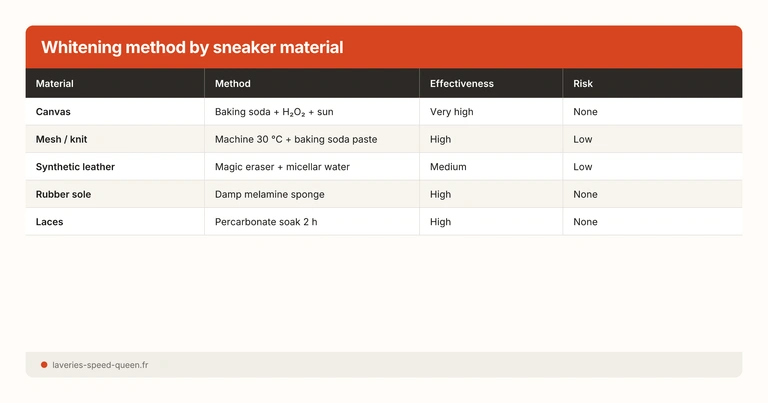
In short: To whiten white sneakers, the most effective method is a baking soda + hydrogen peroxide paste, dried in the sun for 2 hours. Machine washing at 30 °C on a delicate cycle (mesh bag) works for canvas and mesh. Never use bleach on white synthetics — it yellows instead of whitening. Soles can be cleaned with a magic eraser or white toothpaste.
At a glance
Baking soda + hydrogen peroxide + sun — the most effective combination for whitening yellowed fabric.
Machine wash 30 °C, delicate cycle, mesh bag — for canvas and mesh/knit only.
Never bleach on synthetics — sodium hypochlorite yellows polymers. Irreversible yellowing.
Soles: damp magic eraser — melamine is a micro-abrasive that scrubs away yellowing.
Shade drying — direct sunlight yellows some white synthetics after washing.
Why white sneakers turn yellow
White sneaker yellowing has three main causes: polymer oxidation, product residue, and ground-in dirt. Each cause requires a different treatment.
The white color of sneakers isn’t the absence of color — it’s a pigment (titanium dioxide, zinc oxide) or an optical brightener applied to the fiber. Over time, exposure to air, UV light, and sweat degrades these surface treatments.
Chemical oxidation
Synthetic polymers (polyurethane in soles, nylon in mesh) oxidize on contact with air. This slow chemical reaction produces chromophore compounds (which absorb blue light and appear yellow). That's why soles yellow even when not worn.
Detergent or bleach residue
Overdosing detergent leaves surfactant residue in the fibers. When drying, these residues crystallize and yellow. Bleach (sodium hypochlorite) reacts with synthetic polymers and produces irreversible chemical yellowing.
Accumulated dirt and sebum
Foot sweat (salt, sebum, uric acid) works its way into the fabric and gradually oxidizes. Dirt, tar, and grass stains combine with natural yellowing to produce a uniform gray-yellow tint.
Method 1: Baking soda + hydrogen peroxide (most effective)
This method works on canvas sneakers (Converse, Vans) and mesh (Nike, Adidas). It combines a mild abrasive, a whitening agent, and UV sunlight.
Preparing the paste
Mix in a bowl:
- 2 tablespoons of baking soda↗
- 1 tablespoon of 3% hydrogen peroxide (available at any pharmacy or grocery store)
- Mix until you get a thick paste
Baking soda acts as a mild abrasive (it won’t scratch fabric) and as a carrier for the hydrogen peroxide. Hydrogen peroxide is an oxidizing agent that breaks down chromophore compounds (the yellowed molecules) into colorless products.
Application and sun drying
- Brush the sneakers to remove surface dirt.
- Apply the paste with a brush or toothbrush over the entire yellowed surface.
- Place the sneakers in direct sunlight for 2 hours.
- The paste will dry and crack — that’s normal.
- Brush off the dried paste.
- Rinse with cold water.
Why sunlight matters: UV rays activate the decomposition of hydrogen peroxide into oxygen and water. Nascent oxygen (O) is a powerful oxidant that whitens fibers. Without sun, the reaction is much slower and results are less visible.
Adapt to the material
This method is ideal for canvas (Converse, Vans). On mesh/knit, apply a thinner layer — mesh is more delicate than canvas. On synthetic leather, don’t use this method — baking soda can micro-scratch the smooth surface. Clean synthetic leather with a damp cloth and mild soap.
Method 2: Machine wash at 30 °C
Machine washing is the most practical method for a thorough clean. It’s suitable for canvas and mesh sneakers, not leather.
Preparation
Before the machine, prepare your sneakers properly. For a full guide to machine-washing shoes, see our article on how to wash shoes in the machine.
Remove laces and insoles
Laces are washed separately (sodium percarbonate soak). Insoles are hand-cleaned (brush + baking soda) — in the machine they won't clean properly and hinder drying.
Brush off dry dirt
Dried mud, soil, and pebbles must be removed before the machine. They scratch the drum and unnecessarily dirty the wash water. Tap the soles together outside, then brush.
Place in a mesh laundry bag
Put each sneaker in a mesh laundry bag or closed pillowcase. The bag prevents direct impacts against the drum and protects delicate elements (eyelets, reinforcements, logos).
Add towels
Add 2-3 bath towels to the drum. They cushion impacts (less noise, less stress on the sneakers and machine) and balance the load for smoother spinning.
Machine settings
- Temperature: 30 °C max — adhesives soften above this, soles can separate.
- Cycle: delicate, wool, or hand-wash program. Reduced spin (400-600 rpm).
- Detergent: normal dose of liquid detergent. No powder (leaves white residue in mesh). No bleach.
- No fabric softener: unnecessary on synthetics and canvas.
At a laundromat, the delicate 30 °C cycle with automatically dosed detergent is perfectly suited. Professional dosing avoids overdosing, a common cause of residual yellowing.
Method 3: White soles (magic eraser and toothpaste)
Soles yellow independently of the fabric — it’s oxidation of the polyurethane or rubber. They require separate mechanical treatment.
Melamine sponge (magic eraser)
The melamine sponge is a micro-abrasive that scrubs away the oxidized layer on the sole surface without scratching the material. It’s the most effective and quickest method for soles.
How to use: Dampen the sponge, scrub the sole in circular motions. The sponge wears down quickly (that’s normal — it’s a consumable). Rinse the sole with clean water. Results are immediate on surface stains and light yellowing.
White toothpaste
White toothpaste (not gel, not colored toothpaste) contains micro-abrasives (silica, calcium carbonate) and a mild whitening agent. Apply with an old toothbrush, scrub, let sit 10 minutes, rinse. It’s an accessible alternative when you don’t have a magic eraser on hand.
Black marks (rubber)
Black marks on white soles are rubber transfers (gym floors, stairs). The magic eraser removes them easily. For stubborn marks, a little acetone (oil-free nail polish remover) on a cotton pad removes the transfer — but test on a hidden spot first, as acetone can dull some plastics.
By material: the right protocol
Whitening a canvas Converse is not the same as a Nike Air Max in mesh. Each material reacts differently to products and machines.
Canvas (Converse, Vans)
Cotton canvas is the easiest material to whiten. It handles baking soda, hydrogen peroxide, and machine washing well. It’s also the material that yellows least quickly, as cotton is more chemically stable than synthetics.
| Method | Effectiveness | Risk | Best for |
|---|---|---|---|
| Baking soda + hydrogen peroxide + sun | Excellent | None | Deep whitening, yellow stains |
| Machine wash 30 °C, delicate | Good | Low | Overall cleaning, light dirt |
| Sodium percarbonate soak | Very good | None | Uniform whitening, overall graying |
| Diluted bleach | Good (cotton only) | Medium — weakens fibers | Pure white but accelerated wear |
Canvas is the only sneaker material where bleach can work (pure cotton). But even on canvas, sodium percarbonate is preferable: it whitens without weakening fibers.
Mesh and knit (Nike, Adidas, New Balance)
Mesh (synthetic lattice) and knit (technical knit) are the most common materials on modern sneakers. They’re more delicate than canvas because the threads are finer and the structure more open.
- Baking soda + hydrogen peroxide: works but apply a thinner layer. Mesh dries faster than canvas, so reduce sun time to 1.5 hours.
- Machine wash 30 °C: mesh laundry bag↗ mandatory. Mesh snags on drum edges without protection.
- Never bleach: mesh is polyester or nylon — bleach irreversibly yellows these materials.
- No stiff brushes: mesh warps and frays. Use a soft-bristle brush or cloth.
Synthetic leather (Air Force 1, Stan Smith)
Synthetic leather (polyurethane) is a smooth surface that cleans differently from fabric. Baking soda paste is too abrasive — it micro-scratches and dulls the surface.
Synthetic leather protocol:
- Microfiber cloth dampened + Marseille soap↗: surface cleaning.
- For yellow stains: white vinegar↗ diluted (1:3 with water) applied with a cloth.
- For scuffs: a little makeup remover milk (yes, the same kind used on skin) — it contains gentle cleaning agents and waxes that fill micro-scratches.
- Dry with a clean, dry cloth.
Machine washing is not recommended for synthetic leather — the mechanical agitation and prolonged immersion degrade the polyurethane coating. In extreme cases, a quick delicate 30 °C cycle is possible, but hand cleaning gives better results.
Laces: sodium percarbonate soak
White laces often yellow faster than the shoe itself. A sodium percarbonate soak restores them effectively.
Laces accumulate dirt from hands (tying), sweat (heat from feet), and dust. Their braided structure traps grime between the fibers.
Method:
- Fill a bowl with warm water (40 °C).
- Add 1 tablespoon of sodium percarbonate.
- Submerge the laces and let them soak for 2 hours.
- Gently rub the laces between your hands to dislodge residue.
- Rinse with clean water and let dry.
For heavily yellowed laces, a second 2-hour soak or placing them in the sun after soaking speeds up whitening. Sodium percarbonate is safe for cotton or polyester laces — unlike bleach, which weakens fibers and yellows synthetics.
Yellowing: understanding it to prevent it
The best whitening is the one you never have to do. Three habits significantly reduce yellowing.
Never use bleach on synthetics
This is the most common and most destructive mistake. Sodium hypochlorite (the active ingredient in bleach) reacts with synthetic polymers (polyester, nylon, polyurethane) through chlorination of carbon chains. This reaction produces stable, irreversible yellow-brown compounds.
On pure white cotton, bleach works (it oxidizes chromophores without attacking cellulose). But modern sneakers are mostly synthetic — even “canvas” models often contain a percentage of polyester. When in doubt, don’t use bleach. Sodium percarbonate is a universally safe alternative.
Dry in the shade after washing
Sunlight is useful during the baking soda + hydrogen peroxide treatment (it activates the reaction). But after washing, dry your sneakers in the shade. UV rays degrade the optical brighteners in the fabric and accelerate oxidation of polyurethane soles.
Clean regularly (not only when it’s too late)
A quick clean after each wear (damp cloth on fresh stains, magic eraser on the sole) prevents the buildup of dirt that works its way in and gradually yellows. It’s less dramatic than a full whitening session, but more effective in the long run.
At a Speed Queen laundromat
The delicate 30 °C cycle available at our Speed Queen laundromats is well suited for washing sneakers. Professional detergent is automatically dosed — an important advantage since detergent overdosing is a common cause of residual yellowing on white sneakers.
Remember to bring a mesh laundry bag to protect your sneakers in the drum. Add towels to the machine to cushion impacts. Payment by contactless card or cash.
Mistakes to avoid
- Using bleach on synthetics — irreversible chemical yellowing. Sodium percarbonate is the safe alternative.
- Exceeding 30 °C in the machine — adhesives soften, soles separate, mesh warps.
- Forgetting the mesh bag — without protection, sneakers bang against the drum and get damaged (eyelets, reinforcements, logos).
- Tumble drying — heat warps sneakers and separates soles. Air dry only.
- Stuffing with newspaper — printing ink transfers onto damp white fabric. Use white paper towels.
- Scrubbing mesh with a stiff brush — the lattice warps and frays. Soft brush or cloth only.
As an Amazon Associate, we earn a small commission on purchases made through affiliate links in this article — at no extra cost to you. This helps us maintain this site and produce free guides.
At Speed Queen laundromats, the delicate 30 °C cycle is ideal for sneakers. Automatically dosed detergent means no overdosing (= no residual yellowing). Bring a mesh bag and towels. Check our prices or read
our full guide to washing shoes in the machine
.
Sources and references
- American Chemical Society, Polymer Degradation and Stability — polyurethane oxidation mechanisms, accessed March 23, 2026
- Nike, Shoe care guide, nike.com, accessed March 23, 2026
- Converse, How to clean Converse sneakers, converse.com, accessed March 23, 2026
- How to wash shoes in the machine
- Sodium percarbonate laundry guide
- Bleach and laundry: when to use it
- Whiten yellowed laundry: effective methods
- Baking soda and laundry
- Remove a grass stain