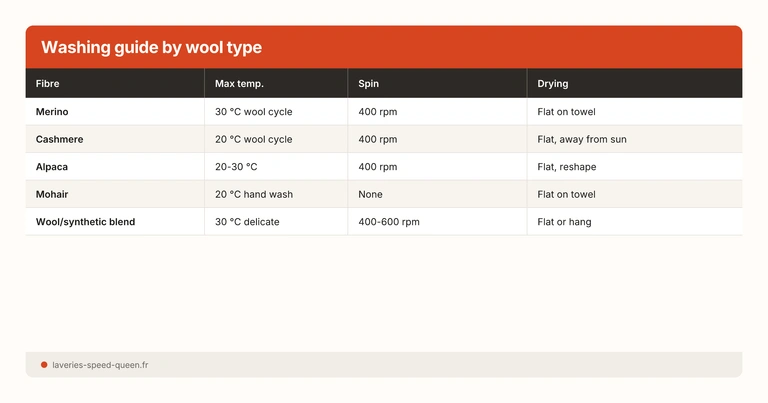
In short: wool felts when exposed to a combination of heat, agitation, and alkalinity. To machine-wash it safely: wool cycle at 30 °C max, liquid wool detergent, mesh laundry bag, spin at 400 rpm, no fabric softener. Always dry flat — never in a tumble dryer, never hanging. A wool sweater only needs washing every 3-5 wears — air it out between uses.
At a Glance
30 °C maximum — wool scales open at 35 °C. Felting is irreversible.
Wool cycle — intermittent drum rotation, spin at 400 rpm max.
Specialist liquid detergent — neutral pH, no protease enzymes. No powder, no softener.
Mesh laundry bag — reduces mechanical friction against the drum.
Flat drying — on a bath towel, away from sunlight. Never hanging, never in a tumble dryer.
Why Wool Felts
Wool fibre is made of keratin — the same protein found in hair and nails. Its surface is covered in cuticles: microscopic scales pointing from root to tip, like tiles on a roof.
Under normal conditions, these scales lie flat and smooth. Three factors cause them to open:
- Heat — above 30-35 °C, the hydrogen bonds holding the scales shut weaken. The scales lift.
- Mechanical agitation — drum rotation rubs fibres against one another. Open scales catch and interlock.
- Alkalinity — a detergent with a high pH (above 8) partially dissolves the scales and speeds up their opening.
When all three factors combine (which is exactly what happens on a standard cotton cycle at 40 °C), the scales interlock irreversibly. The fabric contracts in every direction, becoming thicker, stiffer, and smaller. That is felting.
Felting is not a defect of wool — it is a process deliberately used to make felt and boiled wool. But on a sweater, it is a disaster.
Felting is irreversible
Unlike cotton shrinkage (which can be partially reversed by stretching the garment while damp), wool felting is a permanent physical process. Interlocked scales do not separate. A felted wool sweater will never fully return to its original shape. Prevention is the only reliable strategy.
The Machine Protocol: Step by Step
Machine washing is possible for most woolens, provided you follow this protocol strictly.
1. Check the Care Label
The care label is your first guide:
- Tub with two bars underneath: very delicate machine wash (wool cycle)
- Hand in the tub: hand wash only
- Crossed-out tub: do not wash with water — dry cleaning required
- Number 30 inside the tub: maximum temperature 30 °C
If the label says “hand wash”, you can try the wool cycle — modern Woolmark-certified machines are designed to be as gentle as hand washing. But it is at your own risk.
2. Prepare the Sweater
- Turn it inside out — protects the visible surface from friction against the drum
- Fasten the buttons — prevents buttonholes from stretching
- Place it in a mesh laundry bag↗ — a fine-mesh bag (not too tight) reduces mechanical friction by 60 to 80 % according to tests
- Do not mix with heavy laundry — zips, snaps, and thick fabrics abrade the wool surface
3. Set the Machine
- Cycle: wool (or delicate if no dedicated wool cycle). The wool cycle uses intermittent drum rotation — short movements separated by pauses. This reduced agitation is the key to preventing felting.
- Temperature: 30 °C maximum. 20 °C is even safer, but detergents are less effective in cold water.
- Spin: 400 rpm maximum. Some machines offer 0 rpm (drain only) — the safest option for valuable woolens.
- Load: 2-3 sweaters maximum per cycle. Do not overload — the laundry must “float” in the water.
4. Choose the Right Detergent
Specialist liquid wool detergent
Neutral pH (5-7), no protease enzymes, no strong alkaline agents. Specialist brands (Perwoll Wool & Silk, Ecover Delicate, The Laundress Wool & Cashmere) are formulated to respect keratin.
Mild shampoo (emergency substitute)
If you have no specialist detergent, a few drops of mild shampoo (sulphate-free if possible) will work. Wool is keratin, just like hair — a mild shampoo is chemically compatible.
Powder detergent
Contains alkaline agents (sodium carbonate, pH 10+) and often protease enzymes that break down keratin. Powder can also leave white residue in wool fibres.
Fabric softener
The cationic agents in softener coat fibres and weigh them down. Result: loss of loft, greasy feel, felted appearance. Use white vinegar (1 tbsp in the softener tray) if you want to soften.
5. After the Cycle: Do Not Forget
- Remove the sweater immediately when the cycle ends. Wet laundry left compressed in the drum will lose its shape.
- Reshape the sweater to its original form by gently stretching (shoulders, sleeves, hem).
- Never wring a wool sweater to remove water — you will break fibres and distort the knit.
The Hand-Wash Protocol: For Precious Pieces
For quality cashmere, a vintage sweater, or a fragile woolen, hand washing remains the safest option.
- Fill a basin with cool to lukewarm water (20-25 °C). Never above 30 °C.
- Add the detergent — a few drops of wool detergent or mild shampoo. Mix before immersing the sweater.
- Immerse the sweater and let it soak for 10-15 minutes. Do not rub, do not wring. Gently press the sweater in the water to help the detergent penetrate the fibres.
- Rinse in cool water (same temperature as the wash — a thermal shock can cause felting). Change the water 2-3 times until it runs clear.
- Remove water without wringing — lay the sweater flat on a dry bath towel, roll the towel and press gently. The towel absorbs the excess water.
- Dry flat on a clean, dry towel.
Same temperature from start to finish
Wool is sensitive to thermal shock. If you wash at 25 °C, rinse at 25 °C. A sudden shift from 30 °C to 10 °C (cold tap water) can cause partial felting. In a machine, the wool cycle manages temperature transitions automatically.
By Wool Type: Adapting the Protocol
Not all wools are equal. Fibre fineness, lanolin content, and knit structure all affect how fragile the garment is.
| Wool Type | Recommended Wash | Max Temperature | Key Notes |
|---|---|---|---|
| Merino | Machine (wool cycle) | 30 °C | Fine, soft fibre. Handles the machine wool cycle well. The easiest pure wool to care for. Naturally antibacterial — ideal for wool sportswear. |
| Cashmere | Hand (preferred) or machine | 20-25 °C | Ultra-fine fibre (14-19 microns). Very prone to felting and pilling. If machine: spin at 0 rpm or drain only. Specialist detergent required. |
| Alpaca | Hand (preferred) or machine | 20-25 °C | Heavier fibre than merino. No natural lanolin — more prone to staining. Stretches easily when wet. Flat drying is essential. |
| Mohair | Hand | 20 °C | Long, silky fibre. Very sensitive to friction — pills even on the wool cycle. Hand wash only for pure mohair. |
| Angora | Hand | 20 °C | Extremely fine, fragile fibre (angora rabbit). Sheds fibres when washed. Hand only, in a sealed bag if possible. Dry flat, away from any heat source. |
| Boiled wool / felt | Hand (surface only) | 20 °C | Already intentionally felted. Do not immerse — clean the surface with a damp cloth and mild shampoo. A full wash risks shrinking the fabric further. |
| Wool-synthetic blend | Machine (wool cycle) | 30 °C | More resilient than pure wool thanks to the synthetic component. Wool cycle at 30 °C; 600 rpm spin tolerated if the blend is over 50 % synthetic. |
Drying: The Non-Negotiable Rule
Drying is just as important as washing. Bad drying can ruin a sweater that survived the wash perfectly.
Always Flat
Lay the sweater flat on a dry bath towel, on a flat drying rack, or on a mesh drying screen. Reshape it to its original dimensions (gently pull the sleeves, shoulders, and hem).
Never Hanging
A wet wool sweater weighs 2 to 3 times its dry weight. Hung on a hanger or clothesline, the water weight stretches the fibres downward. The sweater elongates, the shoulders sag, and the shape is lost. This type of deformation is not felting — it is gravity stretching — but it is difficult to correct.
Never in a Tumble Dryer
The heat inside a tumble dryer (60-80 °C in the drum) guarantees felting. Even the “delicate” or “cool” setting on some dryers produces enough residual heat and agitation to damage wool.
The only exception: some premium dryers have a “wool” programme that uses ambient air only, with no heating and very slow rotation. Check that the programme is Woolmark-certified before using it.
Ideal Conditions
- Room temperature: 18-22 °C (normal indoor temperature)
- Ventilation: good air circulation (open window or fan)
- No direct sunlight: UV degrades keratin fibres and can yellow white wool
- No radiator or heated towel rail: direct heat causes localised felting
Drying a thick wool sweater takes 12 to 24 hours. Flip it after 6-8 hours so both sides dry evenly. Change the towel underneath if it becomes saturated.
Rescuing a Felted Sweater: The Conditioner Method
If the worst has happened, there is a method that can partially soften a felted sweater. The result is limited — the sweater will not return exactly to its original shape — but it may regain 1 to 2 sizes.
The Principle
Hair conditioner (or vegetable glycerine↗) contains emollient agents that lubricate keratin scales. The scales do not “unhook”, but the softening allows you to manually stretch the fibres.
The Protocol
- Fill a basin with lukewarm water (25 °C) and add 2 tablespoons of hair conditioner (or vegetable glycerine) per litre of water.
- Immerse the felted sweater and let it soak for 30 minutes.
- Without rinsing, lay the sweater flat on a towel.
- Gently stretch the sweater in every direction — sleeves, shoulders, hem, width. Go gradually, without forcing.
- Pin the sweater to the desired dimensions (use clothes pegs at the edges, pinned to the towel).
- Leave to dry completely flat (12-24 hours).
- Rinse in cold water once dry if you want to remove the conditioner residue.
Manage your expectations
This method works partially on mild felting (a sweater that has lost 1 size). On severe felting (a sweater that went from L to S), results will be limited. Some heavily felted sweaters can be repurposed as accessories (cushion cover, pouch) or decorative boiled wool. Prevention is incomparably more effective than repair.
Washing Frequency: Less Often Than You Think
Wool has natural properties that significantly reduce the need for washing:
- Antibacterial: lanolin (natural wool grease) and the keratin structure inhibit bacterial growth. A merino wool sweater develops significantly fewer odours than a cotton or synthetic sweater worn the same number of times.
- Self-cleaning: the scaly fibre surface repels light soiling. A gentle brush is often enough to remove lint and dust.
- Breathable: wool absorbs up to 30 % of its weight in moisture without feeling wet. Perspiration evaporates naturally.
Recommended Frequency
- Sweater worn over a shirt (office layer): wash every 5-8 wears
- Sweater worn next to skin: wash every 3-5 wears
- Scarf, beanie, gloves: wash every 10-15 uses
- Wool coat: 1-2 washes per season (or dry clean)
Between Washes
- Air the sweater for 24 hours on a wide hanger (not a thin one that marks the shoulders) or flat
- Brush gently with a clothes brush to remove lint and refresh the surface
- Spot-treat stains — dab with a damp cloth and a drop of wool detergent, without immersing the whole sweater
- Store properly: folded (never hanging) in a dry place, with a natural moth deterrent (cedar, lavender) for long-term storage
At the Laundromat: The Wool Cycle on Professional Machines
The professional machines in our Speed Queen laundromats have a delicate cycle suitable for wool. The advantages of laundromat machines for wool:
- Greater water volume: laundry “floats” more freely in the water, reducing mechanical friction between fibres
- Large-diameter drum: movements are wider and gentler than in a compact domestic machine
- Calibrated spin: the low-speed spin is smooth and progressive, with no sudden jolts
For wool blankets, merino throws, or wool coats that do not fit in a domestic machine, the laundromat is often the only option for water washing (the alternative being the dry cleaner).
Mistakes That Destroy Wool
- Washing above 30 °C — scales open at 35 °C. At 60 °C, felting is almost instant. Even 40 °C is a risk.
- Using a cotton or synthetic cycle — the continuous agitation of a standard cycle is too harsh for wool. Only the wool cycle (intermittent rotation) is suitable.
- Adding fabric softener — cationic agents weigh down wool and give it a felted appearance and greasy feel. White vinegar is a safe substitute.
- Spinning above 400 rpm — high-speed mechanical pressure compresses wet fibres and promotes felting.
- Hanging to dry — the weight of the water stretches the sweater downward. Guaranteed distortion of shoulders and length.
- Tumble drying — heat + agitation = felting. Even the 'delicate' setting is too aggressive for wool.
- Using powder detergent — pH too high, protease enzymes that break down keratin, white residue in fibres.
Summary Table: Wool in the Machine
| Setting | Recommendation | Why |
|---|---|---|
| Cycle | Wool (or delicate) | Intermittent drum rotation, less mechanical agitation |
| Temperature | 30 °C max (20 °C ideal) | Scales stay closed below 35 °C |
| Spin | 400 rpm max | Reduced mechanical pressure on wet fibres |
| Detergent | Liquid wool detergent (pH 5-7) | No protease enzymes, no alkaline agents |
| Fabric softener | No (white vinegar as alternative) | Cationic agents weigh down wool |
| Laundry bag | Required | Reduces friction against the drum by 60-80 % |
| Load | 2-3 sweaters max | Laundry must float in the water |
| Drying | Flat on a bath towel | Prevents gravity stretching and heat felting |
As an Amazon Associate, we earn a small commission on purchases made through affiliate links in this article — at no extra cost to you. This helps us maintain this site and produce free guides.
Our laundromats in Blagnac, Croix-Daurade and Montaudran have professional machines with a delicate cycle suitable for wool. The large drum and greater water volume reduce friction — ideal for wool blankets and coats. Payment contactless card or cash. See our prices.
Sources and References
- Textile care symbols: complete guide
- Washing temperature guide
- How to prevent shrinking
- White vinegar and laundry: uses and limits
- Tumble dryer guide
- Wool fibre structure — keratin cuticles and the felting mechanism through scale interlocking
- Woolmark — certification specifications for wool wash cycles in domestic washing machines