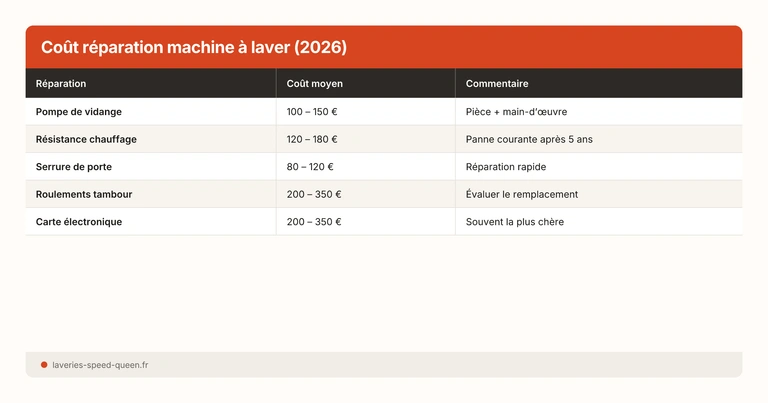
In short: before calling a repair technician, 5 checks in 5 minutes can solve the problem (socket, breaker, door, water, reset). If the fault persists, the average repair cost is GBP 100-350 depending on the part. In the meantime, the laundromat is the fastest way to handle the laundry piling up — no appointment, open 7 days a week, machines ready in 1 hour.
At a Glance
5 basic checks -- socket, breaker, door, water supply, reset. Solves around 30% of reported faults.
Error code -- note it before doing anything. It is the first thing the technician will ask for.
Replacement threshold -- repair over GBP 250 on a machine more than 8 years old = consider replacing.
Urgent laundry -- towels and damp items cannot wait. Head to the laundromat to avoid bacteria and musty smells.
The 5 Checks in 5 Minutes
Before picking up the phone, these simple checks rule out the most common causes. No technical expertise required.
1. The Power Socket
Plug another appliance (hairdryer, lamp) into the same socket. If it does not work either, the problem is the socket or the circuit, not the machine. Also check that the plug is not loose — a partial connection can prevent the machine from starting without tripping the breaker.
2. The Circuit Breaker
Open the fuse board. Is the breaker for the “utility” or “kitchen” circuit in the off position? Has the main RCD (the large switch at the top) tripped? Flip it back on. If the breaker trips again immediately when you start the machine, there is likely an internal short circuit — that is a job for the technician.
3. The Door
All modern machines have a door interlock: the cycle only starts if the door is locked. Open it, close it firmly, listen for the “click”. If the door no longer locks (no click), the door lock or catch may be broken. This is a simple repair (part costs GBP 20-50), but the machine will not start without it.
4. The Water Supply
Is the water supply tap open? Is the inlet hose kinked or crushed behind the machine? If the machine starts but stops almost immediately with an error code, it is often a water supply problem. Also check that the filter at the hose connection is not blocked by limescale (unscrew the hose from the machine end to inspect).
5. The Reset
Unplug the machine from the wall socket. Wait 10 minutes (not 30 seconds — some control boards need time to fully discharge). Plug back in. On some machines, you need to hold the Start button for 5 seconds after plugging in. Check the manual if you still have it.
Note the error code BEFORE unplugging
If your machine displays a code (E1, F5, CL, etc.), write it down or photograph the screen before attempting a reset. This code is the most useful piece of information for the repair technician. Without it, diagnosis takes longer (and costs you more).
The Most Common Error Codes
Every brand uses its own codes, but certain patterns appear frequently. This table gives general guidance — always check your machine’s manual for the exact meaning.
| Common code | Likely meaning | What you can check |
|---|---|---|
| E1 / F1 / E21 | Drainage problem | Check the drain filter (panel at the bottom of the machine) — often blocked by a sock, coin or tissue |
| E2 / F2 / E10 | Fill problem | Check the water tap and inlet hose |
| E3 / F3 | Heating problem | Technician needed — the heating element likely needs replacing |
| E4 / F4 / dE | Door problem | Open and close the door firmly. If the problem persists, the lock is faulty |
| E5 / F5 / UE / UB | Balance problem | Redistribute the laundry evenly in the drum. Common with a single heavy item (duvet, lone pair of jeans) |
| CL / LOC | Child lock activated | Press and hold 2 buttons simultaneously for 3-5 seconds (see manual) |
This table is indicative
Codes vary from brand to brand and model to model. Do not attempt any internal repair (opening panels, dismantling parts) based on this table alone. It is intended to help you understand the nature of the problem and decide whether you can fix it yourself (drain filter, water supply) or whether a technician is needed.
When to Call a Repair Technician
If the 5 basic checks have come up empty and the problem is not a blocked filter or a closed tap, it is time to contact a professional. Here is what to expect.
Average Repair Costs
| Item | Average cost | Notes |
|---|---|---|
| Call-out + diagnosis | GBP 50-80 | Often deducted if you proceed with the repair |
| Drain pump | GBP 100-150 | Parts + labour |
| Heating element | GBP 120-180 | The most common fault after 5 years |
| Door lock / interlock | GBP 80-120 | Quick repair, inexpensive part |
| Drum bearings | GBP 200-350 | Major repair — assess whether replacement is wiser |
| Control board | GBP 200-350 | Often the most expensive repair — model-specific part |
The 50% Rule
A simple rule for deciding between repair and replacement:
Repair
Machine under 5 years old, repair under GBP 200, and no recent previous fault. The average lifespan of a washing machine is 10-12 years -- it has plenty of life left.
Toss-up
Machine 5-8 years old, repair between GBP 150-250. This is the grey zone. Ask the technician for their opinion on the machine's overall condition (drum, seals, motor).
Replace
Machine over 8 years old, repair over GBP 250, or second fault in 12 months. Cumulative repair costs often exceed the price of a new machine at this point.
Managing Your Laundry in the Meantime
The technician cannot come for 5 days. Your laundry basket is overflowing. This is a common situation — here is how to handle it without stress.
Sort by Urgency
Not all laundry has the same level of urgency:
Urgent (cannot wait) -- damp towels, sweaty sportswear, baby clothes, underwear. Bacteria multiply on damp laundry within 24-48 hours. Head to the laundromat.
Moderate (2-3 days) -- bed sheets, clothes worn for a day. Keep them dry and aired in an open basket. They can wait for the technician if the repair is quick.
Not urgent (5-7 days) -- briefly worn clothes, jumpers not in direct skin contact, jeans. Store dry and they will hold without issue.
The Laundromat: The Instant Solution
No appointment, no queue. You arrive, load the machine and leave with clean, dry laundry in about 1 hour.
If it is your first time at a laundromat, do not worry — the process is straightforward.
In practice, a breakdown at home often reveals that the laundromat is faster for large volumes: multiple machines running in parallel, integrated drying, and capacities (9-18 kg) that domestic machines (7-8 kg) simply cannot match.
Tip: take the opportunity for bulky items
Washing machine broken? It might be the right moment to tackle what you have been putting off for months: the duvet, the curtains, the rug. At the laundromat, the 18 kg machine handles them with ease — and you will not need to come back once your machine is repaired.
Do Not Let Damp Laundry Pile Up
The classic trap: leaving wet towels in a heap in the basket “until the technician comes”. Within 48 hours, bacteria turn damp laundry into a source of stubborn smells. Even if you cannot wash everything, at the very least hang up towels and damp items so they air dry. Dirty but dry laundry does not pose an immediate hygiene problem.
Prevention: Avoiding the Next Breakdown
The best breakdown is the one that never happens. Regular maintenance extends your machine’s lifespan by 2-3 years on average.
Clean the drain filter every 2-3 months -- the number one cause of pump failure is a blocked filter. The panel is at the bottom of the machine.
Run an empty cycle at 90 °C once a month with white vinegar or a machine cleaner -- removes detergent residue, bacteria and musty smells.
Empty pockets before every wash -- coins, tissues and staples damage the pump and drum.
Dose detergent correctly -- too much detergent gunks up the machine faster. Residue clogs pipes and encourages mould in the detergent drawer.
Leave the door ajar after every cycle -- ventilation prevents mould forming on the door seal.
- Do not attempt internal repairs yourself -- opening the back panel of a plugged-in or recently used machine exposes you to electrical risk and residual pressurised water. Leave internal work to professionals.
- Do not leave laundry in a broken machine -- if a cycle stopped mid-way, empty the drum as soon as possible. Soaked laundry in a closed machine develops mould and odours within hours.
- Do not restart a machine that trips the breaker -- an internal short circuit can cause a fire. Unplug the machine and call a technician.
As an Amazon Associate, we earn a small commission on purchases made through the affiliate links in this article — at no extra cost to you. This helps us maintain the site and produce free guides.
Washing machine broken? Our self-service laundromats are open 7 days a week from early morning to late evening — no appointment needed, 9 and 18 kg machines ready in 1 hour, detergent and softener included.
How Long Can Dirty Laundry Wait
When the machine breaks down, the immediate practical question is: can the dirty laundry wait a few days? The answer depends on the type of laundry and its condition.
Dry, lightly soiled laundry (5-7 days safe): briefly worn clothes, jeans, jumpers worn over a t-shirt, jackets and indoor clothes can wait a week without hygiene issues. Keep them in an open basket or breathable fabric bag in a ventilated room. Do not stuff them into a sealed plastic bag — lack of air circulation accelerates odour development.
Laundry worn for a full day (2-3 days): t-shirts, shirts, sheets and underwear have absorbed sweat and sebum. Bacteria begin multiplying after 24-48 hours at room temperature. If you cannot wash them, spread them flat or on a hanger so they air dry — dry laundry develops far fewer bacteria than damp laundry crumpled in a heap.
Damp laundry (24-48 hours max): bath towels, sportswear, kitchen cloths — anything still damp after use is a bacterial time bomb. Moraxella osloensis bacteria (responsible for the musty smell in towels) multiply exponentially in damp textiles at 20-30 °C. If you cannot wash these items within 48 hours, dry them completely in the open air. The musty smell that sets into a damp towel left in a heap for 3 days is hard to remove even after a normal wash — it often takes a 60 °C cycle with white vinegar↗.
The reflex to adopt: as soon as the breakdown is confirmed, sort your laundry into two piles — “dry, can wait” and “damp or urgent”. The first pile stays at home. The second goes to the laundromat within 24 hours.
During the Repair: Planning Laundromat Visits
If the repair takes several days (waiting for a part, technician availability), organise your laundromat visits to maximise efficiency and minimise trips.
Gather all dirty laundry and sort into 2-3 bags by temperature (whites/towels at 60 °C, colours at 30-40 °C, delicates). At the laundromat, run 2-3 machines in parallel — everything is washed in 30 minutes instead of 3 hours at home. Add the duvets and curtains you have been putting off for months: this is the ideal opportunity to tackle everything in a single visit.
For families, a rhythm of 2 visits per week (say Wednesday and Saturday) is enough to handle the laundry volume of a 4-person household during the breakdown. Each visit takes about 1 hour (wash + dry) and costs GBP 15-20 for 2-3 machines. That is a reasonable temporary budget compared to the stress of a week without clean laundry.
Sources and References
- Average washing machine lifespan: 10-12 years (consumer testing organisations)