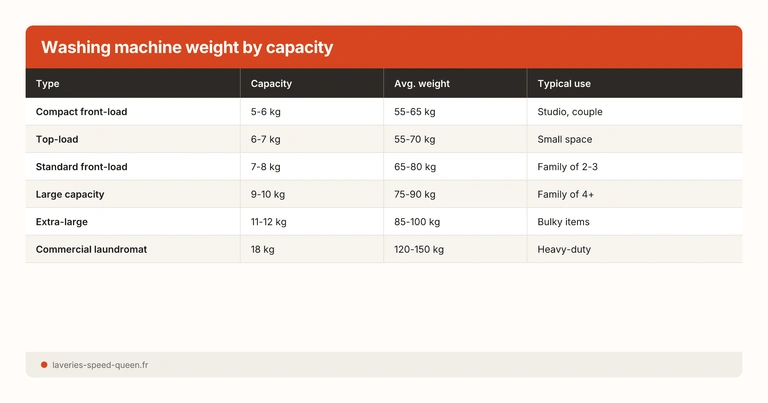
In short: a domestic washing machine weighs between 55 and 95 kg depending on capacity and loading type. Compact models (5 kg) come in at around 55-65 kg, standard front-loaders (7-8 kg) between 65-80 kg, and large capacity (10-12 kg) between 80-95 kg. Commercial laundromat machines reach 120-150 kg — a deliberate choice for maximum stability and durability.
At a Glance
Compact 5 kg: 55-65 kg -- the lightest, suited to small spaces.
Standard front-loader 7-8 kg: 65-80 kg -- the most common format.
Large capacity 10-12 kg: 80-95 kg -- for families or bulky laundry.
Commercial 18 kg: 120-150 kg -- built for 25+ years of intensive use in laundromats.
Weight Table by Capacity and Loading Type
A washing machine’s weight varies mainly by two factors: drum capacity and loading type. Front-loaders are generally heavier than top-loaders at the same capacity, because their door and drum structure differs.
| Type | Laundry capacity | Average weight | Typical use |
|---|---|---|---|
| Compact front-loader | 5-6 kg | 55-65 kg | Studio, couple |
| Top-loader | 6-7 kg | 55-70 kg | Small space, one person |
| Standard front-loader | 7-8 kg | 65-80 kg | Family of 2-3 |
| Large-capacity front-loader | 9-10 kg | 75-90 kg | Family of 4+ |
| Extra-large front-loader | 11-12 kg | 85-100 kg | Large family, bulky items |
| Washer-dryer | 8-10 kg wash / 5-6 kg dry | 70-90 kg | 2-in-1, limited space |
| Commercial laundromat | 9 kg | approx. 115 kg | Self-service laundromat |
| Commercial laundromat | 11-14 kg | approx. 140 kg | Self-service laundromat |
| Commercial laundromat | 18-27 kg | 150-300 kg | Laundromat, hotel, institutional |
These figures are approximate
The exact weight depends on the model, brand and generation. Always check the manufacturer’s technical spec for the precise net weight. The ranges above cover the majority of models sold in 2026.
Weight by Capacity: Empty, Loaded and Running
The weight on the spec sheet is the net weight (empty machine, no water or laundry). When the machine is running, it is considerably heavier: add the cycle water (15-60 litres depending on capacity and programme) and the wet laundry.
| Laundry capacity | Machine empty | Loaded (dry laundry) | Running (water + laundry) |
|---|---|---|---|
| 5 kg | 55-65 kg | 60-70 kg | 80-95 kg |
| 7 kg | 60-75 kg | 67-82 kg | 95-115 kg |
| 8 kg | 65-80 kg | 73-88 kg | 100-120 kg |
| 10 kg | 75-90 kg | 85-100 kg | 115-140 kg |
| 12 kg | 85-100 kg | 97-112 kg | 130-160 kg |
| 18 kg (commercial) | 120-150 kg | 138-168 kg | 180-220 kg |
How to read this table: the running weight is the sum of machine weight + wet laundry weight (about 1.5-2 times the dry weight) + the water filling the drum. This total weight is what loads the floor during the wash cycle. During spin, dynamic forces (vibrations) add to this, but the static total remains the same.
Why Machine Weight Matters
The weight of a washing machine is not just a transport question. It has real consequences for installation, stability and the appliance’s lifespan.
Stability and Spin Vibrations
During spin, the drum turns at 1 000-1 600 rpm. The laundry, imperfectly distributed, creates an imbalance — a centrifugal force pushing the machine in one direction. The counterweights and chassis weight resist this force. The heavier the machine, the better it resists: less vibration, less movement, less noise.
A machine too light for its spin capacity can shift several centimetres per cycle, knock against the wall or adjacent furniture, and prematurely wear out its dampers and bearings. This is why the cheapest (and lightest) machines are also the ones that break down fastest.
Internal Component Lifespan
The drum bearings, dampers and suspension springs absorb mechanical stress at every spin. A heavier machine (with adequate counterweights) reduces the amplitude of vibrations transmitted to these components. Result: bearings last longer, suspension wears out more slowly, and the machine lasts 10-15 years instead of 6-8.
Noise Transmission to Neighbours
In a flat, vibrations travel through the floor to the levels below. A heavy, well-ballasted machine on anti-vibration pads transmits far less structural noise than a light machine that vibrates and shifts. This is an often underestimated factor at the time of purchase.
Moving and Transport
The flip side: a heavier machine is harder to move. An 80 kg washer needs two people and a trolley. A 150 kg commercial model requires a pallet truck or professional movers. If you move frequently, weight is a practical factor to consider — even though stability takes priority for daily use.
Why Washing Machines Weigh So Much
A washing machine’s weight does not come from the drum or the laundry — it comes from the counterweights, chassis and motor. Three components account for most of the mass.
Counterweights (15-25 kg)
Concrete or cast-iron blocks attached around the drum absorb vibrations during spin. The faster the spin (1 000-1 600 rpm), the heavier the counterweights need to be. This is the single heaviest component in the machine.
Drum and tub
A stainless steel drum weighs more than a plastic one but resists corrosion and impacts better. The outer tub (stainless or composite) adds another 5-15 kg. Commercial machines use stainless steel exclusively.
Chassis and motor
The metal frame provides structural rigidity. Classic induction motors weigh more than modern brushless ones, but sometimes offer more torque at low speed -- an advantage for heavy loads like duvets.
Heavier = More Stable: By Design
Manufacturers add weight deliberately. A lighter washing machine is cheaper to produce and ship, but it vibrates more, shifts during spin, makes more noise and wears out its bearings faster.
This is especially visible in commercial machines. Laundromat machines weigh 120-150 kg for an 18 kg capacity unit — nearly double a comparable domestic model. This extra weight is not a drawback: it is an engineering choice. A heavier chassis with commercial-grade suspension absorbs vibrations from bulky loads (duvets, large quantities of sheets) without moving a millimetre, even after 25 years of intensive use.
| Criterion | Domestic (8 kg) | Commercial (18 kg) |
|---|---|---|
| Machine weight | 65-80 kg | 120-150 kg |
| Drum | Stainless or composite | Full stainless steel |
| Counterweights | Concrete (approx. 15 kg) | Reinforced concrete + bolted chassis |
| Designed lifespan | 8-12 years | 25+ years |
| Spin stability | Adequate (slight movement possible) | Perfect (no movement even under heavy load) |
Practical Situations
Installing a Machine on an Upper Floor or in a Flat
A standard concrete or tiled floor supports any domestic washing machine without issue. Building regulations set residential floor load limits at 150 kg/sq m minimum. A machine of 80 kg occupying roughly 0.4 sq m (60 x 65 cm) is well within this limit.
Caution on old timber floors: joists weakened by moisture or woodworm may be a concern. In that case, place the machine on a rigid anti-vibration base that distributes the weight, or have the structure inspected.
Moving a Washing Machine
Lock the drum
Fit the transit bolts BEFORE any move. They stop the drum from hitting the tub during transport. Lost them? Buy replacements -- they are essential.
Drain completely
Run a spin cycle, unplug, empty the pump filter, then tilt the machine slightly to evacuate residual water. An undrained machine is 5-10 kg heavier and risks leaking.
Use a trolley
Above 60 kg, a sack trolley is essential. Always move with two people minimum. Never carry a machine solo -- the risk of back injury is real.
Measure doorways
Check the width of doors, corridors and stairwells BEFORE moving. A standard front-loader is 60 cm wide -- it fits through most standard doors (83 cm) but not always with room to manoeuvre.
Washing Machine in a Flat: Floor Considerations
Installing a washing machine in a flat, especially on an upper floor, raises legitimate questions about floor load capacity. Here is what you need to know.
Floor Loading: The Numbers
Building regulations set residential floor loads at 150 kg/sq m minimum (250 kg/sq m for balconies). A standard front-loader occupies roughly 0.36 sq m (60 x 60 cm). When running, it weighs up to 120-140 kg (machine + water + laundry), giving a floor load of about 330-390 kg/sq m on its direct footprint.
But the load is not concentrated on a single point: it spreads across the surrounding joists or load-bearing slab. In practice, any reinforced concrete floor (the vast majority of post-1960 buildings) handles any domestic washing machine without a second thought. The question only arises for old timber floors (pre-1950) or lightweight mezzanines.
Anti-Vibration Pads and Stands
Rubber anti-vibration pads (GBP 10-30 for a set of 4) serve two functions:
- Acoustic isolation: they reduce the transmission of spin vibrations through the floor, limiting noise for downstairs neighbours.
- Load distribution: full-plate models (one base rather than 4 pads) spread the weight over a larger area, reducing point pressure on the floor.
On a timber floor, a rigid anti-vibration base (metal plate or 2 cm marine plywood) is the best option: it distributes weight and stiffens the machine’s footing.
Loft Conversions and Mezzanines
Converted lofts and mezzanines have lighter floors (often 100 kg/sq m only). Installing an 80 kg washing machine on a timber mezzanine is risky — spin vibrations add significant dynamic forces. Have the structure inspected by a professional before installation.
Laundromat vs Domestic Machine Weight
Commercial laundromat machines weigh significantly more than their domestic equivalents, and this extra weight is entirely intentional.
Why Laundromat Machines Are Heavier
A laundromat machine must withstand 15-30 cycles per day, 365 days a year, for 25 years. Every component is sized accordingly: bolted steel chassis (no plastic), reinforced counterweights, solid stainless steel drum, industrial bearings, commercial suspension. All this mechanical weight absorbs vibrations from every type of load — from a bag of light clothes to a 3 kg feather duvet.
Weight as a Quality Indicator
As a general rule, the weight-to-capacity ratio of a machine is a good indicator of its robustness:
- Budget domestic: 7-8 kg of machine weight per kg of capacity (e.g. 56 kg for 7 kg capacity)
- Mid-range/premium domestic: 8-10 kg per kg of capacity (e.g. 75 kg for 8 kg capacity)
- Commercial laundromat: 7-8 kg per kg of capacity (e.g. 140 kg for 18 kg capacity)
Commercial machines maintain a comparable ratio despite much higher capacity, thanks to structural optimisation. A low ratio on a large-capacity domestic machine (10-12 kg) signals that the manufacturer has skimped on counterweights — expect more vibration and a shorter lifespan.
Common Mistakes
- Choosing a machine purely on light weight -- too-low weight often means insufficient counterweights and more spin vibration.
- Moving a machine without locking the drum -- an unlocked drum bangs against the tub during transport and can break the suspension or heating element.
- Carrying a machine solo -- even 55 kg in a low position is a back injury risk. Always two people, with a trolley if possible.
- Ignoring the level after installation -- a poorly levelled machine vibrates more and wears out faster regardless of its weight. The adjustable feet are there for a reason.
- Confusing machine weight with laundry capacity -- an 80 kg washing machine (machine weight) with 8 kg capacity holds 8 kg of dry laundry, not 80 kg.
Method and Sources
This article covers the physical weight of the washing machine appliance, not laundry weight. Weight ranges are approximate, drawn from spec sheets of major manufacturers (Bosch, Samsung, LG, Miele, Speed Queen) and retailer data. Commercial weights are from Speed Queen technical documentation.
Sources and References
- Building regulations — residential floor loads: 150 kg/sq m minimum
- Speed Queen, Technical documentation SC range, commercial washing machine product sheets
- Consumer testing organisations, Washing machine buying guide, consulted March 2026
As an Amazon Associate, we earn a small commission on purchases made through the affiliate links in this article — at no extra cost to you. This helps us maintain the site and produce free guides.
Machine weight, sorted. To find out how much laundry you can fit inside, check our complete laundry weight guide. And if you need a machine that handles duvets, sheets and bulky items without vibrating, our laundromats are equipped with 18 kg commercial machines.