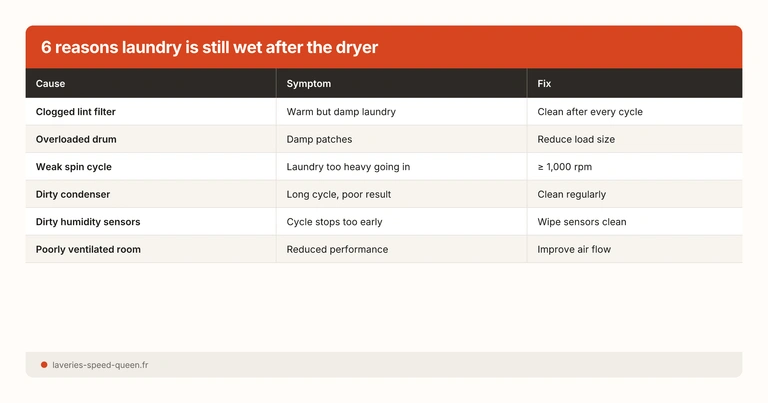
In short: if laundry comes out of the dryer still damp, it is not always a fault. In most cases, start by checking the filter, the programme, the load, the upstream spin and the airflow. Newer models can also be misled by dirty humidity sensors.
Quick Diagnosis
Filter and condenser -- first thing to check, because poor airflow means poor drying.
Load and sorting -- a badly composed load comes out damp even without a fault.
Spin before drying -- the dryer is not there to remove litres of liquid water.
Humidity sensors -- on modern machines, they can cut the cycle short if dirty.
Room and ventilation -- a poorly ventilated machine dries less effectively.
Before Suspecting a Fault, Ask This Question
Does the laundry come out warm but still damp, or cold and virtually unchanged? The distinction matters:
warm but damp= usage, load, programme or airflow issue in most cases;cold and damp= more suspicious — possible heating failure or premature cut-off;mostly dry except thick patches= sorting or load distribution to review.
Many guides stop at “clean the filter”. That is useful but insufficient. The real diagnosis often lies in the complete chain: washing, spinning, sorting, programme choice, airflow and sensors.
Start by Identifying Your Dryer Type
Not all dryers react the same way. A heat pump model may feel less “hot” at the end than an older resistance model without actually being faulty.
| Dryer type | What is normal | Watch point |
|---|---|---|
| Heat pump | Longer cycles and gentler air | Cold room or dirty condenser = rapid efficiency drop |
| Condenser | Stronger heat, water tank to monitor | Full condenser or tank = laundry still damp |
| Vented | Good power if exhaust vents properly | Kinked, blocked or over-long vent hose = poor drying |
Cause 1: The Filter, Condenser or Airflow Is Obstructing Drying
A tumble dryer dries thanks to three things: heat, air and moisture evacuation. If the air cannot circulate, the machine heats up but dries poorly.
Lint filter
The first thing to check. If it is loaded with fibres, air flows poorly and laundry dries more slowly.
Condenser
On applicable models, a clogged condenser sharply reduces drying efficiency.
Water tank
On a condenser dryer, a full reservoir can disrupt or interrupt the cycle.
Machine ventilation
A machine wedged into a poorly ventilated space or with blocked grilles is working in bad conditions.
Electrolux and Candy agree on this point: poor drying is explained first by routine maintenance and airflow, before concluding it is an internal fault.
Cause 2: The Load Is Wrong, Even If It “Fits”
An over-full drum dries poorly, but a badly composed drum also does. This is the most common cause when the machine seems to be working normally.
| Mistake | What happens | Typical result |
|---|---|---|
| Overloaded drum | Hot air circulates poorly | Laundry in a ball, damp and creased |
| Load too small | Some sensors misread humidity | Cycle that ends too early |
| Mixed thicknesses | T-shirts dry before jeans or towels | Thick areas still wet |
| Knotted sheets or duvet covers | Moisture stays trapped | Outside dry, inside damp |
The misleading mix
Putting thin t-shirts and heavy jeans together often makes it look like the machine dries poorly, when in fact it stops as soon as the thin pieces are ready. The thick areas still hold moisture.
Cause 3: The Problem Is the Washing Machine, Not the Dryer
Insufficient spin is a very common false culprit. If laundry enters the dryer soaked or overloaded with water, the dryer must first evaporate that surplus instead of neatly finishing the job.
Check the spin -- poorly spun laundry demands far more dryer time.
Watch out for delicates -- they logically come out of the washer damper.
Do not judge the dryer alone -- if the load comes out very heavy from the wash drum, drying starts at an obvious disadvantage.
In practice, the dryer performs well when it receives properly spun, sorted and distributed laundry. Otherwise, even a good machine seems slow or ineffective.
Cause 4: The Programme Deliberately Leaves Some Moisture
Not all programmes aim for the same result. Some cycles protect the fibre or ease ironing by leaving a slight residual dampness.
Programmes to watch out for:
delicates;iron dry/cupboard dryat a lower setting;syntheticsif the fabric is actually thicker;- residual moisture setting too low.
Electrolux also notes that on humidity-driven programmes, the dryness level selected matters as much as the displayed duration.
The 2 Checks Most People Forget
The selected dryness level -- "iron dry" or an eco mode may intentionally leave more moisture.
The actual load size -- too small or too large, it disrupts drying far more than most people imagine.
Cause 5: Humidity Sensors Can Fool the Machine
On newer dryers, the cycle often stops based on a humidity reading, not just a timer. If the sensors are dirty, the machine may believe the laundry is dry too soon.
The technical point most guides miss
Traces of softener, detergent or limescale on the sensors can disrupt detection. This is one reason a load sometimes comes out still damp even though the machine completed its cycle “normally”.
The right approach:
- locate the metal detection strips if your model has them;
- keep them clean as per the manufacturer’s instructions;
- avoid the build-up of greasy or limescale residue.
Cause 6: The Room or Environment Prevents Good Drying
The dryer does not work in a vacuum. A room that is too cold, too warm or poorly ventilated degrades overall performance.
Electrolux notes that the best results are achieved in a temperate room, citing a practical range around 19-24 °C for optimal efficiency. Candy also stresses adequate air circulation around the appliance.
- Machine enclosed in a cupboard -- hot air stagnates and exhaust degrades.
- Poorly ventilated room -- humidity builds up, especially with condenser models.
- Ambient too cold -- some machines dry less effectively outside their normal operating range.
When Should You Suspect a Real Fault?
Consider a hardware problem if:
- laundry comes out cold cycle after cycle;
- filters are clean but drying time explodes;
- the machine stops abnormally;
- you have already corrected load, programme, spin and routine maintenance without improvement.
In that case, the cause may involve the heating system, internal ventilation or a faulty sensor.
- Burning smell -- stop the machine and do not continue testing.
- Repeated safety cut-offs -- possible overheating or internal fault.
- Unusual noises or water leak -- do not dismantle blindly, get a professional diagnosis.
- Recurring error code -- follow the manual or contact after-sales, not improvised repairs.
Optimising Drying Without Replacing the Machine
Before concluding there is a technical problem, these simple adjustments often significantly improve results without any work on the appliance.
Separate your load into two batches of uniform thickness. Thin t-shirts and thick jeans do not dry at the same rate. Running two short cycles on two uniform loads gives a better result than one long cycle on a mixed load. Total time is often the same, but each item actually comes out dry.
Shake each piece of laundry as you take it from the washing machine before putting it in the dryer. This 2-second gesture per item separates textiles that tangled or knotted during spin. Sheets and duvet covers are the worst offenders — a sheet rolled into a ball dries three times more slowly than an unfolded one.
The Most Useful Diagnostic Method
| Step | Observable symptom | Simple test | What to check | Action without dismantling | Expected result |
|---|---|---|---|---|---|
| 1 | Laundry warm but still damp | Hold the filter to the light and check the tank/condenser | Filter, condenser, tank | Clean then run a short cycle | Better airflow, cleaner drying |
| 2 | Small pieces dry, large still wet | Remove the load and compare thicknesses / knotted areas | Load and sorting | Separate thin, thick, sheets and jeans | More uniform cycle, less residual dampness |
| 3 | Laundry nearly dry but not ready to put away | Re-read the exact programme name and option selected | Programme and dryness level | Switch from a gentle mode to a drier level if the fabric allows | Less dampness at end of cycle without changing the whole method |
| 4 | Laundry very heavy entering the dryer | Compare with a better-spun load | Washing machine spin | Increase spin speed if the fabric allows | Less water to evaporate, faster drying |
| 5 | Cycle ends too early or room poorly ventilated | Clean visible sensors, check space and temperature around | Sensors and environment | Clean, ventilate, leave space around the appliance | More consistent detection and better drying stability |
3-Question Shortcut Diagnosis
If you do not have time for the full diagnostic table, answer these three questions in order. They cover the most common causes and point to the right action in under a minute.
Question 1: Does the laundry come out warm or cold?
- Warm — the machine is heating correctly. The problem is the load, programme or airflow. Go to question 2.
- Cold — the machine is not heating or the cycle is cutting off early. Check the filter and condenser. If everything is clean, suspect a heating element or sensor fault — call a technician.
Question 2: Is all the laundry damp, or only certain items?
- All damp — the filter is probably clogged (blocked air), the load is too large, or the programme is too gentle for the fabric. Clean the filter and rerun an appropriate cycle.
- Only thick items are damp (jeans, towels, bundled sheets) — this is a sorting problem. Thin items dry before thick ones, and the humidity sensor stops the cycle when the thin pieces are done. Separate loads by thickness.
Question 3: Was the laundry very heavy going into the dryer?
- Yes (heavy, dripping) — the problem is the washing machine, not the dryer. The spin was insufficient. Increase spin speed if the fabric allows, or run an extra spin before drying.
- No (normal spin, just damp) — go back to question 1 and check the filter and selected programme.
This shortcut identifies the cause in roughly 80% of cases. If none of the answers fits, work through the detailed diagnostic table above.
At the Laundromat: Why the Problem Is Rare
Professional tumble dryers at the laundromat eliminate most of the causes described above. Their heating power and airflow are substantially greater than domestic models, cutting drying time to 20-30 minutes for a standard load. The larger drum allows better tumbling, even with mixed loads (thin t-shirts and thick jeans).
Filters are cleaned regularly by the operator, the condenser is professionally maintained, and machine ventilation is not constrained by a cupboard or a poorly aired room. Drying is also sold in timed increments, letting you adjust to the actual need: if the laundry is still slightly damp after the first increment, add 10 more minutes instead of restarting a full cycle.
For loads that cause problems at home — thick duvets, bath towels, heavy jeans — the professional dryer is often the only solution that delivers completely dry laundry in a reasonable time.
Method and Sources
This article cross-references manufacturer and support service recommendations with real-world laundry load observations: airflow, residual moisture, sorting by thickness and sensor logic. The goal is not to push towards an expensive repair, but to isolate what is down to usage, maintenance or a genuine machine defect.
- Electrolux, Poor drying results and laundry still damp after drying, published 12 September 2024, accessed 15 March 2026
- Candy, Why is my tumble dryer not drying?, published 16 July 2025, accessed 15 March 2026
As an Amazon Associate, we earn a small commission on purchases made through the affiliate links in this article — at no extra cost to you. This helps us maintain the site and produce free guides.
If your laundry stays damp despite a correct cycle, work through this diagnostic. For loads that dry poorly at home, professional tumble dryers at the laundromat deliver completely dry results in 20-30 minutes.