In short: the laundromat is the ideal solution for washing pet blankets and beds — 18 kg machines, a 60 C cycle to kill fleas and dust mites, and a commercial tumble dryer for thorough drying. Vacuum the hair BEFORE washing, use fragrance-free detergent, never mix with human laundry, and wash at least every 2 weeks.
At a Glance
Vacuum hair BEFORE washing -- the single most important step for a clean result.
60 C to kill fleas, dust mites and larvae -- check the care label first.
Do NOT mix with human laundry -- wash pet items separately.
Thorough drying is mandatory -- parasites and mould thrive in damp conditions.
Why the Laundromat Is the Best Option for Pet Laundry
Pet textiles present three challenges that a home washing machine handles poorly:
Volume
A large dog blanket, an XL removable pet bed, a sofa throw covered in hair — these items are often too bulky for a domestic 7-8 kg machine. Forcing them into a small drum means inadequate tumbling and a rinse cycle that cannot flush out the hair properly.
At a laundromat, 18 kg machines easily accommodate these large items with enough space for an effective wash. It is the same reason you would wash duvets at a laundromat — the available volume changes everything. See our article on washing duvets for the same principles applied to bedding.
Temperature
Your home machine on an eco cycle may not actually reach 60 C for long enough. Yet 60 C is the temperature needed to kill adult fleas, larvae, eggs and dust mites. Commercial machines at a laundromat reliably reach the displayed temperature on the standard cycle. See our washing temperature guide to understand the difference between eco and standard cycles.
Spin and Drying
Pet blankets are thick and retain a lot of water. Insufficient spin followed by incomplete drying creates the perfect conditions for mould and odours. The commercial tumble dryer at a laundromat solves this in 30-40 minutes — impossible to replicate with an airer or a small domestic dryer.
The Honest Take
A small cotton cat blanket washes perfectly well in a home machine at 60 C. The laundromat becomes truly essential when the volume increases: large blankets, bed covers, thick throws. The smart approach is to match the machine capacity to the size of the item, not to take everything to the laundromat by default.
The Critical Step: Vacuum the Hair BEFORE Washing
This is the most important rule in the entire article. Never put a hair-covered textile straight into a machine — not at home, not at a laundromat.
Why It Is Essential
Once wet, pet hair:
- Clumps together in packets that stick to fibres instead of coming loose.
- Clogs the drain filter of the machine, reducing rinse quality.
- Redeposits on the fabric during the cycle, partially undoing the wash.
- Wears on the machine over time by building up in the plumbing.
How to Vacuum Effectively
- Lay out the blanket or bed cover flat on the floor.
- Vacuum both sides, focusing on the sleeping zones (where the animal lies most).
- Follow up with a damp rubber glove or brush to pick up embedded hair that the vacuum missed.
- If the item is heavily loaded, a 10-minute run in the tumble dryer on a cool setting (no wash) before the real cycle shakes hair loose effectively — this is the dry-wash-dry method described in our guide to removing pet hair from laundry.
- NEVER skip the vacuuming step -- it is the difference between a clean result and a textile still covered in hair when it comes out.
- Do not use a lint roller on large blankets -- it is too slow and uses too many sheets. A vacuum cleaner is far more efficient on large surfaces.
- Check pockets and folds -- forgotten kibble, chew bones and toys caught in the creases can jam the machine.
The 60 C Wash: Killing Fleas, Dust Mites and Bacteria
Why 60 C Is the Right Temperature
Pet textiles harbour a varied microscopic population:
- Fleas: adults, larvae and eggs survive at 40 C but are destroyed at 60 C.
- Dust mites: both household dust mites and animal-specific mites do not survive 60 C.
- Bacteria: Staphylococcus, E. coli and other bacteria accumulated through contact with skin, saliva and the animal’s secretions are eliminated at this temperature.
- Parasite larvae: certain intestinal parasites disperse microscopic eggs that contaminate textiles. Washing at 60 C destroys them.
For textiles that cannot withstand 60 C, see our guide on washing at 60 C for alternatives. For severe flea infestations, our article on bed bugs and laundry applies the same heat protocol with additional precautions.
The Right Cycle at the Laundromat
At the laundromat, select the standard cotton cycle at 60 C (not the eco cycle). The standard cycle maintains the temperature throughout the wash phase, which guarantees parasite elimination. The eco cycle may not reach the displayed temperature for long enough.
Which Detergent to Use
Regular detergent is fine. However, two specific recommendations for pet laundry:
- Choose a fragrance-free or hypoallergenic detergent. Animals have more sensitive skin than ours — synthetic fragrances can cause itching, redness or skin irritation, especially in breeds with sensitive skin (French bulldog, Shar-Pei, Sphynx cat).
- Do not add fabric softener. It leaves a film on fibres that reduces the fabric’s absorbency and can irritate the animal’s skin. If the textile feels stiff after drying, half a glass of white vinegar↗ in the softener compartment is a natural, animal-safe alternative.
Item-by-Item Practical Guide
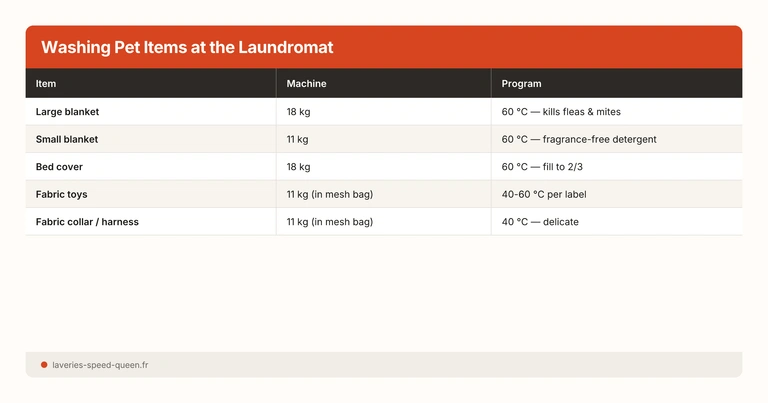
Sleeping Blanket (Cotton, Polyester, Fleece)
Pre-vacuum
Vacuum both sides, then use a damp rubber glove for embedded hair. Fleece blankets are particularly good at trapping hair.
18 kg Machine at the Laundromat
For medium to large blankets. The 11 kg machine is sufficient for small cat blankets. The drum should be no more than two-thirds full.
60 C Standard Cycle
Cotton and polyester handle 60 C. Fleece generally tolerates only 40 C -- check the care label. If 60 C is not possible, add sodium percarbonate to the wash.
Thorough Drying
The commercial tumble dryer is ideal. Fleece blankets dry quickly. Thick cotton blankets need a longer cycle -- check the centre before folding.
Removable Pet Bed
Most modern dog and cat beds have a removable, washable cover. This is the most hygienic approach.
- Remove the cover and turn it inside out to expose the inner surface.
- Vacuum the foam or padding underneath (if it is not washable, shake it outdoors and let it air in the sun).
- Wash the cover at 60 C in the machine, just like a blanket.
- Dry completely before reassembling the bed.
If the bed does not have a removable cover and the entire unit is machine-washable, use an 18 kg machine at the laundromat for enough space.
Fabric Collar and Harness
Fabric collars and harnesses (nylon, polyester) accumulate sweat, sebum, hair and dirt. They wash easily:
- By hand: soak for 30 minutes in a basin of hot water with a dose of detergent, scrub, rinse and dry completely.
- In a machine: place them in a mesh laundry bag to protect buckles and clips. Wash at 40-60 C depending on the material. Air dry (metal parts can rust in the tumble dryer).
Fabric Toys
Plush and fabric toys accumulate saliva, oral bacteria and sometimes treat residue. Wash them regularly:
- Check the care label: most fabric toys are machine-washable at 40-60 C.
- Place them in a mesh laundry bag↗ to prevent seams from splitting in the drum.
- Remove squeakers and detachable parts if possible before washing.
- Dry completely — a toy that is still damp inside develops mould rapidly.
For plush-type toys, see our guide to washing stuffed animals for detailed precautions.
Feeding Mats and Fabric Bowls
Snuffle mats and fabric bowls wash at 60 C in the machine. Remove food residue and rinse with water before washing. Thorough drying is especially important here, as damp food residue breeds bacteria.
The Separation Rule
Never mix your pet’s laundry with your personal laundry.
This rule is sometimes questioned — after all, a 60 C wash kills parasites and bacteria regardless of what is in the drum. But there are practical reasons to maintain the separation:
- Hair: even after vacuuming, some hair remains. If you mix a dog blanket with your shirts, the hair migrates.
- Parasites: in the event of undetected fleas, separation limits the risk of cross-contamination.
- Odour: pet laundry has a distinct smell that can transfer to clothing.
- Consideration for others: at a laundromat, it is also a matter of courtesy towards the next user.
Drying: The Step Everyone Skimps On
A poorly dried pet textile is worse than a dirty one. Residual moisture creates perfect conditions for:
- Dust mite proliferation (they need moisture to survive).
- Mould growth within the thickness of the fabric.
- Musty odours that settle into the fibres.
- Parasite survival among any that withstood the wash.
The Commercial Tumble Dryer: The Solution
At a laundromat, the commercial tumble dryer dries a large dog blanket in 30 to 40 minutes. The heat of the cycle adds an anti-parasitic effect on top of the wash. The lint filter captures residual hair.
Check the centre of the blanket before removing it from the dryer. That is the thickest area and the last to dry. If it still feels damp to the touch, run another 10-15-minute cycle.
If You Air Dry
Spread the item flat or hang it on a line with good air circulation. Outdoor drying in the sun is a good option — UV light has a mild antimicrobial effect. But do not bring the textile back in until it is completely dry through its entire thickness. See our article on outdoor drying for best practices.
Recommended Washing Frequency
| Item | Minimum Frequency | If Outdoor Pet or Shedding Season |
|---|---|---|
| Sleeping blanket | Every 2 weeks | Every week |
| Bed cover | Every 2 weeks | Every week |
| Sofa throw (dedicated to pet) | Every week | Twice a week |
| Fabric toys | 1-2 times a month | Every week |
| Fabric collar/harness | Once a month | Every 2 weeks |
| Snuffle mat | After every use | After every use |
The Organisation Tip
Set a fixed day of the week or month for washing your pet’s items. Sunday morning at the laundromat, for example: you handle all blankets, covers and toys in a single session using the large-capacity machines. It is more efficient than washing them piecemeal at home.
Mistakes to Avoid
- Putting a hair-covered blanket straight in the machine -- vacuuming first is mandatory, not optional.
- Washing at 40 C thinking it is enough -- fleas and their eggs survive at 40 C. You need 60 C.
- Using fabric softener -- it irritates pet skin and reduces fabric absorbency.
- Mixing pet and human laundry -- hair, odours and parasites transfer between items.
- Putting a still-damp blanket back in the bed -- that is the fastest way to develop mould and bad odours.
- Waiting more than a month between washes -- parasites and bacteria accumulate quickly.
Where This Article Ends
This article covers pet textiles. For dealing with pet hair on human clothing, see our article on removing pet hair from laundry. For severe flea infestations, our guide on bed bugs and laundry at a laundromat details a reinforced heat protocol. If your problem is more about machine size, see our first time at a laundromat guide for choosing the right capacity.
Methodology and Sources
- ESCCAP (European Scientific Counsel Companion Animal Parasites), Recommendations for parasite control in companion animals, 2024, accessed 20 March 2026
- Companion Animal Parasite Council, Flea control recommendations, 2025, accessed 20 March 2026
- PetMD, How to wash dog beds and blankets, accessed 20 March 2026
Sources and References
- ESCCAP - Parasite control recommendations (lien externe)
- Removing pet hair from laundry
- Bed bugs and laundry at a laundromat
- Washing a duvet
- Washing temperature guide
- Washing at 60 C: which clothes
- Washing stuffed animals
- First time at a laundromat
- Tumble dryer guide
- Outdoor drying
As an Amazon Partner, we earn a small commission on purchases made via the affiliate links in this article — at no extra cost to you. This helps us maintain this site and produce free guides.
To wash your pet’s blankets and beds in 18 kg machines with a 60 C cycle and commercial drying, visit our laundromats in Blagnac, Croix-Daurade and Montaudran. Vacuum the hair before you come, and leave with completely dry, parasite-free laundry in under an hour. Payment contactless card or cash.