In short: the quick programme (15-30 min) is sufficient for lightly worn laundry, stain-free, loaded at 50 % of the drum. It saves 30-50 % energy. For dirty, stained or sweaty laundry, only a standard cycle (40-60 min) guarantees a proper result. Used wrongly, the express cycle forces a rewash — zero savings, double consumption.
How a quick programme works
A quick programme is not a normal cycle “on fast forward”. The machine alters several parameters to shorten overall duration, and each adjustment has consequences on the result.
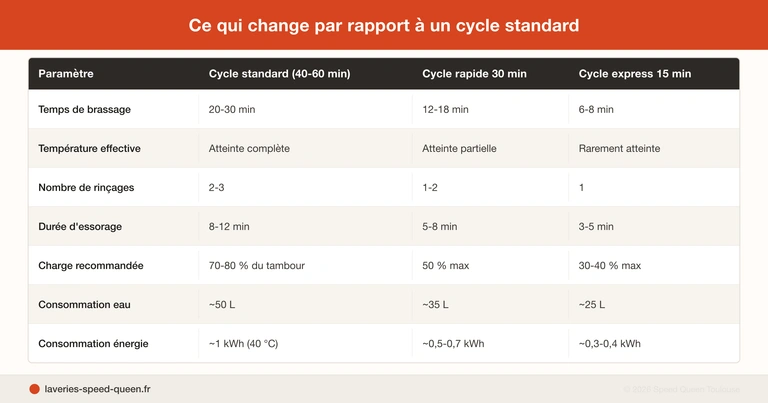
What changes compared with a standard cycle
| Parameter | Standard cycle (40-60 min) | Quick cycle 30 min | Express cycle 15 min |
|---|---|---|---|
| Agitation time | 20-30 min | 12-18 min | 6-8 min |
| Effective temperature | Fully reached | Partially reached | Rarely reached |
| Number of rinses | 2-3 | 1-2 | 1 |
| Spin duration | 8-12 min | 5-8 min | 3-5 min |
| Recommended load | 70-80 % of drum | 50 % max | 30-40 % max |
| Water consumption | ~50 L | ~35 L | ~25 L |
| Energy consumption | ~1 kWh (40 °C) | ~0.5-0.7 kWh | ~0.3-0.4 kWh |
Agitation time is the most critical variable. It is during this phase that detergent acts on fibres, that dirt loosens and disperses in the water. Halving or thirding this time mechanically reduces wash effectiveness.
The temperature myth
Many people select 40 °C or 60 °C on a quick cycle, thinking they can compensate for reduced time with heat. In reality, on a 15-minute cycle the water often does not have time to reach the selected temperature. The heating element warms the water gradually — reaching 60 °C takes about 15-20 minutes depending on the machine. On an express cycle, the machine begins agitating before hitting the thermal target.
Result: you spend energy on heating, but the laundry is not washed at the displayed temperature. Stay at 30 °C on a quick cycle — it is the only realistic temperature.
When the quick programme is enough
Clothes worn for one day
A t-shirt, shirt or trousers worn for one office day without heavy perspiration. Light odour, no visible stain.
Indoor clothes
Pyjamas, house sweats, remote-work clothes worn for 1-2 days. Indoor laundry is less exposed to outside grime.
Refresh between washes
A jumper or pair of jeans worn briefly but stored creased. The quick cycle removes the musty smell and partially de-wrinkles.
Travel laundry
Refreshing a few items worn on a trip. Ideal for getting a clean garment back quickly without waiting for a full cycle.
The deciding criterion: the smell-and-stain test
The rule is simple. Smell the garment and inspect it visually:
- No odour + no stain = 30-min quick programme suitable
- Light odour + no stain = 30-min quick programme, half load, 30 °C
- Noticeable odour OR visible stain = standard cycle required
- Ingrained stain = pre-treatment + standard cycle
When the quick programme is NOT enough
- Sweaty sportswear -- the bacteria behind odours need prolonged contact with detergent and a temperature of at least 30-40 °C on a long cycle. See our sportswear guide.
- Sheets and towels -- these textiles accumulate sweat, sebum, dead skin and bacteria. A 60 °C cycle of 40-60 minutes is the minimum for proper hygiene. Sheet guide.
- Stained laundry -- no quick programme will tackle a sauce, grease or blood stain. Pre-soak or pre-wash followed by a standard cycle is needed.
- Baby laundry -- baby laundry hygiene demands a full wash at 40-60 °C with a double rinse. Baby laundry guide.
- Workwear -- overalls, kitchen uniforms, clothes exposed to dust, grease or chemicals. Workwear guide.
- Drum more than 50 % full -- even lightly soiled laundry will be poorly washed in an overfull drum on a short cycle.
Energy and cost comparison: quick vs standard
The main argument for the quick programme is energy savings. Is it really significant?
| Programme | Duration | Energy consumption | Water consumption | Estimated cost per cycle |
|---|---|---|---|---|
| Express 15 min (30 °C) | 15 min | 0.3-0.4 kWh | ~25 L | ~EUR 0.10 |
| Quick 30 min (30 °C) | 30 min | 0.5-0.7 kWh | ~35 L | ~EUR 0.15 |
| Standard 40 °C | 45-60 min | 0.8-1.0 kWh | ~50 L | ~EUR 0.25 |
| Standard 60 °C | 50-70 min | 1.2-1.5 kWh | ~50 L | ~EUR 0.35 |
| Eco 40 °C | 2 h 30 - 3 h | 0.5-0.7 kWh | ~40 L | ~EUR 0.15 |
Quick vs Eco: the paradox
The eco programme uses as much energy as the quick programme, but delivers a far superior wash result. How? It compensates for low temperature with very long agitation (2.5-3 h). Detergent acts longer at low temperature — a scientifically more effective approach than cutting time.
If your priority is energy savings and a good result, the eco programme is often a better choice than the quick programme. If your priority is time, the quick programme wins — provided the laundry is lightly soiled.
For a full consumption analysis, see our guide on washing machine water and electricity consumption.
The real savings of the quick programme
Over a year, a household that uses the quick programme twice a week instead of a standard 40 °C cycle saves about 25-35 kWh and 1,500 L of water, or EUR 10-15 per year. Modest but real. The savings vanish if you have to rewash every other load. For more, see our energy-saving laundry guide.
Optimising the quick programme
Load to 50 % max -- the most important rule. An overfull drum cancels all the benefits of the quick cycle.
Stay at 30 °C -- the only realistic temperature on a short cycle. Going higher wastes energy with no result.
Use liquid detergent -- it dissolves instantly, unlike powder which needs agitation time to disperse.
Turn clothes inside out -- improves detergent contact with sweat zones (armpits, collar).
Dry immediately after -- the reduced spin of the quick cycle leaves laundry damper. Do not leave it bundled in the drum.
Do not mix soiling levels -- one heavily soiled garment in a "quick" load will transfer its dirt to the clean items without being cleaned itself.
Quick programme and delicate textiles
Contrary to a common belief, the quick programme can benefit certain delicate textiles precisely because it reduces mechanical stress.
When it is a good idea
- Lightly worn silk and satin: a quick cold cycle (20-30 °C) refreshes without risk of prolonged friction. See our guide on washing satin and silk.
- Lightly soiled fine wool: short agitation at cold is preferable to a long cycle that risks felting. See washing a wool jumper.
- Lingerie: bra cups and lace suffer less deformation in a short cycle. Place in a laundry bag.
When it is a bad idea
Heavily soiled delicate textiles (make-up stain on silk, perspiration on wool) need a dedicated “delicates” cycle of 40-60 minutes — not a quick cycle. The delicates programme adjusts spin speed and agitation, which the quick programme does not. See our delicate textiles guide to choose the right programme.
Common mistakes with the quick programme
- Loading to full -- trap number one. A quick cycle with a full drum = laundry barely dampened at the centre. Detergent does not have time to penetrate.
- Selecting 60 °C on 15 min -- the water does not reach that temperature. You pay for heating without the thermal benefit.
- Using powder detergent -- it dissolves poorly in so little time, especially at 30 °C. Powder grains remain in the fibres. Use liquid detergent instead.
- Leaving laundry in the drum after the cycle -- the reduced spin leaves laundry damper. Leaving it bundled promotes odours within hours.
- Hoping to treat a stain -- a quick cycle has zero effect on a stain. Pre-treatment is essential, followed by a standard cycle.
- Washing sheets on quick -- sheets must go through a long 60 °C cycle for proper hygiene. No shortcut.
The 'everything on quick' trap
Some households end up using the quick programme for all their laundry out of habit. This is a hygiene mistake. Sheets, towels and body-worn laundry should go through a standard cycle at 40-60 °C at least once a week. A quick cycle does not reach high enough temperature or agitate long enough to eliminate bacteria, dust mites and sweat residue. See our washing frequency guide.
As an Amazon Associate, we earn a small commission on purchases made via the affiliate links in this article — at no extra cost to you. This helps us maintain this site and produce free guides.
Need a fast, effective wash in Toulouse or Blagnac? Our laundromats in Blagnac, Croix-Daurade and Montaudran feature professional Speed Queen machines with optimised programmes — detergent and softener included, automatically dosed. Payment CB sans contact ou espèces. See our prices.
Sources and references
- Washing machine water and electricity consumption
- Washing machine programme guide
- Energy-saving laundry guide
- Wash temperature guide
- Washing frequency guide
- Sportswear care
- Pre-soak and pre-wash: when and how
- Delicate textiles guide
- Detergent dosing in the machine
- ADEME — Practical guide to household energy management (lien externe)