In short: a 90 °C wash kills 99.9 % of bacteria, viruses and dust mites. It is necessary after an infectious illness, for bed bugs, mould or professional hygiene. Only white cotton and white linen can withstand it. For routine hygiene, a 60 °C wash is enough. A 90 °C cycle uses 3-5 times more energy than 30 °C — reserve it for situations that justify it.
At a glance
Thermal disinfection -- 90 °C denatures bacterial proteins. Effective on 99.9 % of domestic micro-organisms.
Indications -- after illness, bed bugs, mould, professional hygiene. Not for everyday laundry.
Compatible textiles -- white cotton, white linen, towels, white terry towels. Nothing else.
Alternative -- 60 °C + textile disinfectant (percarbonate) for most hygiene situations.
Machine maintenance -- one empty 90 °C cycle per month eliminates biofilm and bad odours.
What 90 °C does
Heat at 90 °C acts as a thermal disinfectant. At this temperature, the structural proteins of micro-organisms denature — they lose their three-dimensional shape and stop functioning. Bacterial cell membranes disintegrate. Viral capsids disassemble. The result is near-total destruction of the microbial load.
What is eliminated at 90 °C
Bacteria (99.9 %)
Including Staphylococcus aureus (skin infections), Escherichia coli (faecal contamination), Salmonella (food), enterococci, Listeria. Most pathogenic bacteria are killed at 60-70 °C -- 90 °C provides a safety margin.
Viruses
Enveloped viruses (flu, coronavirus, RSV) are destroyed from 56 °C. Non-enveloped viruses (norovirus, rotavirus) are more resistant but do not survive 90 °C over a full wash cycle.
Dust mites and parasites
Dust mites (Dermatophagoides) are killed at 60 °C. Bed bugs and their eggs are eliminated at 60 °C held for 30 min. 90 °C offers absolute certainty, even on thick textiles.
Fungi and moulds
Dermatophytes (skin fungi), Candida and moulds (Aspergillus) are eliminated. Spores of some resistant moulds are also destroyed at 90 °C, whereas they can survive at 60 °C.
What resists (or nearly)
Bacterial spores of certain species (Clostridium, Bacillus) are extremely heat-resistant — they can survive 100 °C and above. In practice, these spores pose no sanitary risk in the context of domestic laundry. Complete sterilisation (spore destruction) requires an autoclave at 121 °C for 15 minutes — a procedure reserved for medical settings.
When 90 °C is necessary
A 90 °C wash is not an everyday programme. It is justified in specific situations where the microbial load is high or particularly pathogenic.
After an infectious illness
Gastroenteritis, flu, skin infection (fungal, impetigo, scabies): laundry in contact with the sick person (sheets, towels, underwear, pyjamas) should be washed at 60 °C minimum. 90 °C is recommended for severe cases (norovirus gastroenteritis, MRSA infection) and heavily contaminated laundry (soiled sheets, vomit).
Bed bug infestation
Bed bugs and their eggs are killed by exposure to 60 °C for 30 minutes. A 90 °C cycle guarantees total elimination even in folds and thick layers. Wash all bedding (sheets, duvet covers, pillowcases, mattress protectors) and clothes stored near the bed. Follow with a tumble dry at maximum temperature for 30 minutes.
Mould on laundry
If laundry has developed mould (damp storage, forgotten in the machine), 90 °C destroys fungal spores. First treat mould stains with percarbonate↗, then wash at 90 °C. Spores of certain moulds (Aspergillus niger) resist 60 °C but not 90 °C.
Professional hygiene
Catering, hospitality, nurseries, healthcare: regulations often require high-temperature washing for laundry in contact with the public or food. Professionals using our laundromats benefit from machines suited to these requirements.
Machine maintenance (empty cycle)
An empty cycle (no laundry) at 90 °C once a month dissolves detergent residue, grease deposits and bacterial biofilm that accumulate in the drum, seals and pipes. This maintenance cycle is especially important if you mainly wash at low temperature (30-40 °C). Add 200 ml of white vinegar or 2 tablespoons of percarbonate in the empty drum. Our guide to cleaning your washing machine details the full protocol.
What can go to 90 °C — and what cannot
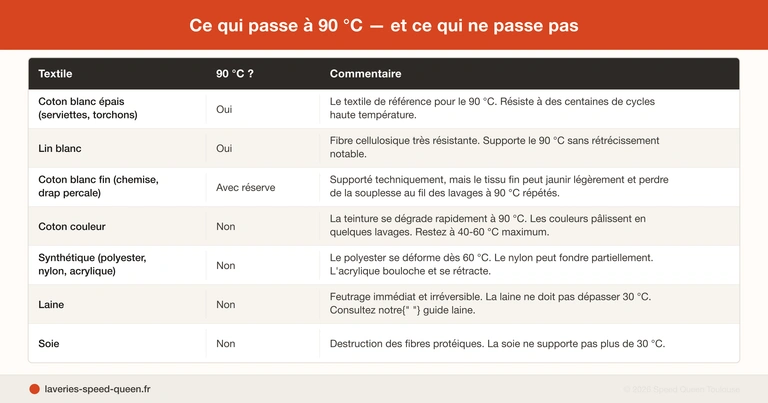
This is the key question. 90 °C is extreme for textile fibres. Only certain materials can handle it.
| Textile | 90 °C? | Comment |
|---|---|---|
| Thick white cotton (towels, tea towels) | Yes | The reference textile for 90 °C. Withstands hundreds of high-temperature cycles. |
| White linen | Yes | Very resistant cellulosic fibre. Handles 90 °C without notable shrinkage. |
| Fine white cotton (shirt, percale sheet) | With reservation | Technically supported, but fine fabric may yellow slightly and lose suppleness over repeated 90 °C washes. |
| Coloured cotton | No | Dye degrades rapidly at 90 °C. Colours fade within a few washes. Stay at 40-60 °C max. |
| Synthetic (polyester, nylon, acrylic) | No | Polyester deforms from 60 °C. Nylon can partially melt. Acrylic pills and shrinks. |
| Wool | No | Instant, irreversible felting. Wool must not exceed 30 °C. See our wool guide. |
| Silk | No | Destruction of protein fibres. Silk cannot take more than 30 °C. |
| Elastane / lycra | No | Elastane permanently loses its stretch above 40 °C. Even 1 % elastane makes the garment incompatible. |
| Viscose / rayon | No | Shrinks and deforms. Maximum 30 °C. |
| Jeans / denim | No | Indigo bleeds heavily at 90 °C. Fabric shrinks. Jeans wash at 30 °C. |
Simple rule: 90 °C = white cotton or white linen
If the garment’s care label does not explicitly state 90 °C or 95 °C, do not wash at 90 °C. When in doubt, stay at 60 °C — that temperature already eliminates the vast majority of bacteria and dust mites. The care label is your guide: see our symbol decoder to identify the maximum allowed temperature.
The alternative: 60 °C + textile disinfectant
For many hygiene situations, 90 °C is not essential. A 60 °C wash combined with a disinfecting agent offers comparable effectiveness while preserving textiles more and using less energy.
Sodium percarbonate
Sodium percarbonate (2Na2CO3-3H2O2) releases hydrogen peroxide from 40 °C. At 60 °C, the release is rapid and effective. Hydrogen peroxide is a powerful oxidiser that destroys bacterial membranes and denatures viral proteins.
Protocol: add 2 tablespoons of percarbonate into the drum (not the detergent drawer), set to 60 °C, cotton programme. Percarbonate is safe for colourfast fabrics at this dose.
When 60 °C is enough
| Situation | 60 °C enough | 90 °C recommended |
|---|---|---|
| Sheets and bedding (routine) | Yes | No |
| Bath towels | Yes | No (unless skin infection) |
| Kitchen towels (normal use) | Yes | No (unless contact with raw meat/fish) |
| Underwear | Yes | No (unless infection) |
| After gastroenteritis | Yes (+ percarbonate) | Yes (if heavily contaminated) |
| Bed bugs | Yes (30 min minimum) | Recommended (safety margin) |
| Mould / damp storage | Partially | Yes (resistant spores) |
| Professional laundry (catering) | If disinfectant added | Yes (regulatory compliance) |
| Monthly machine maintenance | Insufficient | Yes (empty cycle) |
Energy impact
Heating water accounts for roughly 80 % of a wash cycle’s electricity consumption. The consumption difference between temperatures is therefore considerable.
| Temperature | Estimated energy (kWh) | Ratio vs 30 °C | Estimated cost per cycle |
|---|---|---|---|
| Cold / 20 °C | 0.2-0.4 | 0.3x | ~EUR 0.05-0.10 |
| 30 °C | 0.6-0.9 | 1x (reference) | ~EUR 0.15-0.25 |
| 40 °C | 0.8-1.2 | 1.3x | ~EUR 0.20-0.30 |
| 60 °C | 1.5-2.2 | 2.5x | ~EUR 0.40-0.55 |
| 90 °C | 3.0-4.5 | 4-5x | ~EUR 0.75-1.10 |
Estimates based on a class-A domestic machine, 5 kg load, base electricity rate ~EUR 0.25/kWh (2026). Actual consumption varies by machine, load and inlet water temperature.
The right reflex: 30 °C by default, 60 °C for hygiene, 90 °C on indication
80 % of your laundry washes at 30-40 °C. Sheets, towels and underwear go to 60 °C for hygiene. 90 °C is reserved for specific situations (illness, infestation, mould) and monthly machine maintenance. This approach preserves your textiles, your budget and the environment.
Mistakes to avoid
- Washing synthetics at 90 °C -- polyester deforms, nylon can partially melt, acrylic pills and shrinks. Maximum 40 °C for all synthetics.
- Washing wool at 90 °C -- instant, irreversible felting. The jumper goes from size L to child's size in one cycle. Wool must not exceed 30 °C.
- Washing coloured cotton at 90 °C -- dye degrades, colours fade after just a few cycles. Maximum 40 °C for colours.
- Using 90 °C for everyday laundry -- pure energy waste. A t-shirt worn one day at the office washes perfectly at 30 °C.
- Forgetting machine maintenance -- if you mainly wash at low temperature, bacterial biofilm builds up in the machine. A monthly empty 90 °C cycle prevents bad odours.
- Washing elastane garments at 90 °C -- elastane (lycra, spandex) permanently loses its stretch above 40 °C. Even 1 % elastane in the composition makes the garment incompatible with 90 °C.
As an Amazon Associate, we earn a small commission on purchases made via the affiliate links in this article — at no extra cost to you. This helps us maintain this site and produce free guides.
Our laundromats in Blagnac, Croix-Daurade and Montaudran feature professional machines with a high-temperature programme up to 90 °C. Ideal for disinfecting bedding, towels and professional laundry. Payment CB sans contact ou espèces. See our prices.
Sources and references
- Wash temperature guide by textile
- 60 °C wash: which garments
- Sodium percarbonate: usage guide
- Bed bugs and laundry: laundromat guide
- Cleaning your washing machine
- Sorting your laundry correctly
- White vinegar and laundry
- Laundry that smells bad after washing
- ADEME — Guide on reducing electricity bills, impact of wash temperature on consumption
- Studies on microbial survival as a function of temperature — logarithmic reduction of bacterial load at 60 °C and 90 °C