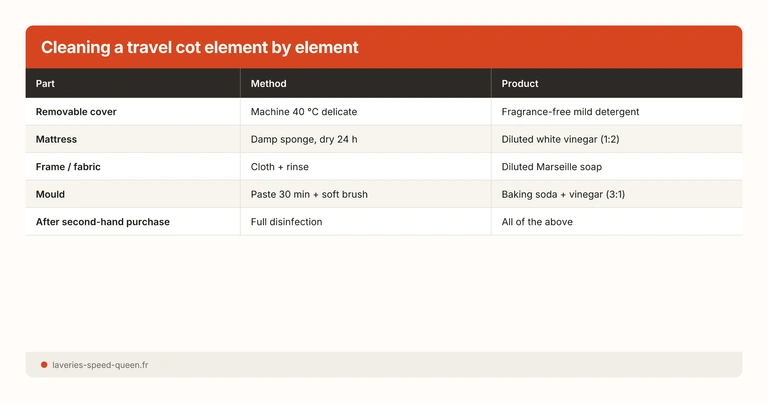
In short: a travel cot is cleaned component by component. The removable cover goes in the machine at 40 °C with a mild detergent. The mattress is cleaned with a sponge and diluted white vinegar. The frame is wiped with a cloth and mild soap. For mould, apply a paste of baking soda + vinegar. After a second-hand purchase, full disinfection is mandatory. The golden rule: complete drying before storage.
At a Glance
Removable cover = machine 40 °C — mild detergent, no softener, air dry.
Mattress = sponge + white vinegar — never in the machine, 24 h drying minimum.
Frame = cloth + mild soap — Marseille soap or diluted black soap, rinse, dry open.
Mould = baking soda + vinegar — 3:1 paste, 30 min, soft brush, sun dry.
Second-hand = full disinfection — every single component, no exceptions.
Storage = dry and ventilated — never in a damp garage, never in a sealed bag.
Why Regular Cleaning Matters
A travel cot is equipment that travels: it goes to grandparents’, on holiday, for weekends away. Between uses, it is often folded and stored for weeks. This cycle of intermittent use creates conditions favourable to the accumulation of dust, dust mites and mould.
The Risks If the Cot Is Not Maintained
- Mould — A cot stored in a damp place (garage, cellar, unventilated cupboard) or folded while not completely dry develops mould within days. Spores are dangerous for a baby’s airways.
- Dust mites — Dust mites thrive in textiles that accumulate dust and moisture. Dust mite allergies affect 20-25% of children (source: French allergy network).
- Bacteria — Spit-up, nappy leaks, sweat: the mattress and cover accumulate organic residue that forms a bacterial culture medium.
- Chemical residues — A new cot may contain manufacturing residues (glues, dyes, finishes). An initial wash removes these substances before first contact with baby’s skin.
Component by Component: The Full Protocol
The Mattress Cover
The cover is the simplest component to clean because it is designed to be removed and washed.
In the machine (removable cover):
- Remove the cover (zip, press studs or elastic)
- Turn inside out
- Wash at 40 °C, delicate programme
- Mild hypoallergenic fragrance-free detergent
- No fabric softener — chemical residues are not desirable on a textile in contact with an infant
- Air dry
If the cover is not removable: clean in place with a damp sponge, mild soap and a damp cloth rinse. Dry the mattress open, in the air.
Check the manufacturer's label
Major brands (BabyBjorn, Chicco, Joie, Graco, Hauck) provide specific washing instructions on the cover’s label or in the manual. Some covers tolerate 60 °C, others are limited to 30 °C. Follow the manufacturer’s guidance as the priority.
The Mattress
A travel cot mattress is typically thin (3-6 cm), made from polyurethane foam or expanded polyethylene. It does not go in the machine: the foam would not survive the agitation, and the drying time would be too long (risk of internal mould).
Routine cleaning:
- Vacuum both sides to remove dust and dust mites
- Prepare a diluted white vinegar↗ solution (1 part vinegar to 2 parts water)
- Dampen a clean sponge and wring it well (the mattress must not be soaked)
- Clean the entire surface in circular motions
- Rinse the sponge in clean water and wipe the mattress again to remove vinegar residue
- Air dry flat, in a ventilated area — minimum 24 hours
Specific stains:
Spit-up / milk
Rinse in cold water immediately (hot water sets milk proteins). Apply baking soda powder to the damp stain, leave for 1 hour, vacuum. Baking soda neutralises acidity and absorbs moisture.
Urine / nappy leak
Blot up excess liquid immediately. Apply pure white vinegar to the area, leave for 15 minutes (vinegar neutralises the ammonia in urine). Sprinkle with baking soda, leave to dry, vacuum. Full guide: remove a urine stain.
Vomit
Remove solid residue with a spoon. Clean with cold water and mild soap. Apply baking soda, leave for 2 hours. Spray white vinegar, leave for 15 min, blot. Guide: remove a vomit stain.
Old yellow stain
Make a paste of baking soda + hydrogen peroxide (3 parts + 1 part). Apply to the stain, leave for 2 hours. Blot and rinse. Hydrogen peroxide is a mild bleach with no dangerous chemical residue for baby.
The Frame (Structure + Fabric)
The travel cot frame comprises a metal or plastic structure and a nylon or polyester fabric.
- Open the cot fully
- Prepare a basin of warm water with mild soap (grated Marseille soap↗ or diluted black soap)
- With a dampened soft cloth, clean the inner fabric (the one in contact with baby), focusing on seams and folds
- Clean the outer fabric
- Clean the frame bars and joints (joints accumulate dust)
- Rinse with a clean damp cloth
- Leave to dry open in the air — never fold a travel cot before it is completely dry
Treating Mould: The Emergency Protocol
Mould is the most common and most dangerous problem on a travel cot. It appears when the cot is stored damp or kept in a humid environment.
Identifying Mould
- Grey-green or black spots on the fabric or mattress
- Characteristic musty smell (even without visible spots)
- Black dots in seams or fabric folds
The Treatment
Mould = immediate treatment
Never let a baby sleep in a cot showing mould. Mould spores are potent allergens and can cause respiratory problems in infants (rhinitis, asthma, bronchiolitis). Treat immediately or replace the cot if the mould is extensive.
On the fabric and frame:
- Make a paste: 3 tablespoons of baking soda + 1 tablespoon of white vinegar
- Apply the paste to the affected areas with an old toothbrush
- Leave for 30 minutes
- Scrub vigorously with the brush
- Rinse thoroughly with a damp cloth
- Dry in direct sunlight if possible — UV-B rays destroy mould spores
On the mattress:
- Apply pure white vinegar to the mouldy areas
- Leave for 1 hour
- Sprinkle with baking soda↗
- Leave to dry completely (24-48 hours)
- Vacuum the dry baking soda
- Check the musty smell has gone
If mould persists after treatment or is deeply embedded in the mattress foam, replace the mattress. A replacement mattress costs 15-30 EUR — far less than the health risk to your baby.
Second-Hand Travel Cot: Disinfection Is Mandatory
Buying second-hand is economical and eco-friendly, but a pre-owned travel cot requires full disinfection before first use. You do not know the storage conditions, any episodes of illness, or the sanitary history of the product.
The Disinfection Protocol
- Disassemble everything — cover, mattress, accessories
- Wash the cover in the machine at 40-60 °C (per the label) with detergent + 1 tablespoon of sodium percarbonate in the drum for a disinfecting effect
- Clean the mattress with white vinegar (both sides) — if the mattress has suspicious stains or an odour, replace it
- Clean the full frame with soap + white vinegar
- Spray a baby-safe surface disinfectant (no bleach, no fragrance) over the entire frame
- Air for 48 hours before first use
- No bleach on a baby cot — chlorine residue irritates baby's skin and airways. White vinegar and sodium percarbonate are safe alternatives.
- Check product recalls — before buying second-hand, check your country's product recall database to verify the model has not been recalled for safety reasons.
- Inspect the frame — check that no bars are bent, cracked or poorly locked. A travel cot with a defective locking mechanism is dangerous.
- Replace the mattress when in doubt — a new replacement mattress costs 15-30 EUR and eliminates all health risk from the original mattress's history.
Recommended Maintenance Frequency
Frequency depends on intensity of use. Here is a schedule adapted to the most common usage patterns.
Regular Use (Every Weekend)
| Component | Frequency | Action |
|---|---|---|
| Mattress cover | Every 2 weeks | Machine 40 °C |
| Mattress | Monthly | Vacuum + white vinegar |
| Frame (fabric) | Quarterly | Cloth + mild soap |
| Frame (bars) | Quarterly | Damp cloth |
| Full clean | Every 6 months | All components |
Occasional Use (Holidays, Travel)
| Component | Frequency | Action |
|---|---|---|
| Mattress cover | Before and after each use | Machine 40 °C |
| Mattress | Before and after each usage period | Vacuum + vinegar |
| Frame | Before and after each storage period | Cloth + soap |
| Full clean | Annually | All components |
Stain = immediate cleaning — regardless of the calendar frequency, a stain (spit-up, urine, vomit) gets cleaned immediately. The longer you wait, the deeper the stain penetrates and the greater the bacterial risk.
Storage: The Rules to Prevent Mould
Storage is the riskiest phase for a travel cot. A cot that is correctly cleaned but poorly stored will develop mould within weeks.
Where to Store
- Yes: dry indoor cupboard, spare bedroom, ventilated dressing room
- No: garage (humidity + temperature swings), cellar (humidity), uninsulated attic (heat + summer humidity), under stairs with no ventilation
How to Store
- Dry completely all parts before folding (24-48 h of airing)
- Do not seal the carry bag — leave an opening for ventilation
- Place a baking soda sachet inside — it absorbs residual moisture and prevents odours
- Stand the folded cot upright rather than laying it flat under a pile of objects — compression traps moisture
Before Reusing After Long Storage
Even if the cot was clean when stored, inspect it systematically before putting your baby back in it:
- Open the cot and smell — a musty odour means a full clean is mandatory
- Visually inspect the fabric, mattress, seams (black dots = mould)
- Vacuum the mattress (dust mites)
- Check the frame locking mechanism
Products to Use (and Those to Avoid)
White vinegar
Natural antibacterial, antifungal, no dangerous residue. The main ingredient for travel cot maintenance. Diluted (1:2) for routine cleaning, pure for mould. The vinegar smell disappears on drying.
Baking soda
Absorbent, deodorising, mild abrasive. Ideal for organic stains (urine, vomit, milk). Sprinkle dry, leave to act, vacuum. Harmless to baby's skin. See: baking soda and laundry.
Marseille soap / black soap
Mild, natural cleaners with no synthetic fragrance. Ideal for the cot fabric and frame. Genuine Marseille soap (72% olive oil) contains no irritating additives.
To avoid absolutely
Bleach (irritates baby's skin and airways), room fragrances (allergens), standard antibacterial wipes (chemical residue), harsh detergents. Any product that leaves chemical residue on a textile in contact with an infant should be avoided.
Cleaning at the Laundromat
The mattress cover and removable textiles from the travel cot can be washed at the laundromat, especially if you do not have a washing machine (on holiday, for example). The delicate programme at 40 °C is perfectly suitable. Bring your own mild hypoallergenic detergent to avoid scented detergent residue left by previous users.
The mattress and frame obviously do not go in the machine — clean them by hand using the protocol described above.
As an Amazon Associate, we earn a small commission on purchases made through the affiliate links in this article — at no extra cost to you. This helps us keep this site running and produce free guides.
Our laundromats in Blagnac, Croix-Daurade and Montaudran offer machines with delicate programmes at 40 °C, ideal for baby laundry. You can wash the travel cot cover, the sleeping bag, the sheets and all baby laundry in a single load. Payment by contactless card or cash. Check our prices.
Sources and References
- How to wash baby clothes: complete guide
- How to disinfect your laundry
- Baking soda and laundry
- White vinegar and laundry: uses and limits
- Sodium percarbonate: usage guide
- Clean a mattress
- Product recall databases (check your local consumer protection agency)
- French allergy network — dust mite allergy prevalence in children